

The Pengx
27 posts

The Pengx
@Thepengx
Co-Founder at https://t.co/VGxJ11usIM. tokenization it’s the real future.
Katılım Ekim 2025
313 Takip Edilen122 Takipçiler


99% full aggregation on sports markets.
Sports traders — stop overpaying. We bring you the best odds in real time.
Next: Smart Order Routing — so you don’t have to do anything. We’ve got you fully covered.
English
This is exactly why martingale is so dangerous.
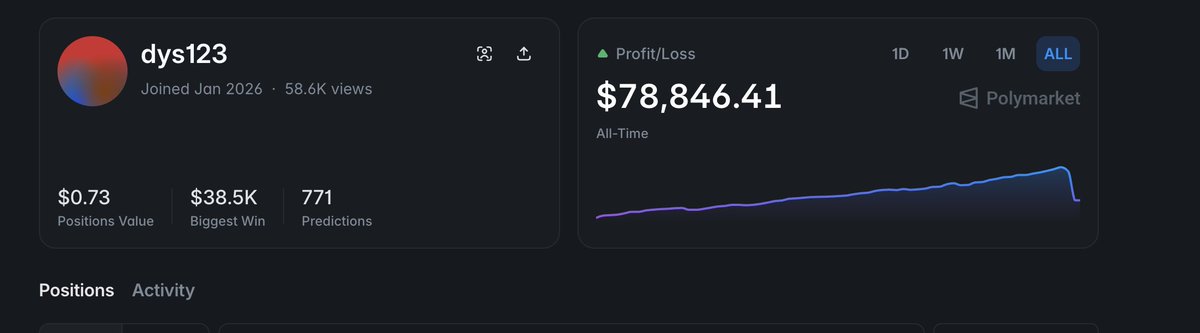
I shared this profile about a month ago and warned about what was coming. Martingale always ends the same way ... total loss. It doesn’t work long term.
After the blowup, he withdrew everything and disappeared.
But the hardest part wasn’t even the strategy itself. It was when emotions took over. After the losses, he dropped another $50K on a random trade outside his own system. That’s what completely broke him.
Martingale doesn’t just destroy accounts, it destroys discipline.
Never use it. It will wipe your portfolio faster than you think.
English
As I said …
Lost almost all
The Pengx@Thepengx
Lately, we’re seeing more traders analyze bot strategies in prediction markets, especially short-term 15-minute markets and micro-profit setups. One strategy that comes up a lot is martingale. The logic is simple: wait for a streak of red or green candles, take the opposite side, and if it loses, double the position so you’re “never down” once it finally hits. On paper, this can work. In reality, it hides extreme tail risk. The core problem is mathematical. To survive a losing streak of *n* trades, your total exposure becomes base size × (2^n − 1). With a base of 100, eight losses already require 25,500 in exposure. Ten losses require over 100,000. In 15-minute markets, streaks of that size are not rare during strong trends. There’s also a false assumption here: that outcomes are independent. In real markets, especially crypto and prediction markets, losses cluster. When momentum or panic kicks in, streaks extend exactly when this strategy is most vulnerable. Liquidity makes it even worse. As size increases, slippage grows, limit orders fail to fill, and orderbook depth disappears. You don’t just lose theoretically — the execution itself breaks the ladder. Add spreads and fees, and the tiny edge from micro profits disappears. You end up winning many small trades and losing everything in one bad sequence. That’s why martingale profiles often look great: high win rate, smooth equity curve, lots of green trades. Until one regime change, one trend day, and the account is done. High win rate is not an edge. It’s just risk that hasn’t shown itself yet. @dys123" target="_blank" rel="nofollow noopener">polymarket.com/@dys123
> Check It Out & Learn English
@Polymarket is at a major crossroads right now, and I’m saying this because I actually care about this space. Like anything that starts off strong, the real challenge isn’t just finding success it’s knowing how to maintain it.
I saw Vitalik post about the crypto markets, and I’m seeing more and more frustrated traders who’ve lost serious capital in prediction markets. Look, losses are a healthy part of any market, but the problem starts when there are zero boundaries. Right now, the average user just dives in blind, does what they do, and only realizes the risk when it’s too late. For most people, it ends badly, and this is where @Polymarket as the dominant player needs to step up and take responsibility for the educational side of things.
When someone bets on a football game, they know they can lose. But the issue is when people start trading because of desperation or because they see all the noise on X about how much MMs and influencers are making. They jump into the deep end before they even know how to swim, lose everything, and that’s where the "disgust" with the ecosystem begins.
We have to learn from what happened with pump.fun. It started with incredible momentum and ended with a bad taste because they didn’t know how to protect the user or provide any real value beyond gambling. I really want this space to succeed, and I hope the team makes the right moves. We need an educational envelope maybe a basic academy so users actually understand what they’re doing before they hit that button.
English
The Pengx retweetledi

Theoretically, what motivates someone to enter a market and place a massive bet on whether the US will attack Iran fully aware they might lose that money? I don’t believe it’s an insider, and I haven't thought so from the start. Here’s why.
Prediction markets have evolved into highly sophisticated tools, not just for traders, but potentially for political and even defense-related entities. In the current psychological climate involving Iran, the US, and Israel, many actions are no longer purely tactical they are designed to confuse, mislead, or intimidate.
In this context, platforms like Polymarket become strategic assets. They can function as instruments of psychological warfare shaping perception, signaling intent, or deliberately sowing uncertainty. If a state intelligence agency were savvy, they would see this as a far safer and more effective tool than leaking actual intelligence that could compromise live operations.
Instead of revealing inside information, you influence the narrative.
There is a real possibility that such institutions are adopting prediction markets as powerful levers in modern psychological campaigns.
English
Lately, we’re seeing more traders analyze bot strategies in prediction markets, especially short-term 15-minute markets and micro-profit setups.
One strategy that comes up a lot is martingale. The logic is simple: wait for a streak of red or green candles, take the opposite side, and if it loses, double the position so you’re “never down” once it finally hits.
On paper, this can work. In reality, it hides extreme tail risk.
The core problem is mathematical. To survive a losing streak of *n* trades, your total exposure becomes
base size × (2^n − 1).
With a base of 100, eight losses already require 25,500 in exposure. Ten losses require over 100,000.
In 15-minute markets, streaks of that size are not rare during strong trends.
There’s also a false assumption here: that outcomes are independent. In real markets, especially crypto and prediction markets, losses cluster. When momentum or panic kicks in, streaks extend exactly when this strategy is most vulnerable.
Liquidity makes it even worse. As size increases, slippage grows, limit orders fail to fill, and orderbook depth disappears. You don’t just lose theoretically — the execution itself breaks the ladder.
Add spreads and fees, and the tiny edge from micro profits disappears. You end up winning many small trades and losing everything in one bad sequence.
That’s why martingale profiles often look great: high win rate, smooth equity curve, lots of green trades.
Until one regime change, one trend day, and the account is done.
High win rate is not an edge. It’s just risk that hasn’t shown itself yet.
@dys123" target="_blank" rel="nofollow noopener">polymarket.com/@dys123 > Check It Out & Learn
English
Just copied @CarOnPolymarket with only 2% of his total positions and already seeing close to 10% profit within 2 days only. Honestly, he’s part of a broader set of traders I combine into my strategy, and he keeps delivering.
With @forsmarkets, we’re turning this into a unified UX where users don’t have to jump between platforms anymore. We’re bringing all major pain points into one seamless system.
Next step: aggregated copy trading meaning you’ll always get the best odds when copying positions across markets.
Stay tuned.

English
You don’t even realize how hard it is to truly aggregate crypto and prediction markets. Everything has to be precise, resolution timing, market ranges, and platform specific rules. Our ML engine has learned how to handle all of this across Kalshi and Polymarket with near perfect accuracy.
This is the most unique thing we’ve built, and I’m incredibly proud of it and our developers who stayed locked in and fully committed to the process.

English
Stop calling them "bets." 🧵
In trading and analysis, we aren’t gambling; we are making decisions.
When you frame a prediction as a "bet," you subconsciously give up control to "luck." When you frame it as a "decision" based on current market situations:
1. You take accountability.
2. You acknowledge the consequences.
3. You refine your process, regardless of the "Yes" or "No" outcome.
The market doesn't reward gamblers. It rewards decision-makers.
English
Extremely proud of the team and partners who made this happen. High quality, short timelines, zero compromises.
This is just the beginning.
Fors Markets@forsmarkets
We’ve officially started rolling out the FORS beta. Access is being approved step by step to ensure stability and the best experience for early users. Now the early believers getting the benefit If you’ve applied, keep an eye out more invites are going out daily.
English
The Pengx retweetledi
Fors is a prediction market aggregator that brings multiple platforms into one view.Fors helps you understand prediction markets by aggregating them in one place.
See what we’re building and why it matters.
English
We’re getting close to launching the Fors beta, and I wanted to share why Fors exists - not as a product pitch, but as a personal journey.
Over the past year, prediction markets have exploded in popularity. Platforms like Polymarket and Kalshi grew incredibly fast, but that growth exposed a clear gap:
the infrastructure for serious, intelligent trading simply didn’t keep up.
As an active trader on these platforms myself, I constantly felt the friction.
Switching between interfaces, manually comparing odds, tracking positions across venues, and trying to manage arbitrage opportunities efficiently, it was all fragmented, time-consuming, and error-prone.
What I always felt was missing was a single, unified interface- an aggregator that brings everything into one place, allows smarter execution, and helps traders actually save money on every trade !!
As a beginner, I also made costly mistakes. Not because the markets were bad but because there was no safe way to learn.
No proper demo trading, no environment to test strategies without risking capital. I kept thinking how different my learning curve would have been if I could practice first, understand market behavior, and only then deploy real money.
Over time, I learned to play it safer manually arbitraging between Kalshi and Polymarket, hedging positions before market close, and focusing on disciplined execution rather than “betting.”
It worked, but it required constant attention and time, which simply doesn’t scale.
At the same time, I realized something else:
Not everyone wants to be a full-time trader. Many people would rather follow proven strategies, based on clear criteria and filters they trust, instead of reinventing the wheel.
That’s where Fors comes in.
Fors is being built as the intelligent execution and aggregation layer for prediction markets combining multiple venues into one interface, enabling smarter trading, demo environments for learning, arbitrage tooling, and strategy replication all designed to turn prediction markets from guesswork into infrastructure.
The beta is coming soon.
I’m excited (and humbled) to finally share what we’ve been building.
English