
Thinknomics Global 🌍

74.7K posts

Thinknomics Global 🌍 banner
Thinknomics Global 🌍

Thinknomics Global 🌍

@Thinknomics

En 2015, grandes analistas de Twitter crearon un chat privado. Hoy comparten sus análisis y la mejor información económica. Si necesitan fiabilidad, razón aquí.

El mundo Katılım Eylül 2015
11 Takip Edilen13.2K Takipçiler
Thinknomics Global 🌍 retweetledi
Combarro
Combarro@_combarro_·
1/ Panorama lamentable, de la industria manufacturera en las grandes economías del euro (2026m03)
Combarro tweet media
Español
2
19
48
5.2K
Thinknomics Global 🌍 retweetledi
Droblo
Droblo@droblo·
España se consolida como el tercer país de la Unión Europea donde las cotizaciones empresariales tienen mayor peso sobre la recaudación fiscal total, alcanzando el 25,8%, lo que lo sitúa "muy por encima" de la media europea del 17,9%, según un análisis realizado por Quantax Así,
Español
2
11
13
1.2K
Thinknomics Global 🌍 retweetledi
pablo
pablo@pablogguz_·
spain needs a different growth model. in the last 30 years, real household disposable income per capita has grown by roughly 38% in real terms (around €5.7k per person at 2024 prices). this can be decomposed into growth in net labour income per capita (+16.7 pp), cash benefits such as pensions (+14.2 pp), and capital and self-employment income per capita (+7.2 pp). however, the labour contribution came entirely from the extensive margin (pulling more people into employment) rather than from higher real wages per worker. in fact, the average spanish employee takes home slightly less in real terms today than in 1995! going forward, this model is unlikely to keep working. the extensive-margin gains came from two channels, both of which leaned on favourable conditions that are (most likely) not going to repeat. the first is that the working-age population grew faster than the total population during the 90s and 2000s, mainly because of the favourable age structure left behind by spain's baby boom (the large cohorts born in the 1960s and 1970s moved into prime working age while the cohorts behind them were smaller), but also because of immigration waves that were disproportionately working-age. this is what demographers often call a demographic dividend, which lifts the employment-to-population ratio purely by composition (even with no change in how much any given working-age person works). the second channel is that, within the working-age population, the employment rate rose substantially, from below 50% in the mid-1990s to around two-thirds today. of course, none of this is bad, but there is only so much further either channel can go. the demographic dividend is already reversing: the baby boom cohorts are now moving into retirement, the cohorts replacing them are much smaller, and ageing will push the working-age share of the population down. the employment rate itself is approaching a natural ceiling -- there is still a gap relative to the average advanced european economy but it is not large, and closing it would only buy spain a few more years of compositional growth. immigration, often raised as the way out, cannot realistically offset the demographic drag ahead. the scale of net inflows required to offset ageing on a sustained basis is multiples of any plausible figure consistent with social and political constraints in european countries, and even if such flows materialised, immigrants themselves age and accrue the same retirement pension entitlements as natives. in other words, sustaining the current demographic structure would require a permanent inflow large enough to offset both the ageing of the native population and that of past migrant cohorts, indefinitely. fertility, however, is now falling across virtually every region of the world, and the global working-age population is projected to peak within a few decades and then decline. there is simply no migrant pool waiting to be drawn from on the scale spain would need. this is also why cash benefits cannot keep doing what they have been doing. it is worth being explicit about why retirement pensions, specifically, are at the centre of all this. spain runs a defined-benefit, pay-as-you-go public pension system: pensions are not the actuarial outcome of what each worker contributed, but a function of years contributed and final wages, paid out of the contributions of those currently working. the current system promises retirees an internal rate of return on their contributions that is significantly higher than anything the payments into the system can plausibly grow at. and because the payments into the system are, mechanically, the number of contributors times the average wage on which they contribute, a gap of that kind is sustainable only as long as the contributing base keeps expanding fast enough relative to the receiving one. the same demographic dynamics that enabled the extensive-margin growth of the last three decades are what allowed this to (sort of) work, but these are now reversing. on top of that, the system already runs a structural deficit: only about three-quarters of contributory pension expenditure is covered by social contributions, and the rest is financed out of general taxation paid by the entire population. and pensions are not an independent source of household income. they are funded by taxes, and taxes have to be levied on income generated somewhere in the economy. in spain, as in any developed country, that income is overwhelmingly the wage bill: personal income tax and social contributions on labour. so the real question is whether labour income per worker is growing. gross compensation per worker (including social security contributions) has in fact risen slightly in real terms since 1995, by around 5%. but the entire gain (and a little more) has been absorbed by a widening fiscal wedge, so that the take-home wage is marginally lower today than it was thirty years ago. in other words, the modest productivity gains the spanish economy has managed to deliver have not reached workers. they have been routed, in their entirety, into financing the rising weight of transfers. one could argue, of course, that if wages eventually start growing, the additional income can simply be taxed away to keep financing rising benefits. but that is just another way of saying that the take-home pay of the average spanish worker is supposed to stay flat for the foreseeable future, and that whatever productivity gains eventually arrive will be routed straight through to retirees. i will leave it to the reader to judge what kind of social contract that describes. thirty years of stagnant wages is already a long experiment in that direction. either policymakers start taking productivity growth seriously or the bill comes due on a model that was always going to run out of room.
pablo tweet media
English
23
193
615
99.2K
Thinknomics Global 🌍 retweetledi
Droblo
Droblo@droblo·
Hoy el Tesoro ha colocado letras a 3 meses al 2,163%, por encima del 2,123% de la emisión previa y el tipo más elevado desde marzo de 2025 También colocó letras a 9 meses al 2,521% (2,471% la subasta anterior) y el interés más elevado desde noviembre de 2024
Español
1
8
10
3.9K
Thinknomics Global 🌍 retweetledi
Miguel Angel García
Miguel Angel García@magarciadiaz·
Ya lo estamos pagando. La falta de debate y consenso ha paralizado cualquier reforma razonable para aumentar el PIB potencial con mas productividad. Las cuentas públicas están coptadas por pensiones y sanidad, y la estructura de ingresos es manifiestamente mejorable
Francisco Nunes@FranNunesEcon

@magarciadiaz Se ha sustituido la razón por el dogma y España está pagando y pagará las consecuencias

Español
1
3
10
722
Thinknomics Global 🌍 retweetledi
Combarro
Combarro@_combarro_·
1/ Datos de transporte de viajeros en 2026m03. La alta velocidad recupera parte del terreno perdido tras la caída de los últimos meses. Pero, en esta crisis, no se aprecia un trasvase AVE → avión.
Combarro tweet media
Español
1
4
21
2.3K
Thinknomics Global 🌍 retweetledi
Juan Ramón Rallo
Juan Ramón Rallo@juanrallo·
Los imperdonables pecados por los que había que amordazar a Jon: a) Hay que deflactar el IRPF b) Hay que transitar a un sistema público de pensiones con cuentas nocionales como en Suecia c) Hay que construir mucho más d) La baja natalidad y la baja productividad son un problema
Español
118
2K
7.2K
152.3K
Thinknomics Global 🌍 retweetledi
Santiago Sánchez
Santiago Sánchez@santisanchezab·
La comparación con Italia es escandalosa. Mientras Italia ha conseguido ejecutar más de 109.000 M€, utilizando los préstamos desde el inicio del Plan, ha más que duplicado los fondos europeos absorbidos por su economía.
Santiago Sánchez tweet media
Español
19
36
61
24.5K
Thinknomics Global 🌍 retweetledi
Sebastián Puig ⚓
Sebastián Puig ⚓@Lentejitas·
Todo esto, mientras morían diariamente cientos de personas y no podías ni desplazarte para ver a tus mayores. En esas fechas, en España se habían notificado un total de 3.396.685 casos confirmados de COVID-19 y 76.882 fallecidos. elespanol.com/espana/2026051…
Español
4
89
152
3.1K
Thinknomics Global 🌍 retweetledi
Sebastián Puig ⚓
Sebastián Puig ⚓@Lentejitas·
La confianza no elimina el miedo; le quita el mando. Buenos días, buena gente
Español
0
16
26
1.1K
Thinknomics Global 🌍 retweetledi
Sebastián Puig ⚓
Sebastián Puig ⚓@Lentejitas·
La línea de alta velocidad Madrid Barcelona es una batidora.
Español
6
6
16
2.5K
Thinknomics Global 🌍 retweetledi
Santiago Calvo
Santiago Calvo@SantiCalvo_Eco·
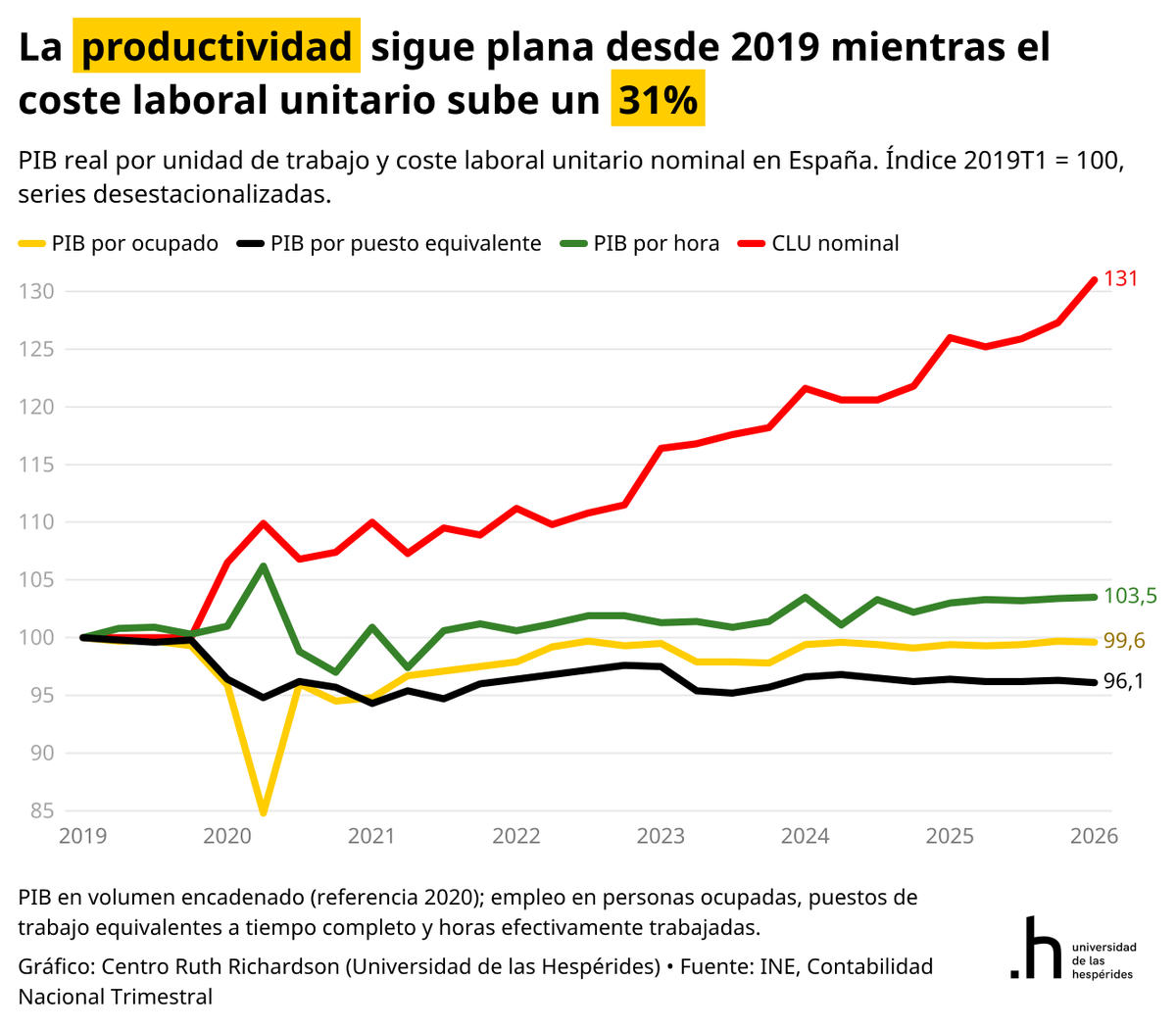
Conviene no olvidar que toda la campaña montada contra @jongonzlz empezó por decir exactamente esto: con el mismo poder adquisitivo, todos los salarios pagan más en 2026 que en 2019. Y que las rentas bajas son las más castigadas: un sueldo de 18.000€ paga casi cuatro veces más que su equivalente real de hace siete años.
Santiago Calvo tweet media
Español
40
2.2K
4K
66.3K