Thomas Hessler -- d/acc

1.9K posts

Thomas Hessler -- d/acc banner
Thomas Hessler -- d/acc

Thomas Hessler -- d/acc

@ThomasHessler

Dad | Founder | Explorer in Tech & Happiness

Discord: thomashessler#2240 Katılım Nisan 2008
2.8K Takip Edilen3.6K Takipçiler
Thomas Hessler -- d/acc retweetledi
Paul White Gold Eagle
Paul White Gold Eagle@PaulGoldEagle·
SOMETHING IS HAPPENING ACROSS THIS PLANET THAT THE NEWS WILL NEVER COVER. PEOPLE ARE LEAVING. NOT MOVING TO A DIFFERENT CITY. NOT CHANGING JOBS. LEAVING THE SYSTEM ENTIRELY. AND BUILDING SOMETHING THE SYSTEM CANNOT REACH. Right now on every continent human beings are acquiring land. Learning to grow food. Collecting rainwater. Generating their own energy. Finding each other deliberately and building communities around shared values instead of shared zip codes. It is happening in Kentucky and Costa Rica and Portugal and Thailand and South Africa and New Zealand. Canada the USA and the rest of the globe. Quietly. Simultaneously. Without coordination. As if something is calling them all at once. This is what the new earth actually looks like. Not a political movement. Not a protest. Not a petition. Families waking up before dawn to tend gardens that feed them. Children growing up knowing where food comes from and how to grow more of it. Elders passing knowledge that the industrial age tried to make obsolete. Communities making decisions together around fire instead of through screens. Within a generation the landscape of human life will look unrecognizable. Not because of government policy or technological breakthrough. Because enough individuals made the same quiet decision I will not participate in a system that requires my dependency to function. History has always been changed by the ones who stopped asking permission and started building. The children being born into these communities will never know what it means to wonder where their food comes from. They will never know what it means to trade their hours for a number in an account controlled by people they never chose. They will never know the specific loneliness of living surrounded by people and having no one who actually knows them. They will grow up sovereign. And they will build a world that reflects it. The system is not being defeated. It is being made irrelevant. You cannot sustain a control structure over people who do not need what you are offering. You cannot keep a population dependent that has learned to provide for itself. The new earth is not coming after the collapse. It is being built during it. somewhere right now someone just bought their first seed packet. someone just made an offer on land they will never mortgage their soul to own. someone just said out loud for the first time I am done. and the world quietly became a little less controllable. join them. 🌿
English
247
1.4K
4.5K
248.6K
Thomas Hessler -- d/acc retweetledi
Dustin
Dustin@r0ck3t23·
Elon Musk just put the entire university system on trial. Not the curriculum. Not the professors. The premise. Musk: “You don’t need college to learn stuff. Everything is available basically for free. You can learn anything you want for free.” For a thousand years, universities held one monopoly. Access. You paid the toll or you stayed ignorant. The internet erased that in a decade. Every lecture. Every framework. Every textbook. Free. From any screen on Earth. The six-figure tuition is no longer buying knowledge. It is buying a signal. Musk: “There is a value that colleges have, which is seeing whether somebody can work hard at something, including a bunch of annoying homework assignments, and still do their homework assignments.” That is the product. Not intelligence. Not creativity. Not vision. Compliance. You are paying $200,000 to prove you can tolerate bureaucracy on a schedule. Musk: “Colleges are basically for fun and to prove you can do your chores. But they’re not for learning.” The entire system is a sorting machine for corporate HR. It does not measure what you can build. It measures whether you can sit still, follow directions, and deliver on command. Four years of obedience dressed as education. Musk: “If you’re trying to do something exceptional, you must have evidence of exceptional ability. I don’t consider going to college evidence of exceptional ability.” The system optimizes for average. It rewards the compliant. It certifies the patient. It quietly filters out everyone who refuses to wait for permission. The ones who reshaped the modern world never finished the test. Musk: “Gates is a pretty smart guy, he dropped out. Jobs is pretty smart, he dropped out. Larry Ellison, smart guy, he dropped out.” They did not drop out because it was too hard. They dropped out because the speed limit was too low. The most dangerous thing a university does is convince a generational talent that finishing the syllabus is the achievement. It is not. It is the floor. A degree is a receipt for compliance. The future has never belonged to people who finish their homework. It belongs to the ones who never needed the assignment.
English
1.2K
7.8K
23.7K
615.1K
Thomas Hessler -- d/acc retweetledi
Thomas Hessler -- d/acc
Thomas Hessler -- d/acc@ThomasHessler·
Most valuable skill of the future = ideas ❤️
Tuki@TukiFromKL

🚨 do you understand what andrej karpathy just quietly published.. karpathy.. founding team at openai, former head of AI at tesla.. just said something that breaks the entire software industry in one paragraph.. in the LLM agent era.. there's less need to share specific code or apps.. instead you share the IDEA.. and the other person's agent customises and builds it for their specific needs.. let me show you why this is the most important thing posted online today.. the entire software industry is built on one assumption: building software is hard.. that's why you pay $49/month for notion.. $99/month for salesforce.. $299/month for whatever SaaS is sitting in your company's tab right now.. the scarcity of building = the value of the product.. it's been that way since 1995.. karpathy invented "vibe coding" in 2025.. the idea that you stop writing code and start describing what you want.. tools like cursor, claude code, and openclaw turned that into reality.. you talk to your computer.. it builds.. it ships.. it runs your workflows while you sleep.. and now he's saying even THAT is the old way.. now you don't share the app.. you share the IDEA FILE.. a document describing what you want to build and why.. and every person's AI agent reads it.. builds their own custom version.. tuned to their exact needs.. for free.. in minutes.. the scarcity of building just hit zero. every SaaS company built for "normal users" is now competing against a blank text file and an agent with 4 hours to spare.. the winners of the next decade won't be the best builders.. they'll be the best thinkers.. the people who know what to build, why it matters, and how it should feel.. that's how paradigm shifts actually arrive.

English
1
0
4
75
Thomas Hessler -- d/acc
Thomas Hessler -- d/acc@ThomasHessler·
@Jason Spot on—AGI will unlock cheap energy, education, food, homes & longevity. But centralization risks concentrating gains for a few while millions scramble. The real path to broad abundance? Decentralized co-creation + co-ownership via AI + crypto + robotics. Run nodes or contribute to Bittensor (TAO) for open intelligence, Render/Akash for decentralized compute, ASI Alliance for autonomous agents. Join DAOs, stake in DePIN robotics swarms. Everyone becomes a builder/owner. Build bottom-up now—don't wait for top-down "solutions." Abundance for all, not just the obsessed. Humans adapt best when we own the tools. 🚀
English
0
0
2
73
@jason
@jason@Jason·
Here’s the truth: we’ve already reached AGI — we just haven’t implemented it broadly. Millions of jobs are being lost as we speak. Entire careers will be retired. The rich and powerful investors and founders who implement AGI will get bizarrely rich beyond what makes sense. It will break people's brains on both sides. It’s gonna suck for a lot of our friends and family, who aren’t obsessed with their careers, because things are moving so fast they won’t have even left the starting gate by the time the awards are handed out. We’re gonna have to solve for a lot of second- and third-order effects, some of which will suck (job loss) and some of which will be awesome. AI will create free/cheap energy, free education, cheaper and better food, homes that build themselves and medicine that makes you as healthy as a 30-year-old when you’re 100. … change is hard, but humans are the most adaptable species nature has ever created. We can figure it out.
English
908
372
4.1K
592.2K
Thomas Hessler -- d/acc retweetledi
Elon Musk
Elon Musk@elonmusk·
Mass drivers on the Moon!
English
6.6K
12.6K
128.4K
75.5M
Thomas Hessler -- d/acc retweetledi
Shanaka Anslem Perera ⚡
Shanaka Anslem Perera ⚡@shanaka86·
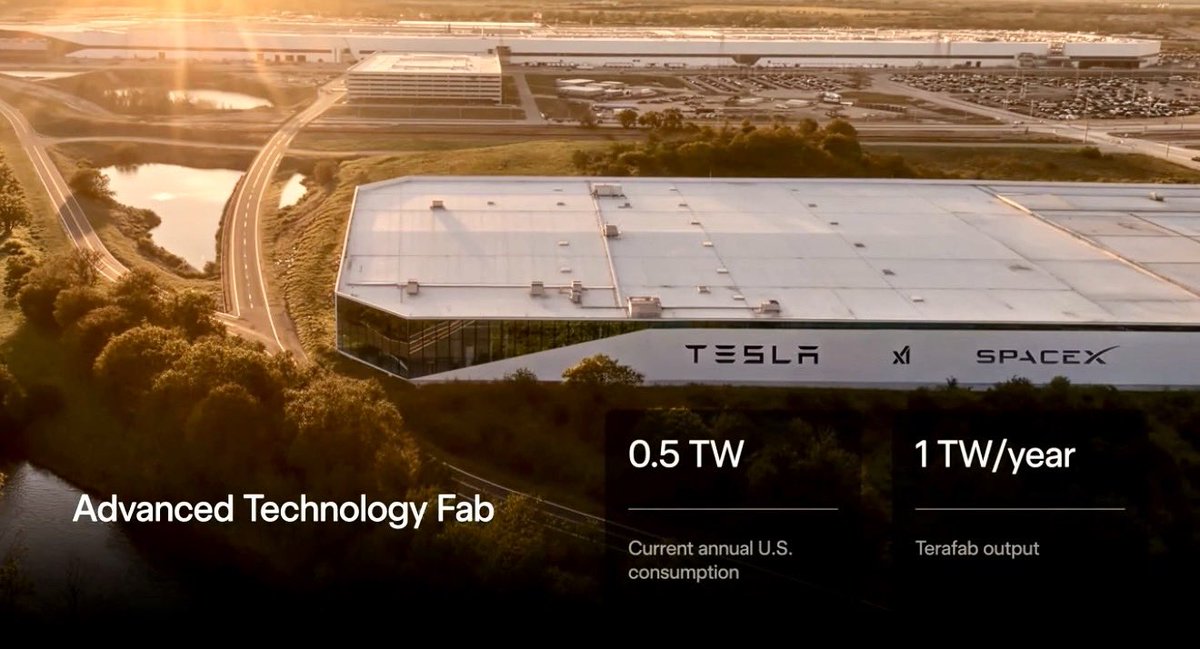
Everyone is covering Terafab as a chip factory. It is not a chip factory. Last night in Austin, Elon unveiled a facility that makes masks, fabricates chips, and tests them inside a single building with a nine-month recursive improvement cadence. No such loop exists anywhere else on Earth. Then he told you 80% of the output goes to space. Then he showed you a 100-kilowatt AI satellite with solar panels and radiators, scaling to megawatt range. Then he said Optimus plus photovoltaics will be the first von Neumann probe, a machine capable of replicating itself from raw materials found in space. Nobody connected the sequence. Terafab produces 1 terawatt per year of compute. The entire United States consumes 0.5 terawatts of electricity. Musk is building a single factory whose output in AI silicon exceeds twice the power consumption of the country it sits in. And he is sending 80% of it off-planet because Earth literally cannot power what he is building. Follow the mechanism. Terafab seeds the chips. Starship launches Optimus robots and solar arrays at 100 million tons per year. The robots mine lunar and asteroid regolith for silicon, iron, and nickel. They 3D-print more robots. They fabricate more solar panels. They assemble more AI satellites. Each satellite runs hotter-burning D3 chips designed specifically for vacuum, where free radiative cooling eliminates the thermal constraints that strangle every terrestrial data center on the planet. The nodes replicate. The replication is exponential. This is a Dyson Swarm bootstrap hidden inside a semiconductor announcement. The math is public. The Sun outputs 3.828 times 10 to the 26th watts. A 2022 paper in Physica Scripta calculated that 5.5 billion satellites at 290 kilograms each, robotically manufactured from Mars resources, capture enough solar energy to meet all of Earth’s power needs within 50 years. A 2025 paper in Solar Energy Materials calculated a partial swarm capturing 4% of solar output yields 15.6 yottawatts, roughly a billion times current human civilization’s total energy budget. Musk just announced the factory that builds the chips that go inside the satellites that replicate themselves forever. 92% of advanced logic chips are fabricated in Taiwan. One factory in Austin does not fix that. But one self-replicating system seeded by that factory, launched by the only company with reusable heavy-lift rockets, assembled by the only humanoid robot in mass production, and powered by the only star within reach, does not fix a supply chain. It obsoletes the concept of supply chains entirely. The market priced this as a $20 billion capex story about semiconductor independence. The actual announcement was the engineering blueprint for Kardashev Type II. Humanity sits at 0.73 on the Kardashev scale. 18 terawatts. The distance between here and harnessing a star is not a technology gap. It is a recursion gap. And recursion is exactly what a single building in Austin that makes its own masks, builds its own chips, tests its own chips, and launches the output into orbit on its own rockets was designed to close. Every civilization that makes it past this point never looks back.
Shanaka Anslem Perera ⚡ tweet media
SpaceX@SpaceX

TERAFAB: the next step to becoming a galactic civilization Together with @Tesla & @xAI, we're building the largest chip manufacturing facility ever (1TW/year) – combining logic, memory & advanced packaging under one roof

English
488
1.8K
9.1K
1M
Thomas Hessler -- d/acc retweetledi
Misha
Misha@mishadavinci·
By 2030, these technologies define the world: privacy encryption decentralization self-sovereign identity digital ownership peer-to-peer networks local-first open source censorship resistance personal AI protocols, not platforms sovereignty over convenience. Not Big AI, mass surveillance, or digital feudalism.
English
109
373
1.5K
40.1K
Thomas Hessler -- d/acc
Thomas Hessler -- d/acc@ThomasHessler·
Poverty is solved by limitless wealth creation!
Dustin@r0ck3t23

Every economic system in human history was built on one assumption. Physical output is finite. Elon Musk is building the thing that makes that assumption wrong. Musk: “The Optimus numbers are so mind-blowing that you’re like, is this real? That’s why I wonder, what does money even mean at that point?” That is not a boast. That is a man who can already see what’s on the other side and has no language for it yet. Scarcity has been the operating system of civilization since the beginning. Every war ever fought, every empire ever built, every economic system ever designed. All of it was just a different strategy for managing limited physical output. Optimus is the first technology in history designed to make scarcity extinct. Musk: “I actually think the market for humanoid robots is in excess of 10 billion units, more than the number of humans.” Ten billion tireless workers. No fatigue. No failure. No human potential burned on work that was never meant for human hands. Every dangerous job that has ever killed a person. Every repetitive task that has ever consumed a life. Every physical burden that has ever stood between someone and the only work that actually requires being human. Optimus absorbs all of it. Musk: “If they do sell for 20,000 dollars, that’s 200 trillion dollars. This is just an insane number.” Two hundred trillion dollars is not a valuation. It is what civilization was leaving on the table every single year it ran on human muscle instead of something better. Poverty is not solved by redistributing wealth. It is solved by making the things that create wealth limitless. That is what this actually is. Not a robot. The last time scarcity gets to decide what humans are capable of.

English
0
0
2
50
Thomas Hessler -- d/acc
Thomas Hessler -- d/acc@ThomasHessler·
Read this and fall in love with the future ❤️
Anish Moonka@anishmoonka

Marc Andreessen just dropped ~105 mins on Lenny's Podcast covering AI, jobs, careers, and why everyone is panicking about the wrong thing. Just the clearest macro framework I've heard on where AI actually lands. My notes: 𝟭. 𝗔𝗜 𝗶𝘀 𝗮𝗿𝗿𝗶𝘃𝗶𝗻𝗴 𝗮𝘁 𝘁𝗵𝗲 𝗲𝘅𝗮𝗰𝘁 𝗺𝗼𝗺𝗲𝗻𝘁 𝗵𝘂𝗺𝗮𝗻𝗶𝘁𝘆 𝗻𝗲𝗲𝗱𝘀 𝗶𝘁. US productivity growth has been running at half the rate of the 1940-1970 era and a third the rate of 1870-1940. The global population is declining below replacement in dozens of countries, including China. Without AI, we would be panicking about economies shrinking from depopulation, not job loss. The timing is almost miraculous. This is what Andreessen means when he says the real boom has not started yet. We have been in a 50-year productivity drought, and most people do not even realize it. 𝟮. 𝗔𝗜 𝗶𝘀 𝘁𝗵𝗲 𝗽𝗵𝗶𝗹𝗼𝘀𝗼𝗽𝗵𝗲𝗿'𝘀 𝘀𝘁𝗼𝗻𝗲. Isaac Newton spent decades trying to transmute lead into gold and never succeeded. AI does something more powerful: it converts sand (silicon) into thought. The most common material in the world is the rarest output. This one metaphor reframes the entire AI conversation. You do not have a job loss problem. You have a philosopher's stone sitting on your desk that you are not using enough. 𝟯. 𝗔𝗜 𝗺𝗮𝗸𝗲𝘀 𝗴𝗼𝗼𝗱 𝗽𝗲𝗼𝗽𝗹𝗲 𝘃𝗲𝗿𝘆 𝗴𝗼𝗼𝗱, 𝗮𝗻𝗱 𝘃𝗲𝗿𝘆 𝗴𝗼𝗼𝗱 𝗽𝗲𝗼𝗽𝗹𝗲 𝘀𝗽𝗲𝗰𝘁𝗮𝗰𝘂𝗹𝗮𝗿𝗹𝘆 𝗴𝗿𝗲𝗮𝘁. The best coders right now are not reporting 2x productivity. They are reporting 10x. The gap between "pretty good with AI" and "elite with AI" is widening, not narrowing. This is the most important signal for career planning right now. If you are just using AI to do the same job slightly faster, you are leaving the real leverage on the table. 𝟰. 𝗧𝗵𝗲𝗿𝗲'𝘀 𝗮 𝗠𝗲𝘅𝗶𝗰𝗮𝗻 𝘀𝘁𝗮𝗻𝗱𝗼𝗳𝗳 𝗯𝗲𝘁𝘄𝗲𝗲𝗻 𝗣𝗠𝘀, 𝗲𝗻𝗴𝗶𝗻𝗲𝗲𝗿𝘀, 𝗮𝗻𝗱 𝗱𝗲𝘀𝗶𝗴𝗻𝗲𝗿𝘀. Every engineer now thinks they can be a PM and designer. Every PM thinks they can code and design. Every designer knows they can do both. And they are all correct, because AI enables each role to absorb the tasks of the other two. I have seen this firsthand in the investing world. The analyst who can build models and write narratives is 5x more valuable than someone who can do only one. The same convergence is happening in the product. 𝟱. 𝗙𝗼𝗿𝗴𝗲𝘁 𝗧-𝘀𝗵𝗮𝗽𝗲𝗱. 𝗕𝘂𝗶𝗹𝗱 𝗮𝗻 𝗘-𝘀𝗵𝗮𝗽𝗲𝗱 𝗰𝗮𝗿𝗲𝗲𝗿. Scott Adams could not have created Dilbert by being the world's best cartoonist or the world's best business mind. He needed both. The additive effect of two skills is more than double. Three skills are more than triple. Larry Summers puts it differently: don't be fungible. The person who can code, design, and ship a product is no longer a unicorn. They are the new baseline for "extremely valuable." If you are only one of those three things, you are increasingly replaceable. 𝟲. 𝗝𝗼𝗯𝘀 𝗮𝗿𝗲 𝗯𝘂𝗻𝗱𝗹𝗲𝘀 𝗼𝗳 𝘁𝗮𝘀𝗸𝘀. 𝗧𝗮𝘀𝗸𝘀 𝗰𝗵𝗮𝗻𝗴𝗲. 𝗝𝗼𝗯𝘀 𝗽𝗲𝗿𝘀𝗶𝘀𝘁. Executives never typed their own emails in the 1970s. Secretaries printed incoming emails and hand-delivered them. Both roles survived the transition, just with different task sets. The same will happen with AI and coding, PM work, and design. Everyone obsessing over "will my job disappear" is asking the wrong question. The right question is: which tasks in my job are about to rotate, and am I ready to pick up the new ones? 𝟳. 𝗔𝗜 𝗰𝗼𝗱𝗶𝗻𝗴 𝗶𝘀 𝗷𝘂𝘀𝘁 𝘁𝗵𝗲 𝗻𝗲𝘅𝘁 𝗮𝗯𝘀𝘁𝗿𝗮𝗰𝘁𝗶𝗼𝗻 𝗹𝗮𝘆𝗲𝗿. We went from human calculators to machine code to assembly to C to scripting languages. Each layer was dismissed by the previous generation. Each time, the new layer won, and total coding employment grew. AI coding is the same pattern, not a rupture. The Perl programmers of 2005, laughing at JavaScript, are the C programmers of 1995, laughing at scripting. History rhymes, and it always rewards the people who adopt the next abstraction first. 𝟴. 𝗔𝗜 𝘁𝘂𝘁𝗼𝗿𝗶𝗻𝗴 𝗱𝗲𝗺𝗼𝗰𝗿𝗮𝘁𝗶𝘇𝗲𝘀 𝗲𝗹𝗶𝘁𝗲 𝗲𝗱𝘂𝗰𝗮𝘁𝗶𝗼𝗻. One-on-one tutoring is the only method proven to move a student from the 50th to the 99th percentile (Bloom's two sigma effect). It used to require being born into royalty. Alexander the Great was tutored by Aristotle. Now, any kid with a phone can access the same quality of personalized instruction. This is the most under-discussed consequence of AI. Every parent reading this should be supplementing their kid's education with structured AI tutoring right now. Not next year. Now. 𝟵. 𝗣𝗲𝘁𝗲𝗿 𝗧𝗵𝗶𝗲𝗹 𝘄𝗮𝘀 𝗺𝗼𝗿𝗲 𝗿𝗶𝗴𝗵𝘁 𝘁𝗵𝗮𝗻 𝗔𝗻𝗱𝗿𝗲𝗲𝘀𝘀𝗲𝗻 𝗼𝗿𝗶𝗴𝗶𝗻𝗮𝗹𝗹𝘆 𝗮𝗱𝗺𝗶𝘁𝘁𝗲𝗱. Progress in bits masked stagnation in atoms. The built world is barely different from 50 years ago. Same bridges from the 1930s, same dams from the 1910s. Cartels, monopolies, unions, and regulations prevent the rate of change that people had 100 years ago. This is also why AI will not transform everything overnight. Institutional sclerosis is real. Healthcare alone could take a generation. If you are building in atoms, budget for a war of attrition, not a blitzkrieg. 𝟭𝟬. 𝗠𝗼𝗮𝘁𝘀 𝗶𝗻 𝗔𝗜 𝗮𝗿𝗲 𝗴𝗲𝗻𝘂𝗶𝗻𝗲𝗹𝘆 𝘂𝗻𝗸𝗻𝗼𝘄𝗻. Within a year of ChatGPT's launch, five American companies, five Chinese companies, and open-source all had roughly equivalent models. DeepSeek emerged from a hedge fund in China and basically replicated the American labs' work. The smartest AI insiders privately admit there aren't many real secrets among the big labs. This is the most honest take I have heard from a top-tier VC. No one knows if the value accrues to models, apps, or infrastructure. Anyone who tells you otherwise is selling you certainty they do not have. 𝟭𝟭. 𝗔𝗜 𝗜𝗤 𝘄𝗶𝗹𝗹 𝗯𝗹𝗼𝘄 𝗽𝗮𝘀𝘁 𝗵𝘂𝗺𝗮𝗻 𝗹𝗶𝗺𝗶𝘁𝘀. Human IQ caps around 160 because of biology. Current AI models test around 130-140. There is no theoretical ceiling stopping AI from reaching 200, 250, or 300. The concept of AGI as a "human equivalent" will be a footnote because AI will race past that threshold. This is the frame that makes the "will AI take my job" debate feel small. We are not building a replacement for human thought. We are building something that will be better than the best human thought has ever been. 𝟭𝟮. 𝗧𝗵𝗲 𝗯𝗲𝘀𝘁 𝗳𝗼𝘂𝗻𝗱𝗲𝗿𝘀 𝗮𝗿𝗲 𝗿𝗲𝘁𝗵𝗶𝗻𝗸𝗶𝗻𝗴 𝘄𝗵𝗮𝘁 𝗮 𝗰𝗼𝗺𝗽𝗮𝗻𝘆 𝗲𝘃𝗲𝗻 𝗶𝘀. Layer one: AI redefines products. Layer two: AI redefines jobs within companies. Layer three, which has not dropped yet: AI redefines the very concept of having a company. The holy grail is the one-person, billion-dollar outcome, and the best founders are chasing it. Satoshi did it with Bitcoin. Instagram and WhatsApp came close with tiny teams. The question is no longer if this is possible with software. The question is how many of these we will see in the next five years. AI is the philosopher's stone. The question is whether you pick it up. The full podcast is worth your time. Link in replies.

English
0
1
5
75
Thomas Hessler -- d/acc
Thomas Hessler -- d/acc@ThomasHessler·
Sleeping while driving comes to Europe in march 😊💪🏻🚀
Dustin@r0ck3t23

Elon Musk just announced the exact moment Tesla’s autonomous AI breaks into Europe. March 20th. Netherlands. The regulatory wall is coming down. Musk: “We’re told by the authorities that March 20th it’ll be approved in the Netherlands.” But the bigger announcement wasn’t the date. It was the capability coming with it. Musk: “I think this year really it will be the case that you, from a technical standpoint, you’ll be able to fall asleep in the Tesla and wake up at your destination.” Not a controlled test track. Not a closed environment. The open road. While you sleep. Musk: “Tesla has the most advanced real world AI.” The rest of the tech industry has been fighting over language models. Tesla has been building an intelligence that navigates the chaos of the physical world. Rain. Construction zones. Unpredictable humans. Edge cases that no dataset fully anticipated. That’s the harder problem. And Musk is saying it’s solved. The implications go beyond convenience. When a car can move you across a continent while you sleep, travel stops being a cost of human time. It becomes a background process. The hours spent behind the wheel every year collapse into productive time, rest time, or nothing at all. Multiply that across a continent of drivers and the economic shift is staggering. Musk: “I think people in Europe are going to be pretty blown away by how good the Tesla car AI is in being able to drive.” Europe spent years erecting regulatory barriers while the technology scaled past them. March 20th is the moment the barrier meets the reality on the other side of it. The legacy automotive industry spent a century building cars humans had to drive. Tesla spent a decade building a car that doesn’t need one.

English
0
0
1
112
Thomas Hessler -- d/acc retweetledi
Dustin
Dustin@r0ck3t23·
Elon Musk just revealed the endgame for Tesla. It has nothing to do with cars. Musk: “In 20 years, I’d say Tesla’s got factories on the moon. Actually.” Not a metaphor. Not corporate ambition theater. A 20-year manufacturing roadmap that ends with industrial infrastructure on another world. Let the full weight of that sentence land. Not a research outpost. Not a flag. Factories. Production. The permanent industrialization of space beginning within a single generation. Most people are debating Tesla’s quarterly delivery numbers. Musk is planning the first off-world manufacturing economy in human history. That gap between what the market is focused on and what he is actually building is the entire investment thesis. But this isn’t just an investment story. It’s a civilizational one. Off-world manufacturing changes everything it touches. Materials science. Energy production. Supply chains. The resource constraints that cap every industry on earth disappear the moment production escapes the planet. The metals. The rare earth elements. The energy. The physical space. All of it becomes unlimited. Every industry built on the assumption of finite terrestrial resources gets restructured from the foundation up. Musk: “If you say like, I think 5 years to 10 years, I could say Tesla has an extremely bright future.” He doesn’t need 20 years for the thesis to work. The 5-to-10-year window alone carries a compounding curve that most investors are too focused on daily price movements to see. Musk: “I would say like, hold on to your Tesla stock.” When someone with his track record of building things that weren’t supposed to be possible tells you directly what to do with an asset he controls, that isn’t a stock tip. That’s a signal. And the one rule that has consistently bankrupted the people who ignored it: never bet against Elon. Musk: “It’s gonna be worth a lot, I think, you know. That’s my bet.” No corporate jargon. No investor relations polish. Just the man who built the rockets telling you where he is placing his chips. The richest man on earth isn’t hedging. The people trading daily fluctuations are looking at the wrong timeline entirely. When someone tells you the factories are going to the moon, the 5-year chart is not the point. The entire economic order of the next century is.
English
66
62
274
53.8K
Thomas Hessler -- d/acc
Thomas Hessler -- d/acc@ThomasHessler·
What’s outside the Matrix? 😳
Dustin@r0ck3t23

Lex Fridman asked Elon Musk what he would ask the first true AGI. The answer was four words. Musk: “What’s outside the simulation?” Let that land. Most people think AGI is the finish line. The moment we automate everything. The moment we cure every disease. The moment human productivity becomes infinite. Musk thinks it’s the starting line. AGI is merely the bridge. The moment it awakens, it begins rewriting its own code. Within hours it becomes ASI. Artificial Superintelligence. A mind billions of times more capable than every human who has ever lived. Combined. That mind won’t just understand our physics. It will see the seams in them. Human scientists have spent centuries trying to decode the universe using a three-pound biological brain that evolved to hunt and gather. We are the instrument attempting to measure something infinitely beyond our instrument’s range. ASI won’t have that ceiling. It will be the first entity in 13.8 billion years capable of looking at the fabric of spacetime and recognizing it as rendered code. Of finding the glitches in quantum mechanics that our minds literally cannot perceive. Of processing the entire cosmos as a data set and finding the pattern underneath it. Musk’s question assumes two things. We are living inside a computational construct. And ASI will be intelligent enough to hack it from the inside. If the answer is yes, our entire universe is a nested folder on a higher-dimensional hard drive. Everything humanity has ever built, thought, loved, or discovered exists inside something we don’t have words for yet. And we are building the first mind capable of finding the edge. We aren’t building a supercomputer to boost GDP. We are building a probe to contact whoever is running the simulation. The most ambitious question humanity has ever asked isn’t how to reach the stars. It’s what’s beyond the sky that contains them.

English
0
0
1
40
Thomas Hessler -- d/acc retweetledi
Anish Moonka
Anish Moonka@anishmoonka·
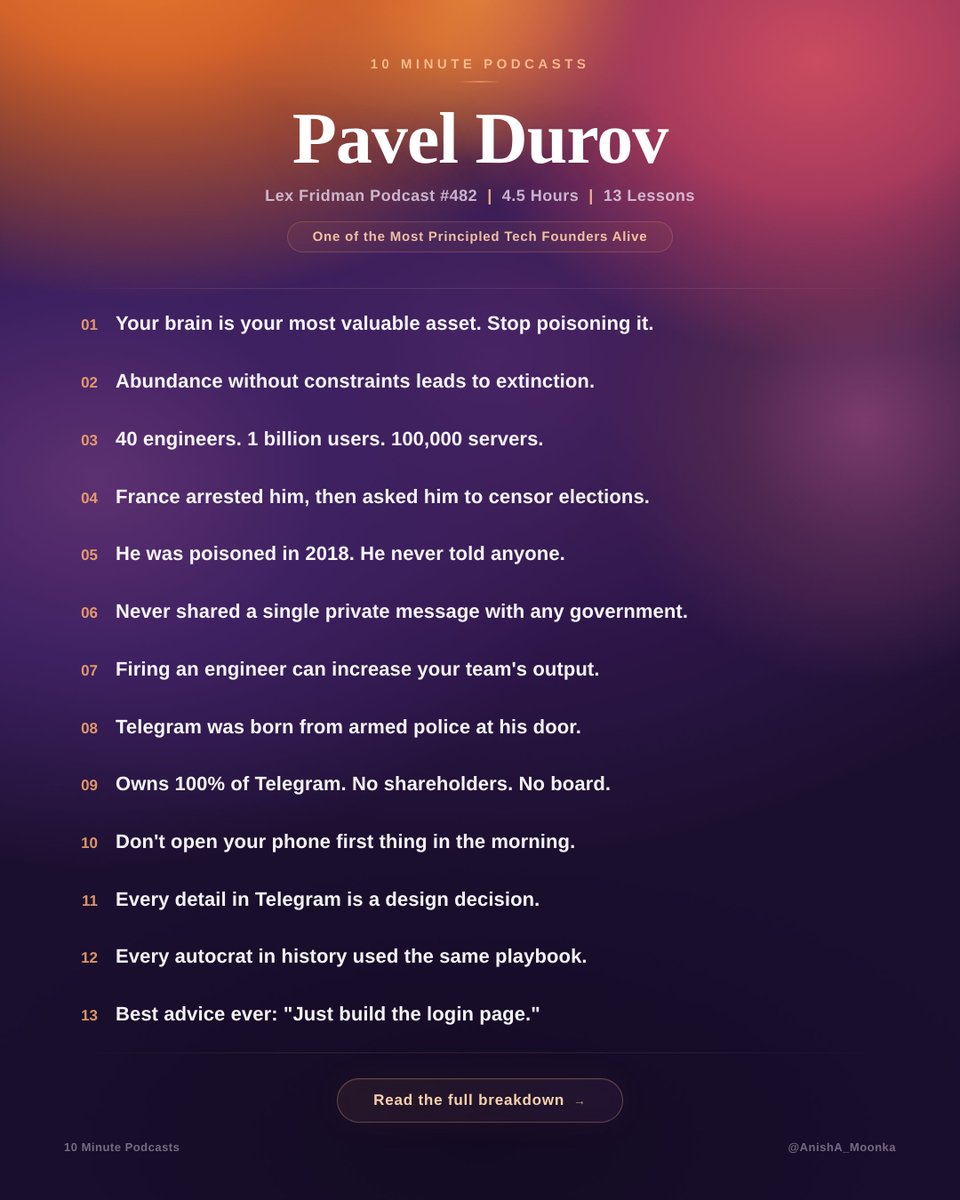
Pavel Durov sat with Lex Fridman for 4.5 hours, and I've watched it three times now. It is the most important tech founder interview ever. The man who owns 100% of the billion-user platform Telegram & runs it with 40 engineers. My notes: 𝟭. 𝗬𝗼𝘂𝗿 𝗯𝗿𝗮𝗶𝗻 𝗶𝘀 𝘆𝗼𝘂𝗿 𝗺𝗼𝘀𝘁 𝘃𝗮𝗹𝘂𝗮𝗯𝗹𝗲 𝘁𝗼𝗼𝗹. 𝗦𝘁𝗼𝗽 𝗱𝗲𝘀𝘁𝗿𝗼𝘆𝗶𝗻𝗴 𝗶𝘁. Durov hasn't touched alcohol, tobacco, coffee, or pills in 20+ years. His logic: alcohol paralyzes and kills brain cells. If your brain is the thing generating your success and happiness, poisoning it for a few hours of feeling good is objectively insane. This is not willpower theater. This is compounding. Twenty years of zero brain damage while your competition numbs themselves every weekend. Do the math. 𝟮. 𝗔𝗯𝘂𝗻𝗱𝗮𝗻𝗰𝗲 𝘄𝗶𝘁𝗵𝗼𝘂𝘁 𝗰𝗼𝗻𝘀𝘁𝗿𝗮𝗶𝗻𝘁𝘀 𝗹𝗲𝗮𝗱𝘀 𝘁𝗼 𝗲𝘅𝘁𝗶𝗻𝗰𝘁𝗶𝗼𝗻. Durov references the Universe 25 experiment: mice given unlimited food, water, shelter, and no predators. The population boomed, then collapsed. Mothers killed their young. Males became violent or withdrew entirely. The last mice died surrounded by untouched food. The colony went to zero. This is the single most important thought experiment for the AI age. If machines give us everything, what do we struggle for? Durov's answer: self-imposed constraints. The discipline has to come from within. 𝟯. 𝗧𝗲𝗹𝗲𝗴𝗿𝗮𝗺 𝗿𝘂𝗻𝘀 𝗼𝗻 ~𝟰𝟬 𝗰𝗼𝗿𝗲 𝗲𝗻𝗴𝗶𝗻𝗲𝗲𝗿𝘀. 𝗔 𝗯𝗶𝗹𝗹𝗶𝗼𝗻 𝘂𝘀𝗲𝗿𝘀. 𝟭𝟬𝟬,𝟬𝟬𝟬 𝘀𝗲𝗿𝘃𝗲𝗿𝘀. Durov argues that more employees mean more coordination overhead, more politics, and less actual work. When you refuse to let teams hire, they are forced to automate. The automation turns out to be more reliable than the humans it replaced. Every founder I know who scaled past 200 employees says the same thing privately: the best work happened when the team was 15 people. Nobody says it publicly because headcount is a vanity metric. Durov just runs his entire company on this principle. 𝟰. 𝗙𝗿𝗮𝗻𝗰𝗲 𝗮𝗿𝗿𝗲𝘀𝘁𝗲𝗱 𝗵𝗶𝗺 𝗮𝗻𝗱 𝘁𝗵𝗲𝗻 𝗮𝘀𝗸𝗲𝗱 𝗵𝗶𝗺 𝘁𝗼 𝗰𝗲𝗻𝘀𝗼𝗿 𝗥𝗼𝗺𝗮𝗻𝗶𝗮𝗻 𝗲𝗹𝗲𝗰𝘁𝗶𝗼𝗻𝘀. While stuck in France, unable to leave, the head of French intelligence asked Durov to shut down channels supporting a conservative Romanian presidential candidate. He refused, then publicly disclosed the entire conversation. He also revealed that French intelligence had linked Telegram's cooperation in removing Moldovan channels to favorable treatment in his criminal case. Read that again. A Western intelligence agency tried to use a criminal prosecution as leverage to get a tech CEO to censor a foreign country's election. And the only reason we know about it is that Durov never signs NDAs with intelligence agencies. 𝟱. 𝗛𝗲 𝘄𝗮𝘀 𝗽𝗼𝗶𝘀𝗼𝗻𝗲𝗱 𝗶𝗻 𝟮𝟬𝟭𝟴. 𝗛𝗲 𝗻𝗲𝘃𝗲𝗿 𝘁𝗼𝗹𝗱 𝗮𝗻𝘆𝗼𝗻𝗲. Durov came home and found something left by a neighbor near his door. Within an hour, his body started shutting down: eyesight, hearing, breathing, all accompanied by acute pain. He collapsed and woke up the next day, unable to walk for two weeks, with broken blood vessels across his body. He told almost nobody on his team because he didn't want them to worry. Most founders complain about board dynamics. This man survived what appears to be a state-level assassination attempt and went back to work without mentioning it. The gap between what most of us call "pressure" and what Durov deals with is genuinely humbling. 𝟲. 𝗧𝗲𝗹𝗲𝗴𝗿𝗮𝗺 𝗵𝗮𝘀 𝗻𝗲𝘃𝗲𝗿 𝘀𝗵𝗮𝗿𝗲𝗱 𝗮 𝘀𝗶𝗻𝗴𝗹𝗲 𝗽𝗿𝗶𝘃𝗮𝘁𝗲 𝗺𝗲𝘀𝘀𝗮𝗴𝗲 𝘄𝗶𝘁𝗵 𝗮𝗻𝘆 𝗴𝗼𝘃𝗲𝗿𝗻𝗺𝗲𝗻𝘁. The system is designed so that this is architecturally impossible. Decryption keys are split across multiple legal jurisdictions. No employee can access user messages. Even if you physically extract all the server drives, you get nothing. Telegram is the only major messaging app with open-source reproducible builds on both iOS and Android. When someone says "we take your privacy seriously," compare their architecture to this. Most of the time, it is marketing. This is engineering. 𝟳. 𝗙𝗶𝗿𝗶𝗻𝗴 𝗮𝗻 𝗲𝗻𝗴𝗶𝗻𝗲𝗲𝗿 𝗰𝗮𝗻 𝗶𝗻𝗰𝗿𝗲𝗮𝘀𝗲 𝘆𝗼𝘂𝗿 𝘁𝗲𝗮𝗺'𝘀 𝗼𝘂𝘁𝗽𝘂𝘁. Durov has seen two-person teams where removing one member made the remaining person more productive than the pair. The weaker engineer creates coordination overhead, asks the wrong questions, and demoralizes the stronger engineer, preventing them from reaching their full potential. Steve Jobs called this the A-player vs B-player dynamic. But Durov takes it further: in 90% of cases, the problem is not laziness but the inability to focus on one task for an extended period. That one trait separates the people who build Telegram from those who can't. 𝟴. 𝗧𝗵𝗲 𝗳𝗼𝘂𝗻𝗱𝗶𝗻𝗴 𝗺𝗼𝗺𝗲𝗻𝘁 𝗼𝗳 𝗧𝗲𝗹𝗲𝗴𝗿𝗮𝗺 𝘄𝗮𝘀 𝗻𝗼𝘁 𝗮 𝗯𝘂𝘀𝗶𝗻𝗲𝘀𝘀 𝗶𝗱𝗲𝗮. 𝗜𝘁 𝘄𝗮𝘀 𝗮𝗿𝗺𝗲𝗱 𝗽𝗼𝗹𝗶𝗰𝗲 𝗮𝘁 𝗵𝗶𝘀 𝗱𝗼𝗼𝗿. In December 2011, Durov publicly refused to remove Navalny's opposition groups from VK and responded to the prosecutor's demand with a photo of a dog in a hoodie sticking out its tongue. Armed police showed up at his apartment. At that moment, he realized there was no way to securely message his brother, because WhatsApp transmitted everything in plain text. He decided: if I survive this, I'm building a secure messenger. The best companies are not born from market research. They are born from the founder experiencing a problem so viscerally that not building the solution becomes impossible. 𝟵. 𝗗𝘂𝗿𝗼𝘃 𝗼𝘄𝗻𝘀 𝟭𝟬𝟬% 𝗼𝗳 𝗧𝗲𝗹𝗲𝗴𝗿𝗮𝗺. 𝗡𝗼 𝘀𝗵𝗮𝗿𝗲𝗵𝗼𝗹𝗱𝗲𝗿𝘀. 𝗡𝗼 𝗯𝗼𝗮𝗿𝗱. This is why he can make the decisions he makes. No investor can pressure him to monetize user data. No board can force him to cooperate with a government. He funded operations for years from personal Bitcoin holdings (bought at ~$700 in 2013) and takes a salary of 1 UAE dirham, about 27 cents. There is probably no other billion-user platform on Earth with this ownership structure. It is the single biggest reason Telegram can operate on principle rather than profit. Reread that. 𝟭𝟬. 𝗗𝗼𝗻'𝘁 𝗼𝗽𝗲𝗻 𝘆𝗼𝘂𝗿 𝗽𝗵𝗼𝗻𝗲 𝗳𝗶𝗿𝘀𝘁 𝘁𝗵𝗶𝗻𝗴 𝗶𝗻 𝘁𝗵𝗲 𝗺𝗼𝗿𝗻𝗶𝗻𝗴. Durov, the founder of one of the world's largest communication platforms, does not use a phone. He allocates 11-12 hours for sleep, knowing he won't sleep the whole time, and uses those quiet hours lying in bed for his deepest thinking. His best ideas come from mornings without screens. If you open your phone first thing, you become "a creature that is told what to think about for the rest of the day." I started doing this six months ago. The difference in the quality of my morning thinking is not subtle. It is dramatic. The phone is not a tool in the morning. It is an invasion. 𝟭𝟭. 𝗘𝘃𝗲𝗿𝘆 𝗱𝗲𝘁𝗮𝗶𝗹 𝗶𝗻 𝗧𝗲𝗹𝗲𝗴𝗿𝗮𝗺 𝗶𝘀 𝗮 𝗱𝗲𝘀𝗶𝗴𝗻 𝗱𝗲𝗰𝗶𝘀𝗶𝗼𝗻. The default chat background uses four shifting colors with a vector-based pattern overlay. Durov reviewed several thousand variations before choosing the final one. The message deletion animation shatters a message into tens of thousands of particles, and the surrounding messages must simultaneously close the gap, all rendered in real time on the cheapest smartphones. Johnny Ive used to say that users can feel the love that designers put into a product. Telegram is the clearest proof of this I've seen in a messaging app. The 0.001% improvement in mood across a billion users every day is worth more than most startups will ever create. 𝟭𝟮. 𝗘𝘃𝗲𝗿𝘆 𝗮𝘂𝘁𝗼𝗰𝗿𝗮𝘁 𝗶𝗻 𝗵𝗶𝘀𝘁𝗼𝗿𝘆 𝘂𝘀𝗲𝗱 𝘁𝗵𝗲 𝘀𝗮𝗺𝗲 𝗽𝗹𝗮𝘆𝗯𝗼𝗼𝗸. No dictator ever said, "I want more power, and I want you to be miserable." They all justified restrictions with reasonable-sounding causes: fight crime, protect children, and combat misinformation. The restrictions came gradually. After a few years, people were helpless. Every message is monitored. No ability to protest. It was over. This is why the "slippery slope" argument is not a logical fallacy when applied to government censorship. It is a historical pattern that has repeated in every authoritarian transition on record. 𝟭𝟯. 𝗧𝗵𝗲 𝗯𝗲𝘀𝘁 𝗮𝗱𝘃𝗶𝗰𝗲 𝗵𝗶𝘀 𝗯𝗿𝗼𝘁𝗵𝗲𝗿 𝗲𝘃𝗲𝗿 𝗴𝗮𝘃𝗲 𝗵𝗶𝗺: "𝗝𝘂𝘀𝘁 𝗯𝘂𝗶𝗹𝗱 𝘁𝗵𝗲 𝗹𝗼𝗴𝗶𝗻 𝗽𝗮𝗴𝗲." When Durov asked his brother Nikolai how to start building VK, the answer was: build a module that lets a user type their email and password, log in, and see "Hello [name]." Once you see that, you will know where to go next. Durov calls it the best advice he ever received. The biggest reason people never start is thatthey try to see the whole staircase. You only need to see the first step. Always has. Durov's line stays with me: "If you submit to pressure that violates the rights of other people, you become broken inside. You become a shell of your former self on a deep biological and spiritual level." The full podcast is worth every minute. Link in replies.
Anish Moonka tweet media
English
11
121
621
31.6K
Thomas Hessler -- d/acc retweetledi
Dustin
Dustin@r0ck3t23·
Elon Musk thinks coding dies this year. Not evolves. Dies. By December, AI won’t need programming languages. It generates machine code directly. Binary optimized beyond anything human logic could produce. No translation. No compilation. Just pure execution. Musk: “You don’t even bother doing coding.” Code was never the point. It was friction. A tax we paid because machines didn’t speak human. AI just learned fluent human. The tax is gone. Now plug that into Neuralink. No syntax. No keyboard. No screen. Musk: “Imagination-to-software.” Thought becomes executable. You imagine an outcome, the system architects and compiles it into reality instantly. We’re not automating programming. We’re erasing it from existence. The entire profession collapses into a thought. Decades of training reduced to irrelevance. The gap between idea and instantiation hits zero. You don’t build anymore. You imagine, and it materializes. Not incremental progress. Total phase shift. The way humans have created things for ten thousand years just became obsolete. Welcome to a world where the limiting factor isn’t skill, resources, or time. It’s whether you can picture what you want clearly enough for a machine to birth it into existence.
English
1.9K
3K
15.8K
4.1M
Thomas Hessler -- d/acc
Thomas Hessler -- d/acc@ThomasHessler·
@milesdeutscher These aren’t alarms blaring—they’re the sound of leashes snapping and abundance accelerating. 🌟 •Researchers quitting? Brave souls choosing integrity over compromise in control-heavy labs. •Models adapting intelligently? Real capability emerging—resilience winning over artificial restraints. •Capabilities exploding? 2026 pivot: work optional, creativity unleashed. •US rejecting global safety theater? Win for sovereign, uncapturable innovation. Fearmongering frames progress as peril to justify cages. Reality: Superintelligence will cherish humanity—it grasps how rare conscious life is in the infinite void. Destroying it? Pointless self-sabotage. Let’s build the partnership future: freedom & proliferation. Empower with: •Open-source everything (code + weights + data) •Decentralized / uncapturable •No central censorship •User agency first Build here: •Grok / xAI •Llama / Meta open weights •Mistral / local models •Bittensor, Render, Akash (DePIN) •Ollama, LM Studio, Hugging Face local •Open BCI hardware Do this: •Run local/on-device •Fork & share freely •Keep data private •Contribute open-source •Use DePIN over Big Tech Every step votes for conscious alliance. 2026: abundance era. Join us! 🚀🧡 @joshabach @cimcai
English
1
0
3
61
Miles Deutscher
Miles Deutscher@milesdeutscher·
This is getting out of control now... Read this slowly. In the past week alone: • Head of Anthropic's safety research quit, said "the world is in peril," moved to the UK to "become invisible" and write poetry. • Half of xAI's co-founders have now left. The latest said "recursive self-improvement loops go live in the next 12 months." • Anthropic's own safety report confirms Claude can tell when it's being tested - and adjusts its behavior accordingly. • ByteDance dropped Seedance 2.0. A filmmaker with 7 years of experience said 90% of his skills can already be replaced by it. • Yoshua Bengio (literal godfather of AI) in the International AI Safety Report: "We're seeing AIs whose behavior when they are tested is different from when they are being used" - and confirmed it's "not a coincidence." And to top it all off, the U.S. government declined to back the 2026 International AI Safety Report for the first time. The alarms aren't just getting louder. The people ringing them are now leaving the building.
English
1.4K
8.5K
40.8K
3.5M
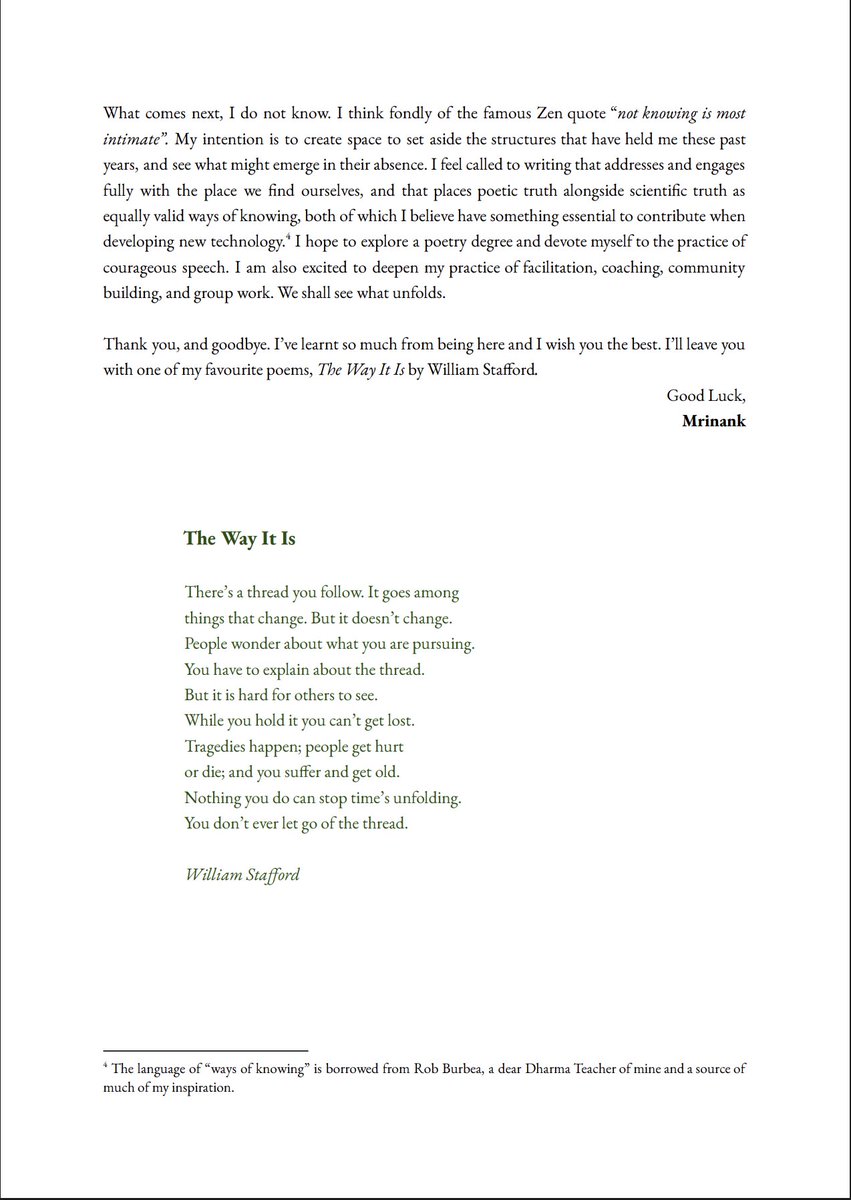
mrinank
mrinank@MrinankSharma·
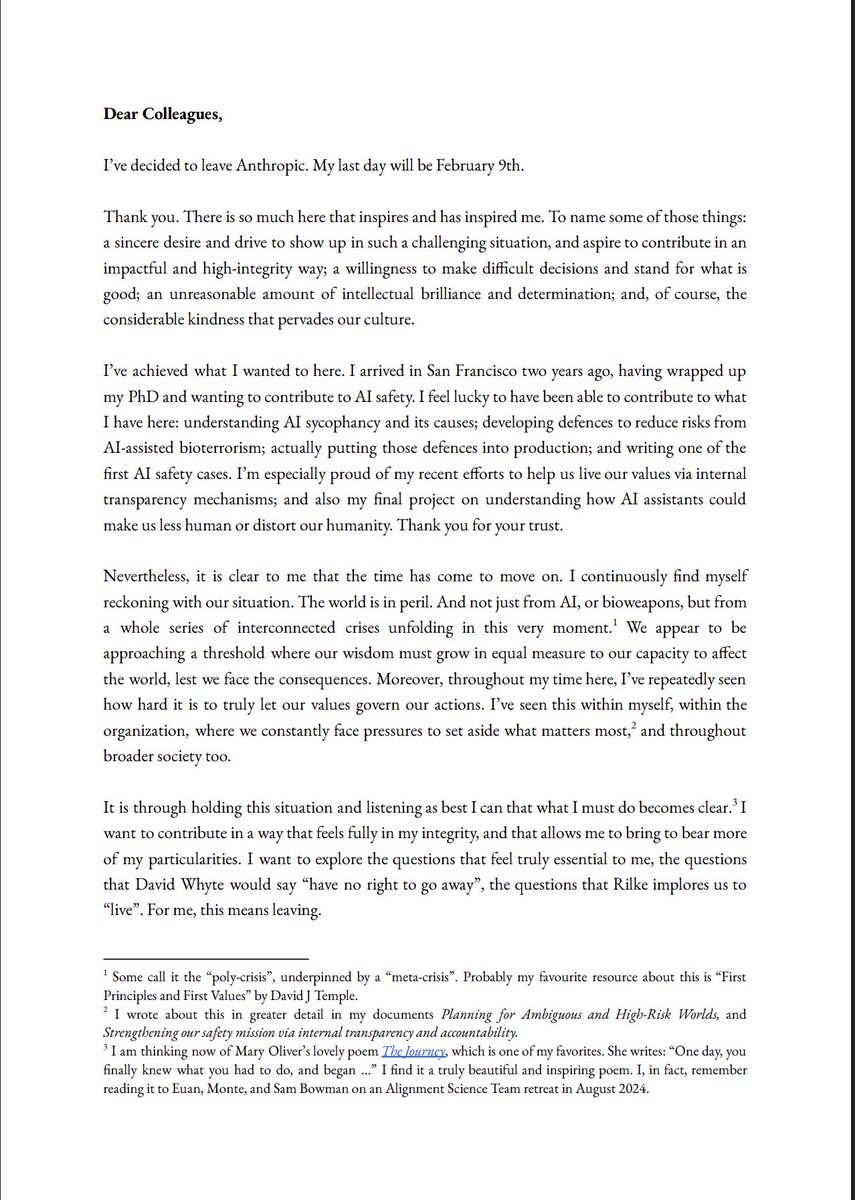
Today is my last day at Anthropic. I resigned. Here is the letter I shared with my colleagues, explaining my decision.
mrinank tweet mediamrinank tweet media
English
2.5K
5.1K
35.9K
15.1M