Thomas Plé

22 posts

Thomas Plé

Thomas Plé

@Thomas__Ple

Katılım Nisan 2022
41 Takip Edilen42 Takipçiler
Thomas Plé retweetledi
Jean-Philip Piquemal
Jean-Philip Piquemal@jppiquem·
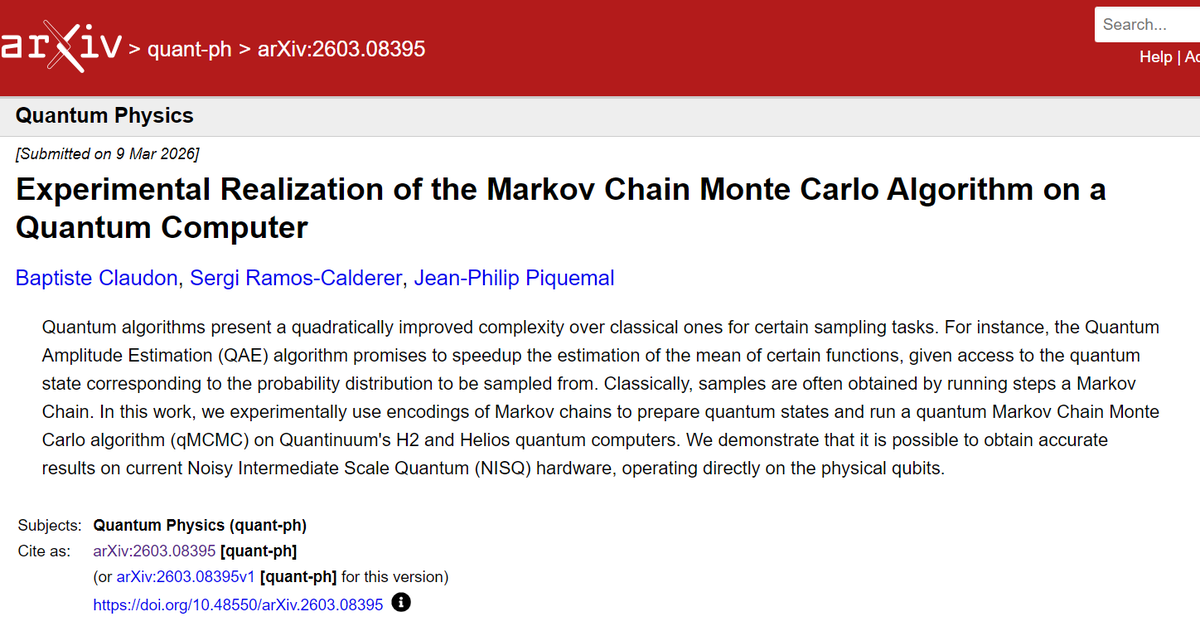
#quantumcomputing New group preprint: "Experimental Realization of the Markov Chain Monte Carlo Algorithm on a Quantum Computer". arxiv.org/abs/2603.08395 In this work, we experimentally use encodings of Markov chains to prepare quantum states and run a quantum Markov Chain Monte Carlo algorithm (qMCMC) on Quantinuum's H2 and Helios quantum computers. We demonstrate that it is possible to obtain accurate results on current Noisy Intermediate Scale Quantum (NISQ) hardware, operating directly on the physical qubits. Great work by B. Claudon @qubit_pharma and nice collaboration with S. Ramos-Calderer @quantumlah.
Jean-Philip Piquemal tweet media
English
0
5
18
2.6K
Thomas Plé retweetledi
Jean-Philip Piquemal
Jean-Philip Piquemal@jppiquem·
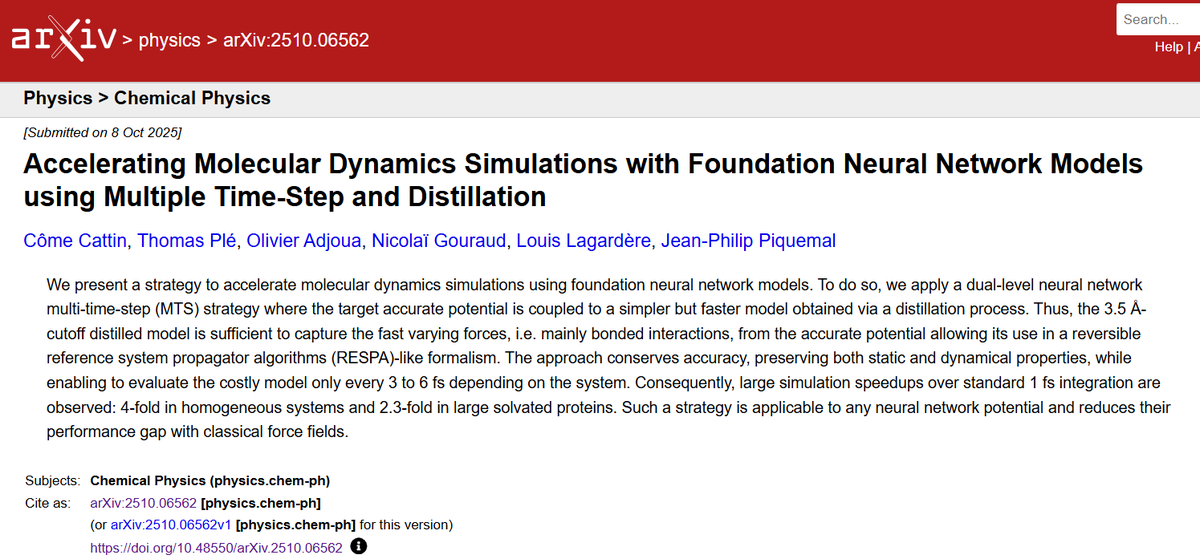
#compchem Our paper in J. Phys. Chem. Lett. (@JPhysChem): "Accelerating Molecular Dynamics Simulations with Foundation Neural Network Models using Multiple Time-Step and Distillation" made it to one of the covers! pubs.acs.org/doi/full/10.10…
Jean-Philip Piquemal tweet media
Jean-Philip Piquemal@jppiquem

#compchem #machinelearning First paper of the year, just out in J. Phys. Chem. Lett. ( @JPhysChem ): "Accelerating Molecular Dynamics Simulations with Foundation Neural Network Models using Multiple Time-Step and Distillation". Check the paper: pubs.acs.org/doi/full/10.10… (see also the updated preprint: arxiv.org/abs/2510.06562) We present a distilled multi-time-step (DMTS) strategy to accelerate molecular dynamics simulations using foundation neural network models. DMTS uses a RESPA-like formalism and a dual-level neural network where the target accurate potential is coupled to a simpler but faster model obtained via a distillation process. The approach conserves accuracy, preserving both static and dynamical properties. For those who read the initial preprint, the published version includes additional results leveraging active learning for enhanced stability. Such a strategy is applicable to any neural network potential and reduces their performance gap with classical force fields. Great work (and 1st paper!) by @comecattin. Kudos to the team: @Thomas__Ple, O. Adjoua, L. Lagardère and @NicolaiGouraud (@qubit_pharma). Funded by the @ERC_Research (project EMC2), supercomputing time @Genci_fr

English
1
10
43
2.3K
Thomas Plé retweetledi
Jean-Philip Piquemal
Jean-Philip Piquemal@jppiquem·
💫 As promised, we just released on GitHub the weights of the #FeNNixBio1 foundation machine learning model for drug design! 💫 Weights: github.com/FeNNol-tools/F… FeNNol GPU code: github.com/FeNNol-tools/F… The models are distributed under the open source ASL license (i. e. restricted to non-commercial academic research). You can also check the updated version of the preprint that includes a unified transformers architecture as well as the full computation of the Freesolv hydration free energies dataset etc... doi.org/10.26434/chemr… Happy holidays and merry Christmas everyone! 🎅 🎄 Sorbonne Université / CNRS @qubit_pharma #machinelearning #moleculardynamics #drugdesign #compchem #GPU #biophysics
English
2
18
61
5.1K
Thomas Plé retweetledi
Jean-Philip Piquemal
Jean-Philip Piquemal@jppiquem·
#compchem New preprint: "𝐀𝐜𝐜𝐞𝐥𝐞𝐫𝐚𝐭𝐢𝐧𝐠 𝐌𝐨𝐥𝐞𝐜𝐮𝐥𝐚𝐫 𝐃𝐲𝐧𝐚𝐦𝐢𝐜𝐬 𝐒𝐢𝐦𝐮𝐥𝐚𝐭𝐢𝐨𝐧𝐬 𝐰𝐢𝐭𝐡 𝐅𝐨𝐮𝐧𝐝𝐚𝐭𝐢𝐨𝐧 𝐍𝐞𝐮𝐫𝐚𝐥 𝐍𝐞𝐭𝐰𝐨𝐫𝐤 𝐌𝐨𝐝𝐞𝐥𝐬 𝐮𝐬𝐢𝐧𝐠 𝐌𝐮𝐥𝐭𝐢𝐩𝐥𝐞 𝐓𝐢𝐦𝐞-𝐒𝐭𝐞𝐩 𝐚𝐧𝐝 𝐃𝐢𝐬𝐭𝐢𝐥𝐥𝐚𝐭𝐢𝐨𝐧" in link with our #FeNNix-Bio1 foundation #machinelearning model. 👉 Check it out: arxiv.org/abs/2510.06562 We present a strategy to accelerate molecular dynamics simulations using foundation neural network models. To do so, we apply a dual-level neural network multi-time-step (MTS) strategy where the target accurate potential is coupled to a simpler but faster model obtained via a distillation process. Consequently, large simulation speedups over standard 1 fs integration are observed: 4-fold in homogeneous systems and 2.3-fold in large solvated proteins. Such a strategy is applicable to any neural network potential and reduces their performance gap with classical force fields. Great work from @comecattin. Thanks to all co-authors. Funding @ERC_Research (project EMC2) and supercomputing time @Genci_fr. Sorbonne Université and CNRS @qubit_pharma
Jean-Philip Piquemal tweet media
English
3
22
132
14.2K
Thomas Plé retweetledi
Jean-Philip Piquemal
Jean-Philip Piquemal@jppiquem·
#compchem Second preprint linked to the FeNNix-Bio1 #machinelearning foundation model. FeNNix-Bio1's inference is pretty fast already with a few GPUs but, "what if", we were able to push it at the #Exascale? Let's have a glimpse into the future (1/3): "Pushing the Accuracy Limit of Foundation Neural Network Models with Quantum Monte Carlo Forces and Path Integrals" Check it out 💫: arxiv.org/abs/2504.07948 We propose an end-to-end integrated strategy to produce highly accurate quantum chemistry synthetic datasets (energies and forces) aimed at deriving Foundation Machine Learning models for molecular simulation. Starting from Density Functional Theory (DFT), a "Jacob's Ladder" approach leverages computationally-optimized layers of massively #GPU-accelerated software with increasing accuracy. Thanks to Exascale, this is the first time that the computationally intensive calculation of Quantum Monte Carlo forces (QMC), and the combination of multi-determinant QMC energies and forces with selected-Configuration Interaction wavefunctions, are computed at such scale at the complete basis-set limit. To bridge the gap between accurate QC and condensed-phase Molecular Dynamics, we leverage transfer learning to improve the DFT-based FeNNix-Bio1 foundation model. 🚀The resulting approach is coupled to path integrals adaptive sampling quantum dynamics to perform nanosecond reactive simulations at unprecedented accuracy on a full Satellite Tobacco Mosaic Virus (STMV) 1M, all-atom, complete solvated model (see the video produced using @VTX_mol, @MaximeMARIA_ @MatthieuMontes ). These results demonstrate the promise of Exascale to deepen our understanding of the inner machinery of complex biosystems. Immense thanks to all co-authors at @qubit_pharma, @LCT_UMR7616 (@Sorbonne_Univ_ /@CNRS ), @UChicago, @SandiaLabs, @ORNL and @argonne for this collaborative efforts. Some are on X: @QMC_Anouar @Thomas__Ple @OlivierApp @EPosenitskiy @blazhynska66497 @ApplencourtT @JeongnimK #HPC This work was made possible thanks to #INCITE projects enabling the use of Argonne's Aurora exascale system and of the Polaris machine, to @Genci_fr (Jean Zay @ Idris) and @EuroHPC_JU (Leonardo @Cineca1969). #supercomputing
English
28
34
144
15.1K
Thomas Plé retweetledi
Jean-Philip Piquemal
Jean-Philip Piquemal@jppiquem·
#compchem What could we do if we had a fast and accurate foundation #MachineLearning learning model for condensed phase molecular dynamics simulation of biological systems? 👉Check the @ChemRxiv preprint: "A Foundation Model for Accurate Atomistic Simulations in Drug Design": doi.org/10.26434/chemr… Amazing work by @Thomas__Ple and the teams at @LCT_UMR7616 and @qubit_pharma introducing the FeNNix-Bio1 foundation model. Trained exclusively on synthetic quantum chemistry data, it provides predictive condensed- phase Molecular Dynamics simulations including quantum nuclear effects. Its full-range of capabilities is demonstrated by modelling: water properties, ions in solution, small molecules hydration free energies, complex folding free-energy landscapes, large-scale protein dynamics, protein-ligand binding, chemical reactions and by coupling it to protein structure prediction foundation models’ outputs for further refinement. FeNNix-Bio1 is accurate and systematically improvable while limiting human parametrization efforts. Big kudos to all other co-authors: @OlivierApp, @QMC_Anouar, @EPosenitskiy, C. Villot, L. Lagardère. Implemented and #GPU-accelerated in Tinker-HP/Deep-HP @TINKERtoolsMD. Funding @ERC_Research (project EMC2). A big thank to @Genci_fr (grand challenge H100 @ IDRIS/Jean Zay), @EuroHPC_JU (Cineca/Leonardo) and to @argonne (#INCITE project/Aurora) for #supercomputing time.
Jean-Philip Piquemal tweet mediaJean-Philip Piquemal tweet mediaJean-Philip Piquemal tweet mediaJean-Philip Piquemal tweet media
English
1
17
71
11.7K
Thomas Plé retweetledi
Jean-Philip Piquemal
Jean-Philip Piquemal@jppiquem·
#compchem New group preprint: "Velocity Jumps for Molecular Dynamics". arxiv.org/abs/2412.15073 We introduce the Velocity Jumps approach, denoted as JUMP, a new class of Molecular dynamics integrators, replacing the Langevin dynamics by a hybrid model combining a classical Langevin diffusion and a piecewise deterministic Markov process, where the expensive computation of long-range pairwise interactions is replaced by a resampling of the velocities at random times. Fantastic job by @NicolaiGouraud and another nice interdisciplinary collab with Pierre Monmarché. @OlivierApp @Thomas__Ple @qubit_pharma @LCT_UMR7616 @Genci_fr @TINKERtoolsMD
Jean-Philip Piquemal tweet media
English
1
24
83
6.8K
Thomas Plé retweetledi
Jean-Philip Piquemal
Jean-Philip Piquemal@jppiquem·
#compchem Just published in @ChemicalScience: Water-Glycan Interactions Drive the SARS-CoV-2 Spike Dynamics: Insights into Glycan-Gate Control and Camouflage Mechanism. dx.doi.org/10.1039/D4SC04… Towards developing therapeutic strategies against #COVID19, we performed μs-long all-atom AMOEBA high-resolution polarizable adaptive sampling molecular dynamics simulations and zoomed in on the #SARSCoV2 interaction layers in open and closed states. Simulations reveal a protein-solvent-glycan polarization network supporting the open state. Besides, we showed that the glycan shield maintains viral camouflage in both states. Amazing work by @blazhynska. Kudos to L. Lagardère and @OlivierApp. Another epic collaboration with @leucinw and @prenbme. This research was funded by @ERC_Research (project EMC2). We thank @awscloud for supporting this research and providing extensive #GPU-accelerated cloud computational ressources as well as @Genci_fr for #supercomputing time. #HPC @LCT_UMR7616 @qubit_pharma @Sorbonne_Univ_ @CNRSchimie @UTBiomedical @TINKERtoolsMD
Jean-Philip Piquemal tweet media
English
3
29
63
17.9K
Thomas Plé retweetledi
Jean-Philip Piquemal
Jean-Philip Piquemal@jppiquem·
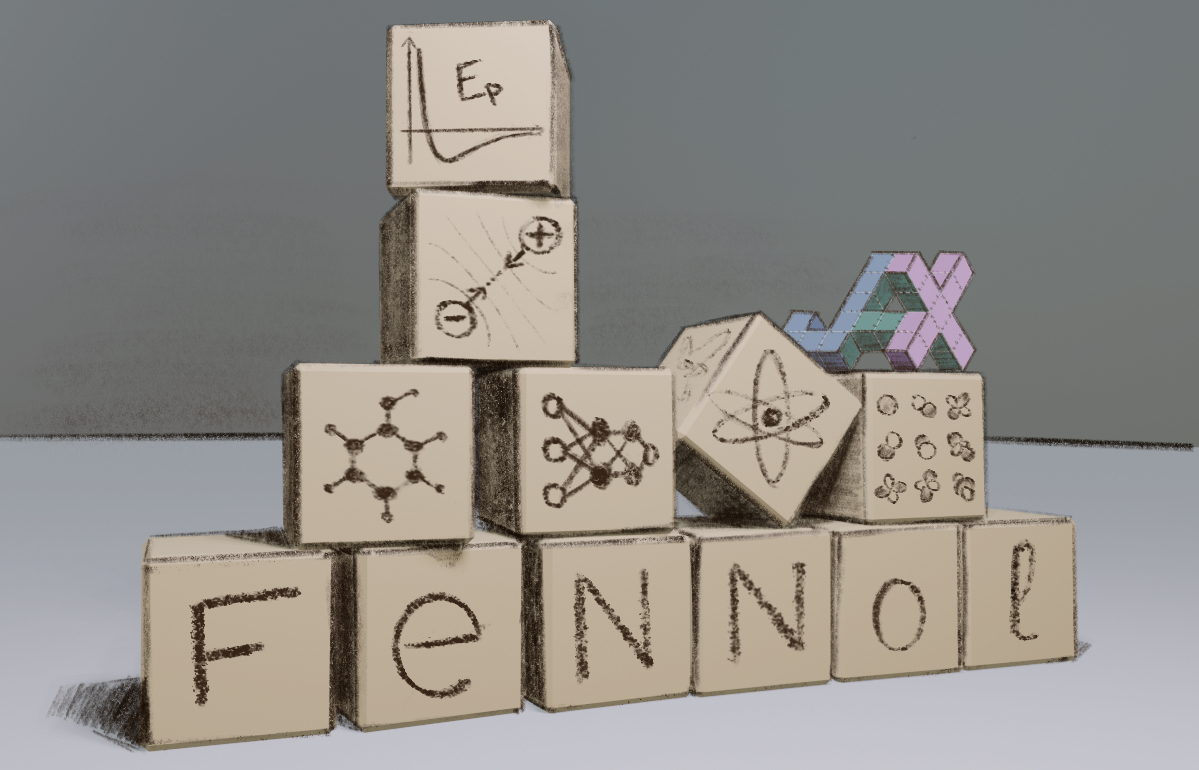
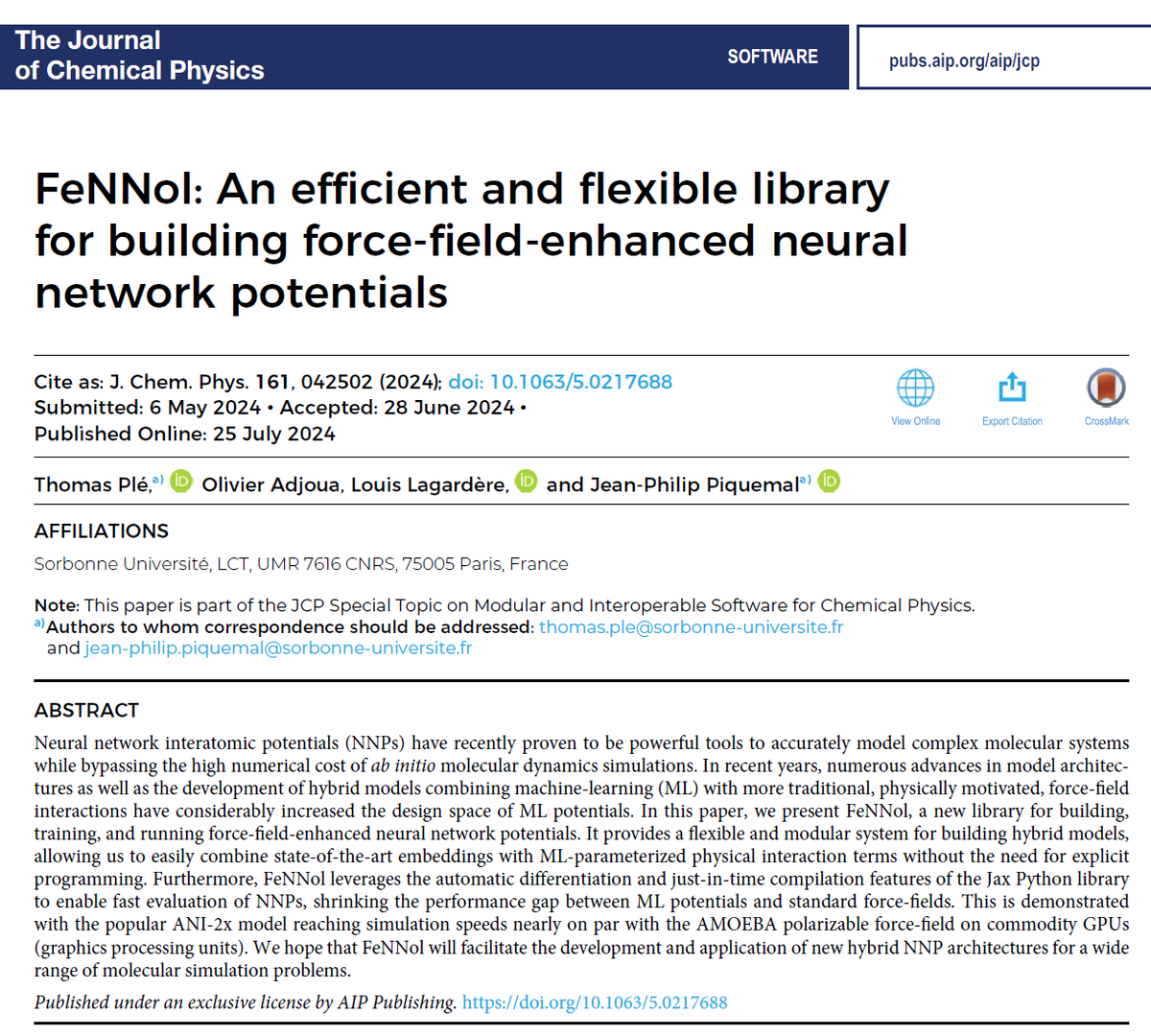
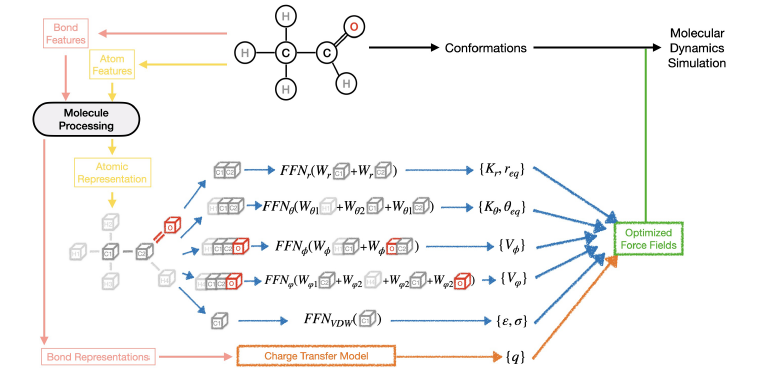
#compchem Happy to see this one out and published @JChemPhys as part of the special issue: "Modular and Interoperable Software for Chemical Physics": "FeNNol: an Efficient and Flexible Library for Building Force-field-enhanced Neural Network Potentials. FeNNol is a new #GPU-accelerated #opensource library for building, training and running force-field-enhanced #neuralnetwork potentials. It provides a flexible and modular system for building hybrid models, allowing to easily combine state-of-the-art embeddings with ML-parameterized physical interaction terms without the need for explicit programming. FeNNol is fast and intends to reduce the performance gap between ML potentials and standard (polarizable) force-fields. JCP paper: doi.org/10.1063/5.0217… Preprint (updated): arxiv.org/abs/2405.01491 Github: github.com/thomasple/FeNN… Congrats @Thomas__Ple, @OlivierApp, L. Lagardère @LCT_UMR7616. Funding @ERC_Research (project EMC2). Supercomputer time @Genci_fr #supercomputing #HPC #machinelearning
Jean-Philip Piquemal tweet mediaJean-Philip Piquemal tweet media
English
1
16
53
5.1K
Thomas Plé retweetledi
Jean-Philip Piquemal
Jean-Philip Piquemal@jppiquem·
#compchem Just published in JCTC @JCIM_JCTC: "Advancing Force Fields Parameterization: A Directed Graph Attention Networks Approach". dx.doi.org/10.1021/acs.jc… In this study, we propose a Graph-Based Force Fields (GB-FFs) model to directly derive parameters for the Generalized Amber Force Field (GAFF) from chemical environments. Our end-to-end parameterization approach eliminates the need for expert-defined procedures & enhances the accuracy and transferability of GAFF across a broader range of molecular complexes. Nice work by G. Chen, @JaffrelotT, @Thomas__Ple, L. Lagardère & great collab with Y. Maday. Funded @ERC_Research (project EMC2). @Genci_fr
Jean-Philip Piquemal tweet media
English
3
22
77
6.1K
Thomas Plé retweetledi
Jean-Philip Piquemal
Jean-Philip Piquemal@jppiquem·
#compchem Check out this new paper where we reach chemical accuracy at the Full CI/CBS limit for small molecules (up to nearly 300 qubits!!) using GPU-accelerated quantum emulation.
Jean-Philip Piquemal@jppiquem

Speaking today at the @isqbp 2024 conference about new important results that we obtained in #quantumcomputing for #compchem. Check out the new preprint: "Shortcut to Chemically Accurate Quantum Computing via Density-based Basis-set Correction" arxiv.org/abs/2405.11567 We present a new hybrid computing scheme for getting accurate energies and first-order properties of small molecules. The use of GPU-accelerated emulation allows us to obtain quantitative results at with ADAPT-VQE that would otherwise require brute-force quantum simulations using far more than 100 logical qubits. It is grounded on on-the-fly pivoted Cholesky-like adaptive basis sets (System-Adapted-Basis-Sets or SABS) and on a specific density basis set embedding of the quantum ansatz denoted density-based basis-set correction that allows recovering missing dynamical correlation effects due to basis set incompletess. Remaining missing basis effects can be included via a cheap Hartree Fock correction. We converge the ground-state energies of four systems (He, Be, H2, LiH) within chemical accuracy of the CBS full-configuration-interaction reference, while offering a systematic increase of accuracy beyond a double-zeta quality for various molecules up to the H8 hydrogen chain. We also obtain dissociation curves for H2 and LiH that reach the CBS limit whereas for the challenging simulation of the N2 triple-bond breaking, we achieve a near-triple-zeta quality at the cost of a minimal basis-set. A nice feature of the approach is that it can be also used as "a posteriori" correction to any real QPU computation. Stellar work by @Dr_DiataTraore @OlivierApp @ChemCesar I.-M. Lygatsika and great interdisciplinary work between chemistry, physics, #HPC and mathematics. Great collaboration between @LCT_UMR7616 (J. Toulouse, E. Giner), LJLL (Y. Maday), @qubit_pharma ( @alberto_peruzzo @EPosenitskiy) and @nvidia ( @khammernik). Funding from @ERC_Research (project EMC2) and PEPR Epiq @AgenceRecherche. Computer time @Genci_fr, @Scaleway_fr and NVIDIA.

English
0
5
38
3.9K
Thomas Plé retweetledi
Jean-Philip Piquemal
Jean-Philip Piquemal@jppiquem·
#compchem Latest group preprint: FeNNol: an Efficient and Flexible Library for Building Force-field-enhanced Neural Network Potentials. arxiv.org/abs/2405.01491 A new GPU-accelerated #opensource library for building, training and running force-field-enhanced neural network potentials. It provides a flexible and modular system for building hybrid models, allowing to easily combine state-of-the-art embeddings with ML-parameterized physical interaction terms without the need for explicit programming. FeNNol shrinks the performance gap between ML potentials and standard force-fields. Available at github.com/thomasple/FeNN… Great work by @Thomas__Ple, @OlivierApp, L. Lagardère @LCT_UMR7616. Funding @ERC_Research (project EMC2). Supercomputer time @Genci_fr. #NeuralNetworks #GPU #supercomputing #HPC
Jean-Philip Piquemal tweet media
English
5
15
84
12.8K
Thomas Plé retweetledi
Jean-Philip Piquemal
Jean-Philip Piquemal@jppiquem·
🥂As the end of year is nearly there, a quick recap on the 2023 @PiquemalGroup's papers & preprints in #MachineLearning for #compchem🤖: - Generalized Many-Body Dispersion Correction through Random-phase Approximation for Chemically Accurate Density Functional Theory; J. Phys. Chem. Letter @JPhysChem (Open Access) doi.org/10.1021/acs.jp… - Routine Molecular Dynamics Simulations Including Nuclear Quantum Effects: from Force Fields to Machine Learning Potentials; JCTC @JCIM_JCTC (Cover) dx.doi.org/10.1021/acs.jc… Preprint: arxiv.org/abs/2212.03137 - Scalable Hybrid Deep Neural Networks/Polarizable Potentials Biomolecular Simulations including long-range effects; @ChemicalScience (Open Access) doi.org/10.1039/D2SC04… - Force-Field-Enhanced Neural Network Interactions: from Local Equivariant Embedding to Atom-in-Molecule properties and long-range effects; @ChemicalScience (Open Access) doi.org/10.1039/D3SC02… - Incorporating Neural Networks into the AMOEBA Polarizable Force Field; preprint @ChemRxiv doi.org/10.26434/chemr… - Advancing Force Fields Parameterization: A Directed Graph Attention Networks Approach; preprint @ChemRxiv doi.org/10.26434/chemr… Thanks to all our great co-authors: @Thomas__Ple, @JaffrelotT, @OlivierApp, @MaugerNastasia, @PierPoier, @olexandr, @leucinw, @prenbme, X. Wang, H. Gökcan, S. Huppert, Y. Maday, L. Lagardère. @LCT_UMR7616. Funding @ERC_Research (project EMC2), supercomputer time @Genci_fr . This research uses the Tinker-HP @TINKERtoolsMD MD engine. Check it out at tinker-hp.org
Jean-Philip Piquemal tweet mediaJean-Philip Piquemal tweet mediaJean-Philip Piquemal tweet mediaJean-Philip Piquemal tweet media
English
0
7
42
4.4K
Thomas Plé retweetledi
Jean-Philip Piquemal
Jean-Philip Piquemal@jppiquem·
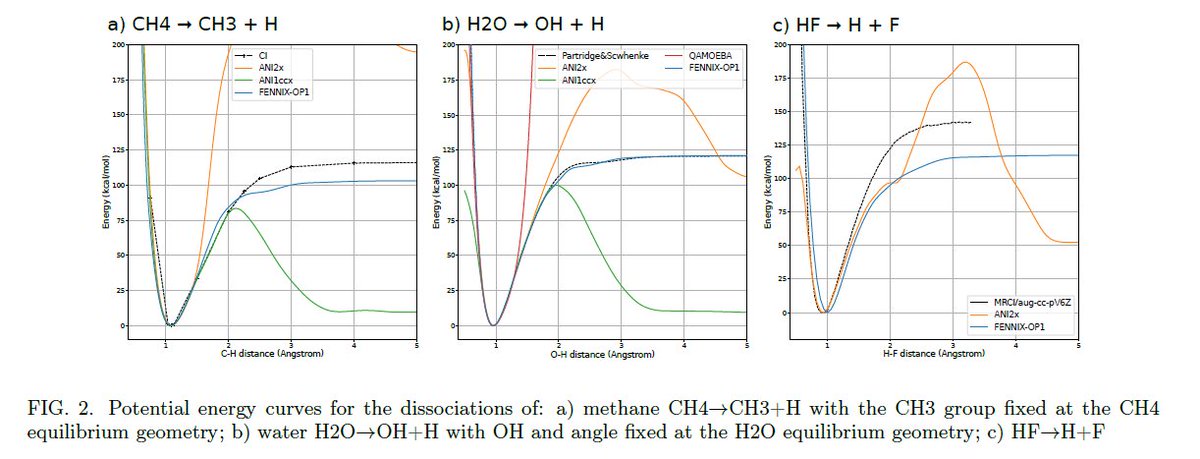
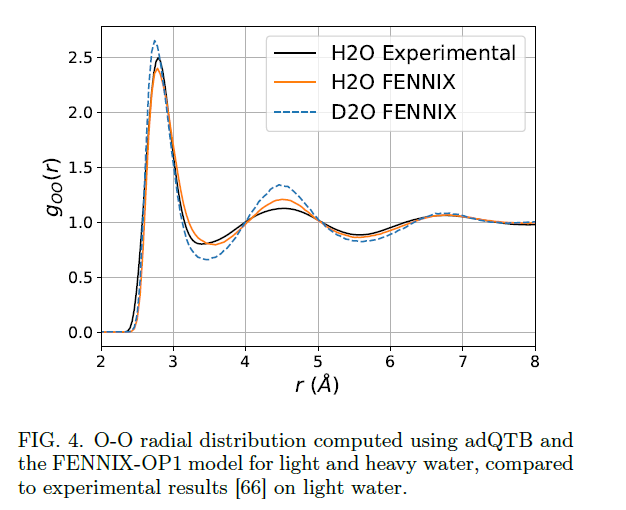
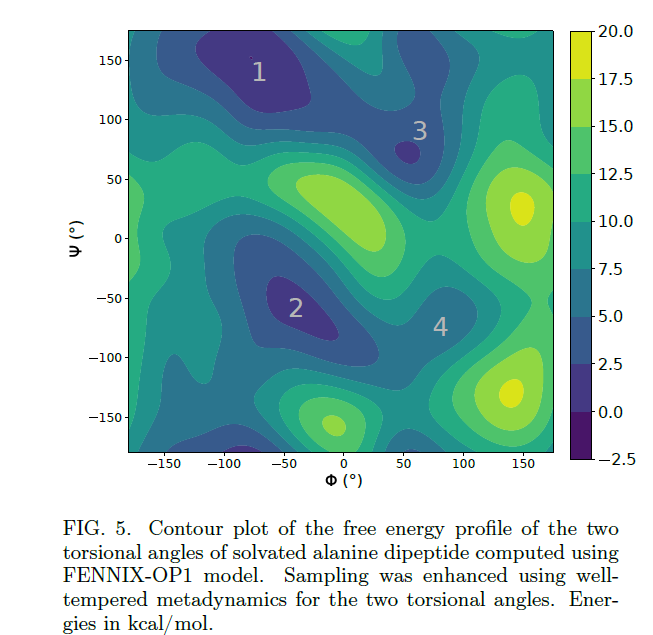
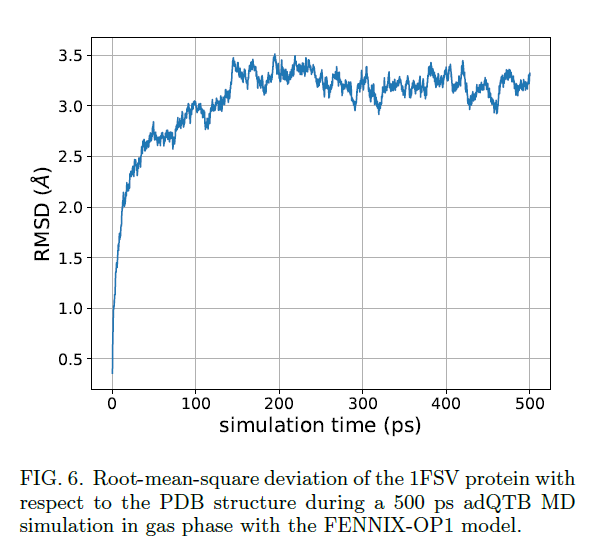
🚨Just published in @ChemicalScience🚨: "Force-Field-Enhanced Neural Network Interactions: from Local Equivariant Embedding to Atom-in-Molecule properties and long-range effects. doi.org/10.1039/D3SC02… Amazing #compchem work by @Thomas__Ple introducing the hybrid physically-driven #machinelearning FENNIX model. Exhibiting accurate gas-phase energy predictions, FENNIX is reactive, transferable to the condensed phase and able to produce stable Molecular Dynamics simulations including nuclear quantum effects. Funded @ERC_Research (project EMC2), supercomputer time @Genci_fr. @TINKERtoolsMD @LCT_UMR7616
Jean-Philip Piquemal tweet media
English
4
18
88
15K
Thomas Plé
Thomas Plé@Thomas__Ple·
@simonbatzner @jppiquem There are F atoms in molecules of the DES370K dimers. Though we only train on the dimer interaction energy and not on individual monomers. So the H-F covalent stretching would be a very indirect information.
English
1
0
1
92
Simon Batzner
Simon Batzner@simonbatzner·
@Thomas__Ple @jppiquem Text says there are "no covalent interaction energies for F", so there are non-covalent ones in the presence of other atoms? That would still provide (H, F) / (F, H) info to the Allegro module, or are there no H-F pairs at all?
English
1
0
0
98