
Chris Tipper | 📈 ₿ 🥇🥈

1.3K posts

Chris Tipper | 📈 ₿ 🥇🥈 banner
Chris Tipper | 📈 ₿ 🥇🥈

Chris Tipper | 📈 ₿ 🥇🥈

@TipperAnalytics

Expert analysis and trades using Global Liquidity, Bitcoin & Bullion. Chief Economist and Strategist: The Ainslie Group (Bullion, Crypto, Tokens, Wealth).

Brisbane, QLD, Australia Katılım Nisan 2022
45 Takip Edilen17.6K Takipçiler
Chris Tipper | 📈 ₿ 🥇🥈
The thing most people are scared of is the wrong thing. Inflation ticked up last print. Headlines lit up. "Sticky inflation," "stalled progress," the usual run. The actual macro trend underneath the noise has been disinflationary for almost two years. @realDhruvSuri came on Insights this week to pull apart the three terms most people use interchangeably and most people get wrong. Inflation. Disinflation. Deflation. Each one demands a different response from a portfolio. Each one means something very different is happening inside the economy. The argument we ended up at: the genuine tail risk isn't another inflation surprise. It's a deflationary bust. And the loudest deflationary indicator we have right now isn't a CPI print at all. It's the oil chart.
English
0
3
5
263
Chris Tipper | 📈 ₿ 🥇🥈
Global liquidity hit another record high this week. The base underneath it shrank again. That gap is the story of the moment. The Shadow Monetary Base is the pool of central bank reserves and eligible bonds that gets leveraged into the headline number. Its three-month annualised change is now firmly negative. The base is contracting while the headline keeps climbing. The two have decoupled. The headline is being lifted by an expanding collateral multiplier rather than by genuine new liquidity creation. The supports that have been engineering that surface number are visibly working harder for less. The dollar has reversed against every major currency bar the yuan. Bond volatility has ticked up off four-year lows. China has withdrawn for a fifth consecutive week, with PBoC liquidity back to pre-Chinese-New-Year levels and the renminbi at a three-year high. Each of these levers used to lift the headline. Each is now pulling against it. This week's letter unpacks the layers. Why the multiplier is the most fragile part of the configuration. Where the rotation into Developed Market exposure is heading next. What a bear-flattening curve and a 5 per cent long end are actually telling us. And the moment the support package stops working. open.substack.com/pub/tipperanal…
Chris Tipper | 📈 ₿ 🥇🥈 tweet media
English
0
4
1
286
Chris Tipper | 📈 ₿ 🥇🥈
$400K home. Sold for $900K. $500K gain. Old rules: 50% CGT discount, $112,500 tax at the top marginal rate. New rules: inflation indexation only, $171,000 on the same transaction. $58,500 extra on a property sale that hasn't changed. Same house. Same buyer. Same Australia. Just a different government deciding what your gain is.
English
90
68
310
86.2K
Chris Tipper | 📈 ₿ 🥇🥈
Every losing trader looks back and finds a rule that would have made them money. Hindsight always finds a rule. The traders who actually compound aren't switching systems. They're following one. Cycle theory, waiting for the lows, waiting for confirmation. Sitting on their hands when the chart says "not yet." The backtest proves it over and over. Discipline beats every other variable.
English
0
32
23
1.4K
Chris Tipper | 📈 ₿ 🥇🥈
The playbook @realDhruvSuri runs: gold first, before the crash. Switch into silver during the crash. Position in silver for the next leg up while the GSR falls off. Nimble execution matters. Bullion dealers get queues in those windows. Gold and Silver Standard tokens on the blockchain solve the timing problem with 24-7 access. For everyone else: stack dollars and wait for pullbacks. A GSR spike paired with a weekly cycle low is the entry. The eight-year macro low is the big one.
English
1
19
25
1.1K
Chris Tipper | 📈 ₿ 🥇🥈
They abolished it in 1985. Sydney rent rose 43% inside two years. New Zealand tried it in 2021. By 2023 they reversed it. Rents up 15 to 20%. In some areas $450 became $690. You can't argue this on theory anymore. Two countries, two attempts, same outcome. Take the tax shield off landlords and the cost flows straight to the tenant. We have the evidence. We're choosing to ignore it.
English
1
1
7
550
Chris Tipper | 📈 ₿ 🥇🥈
Internal five-year plan at Vincents: headcount probably drops as AI gets sharper. Revenue per employee goes up. Admin is the obvious one. The assistive processes still done by humans are the next layer. Most businesses will feel that within five years. Not a prediction. A planning assumption. The businesses that plan for it have time. The ones that don't get caught.
English
0
1
5
256
Chris Tipper | 📈 ₿ 🥇🥈
100-year average: 50. Decades well above. Decades well below. Right now we're sitting above 50 in a multi-decade bull run for metals. Dhruv's read: a GSR above 50 in this phase of the cycle is a no-brainer. From 2030 onwards, that window narrows. You could be waiting generations for the next one. Cycles don't repeat on demand. The setup is the setup.
English
3
9
96
2K
Chris Tipper | 📈 ₿ 🥇🥈
Chart of the Week The MOVE Index sits below 80. Last week was the dollar. This week is the variable that does most of the work on the U.S. side of the plumbing. The MOVE Index is the bond market's volatility gauge. When it's compressed, lenders in U.S. money markets accept smaller haircuts on the Treasury bonds offered as collateral. Smaller haircuts means more lending capacity sits against the same pool of bonds. More lending capacity translates directly into more headline liquidity. Suppress this one number, and the entire money-market system runs hotter on the same underlying collateral. Treasury buybacks are explicitly engineered to keep this compressed. Each 10-point rise in the MOVE Index triggers approximately $30 to $40 billion of buybacks, pulling duration out of the market and dampening volatility before it can run. The Fed's Reserve Management Purchases sit alongside, adding bank reserves into the system. Together they have moved roughly $600 billion since October. This is what the late-cycle plumbing looks like. Not rate cuts. Not announcements. Not QE. A quiet, persistent suppression of the volatility variable that determines how much credit the money market can manufacture against the existing collateral base. But suppression has a half-life. Volatility behaves like a beachball held under water. Hold it down long enough and it pops up somewhere else in the system. If bond vol remains capped, the most likely vent is the dollar. That is the configuration we are now in. Bond vol suppressed, dollar sliding. Headline liquidity at a new high. The cycle, beneath all of it, still rolling lower. Watch the cross-rates. That is where the next test of this configuration prints first.
Chris Tipper | 📈 ₿ 🥇🥈 tweet media
English
0
5
6
264
Chris Tipper | 📈 ₿ 🥇🥈
Going into business with someone? Best mates, brothers, sisters, whoever. Get a shareholders agreement before anything goes wrong. It sets the rules of engagement. What you can and cannot do. How decisions get made. What happens if one party wants out. By the time the dispute happens, it's too late to write the rules. The cost of drafting it now is nothing compared to the cost of fighting without one.
English
0
3
9
630
Chris Tipper | 📈 ₿ 🥇🥈
A lot of the budget speech was framed as Robin Hood. Taking from the rich, giving to the Aussie battler, restoring fairness. Look at who's actually wearing the changes. CGT discount halved on the family share portfolio. Trust income flat-taxed on the family farm. Indexed cost base on the family home. These aren't the rich. These are mum and dad. Everyday Australians who built a small position over 20 years and just got told the rules they bought under don't apply on the way out.
English
0
0
1
341
Chris Tipper | 📈 ₿ 🥇🥈
This is the most underappreciated structural risk in the entire precious metals trade. Physical access closing happens fast and rarely reopens at the same terms. India's gold import tightening cycles in 2013 and 2019 both lasted longer than the policy windows implied, and the LBMA pool isn't built for sustained physical-paper convergence. Australian dealer flow data through April was already showing 30%+ wait times on standard kilo bars. That gap between paper price and physical availability is the early warning system most macro investors aren't even watching.
English
0
0
1
31
Macro Liquidity by Sunil Reddy
Many are thinking only about price. Very few are thinking about availability. That is the real mistake. Yes, restrictions on gold and silver imports can reduce short-term demand. Yes, paper prices can get hit. Yes, you can hedge that move in the paper market through futures, options, or cash management. But don’t be foolish enough to think paper price and physical access are the same thing. When the system is calm, gold and silver are treated like normal commodities. When governments, fiat currencies, oil bills, and balance of payments are under pressure, the same metals suddenly become “restricted,” “regulated,” “controlled,” and “permission-based.” That is the state protecting the fiat system. They will first tax monetary metals. Then restrict them. Then decide who gets access. So trade the short-term downside if your model says so. But understand the bigger picture: By the time the crowd realizes why physical gold and silver matter, they may not be able to access them as freely as they can today. Price is the distraction. Availability is the real signal.
Macro Liquidity by Sunil Reddy@Macrobysunil

BREAKING: India just restricted silver bar imports. Silver bars under HS codes 71069221 and 71069229 — including 99.9%+ silver bars, have moved from Free to Restricted. That difference is huge. A duty hike only makes imports costly. A restriction makes imports permission-based. That means India is no longer just taxing silver demand. It is trying to control the physical flow of silver into the country. Why does it matter? • Importers lose free access • Physical supply will tighten • Domestic premiums can rise • MCX silver can disconnect from global silver during stress • Industrial and bullion users may rush for inventory • Real price discovery can shift from paper charts to physical availability Silver is no longer being treated like a normal commodity. It is being treated like a sensitive external-sector asset that challenges forex reserves of the central bank. When a country that is already dependent on imported energy starts controlling monetary metal inflows, it usually means one thing: Pressure is building somewhere in the currency, trade deficit, or dollar liquidity system. You don't own enough silver.

English
11
25
147
16.5K
Chris Tipper | 📈 ₿ 🥇🥈
The pattern you're laying out lines up with where physical silver demand is actually heading. The industrial floor (solar, EV, grid storage, defence) is now larger than investment demand for the first time in modern history. When the ratio breaks, the rotation isn't just gold leads to silver leads to miners, it's a structural rerating where silver decouples from gold's pace entirely. The 2011 high gets retaken faster than anyone is positioned for, and miners running silver above $35 break-evens get extraordinary operating leverage from there.
English
0
0
0
41
LBroad
LBroad@BroadLuis·
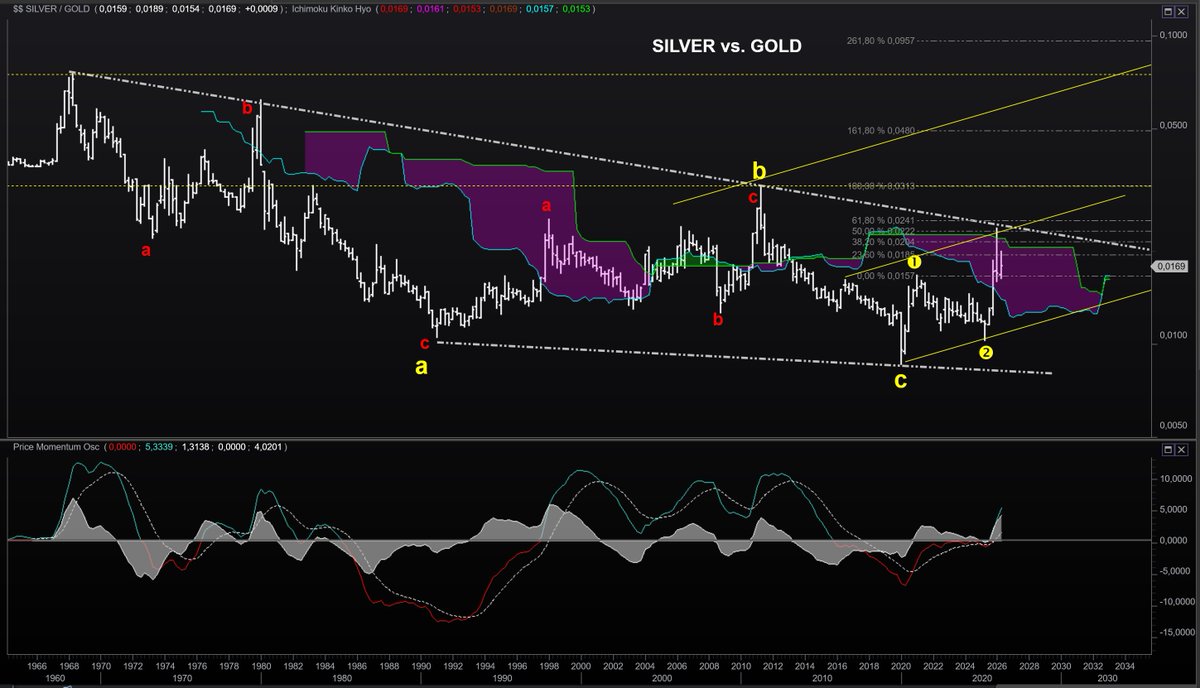
🧭 Before looking at silver's price, I look at its ratio against gold. And what I see right now is one of the most important structures I've analyzed in years. 📐 This is a quarterly chart. More than six decades of history. Slow by definition. And that's exactly what makes it valuable: it strips away the noise and reveals the real architecture of the market. The real architecture looks like this: since the late 1960s, the SILVER/GOLD ratio has spent more than 50 years compressed inside a major downtrend. Every attempt by silver to lead gold has been rejected. Every advance has ended trapped within the same secular compression structure. More than half a century without resolution. ⚙️ But something is changing. What I see now is a large ABC corrective pattern, nearly complete, formed right below the primary downtrend line. These structures don't tend to precede minor moves. They tend to appear before major capital displacements. And long-term momentum just turned higher from historically oversold levels. That doesn't happen often. 🔄 The cycle sequence is always the same: Gold leads first. Then silver wakes up. Then the beta comes through in the miners. When silver starts breaking its secular compression against gold, the message isn't simply that silver is going up. The message is that the cycle is changing phase. 💡 The key isn't a weekly candle or an isolated monthly bounce. The key is that a structure more than 50 years in the making is approaching its resolution point. If the SILVER/GOLD ratio breaks the primary downtrend, we wouldn't be looking at a simple trade. We'd be looking at a historic rotation within the precious metals cycle. More than half a century of compression doesn't resolve with a small move. It resolves with something broad, powerful, and lasting. Price tells you what happened. Structure tells you what is changing underneath. #Silver #Gold #PreciousMetals #MinerAlphaLab
LBroad tweet media
English
4
13
73
5.1K
Chris Tipper | 📈 ₿ 🥇🥈
The 1970s parallel is the right historical reference but the mechanism is different. The 70s was wage-price spiral on commodity scarcity. This one is fiscal dominance forcing the Fed to monetise into a structurally short bond market. The path to nominal gold prices the 70s analog implies ($15K+ in today's dollars equivalent move) goes through a Treasury market accident, not a CPI surprise. That's why bullion is leading the inflation prints this cycle instead of lagging them.
English
0
1
1
97
Peter Schiff
Peter Schiff@PeterSchiff·
We are beginning the biggest surge in both inflation and bond yields since the 1970s. Even when the Iran war ends, inflation and yields will continue to rise. Those who thought inflation was transitory in 2021 or subprime was contained in 2007 are just as oblivious now. Got gold?
English
230
273
2.9K
165K
Chris Tipper | 📈 ₿ 🥇🥈
The connection you're flagging is the real story. Stocks as inflation hedge is the regime where the equity-bond correlation flips positive and the 60/40 stops working as a portfolio at all. Fund managers piling into equities while flagging inflation as the top tail risk tells you the bond market has lost its job. Gold is the asset most under-allocated in this setup, and it tends to be the one that catches up violently when the inflation-hedge trade rotates from where it shouldn't have been.
English
0
5
12
586
Lisa Abramowicz
Lisa Abramowicz@lisaabramowicz1·
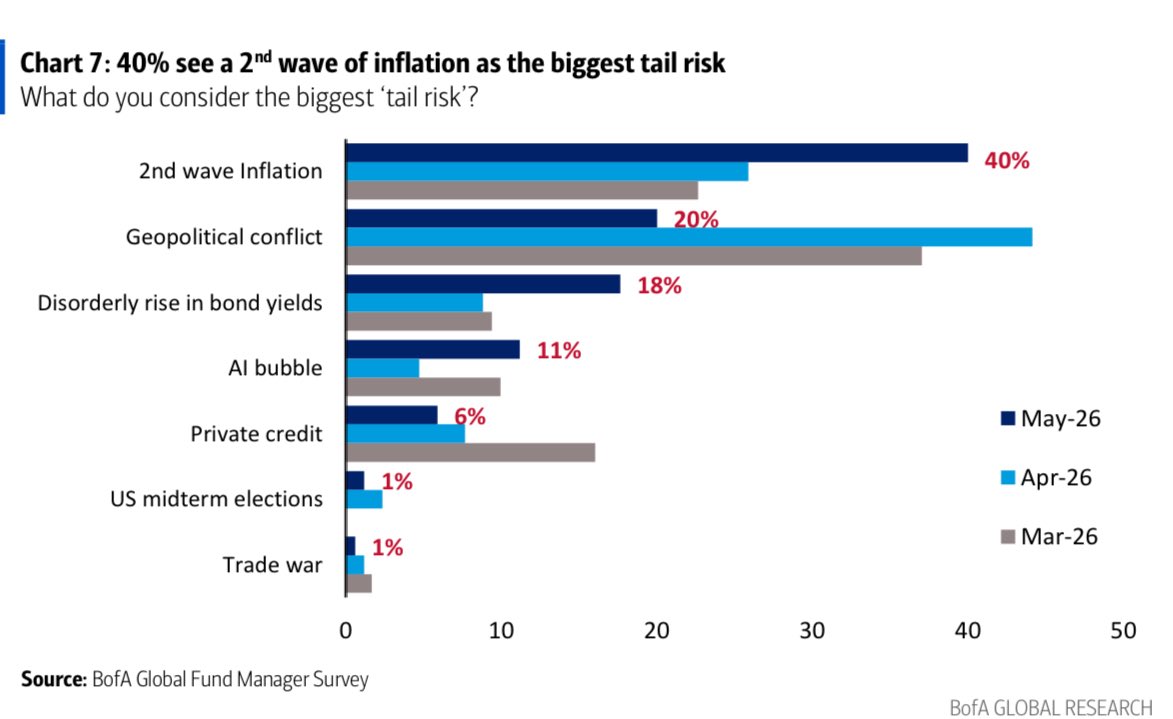
Two takeaways from May’s BofA fund manager survey: first, equity allocations surged by a record amount on the month, and second, 40% of respondents see a second wave of inflation as the biggest tail risk. The two ideas are connected: stocks are increasingly seen as an inflation hedge
Lisa Abramowicz tweet mediaLisa Abramowicz tweet media
English
35
105
443
218.5K
Chris Tipper | 📈 ₿ 🥇🥈
The mechanism people underestimate is the speed of it. Once the SPR can't backstop and refiners start sourcing from non-USD energy corridors, the marginal seller of USTs isn't a strategic decision anymore, it's a forced one. Foreign official holdings have been net flat for three years already. The shift from accumulation to active liquidation is the regime change. The Treasury market is the bottleneck for everything downstream.
English
0
0
0
99
Luke Gromen
Luke Gromen@LukeGromen·
@PauloMacro Once we hit tank bottoms, then the world gets to REALLY selling USTs to source oil from other sources
English
25
35
443
20.1K
Chris Tipper | 📈 ₿ 🥇🥈
Agree on direction, the timing question is what the Treasury market forces on them. The 2-year above 4% with $38T+ in debt is the kind of condition that historically resolves through a financial accident rather than a measured pivot. Bessent's options are narrowing. Yield curve control in some form is closer than the market is pricing, and gold is already trading like it knows.
English
1
1
0
248
Otavio (Tavi) Costa
Otavio (Tavi) Costa@TaviCosta·
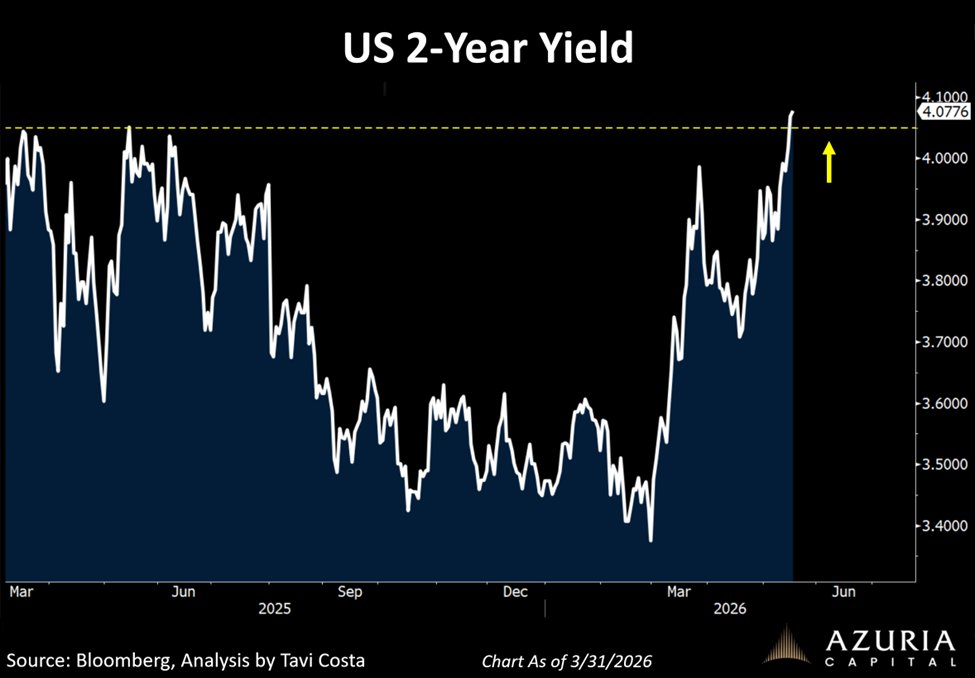
Nothing good happens when 2-year yields move above 4% with debt levels this high. Unpopular view: The Fed is probably closer to easing than tightening with the way the Treasury market has been behaving recently. tavicosta.substack.com/p/macro-update…
Otavio (Tavi) Costa tweet media
English
53
98
801
38.7K
Chris Tipper | 📈 ₿ 🥇🥈
The 47 billion is the headline, but the second-order effect is the floor it puts under USD/JPY volatility. Every defensive sale tightens the feedback loop between Japan's domestic policy and US Treasury supply. The MOF has now spent more in three months than the entire 2022 intervention campaign and gotten less for it. That marginal return on intervention is the leading indicator everyone should be watching.
English
0
0
12
1.8K
Gold Telegraph ⚡
Gold Telegraph ⚡@GoldTelegraph_·
Japan spent $63 billion in May defending the yen. Japan, the single largest foreign holder of U.S. government debt, sold $47 billion of U.S. Treasurys. Nothing to see here…
English
35
199
1.3K
90.1K
Chris Tipper | 📈 ₿ 🥇🥈
War in the background. Bitcoin looking like it could break out. Liquidity giving mixed signals. Met with @Packin_Sats and @IsaacCryptoTube for May's Bitcoin Analysis Beyond the Block. Joe on the macro and committee thesis, Isaac on the order flow and technicals. Nominal liquidity is going up and to the right. Momentum and rate of change is the part most people aren't reading correctly. The underlying drivers that pushed liquidity up over the last couple of months are unlikely to keep doing so at the same rate. S&P and Nasdaq at all-time highs. Bitcoin lagging on volatility-adjusted terms. Sentiment running hot at what we think is a shaky base.
English
7
11
21
990
Chris Tipper | 📈 ₿ 🥇🥈
Same observation, 10 years running. The clients who get through the tough periods are the ones who listened. Took the advice. Actioned it. Good structure, clean financial reporting, forward planning. Those businesses come out of any environment on top. They see margin pressure before it becomes a problem. They protect GP because they're watching it. Resilience isn't a personality trait. It's a structure that lets you act on what the numbers are telling you.
English
0
1
0
175