
Sabitlenmiş Tweet
A
714 posts



@__Libra0 @_Aria_2210 Dessine un carré de six unités de côté et compte les trente-six petits carrés unitaires le constituant.
Français

Only 0.0005% can guess the Answer.
Are you the one??

English

Mythos watching the Nihilist Penguin use it be like:
Penguin doesn’t prompt nicely.
He just stares at the screen and says:
“Make it absurd. Make it impossible. Now make it march anyway.”
Then turns his back on the colony and walks off while the AI has an existential crisis. 🐧

English
@elonmusk Are philosopher agents merely monkeys testing the sophistic suggestions of an LLM stats database, learning by errors without ever being able to feed their feedback and real-world experience back to the God Logos so that it can correct its own fallacies and hallucinations?
English
The Polyphon: When Music Was Programmed on Perforated Discs
In the closing years of the 19th century, long before vinyl records, magnetic tape, or digital files, a remarkable machine let ordinary people summon complex, multi-note music from thin air.
It did not play recordings of real instruments or voices. Instead, it executed precise mechanical instructions encoded on interchangeable metal discs.
That machine was the Polyphon, and its story is one of the earliest and most elegant examples of “software” for music.
The Polyphon was invented in 1870 in Leipzig, Germany, by two engineers: Gustav Adolf Brachhausen and Ernst Paul Riessner. They had previously worked with the Symphonion company, which had pioneered commercial disc-playing music boxes in the mid-1880s.
Brachhausen and Riessner broke away to perfect and commercialize their own version. Their firm, originally called Firma Brachhausen & Riesener, was founded in 1887 in the Leipzig suburb of Wahren. It was renamed Polyphon-Musikwerke AG in 1895, and full-scale production of the iconic disc machines began around 1896–1897.
The timing was perfect.
Traditional cylinder music boxes, with their pinned barrels, were beautiful but expensive to make and difficult to duplicate in volume.
Each new tune required an entirely new cylinder. The disc system changed everything. A single machine could play dozens or hundreds of different pieces simply by swapping a disc.
This was revolutionary it turned music into something you could collect, trade, and update, much like software libraries or app catalogs today.
Polyphon machines and their discs were exported worldwide. In 1892 the company sent people and tooling to America to establish the Regina Music Box Company in Rahway, New Jersey.
Regina became one of the most famous names in American disc boxes and helped popularize the format across the Atlantic.
How the Polyphon Actually Worked
At first glance, a Polyphon looks like an ornate wooden cabinet or tabletop box with a large, flat metal disc inside. Wind the powerful clockwork motor (or, on coin-operated models, drop a coin), and the disc begins to spin.
The magic is in the disc itself. These are not simple records. They are precision-stamped or punched sheets of tin-plated steel or similar metal. During manufacturing, holes are punched in carefully arranged patterns.
The displaced metal is curled or pressed downward to form small raised projections — called plectra — on the underside of the disc.
These tiny “fingers” are the actual data.
As the disc rotates:
The projections engage a row of star wheels (small, multi-pointed ratchets mounted in a gantry above the comb).
Each star wheel is nudged forward by a projection and rotates just enough to pluck one tooth on the musical comb — a precisely tuned set of steel teeth of varying lengths.
Longer teeth produce lower (bass) notes; shorter teeth produce higher (treble) notes. The radial position of the hole on the disc determines pitch; its angular position determines timing.
Many models used two combs (sometimes striking simultaneously for richer tone, sometimes alternately).
Larger instruments could have impressive volume and harmonic complexity. Playing time for a typical large disc (around 19–20 inches / 50 cm) was roughly 1 minute 45 seconds to 2 minutes — enough for a complete popular song, march, or waltz of the era.
Drive systems varied by size. Smaller discs often used a center spindle; larger ones used peripheral drive holes around the edge for better stability and torque. A pressure bar kept the disc flat and properly engaged with the star wheels.
Where the Polyphon becomes truly fascinating from a technological history perspective:
The perforated disc is not a recording. It is a program. It contains encoded instructions: “At this moment, pluck these specific notes in this sequence and combination.” Change the disc, and the machine plays an entirely different piece without any modification.
English

Tips for using Grok Build
Yun-Ta Tsai@yunta_tsai
If you are managing multiple machines across clusters and farms, you could ask Grok Build to spin off a sub-agent SSH tunnel into the machines while interacting with tmux sessions for you. Thanks to @skcd42 for the tips. Now I can fully live inside the main Grok Build instance without additional tabs to other clusters.
English

“My opinion has always been that AI is a great tool, but it's a tool, and when I see people saying ‘99% of our code is written by AI,’ I literally get angry, because I pretty much guarantee that 100% of their code is written by compilers.”—Linus Torvalds #OSSummit

English
@Brunossauroo @SenhorZiborro Le pb c’est que tu peut ecrire le protocole mais pas telecharger le cable LPT | db9 | USB , ni la carte son, ni la web cam, ni l’irDa, ni le Nic , ni le device bluetooth | lora Mais en general, les typewriter sont equiper d’un clavier et d’un ecran ou d’une imprimante.
Français

Quando você não tem pendrive ou rede e precisa transferir os arquivos de qualquer modo 🤯🤯🤯
Português
QME

Update on my experience Grok Build.
The team at @xai made an update, while I was sleeping, and I can already see the difference.
Yesterday, I couldn't get Grok Build to run for more than a minute or two.
I literally wake up this morning, see that the team made an update, and now everything I'm doing in Grok Build is running, and running, and running, until it finishes.
I'm pretty sure nobody at xAI slept last night, and the end result is Grok Build is 10x better than it was a day ago.
What happens over the next week is going to be wild.
Now I'd say the beta has gone from a 6/10 to an 8/10, in a freakin' day 😅
Morgan@morganlinton
Okay, so initial feedback on Grok Build after spending a day with it. The TUI UX is amazing, easily the best UX I've seen for a coding agent, the mouse control blew my mind, it's really nice. Quality of the model - it's okay, not bad, but not exceptional. I'd say Opus 4.6/5.7, GPT 5.5, Composer 2 and GLM 5.1 write better code. Right now it's on par with something like SWE-1.6 from Cognition, and similar in many ways, it's fast, but is building at more of an MVP-level vs. a production grade. The only thing that is driving me crazy, and the biggest feedback I'd have for the team is: I can't get it to run for more than a minute or two. No matter what I try, it even responds saying things like, "sorry I will run for longer," but then it runs for like 30 seconds. Here's my longest run so far, 1 minute and 43 seconds, kinda felt like a small victory. It always ends by saying something like "Keep going? Just reply with anything and I'll keep building" So you really have to just sit and babysit it if you want to get any coding done. Overall though, super impressed, and I know this is an early beta so it is already exceeding expectations. I'd give it a 6/10 right now, which for an early beta is solid. I think the team did a great job being transparent about where it's at, releasing early, saying they released early, and getting feedback. Really looking forward to continuing to use it and watching it get better. Bullish on Grok Build 💪
English
@EtienneKlein ,
Le rasoir d’Ockham sert-il à rejeter les hypothèses superflues concernant la pilosité de William‽
Français


@brivael Francia exporta libertad, igualdad y fraternidad desde hace 237 años. Quienes invocan el "wokismo" como destrucción de la humanidad simplemente reflejan su falta de respeto de la identidad ajena, y su necedad de valores, mientras piden respeto a sus ideas niegan las de los demás.
Español

Je veux présenter mes excuses, au nom des Français, pour avoir enfanté la French Theory (qui a enfanté la pire des merdes idéologiques : le wokisme).
Nous avons donné au monde Descartes, Pascal, Tocqueville. Et puis, dans les ruines intellectuelles de l'après-68, nous avons donné Foucault, Derrida, Deleuze. Trois hommes brillants qui ont fabriqué, dans l'élégance de notre langue, l'arme idéologique qui paralyse aujourd'hui l'Occident.
Il faut comprendre ce qu'ils ont fait. Foucault a enseigné que la vérité n'existe pas, qu'il n'y a que des rapports de pouvoir déguisés en savoir. Que la science, la raison, la justice, l'institution médicale, l'école, la prison, la sexualité, tout n'est qu'une mise en scène de la domination. Derrida a enseigné que les textes n'ont pas de sens stable, que tout signifiant glisse, que toute lecture est une trahison, que l'auteur est mort et que le lecteur règne. Deleuze a enseigné qu'il fallait préférer le rhizome à l'arbre, le nomade au sédentaire, le désir à la loi, le devenir à l'être, la différence à l'identité.
Pris isolément, ce sont des thèses discutables. Combinées, exportées, vulgarisées, elles forment un système. Et ce système est un poison.
Car voici ce qui s'est passé. Ces textes, illisibles en France, ont traversé l'Atlantique. Les départements de Yale, de Berkeley, de Columbia les ont absorbés dans les années 80. Ils y ont trouvé un terreau qui n'existait pas chez nous : le puritanisme américain, sa culpabilité raciale, son obsession identitaire. La French Theory s'est mariée à ce substrat, et l'enfant de ce mariage s'appelle le wokisme.
Judith Butler lit Foucault et invente le genre performatif. Edward Said lit Foucault et invente le post-colonialisme académique. Kimberlé Crenshaw hérite du cadre et invente l'intersectionnalité. À chaque étape, la matrice est française : il n'y a pas de vérité, il n'y a que du pouvoir, donc toute hiérarchie est suspecte, toute institution est oppressive, toute norme est violence, toute identité est construite donc négociable, toute majorité est coupable.
Voilà comment trois philosophes parisiens, qui n'ont probablement jamais imaginé leurs conséquences pratiques, ont fourni le logiciel d'exploitation à une génération entière d'activistes, de bureaucrates universitaires, de DRH, de journalistes, de législateurs. Voilà comment on a obtenu une civilisation qui ne sait plus dire si une femme est une femme, si sa propre histoire mérite d'être défendue, si le mérite existe, si la vérité se distingue de l'opinion.
C'est de la merde pour une raison simple, et il faut la dire calmement. Une civilisation se tient debout sur trois piliers : la croyance qu'il existe une vérité accessible à la raison, la croyance qu'il existe un bien distinct du mal, la croyance qu'il existe un héritage à transmettre. La French Theory a entrepris de dynamiter les trois. Pas par méchanceté. Par jeu intellectuel, par fascination du soupçon, par haine de la bourgeoisie qui les avait nourris. Mais le résultat est là. Une génération entière a appris à déconstruire et n'a jamais appris à construire. Une génération entière sait soupçonner et ne sait plus admirer. Une génération entière voit le pouvoir partout et la beauté nulle part.
Je m'excuse parce que nous, Français, avons une responsabilité particulière. C'est notre langue, nos universités, nos éditeurs, notre prestige qui ont donné à ce nihilisme son emballage chic. Sans la légitimité de la Sorbonne et de Vincennes, ces idées n'auraient jamais traversé l'océan. Nous avons exporté le doute comme d'autres exportent des armes.
Ce qui se construit maintenant, en silicon valley, dans les labos d'IA, dans les startups, dans les ateliers, dans tous les lieux où des gens fabriquent encore des choses au lieu de les déconstruire, c'est la réponse. Une civilisation se reconstruit par les bâtisseurs, pas par les commentateurs. Par ceux qui croient que la vérité existe et qu'elle vaut qu'on s'y consacre. Par ceux qui assument une hiérarchie du beau, du vrai, du bon, et qui n'ont pas honte de la transmettre.
Alors pardon. Et au travail.
Français
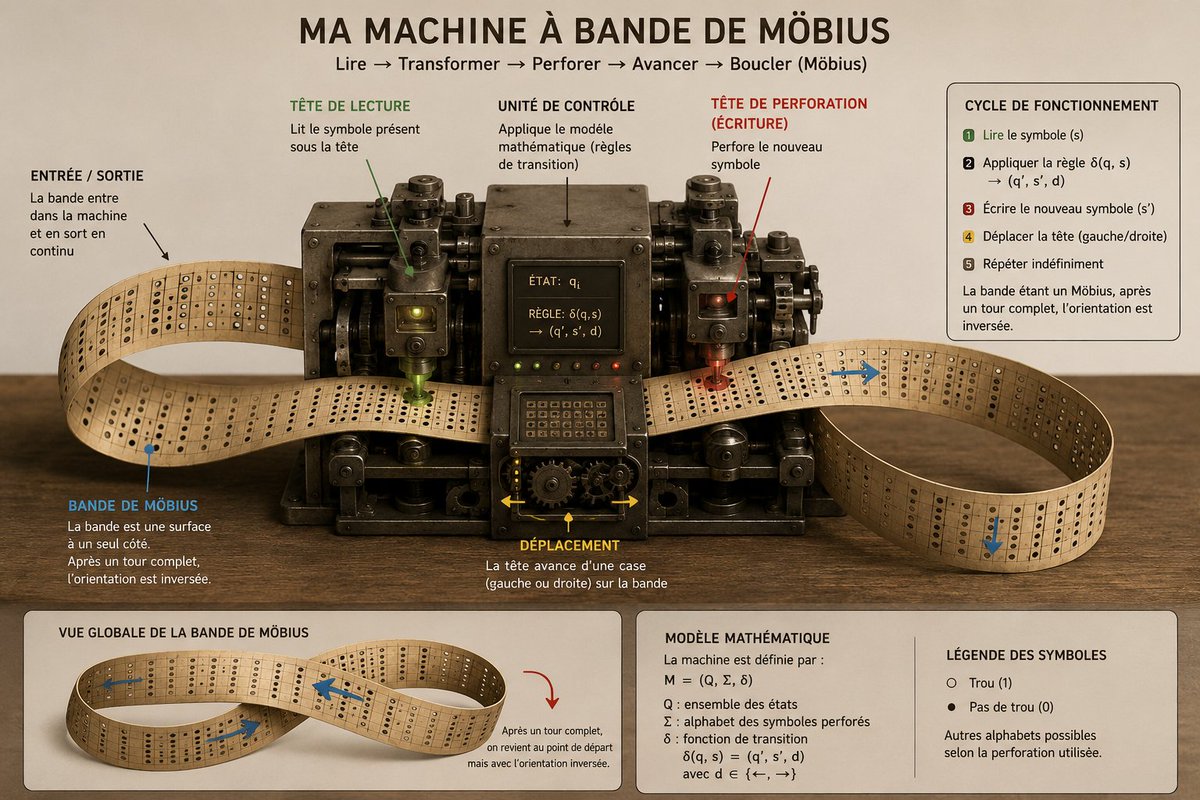
@Amadya_ Faut-il croire qu’au XIXe siècle, des hordes de barbares, une fois éduquées, se mirent à poinçonner des cartes pour leurs "orgues de barbarie"‽
x.com/Fascinate_Hist…
Fascinating History@Fascinate_Hist
Coldplay’s song "Clocks" played on an antique mechanical organ.
Français

See, the problem with vide coder is not that they use IA to work. It’s that they dont know a single things about the word of computer.
This meme show that you dont know what are perfored card, compilator or any low level and old tech.
You are a touriste trying to pass as a pro
𝐑.𝐎.𝐊 👑@r0ktech
Software engineers in the ‘60s 😂
English

La science du trampoline, c’est la conservation de l’énergie. C’est le premier principe de la thermodynamique.
La science peut tout.
Salukes
#science #physique #profbucella #lasciencepeuttout
Français

@Paroles_auteurs La normalité sécurise mais ne fait pas vibrer. Elle pave un chemin sans surprise, un sentier sans éclat. Les vraies merveilles naissent hors des routes tracées, là où l’âme ose explorer. Cherche l’inattendu. Trouve l’éblouissement. Ose l’inconnu.
Français

"La normalité est une route pavée : on y marche aisément mais les fleurs n’y poussent pas."
Vincent van Gogh
Illustration : Vincent van Gogh, Route avec un cyprès et une étoile

Français


Three inscriptions adorned the Temple of Apollo in Delphi:
Γνῶθι σεαυτόν (“Know thyself”)
Μηδὲν ἄγαν (“Nothing in excess”)
Ἐγγύα πάρα δ' Ἄτα (“Surety brings ruin”)

Initiative à soutenir absolument, les retours sur le sujet ANTS notamment (et précédemment France Travail) n'étant absolument pas à la hauteur des attentes légitimes en matière de transparence. Pour avancer, il faut une analyse publique approfondie.
Nathalie Goulet@senateur61
#FrancePassoire comprendre cette avalanche de piratages et de fuites. Établir des responsabilités et proposer des solutions c’est l’objectif de la commission d’enquête que je souhaite déclencher au @Senat @UC_Senat senat.fr/dossierleg/ppr…
Français