
Tom Penrose
3.5K posts

Tom Penrose
@TomPenrose
Head of Operations at Multiplayer Wizards. We help game developers launch their games. Ex @unity @Multiplay @IGfestuk, cyclist and keen climber.
Southampton, England Katılım Ekim 2008
352 Takip Edilen411 Takipçiler
@KeloniaGames This looks fantastic. How can I follow for updates? :)
English

👀 Prototyping a game where you play as an Egyptian silhouette carved into ancient temple walls !!
#indiegame #indiedev #gamedev #IndieGameDev
English


Soooooo..... With things all signed and complete, ready to go on the 2nd of December...
I'm super happy to announce that I'll be joining Activision Blizzard as part of the Central Tech Team, helping with the release of games + updates to the various titles they publish.

English
Hmmm - Sneaky. Might want to turn this off if you are concerned about AI and your data on X. forbes.com/sites/johnkoet…
English

Tom Penrose retweetledi

What happens if your CPU gets something wrong? If it wakes up one day and decides 2+2=5?
Well, most of us will never have to worry about that. But if you work at a company the size of Google, you do, which is why this paper on "mercurial cores" is so fascinating.
What the authors report--and supposedly this is common knowledge at the hyperscalers--is that a couple cores per several thousand machines are "mercurial." Due to subtle manufacturing defects or old age, they give wrong answers for certain instructions. These can cause all sorts of impossible-to-diagnose issues. Some rare problems at Google that were traced back to bad CPUs include:
- Mutexes not working, causing application crashes
- Silent data corruption
- Garbage collectors targeting live memory, causing application crashes
- Kernel state corruption causing kernel panics
What makes CPUs go bad? It's very hard to tell. The authors posit that issues are becoming more frequent as CPUs get more complex, but there aren't solid numbers behind that. There are certainly strong relationships between frequency, temperature, voltage, and bad CPU behavior--most mercurial CPUs only cause problems under very specific conditions, but those conditions vary from CPU to CPU. Age is another source of problems, as older CPUs are more likely to exhibit problems.
Bad CPUs are an especially serious problem because they're very hard to detect. If cosmic rays flip bits in storage or on the network, that can be detected through error coding. But there's no analogy for a CPU that allows cheap online verification of its correctness. Instead, the best detection techniques involve monitoring for symptoms. If a core exhibits exceptionally high rates of process crashes or kernel panics relative to its fellows, that's a strong indication something is wrong with it. For the most critical applications, the authors propose triple modular redundancy--redoing each of its computations on three cores and majority-voting a reliable result.
More than anything, this paper is a call to action--letting everyone know that CPUs can fail. So now, if you ever find a bug you can't diagnose, you can blame the CPU! 🙂

English
After some advice - is there an open source project out there that turns a raspberry pie into a mini monitoring node? I want something quick and easy to just plonk on a family members network to see if they are maxing out their line / get some stats
English
@pumplekin @ObsoleteSony That sounds ripe for a Twitter threaded story!
English

@ObsoleteSony This thread has reminded me of when I used a bunch of Sega Dreamcasts to build a webserver farm.
English
Today I’m playing Uncharted 4, a PS4 game, on an Xbox controller, on my TV, remotely connected to my PC. Tech is wild, but awesome 😂
English
If you want to see how much you’ve grown as a person, just look back at Facebook statuses from 15 years ago - wooooow.
English
Awesome explanation of the XZ attack
Thomas Roccia 🤘@fr0gger_
🤯 The level of sophistication of the XZ attack is very impressive! I tried to make sense of the analysis in a single page (which was quite complicated)! I hope it helps to make sense of the information out there. Please treat the information "as is" while the analysis progresses! 🧐 #infosec #xz
English
Slack playing nice music when you are waiting for someone in a huddle was both terrifying and amazing at the same time
English
Just got asked if I can get some more ram in a machine as a script has an out of memory error.
Exception: Cannot allocate 554 TiB for array.
I don't think I can do this one ...
English
Fun to do a podcast with @GameDevLondon! gamedev.london/podcast/episod…
English
Tom Penrose retweetledi

30 years ago #Today, iD Software released the game DOOM, now considered one of the most influential titles in video game history, popularizing the first-person shooter genre with its “deathmatch” multi-player mode.
twitter.com/ArtPixelGames/…
English
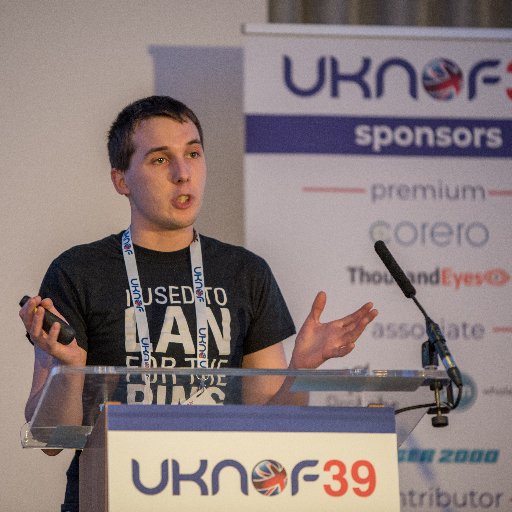
I treated myself to a new T-shirt. To anyone who gets the reference, you're old too ;)

English
@cshwkuk It’s amazing. The community have done an incredible job!
English

Standard day at Multiplayer Wizards. Making games work on train WiFi. Today, it was a LAN session of OpenRA!

English