Sabitlenmiş Tweet

solana airdrop giveaway... retweet this and join t.me/tondancecom to receive cash links
English
Tondance.com
14 posts

@TonDance2
join our contests! new type of social network https://t.co/yRVsBOU9eR

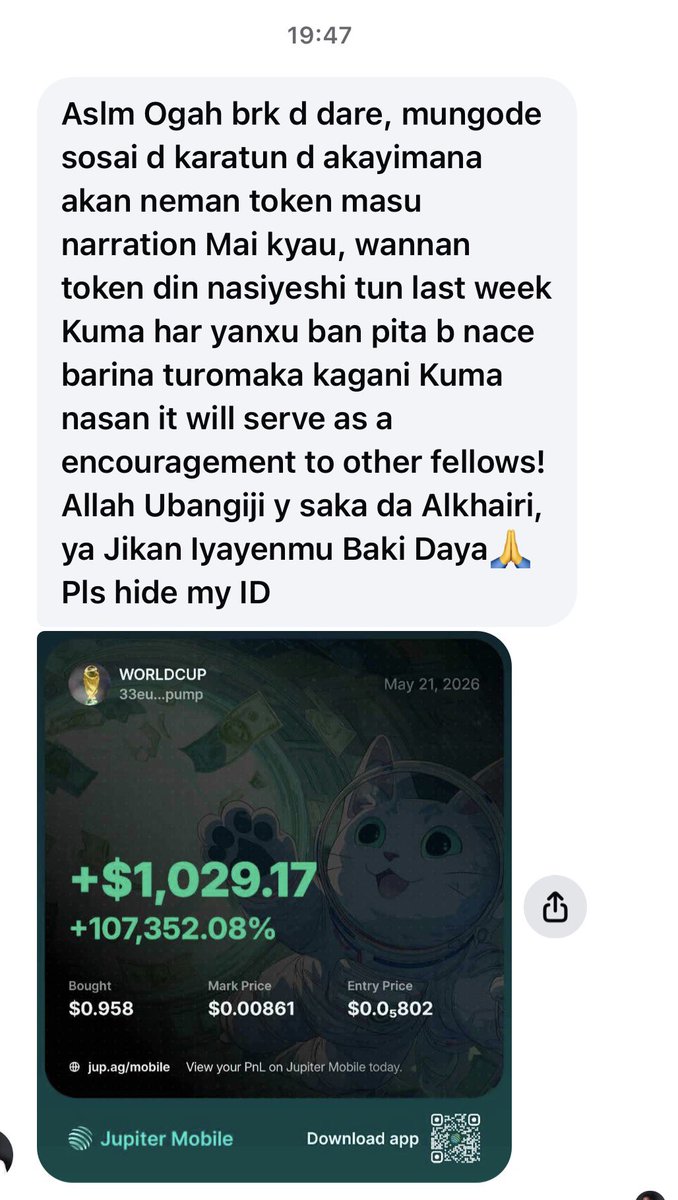

Every year, I want to celebrate my Birthday in a different way. This year, I’ll be celebrating it with a new token. $BIRTHDAY is now live @flipcash Token Link : app.flipcash.com/token/BAsZYiZ7… You can send it to a friend, split bills or give it to someone as a birthday gift. It also doesn’t have to be your birthday for you to get some, you can also get it as a surprise present 🎁 . Want a birthday wish? We’re sending out cash links. Just say “Happy Birthday” 🎂

Due to the market rally, smart trader pension-usdt.eth is now down over $15.5M on his 1,000 $BTC($77.5M) and 20,000 $ETH($48.7M) shorts. His total profit has dropped from $33.28M to $14.98M. He once had 20 wins in a row with a win rate above 85%. #perps" target="_blank" rel="nofollow noopener">hypurrscan.io/address/0x0ddf…
“If Flipcash works, the impact could be profound. Not because it creates another payment app. Because it changes the unit around which economic life can organize. Today, most communities are socially real but economically weak. A campus exists. A town exists. A creator community exists. A diaspora exists. A group of friends exists. But economically, they all dissolve into the same distant money. Their attention, labor, loyalty, trust, and trade flow outward into systems they do not shape. Flipcash, if it works, gives those communities an economic center of gravity. A currency becomes more than a payment instrument. It becomes a shared vessel. People do not just transact through it. They build value into it. Every new participant, every payment, every merchant, every act of acceptance adds to something held in common by the people using it. That is the big shift. Instead of value being extracted from communities, value can accumulate inside them. A neighborhood could have more than local pride. It could have local upside. A campus could have more than school spirit. It could have a shared economy. A creator’s audience could become less like followers and more like participants. A city district, a sports club, a religious community, a music scene, a mutual aid network, a diaspora, a group of small businesses — each could have a currency that reflects its own relationships, its own activity, its own growth. And because these currencies remain exchangeable, communities do not have to become isolated to become economically distinct. That is the important part. Historically, local money meant local friction. To have your own currency was to be harder to trade with. So the world converged on larger and larger monetary centers. Coordination improved, but something was lost. Money became more efficient, but less intimate. More scalable, but less rooted. If this works, that tradeoff weakens. Communities can have their own currencies without being cut off from one another. The world could become more plural without becoming more fragmented. That is a beautiful idea. It means money could become local again, without becoming small. It means economic identity could become more personal without becoming parochial. It means a community could begin with five people paying each other back, and over time become a small economy with its own rhythm, its own loyalty, its own stored value. The deepest impact is not that people might make money. It is that communities might become worth building again. Because if the people who build the community also share in the value created by the community, then participation itself becomes meaningful in a new way. Inviting someone in is not just growth for a platform. It is growth for the people already there. Accepting the currency is not just accepting payment. It is joining the network. Spending it is not just transferring value. It is helping the currency circulate. The economy becomes less anonymous. Money begins to remember where it came from. A dollar is generic. It carries no story. It belongs nowhere. It passes through a community and leaves no trace. But a community currency says: this value came from us. It moves among us. It grows as we grow. That could change behavior. People might choose the local café not only because they like it, but because it strengthens the currency they hold. Merchants might accept a community currency not only because they can redeem it, but because holding some of it aligns them with the people they serve. Creators might stop treating audiences as attention pools and start treating them as economies. It could give communities a way to coordinate capital, trust, and belief at human scale. …

.@flipcash just built a system where anybody can create their own currency. Imagine your friend group, your neighborhood or even your local community, having their own actual money. Not points, not a loyalty scheme. Real exchangeable currency backed by real dollars. The moment a currency is created, it is ready to be used. No waiting, no convincing anyone to join first. Someone builds it and it's ready immediately. That alone solves one of the biggest problems new currencies have ever faced. It starts calm and stable. A small group can use it to pay each other back, split expenses, settle debts, and it barely moves in value. It has to be useful before it can be anything else. But as more people start using it, something interesting happens. The value begins to grow, not because of hype or speculation, but because more people are genuinely participating. Everyone who joined early benefits as the community expands. The simplest starting point is something everyone already does, paying friends back. A meal, a movie ticket, a shared expense. With this idea in mind, I have launched $VOYAGER Life itself is a Voyage, you meet new people, you learn new skills and you build new things. Holders and community members are all part of this new voyage, question is, are you? Fortune favors the Voyagers. Currency link : app.flipcash.com/token/3NJX8VPi… Telegram : t.me/voyagerscommun…