
Sabitlenmiş Tweet
We are surgeons and we operate beyond our knives and operating rooms.
Underneath our incisions is a world that we must be part of
#racism #gunviolence are public health issues
#ThisIsOurLane
English
Bellal Joseph
15.1K posts

@TopKniFe_B
Trauma Surgeon part 🦄 and sometimes a researcher free spirit with a wild heart 🦁 🦅

🫀The failing right ventricle: the most misunderstood chamber in critical care For years, we focused on the left ventricle. But in the ICU, the real killer is often the right ventricle. ->What is acute RV failure? 👉 Not just “weak contraction” It’s a hemodynamic collapse syndrome: RV dilation ↓ LV preload ↓ cardiac output ↑ venous congestion ➡️ → multi-organ failure ->The key pathophysiology (the vicious cycle) 1. ↑ Afterload (PE, ARDS, PH) 2. → RV dilation 3. → Septal shift → LV underfilling 4. → ↓ CO → hypotension 5. → ↓ RCA perfusion 6. → RV ischemia 👉 And the cycle accelerates ->The most important concept 👉 The RV does NOT tolerate pressure Handles preload very well Fails rapidly with afterload ➡️ Even small ↑ PVR → collapse ->Main causes you MUST think first 🔴 Pulmonary embolism 🔴 RV myocardial infarction 🔴 ARDS / mechanical ventilation 🔴 Decompensated pulmonary hypertension 🔴 Post-cardiac surgery ->Diagnosis is NOT obvious There is no single sign. 👉 It requires suspicion + integration: Clinical: congestion + hypoperfusion ECG + biomarkers POCUS (your best friend 🤓) Hemodynamics ->Echo mindset (fast ICU approach) 👉 Don’t overcomplicate Look for: ✔ RV dilation ✔ Septal shift (D-sign) ✔ TAPSE ↓ ✔ Venous congestion The real ICU mistake ❌ Treating RV failure like LV failure ->Management principles 👉 Think in 4 pillars: 1. Preload — “not too much, not too little” Hypovolemic → small fluid Congested → REMOVE fluid 👉 CVP is not a target, it’s a warning 2. Afterload, THE key target ✔ Treat PE ✔ Optimize ventilation ✔ Reduce PVR 👉 If afterload stays high → RV will fail 3. Contractility Dobutamine Milrinone Levosimendan 👉 Choose based on context 4. Perfusion pressure 👉 Norepinephrine is your anchor ✔ Maintains coronary perfusion ✔ Supports RV function ->Ventilation: the silent killer ⚠️ Positive pressure = ↑ PVR 👉 Over-ventilate → worsen RV failure ->When nothing works 👉 Think early: VA-ECMO RV assist devices 🤓Key insight This is NOT just a cardiac problem. 👉 It is a ventriculo–arterial coupling failure When: Ees / Ea ↓ → RV collapses 🤓Bottom line ✔ RV failure is preload dependent BUT afterload sensitive ✔ Small mistakes → rapid collapse ✔ Early recognition + physiology-based treatment saves lives ->Clinical mindset 👉 Don’t ask: “Is the RV failing?” 👉 Ask: “Why is the RV failing and, what is driving the afterload?” 📃Reference Giannakoulas G. et al. European Heart Journal (2025) 00, 1–16 doi.org/10.1093/eurhea…
The PROMINE trial, an open-label RCT comparing ketamine versus propofol for patients undergoing emergency intubation in the ICU, they found: -Minimal difference in the lowest MAP value of 66 versus 60, mean difference, 6.0 [95% CI − 0.0 to 11.9]; p = 0.050 -Less vasopressor use, 22% versus 33%, 0.56 (0.28 to 1.10) -A potential signal of worse mortality with ketamine, 60% versus 50%, p=0.17, OR 1.21; 95% CI 0.92–1.58) This potential mortality signal is quite interesting. PMID: 41870554 pubmed.ncbi.nlm.nih.gov/41870554/ #emergencymedicine #criticalcare #science #data #research
Sarcopenic obesity in older adults: a clinical overview nature.com/articles/s4157…
🫀Pulmonary artery catheter: dead… or misunderstood?🤔 For years, we were told: ❌ “No mortality benefit” ❌ “Too invasive” ❌ “Old technology” But in cardiogenic shock… the story is changing. ->New meta-analysis. ~790,000 patients. 👉 The signal is clear: ↓ Mortality (OR 0.70) ↓ Hazard of death by 32% ↑ Use of MCS (OR 2.76) ⚠️ ↑ Sepsis risk (OR 1.83) ->So what’s really happening? This is NOT about the catheter. 👉 It’s about what you do with the data. ->PAC as a “therapeutic enabler” PAC doesn’t treat patients. 👉 It enables: Phenotype-driven shock classification Precise preload / afterload optimization Early identification of RV failure Timely escalation to MCS 👉 In other words: It transforms guesswork into strategy ->Why previous trials failed PACMAN. ESCAPE. They showed no benefit. But the problem wasn’t the catheter… 👉 It was the absence of: Structured protocols Shock teams Clear hemodynamic targets ->Modern cardiogenic shock is different Today we have: Shock teams SCAI staging Protocol-driven escalation Advanced MCS (Impella, ECMO) 👉 In this context, PAC becomes powerful. ->The trade-off Let’s be honest: ⚠️ Increased infection risk OR ~1.8 for sepsis So: 👉 Use it selectively 👉 Use it early 👉 Remove it as soon as possible ->Key takeaway PAC is not obsolete. 👉 It was misused. And now, in the right hands: It may be one of the most important tools in cardiogenic shock. 📃Reference Ortega-Hernández JA et al. Pulmonary artery catheter monitoring in cardiogenic shock: systematic review and meta-analysis. Shock 65(4):p 648-659, April 2026. | DOI: 10.1097/SHK.0000000000002784 esc365.escardio.org/presentation/3…


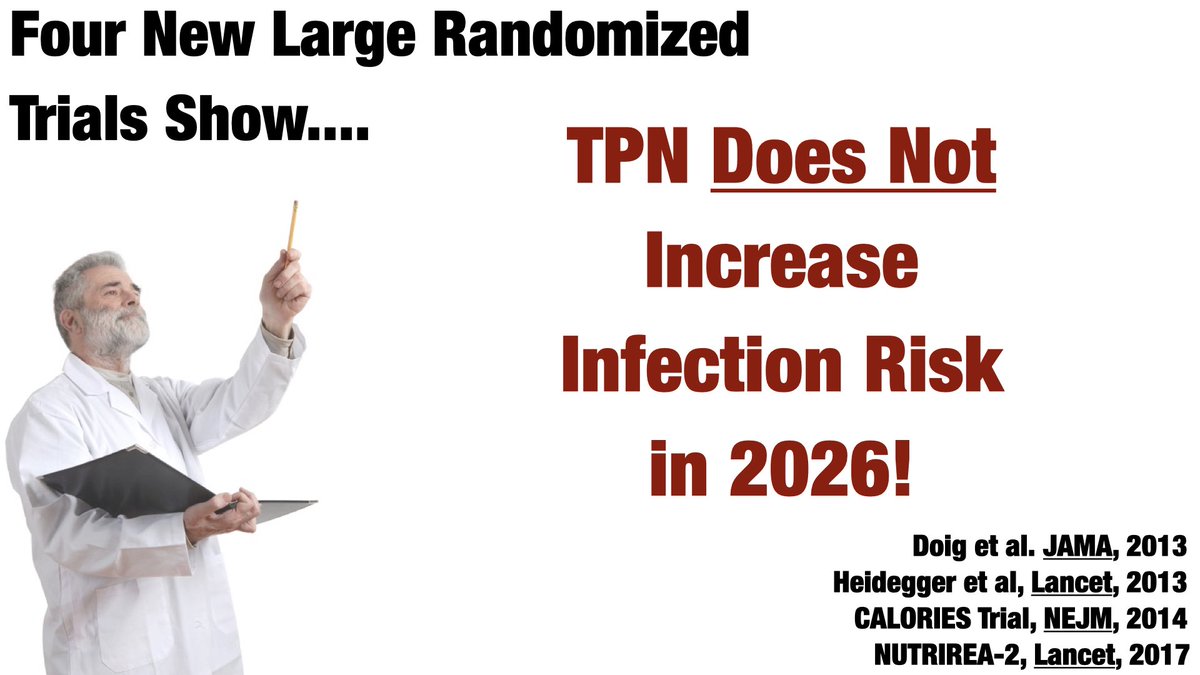
The results of the PRONTO RCT of procalcitonin in people with suspected sepsis are absolutely fascinating. Mortality was significantly lower in the procalcitonin-guided care group: 13.6% (372/2738) vs 16.6% (450/2715) (p=0.0009) but there was no difference in antibiotic initiation, narrowing, or days of therapy! So apparently procalcitonin saves lives even if it doesn’t change antibiotic prescribing? 🤔 1/


IO access is an excellent way of establishing vascular access in urgent cases (trauma, burn, shock, resuscitation) when intravenous access fails or would take too long. See the technique for proximal tibia and humerus. #orthopaedics #trauma #IOneedle #orthotwitter #orthoX #meded
In adults with uncomplicated #appendicitis, 44% treated with antibiotics required appendectomy within 10 years, but complication rates were lower and quality of life similar to surgery. ja.ma/3NU446Z


Sunset on the #FellowshipofTheSun 🌞🌵 2 more matches closing with 100% and congrats to these two. @malmaaniMD @fcastillodiaz99 this is your dream we’re just witnessing! We matched 30 into USA residency. 28 in surgery. Every ending sets the next beginning. Every sunset… a new sunrise. Fellowship of the 🍑 😉 #Match2026