TradeFox

1.4K posts

TradeFox banner
TradeFox

TradeFox

@tradefoxai

Prediction market aggregator and prime brokerage. Backed by @alliance and @CMT_Digital.

New York Katılım Şubat 2025
10 Takip Edilen10K Takipçiler
Sabitlenmiş Tweet
TradeFox
TradeFox@tradefoxai·
We’ve added 100s of new smart money wallets, categorized by strategy and edge: - Trading bots - Bonding Soon Whales - High Win Rate Wizards - Hyped High Volume Market Makers - Manual Movers - Wall Street Wizards, - Insiders, Sports, Politics, Weather, etc Copy trade any of them in one click.
English
12
17
55
37.9K
TradeFox
TradeFox@tradefoxai·
Great Breakdown of the SpaceX IPO
Yoshi@tradefoxintern

What does the market think a SpaceX IPO is worth? Right now, markets are pricing a blockbuster listing, but not a clean path to a $2T+ close On Polymarket: - >$1T: 93% - >$1.2T: 91% - >$1.4T: 88% - >$1.6T: 75% - >$1.8T: 60% - >$2T: 44% - >$2.2T: 31% - >$2.4T: 25% - >$3T: 14% That curve matters The market is basically saying: - A trillion-dollar close looks highly likely - $1.5T-$1.8T is the real battleground - $2T+ is possible, but far from guaranteed Why is the market this bullish? Because SpaceX is no longer being valued like a pure rocket company. It is being valued like a monopoly-like launch business + a hyperscale satellite internet platform + an Elon Musk scarcity asset The core fundamentals are strong: - Reuters reported SpaceX generated about $15B-$16B of revenue last year - EBITDA was about $8B - Starlink was the main driver, contributing roughly 50%-80% of revenue - Reuters also reported SpaceX could seek a valuation above $75B for the IPO raise alone, after prior private-market marks around $800B and later IPO scenarios around $1.5T-$1.75T :contentReference[oaicite:0]{index=0} That helps explain why prediction markets are comfortable with >$1.4T and still give >$1.8T a 60% chance But there are also reasons the market stops short of pricing $2T as the base case. At $1.8T-$2T, investors are no longer just paying for launch dominance and Starlink scale They are also paying upfront for: - continued Starlink hypergrowth - successful direct-to-device rollout - Starship execution - tighter integration of AI / xAI ambitions into the broader story - sustained Musk premium into public markets :contentReference[oaicite:2]{index=2} That is where the real debate is. Bull case: - Starlink keeps compounding fast - public investors treat SpaceX as the highest-quality pureplay on space infrastructure - scarcity + retail demand + Musk optionality push the close toward the upper end of the range Base case: - the IPO is enormous - demand is very strong - but valuation settles somewhere around the $1.5T-$1.8T zone the market is already centered on Bear case: - investors push back on how much future perfection is already priced in - the deal still works, but closes below the most aggressive expectations My read: Markets are not asking whether SpaceX is a great company. They are asking how much of the next decade gets pulled forward into day 1 pricing. Right now, the answer looks like: - yes to $1T - probably yes to $1.6T - maybe to $2T - definitely not a consensus on $3T Not financial advice. DYOR (Link to market in comments)

English
8
0
1
391
TradeFox retweetledi
Yoshi
Yoshi@tradefoxintern·
What does the market think a SpaceX IPO is worth? Right now, markets are pricing a blockbuster listing, but not a clean path to a $2T+ close On Polymarket: - >$1T: 93% - >$1.2T: 91% - >$1.4T: 88% - >$1.6T: 75% - >$1.8T: 60% - >$2T: 44% - >$2.2T: 31% - >$2.4T: 25% - >$3T: 14% That curve matters The market is basically saying: - A trillion-dollar close looks highly likely - $1.5T-$1.8T is the real battleground - $2T+ is possible, but far from guaranteed Why is the market this bullish? Because SpaceX is no longer being valued like a pure rocket company. It is being valued like a monopoly-like launch business + a hyperscale satellite internet platform + an Elon Musk scarcity asset The core fundamentals are strong: - Reuters reported SpaceX generated about $15B-$16B of revenue last year - EBITDA was about $8B - Starlink was the main driver, contributing roughly 50%-80% of revenue - Reuters also reported SpaceX could seek a valuation above $75B for the IPO raise alone, after prior private-market marks around $800B and later IPO scenarios around $1.5T-$1.75T :contentReference[oaicite:0]{index=0} That helps explain why prediction markets are comfortable with >$1.4T and still give >$1.8T a 60% chance But there are also reasons the market stops short of pricing $2T as the base case. At $1.8T-$2T, investors are no longer just paying for launch dominance and Starlink scale They are also paying upfront for: - continued Starlink hypergrowth - successful direct-to-device rollout - Starship execution - tighter integration of AI / xAI ambitions into the broader story - sustained Musk premium into public markets :contentReference[oaicite:2]{index=2} That is where the real debate is. Bull case: - Starlink keeps compounding fast - public investors treat SpaceX as the highest-quality pureplay on space infrastructure - scarcity + retail demand + Musk optionality push the close toward the upper end of the range Base case: - the IPO is enormous - demand is very strong - but valuation settles somewhere around the $1.5T-$1.8T zone the market is already centered on Bear case: - investors push back on how much future perfection is already priced in - the deal still works, but closes below the most aggressive expectations My read: Markets are not asking whether SpaceX is a great company. They are asking how much of the next decade gets pulled forward into day 1 pricing. Right now, the answer looks like: - yes to $1T - probably yes to $1.6T - maybe to $2T - definitely not a consensus on $3T Not financial advice. DYOR (Link to market in comments)
English
2
8
9
986
TradeFox
TradeFox@tradefoxai·
Smart Wallet of the day: • $85k PnL • $6.2m Volume • A whopping 72% win rate • Exclusively Trades whether markets • $38k PnL in last 7 days Copy Trade him in 2 clicks (Link in comments)
English
1
5
7
599
TradeFox
TradeFox@tradefoxai·
Oil is currently seeing the Biggest Supply Chain Risk of all time Intern breaks down potential scenarios here
Yoshi@tradefoxintern

Where is Oil Price Heading? A Detailed Analysis Right now, oil is trading like a market with falling headline risk, but still meaningful structural supply risk Spot says one thing: - WTI: ~$87 - Brent: ~$99 - Both are down ~5% on the day - But Brent is still up ~40% over the last month Prediction markets say another: - Oil >$100 by end of March: 40% - >$110: 16% - >$120: 8% By end of June, the market gets much more aggressive: - >$100: 75% - >$110: 68% - >$120: 45% - >$130: 41% - >$150: 24% - >$200: 14% That curve matters. It suggests the market is not pricing a straight-line spike right now It is pricing near-term volatility, but also a real chance that supply stress lasts long enough to push oil materially higher over the next few months Why? Because the physical market is still tight. The IEA has described this as the biggest oil supply disruption in market history: - Hormuz flows collapsed from ~20 mb/d to a trickle - Global supply projected to fall by ~8 mb/d in March - Brent briefly touched ~$120 - Strategic reserve releases are only a temporary buffer So oil is now balancing 2 opposing forces: 1. De-escalation - Peace headlines and ceasefire hopes are pulling crude lower - If tensions cool, oil can retrace further 2. Persistent disruption - If Hormuz stays impaired, the market likely has to reprice higher - That is where the June probabilities start to matter much more than the March ones This is also no longer just a crude story If disruption persists, the shock moves into: - gasoline, diesel, jet fuel - LPG and petrochemicals - fertilizer and freight - then inflation, margins, and global growth My read: - Base case: oil stays highly volatile, likely chopping between the high-$80s and low-$100s - Bull case: if disruption persists into April/May, $110+ becomes much more realistic - Tail case: if shipping and refining dislocations worsen, the upside tail is far fatter than spot suggests Spot is reacting to diplomacy. Prediction markets are pricing duration The physical market is still pricing fragility (Link to market in the comments)

English
7
1
2
765
TradeFox retweetledi
Yoshi
Yoshi@tradefoxintern·
Where is Oil Price Heading? A Detailed Analysis Right now, oil is trading like a market with falling headline risk, but still meaningful structural supply risk Spot says one thing: - WTI: ~$87 - Brent: ~$99 - Both are down ~5% on the day - But Brent is still up ~40% over the last month Prediction markets say another: - Oil >$100 by end of March: 40% - >$110: 16% - >$120: 8% By end of June, the market gets much more aggressive: - >$100: 75% - >$110: 68% - >$120: 45% - >$130: 41% - >$150: 24% - >$200: 14% That curve matters. It suggests the market is not pricing a straight-line spike right now It is pricing near-term volatility, but also a real chance that supply stress lasts long enough to push oil materially higher over the next few months Why? Because the physical market is still tight. The IEA has described this as the biggest oil supply disruption in market history: - Hormuz flows collapsed from ~20 mb/d to a trickle - Global supply projected to fall by ~8 mb/d in March - Brent briefly touched ~$120 - Strategic reserve releases are only a temporary buffer So oil is now balancing 2 opposing forces: 1. De-escalation - Peace headlines and ceasefire hopes are pulling crude lower - If tensions cool, oil can retrace further 2. Persistent disruption - If Hormuz stays impaired, the market likely has to reprice higher - That is where the June probabilities start to matter much more than the March ones This is also no longer just a crude story If disruption persists, the shock moves into: - gasoline, diesel, jet fuel - LPG and petrochemicals - fertilizer and freight - then inflation, margins, and global growth My read: - Base case: oil stays highly volatile, likely chopping between the high-$80s and low-$100s - Bull case: if disruption persists into April/May, $110+ becomes much more realistic - Tail case: if shipping and refining dislocations worsen, the upside tail is far fatter than spot suggests Spot is reacting to diplomacy. Prediction markets are pricing duration The physical market is still pricing fragility (Link to market in the comments)
English
3
8
13
1.6K
TradeFox
TradeFox@tradefoxai·
Smart Wallet of the day: • $14k PnL • $209k Volume • 72% win rate • Exclusively trades Mention markets and Geopolitics Copy Trade him in 10s or less (Link in comments)
English
7
5
9
797
TradeFox retweetledi
PJ
PJ@Prithvir12·
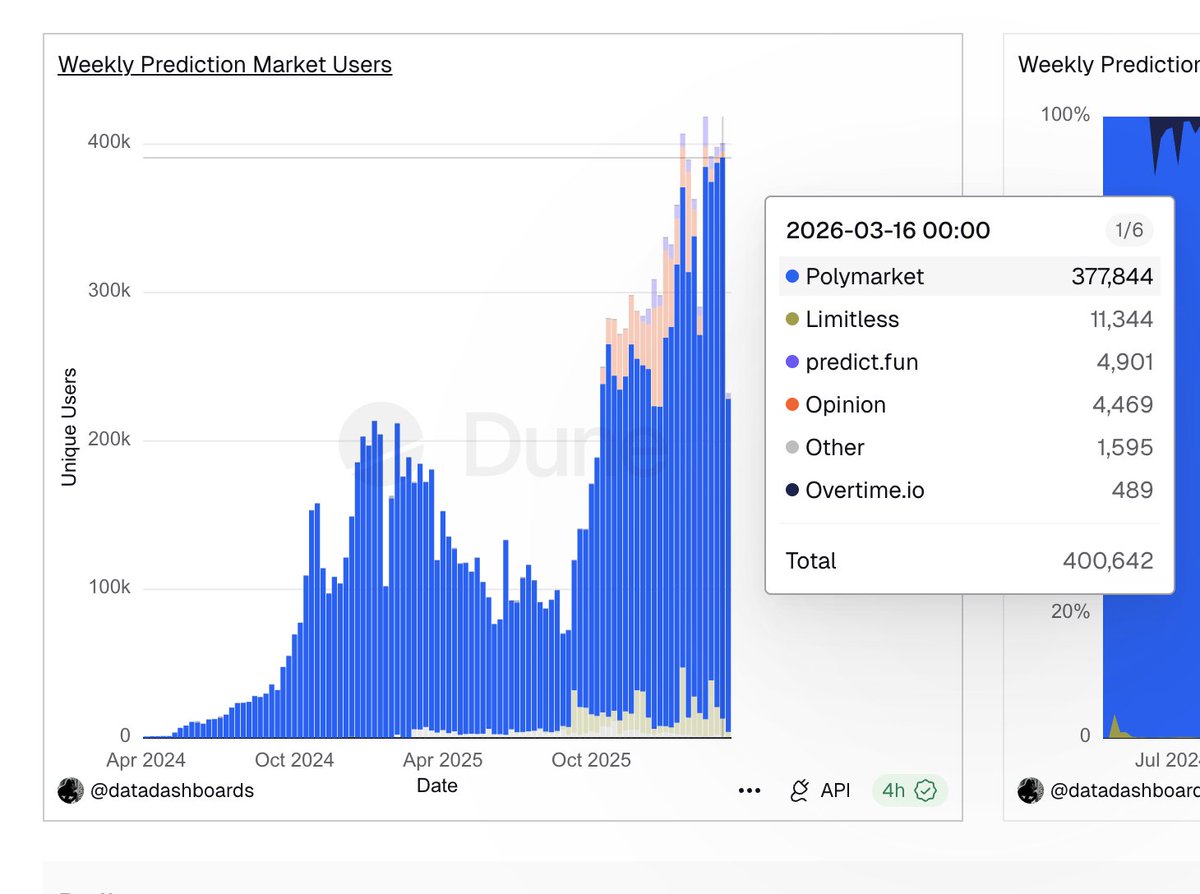
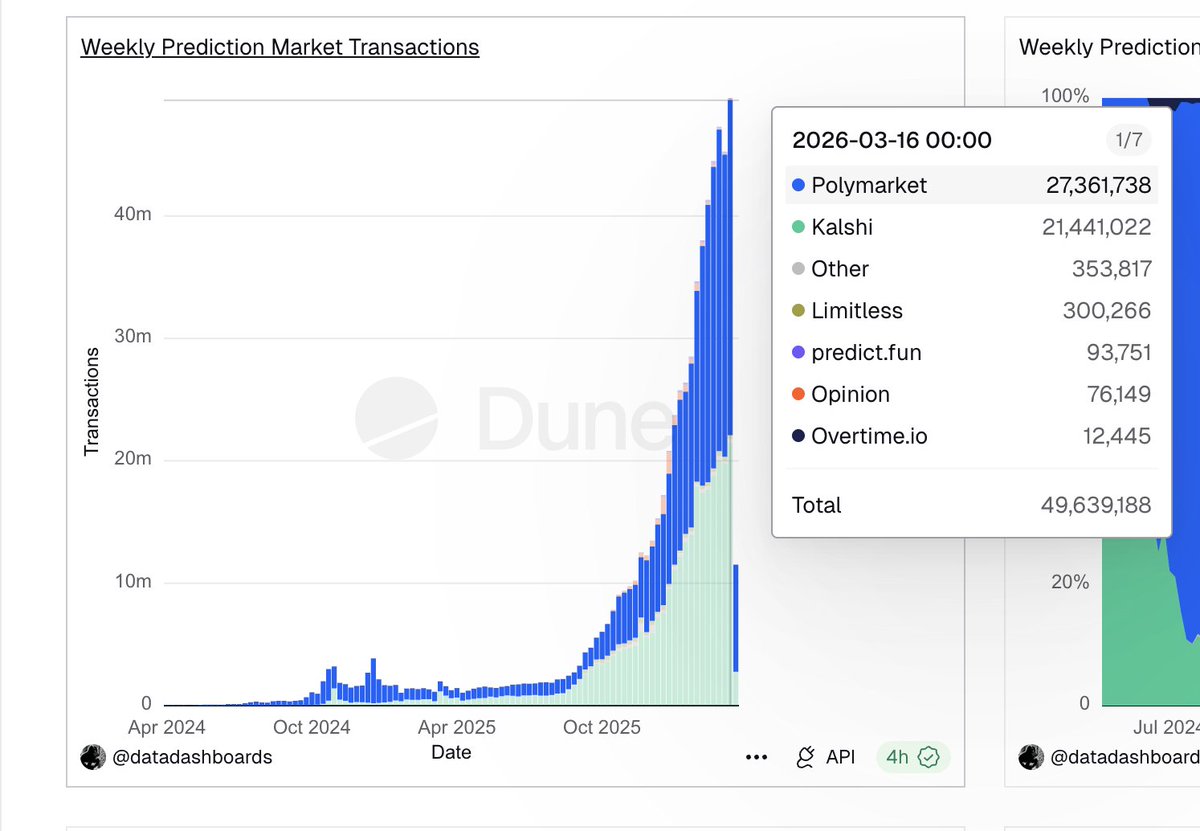
Prediction Market Weekly Update Notional Volume 1. @Kalshi $3.40b 2. @Polymarket $2.54b 3. @cryptocom $158.7m 4. @Opinionlabsxyz $128.5m 5. @Limitless $98.5m 6. @predictdotfun $60.3m 7. Other $23.5m 8. @overtime $4.0m Total $6.41b Open Interest 1. @Kalshi $497.0m 2. @Polymarket $448.7m 3. @predictdotfun $14.9m 4. @Opinionlabsxyz $13.8m 5. Other $5.3m 6. @Limitless $0.6m Total $980.3m Transactions 1. @Polymarket 27.36m 2. @Kalshi 21.44m 3. Other 353.8k 4. @Limitless 300.3k 5. @predictdotfun 93.8k 6. @Opinionlabsxyz 76.1k 7. @overtime 12.4k Total 49.64m Users 1. @Polymarket 377.8k 2. @Limitless 11.3k 3. @predictdotfun 4.9k 4. @Opinionlabsxyz 4.5k 5. Other 1.6k 6. @overtime 489 Total 400.6k I post these every week Lmk what other data is interesting to add h/t @datadashboards for the @Dune dashboard Use @tradefoxai to trade all from one interface
PJ tweet mediaPJ tweet mediaPJ tweet mediaPJ tweet media
PJ@Prithvir12

Prediction Market Weekly Update Notional Volume 1. @Kalshi $2.93b 2. @Polymarket $2.34b 3. @cryptocom $156.1m 4. @Limitless $128.1m 5. @predictdotfun $91.2m 6. @Opinionlabsxyz $77.9m 7. Other $20.6m 8. @overtime $4.0m Total $5.76b Open Interest 1. @Kalshi $466.1m 2. @Polymarket $451.1m 3. @Opinionlabsxyz $18.5m 4. @predictdotfun $17.5m 5. Other $5.7m 6. @Limitless $0.6m Total $959.4m Transactions 1. @Polymarket 24.67m 2. @Kalshi 19.75m 3. @Limitless 349.7k 4. Other 244.9k 5. @predictdotfun 113.4k 6. @Opinionlabsxyz 110.8k 7. @overtime 13.7k Total 45.25m Users 1. @Polymarket 366.7k 2. @Limitless 18.4k 3. @predictdotfun 5.7k 4. @Opinionlabsxyz 4.6k 5. Other 1.7k 6. @overtime 491 Total 397.5k I post these every week. Lmk what other data is interesting to add. h/t to @datadashboards for the @Dune dashboard. Use @tradefoxai to trade all from one interface.

English
6
4
17
2.9K
TradeFox
TradeFox@tradefoxai·
Intern with some deep research on where the US-Iran War is heading
Yoshi@tradefoxintern

What do markets think happens next in the US-Iran war? Right now, they’re pricing a conflict that stays hot, keeps energy markets stressed, and leaves a meaningful tail risk of much higher oil On Polymarket: - Ceasefire by Mar 31: just 12% - Ceasefire by Apr 15: 31% - Ceasefire by Apr 30: 44% - US forces entering Iran by Mar 31: 22% - US forces entering Iran by Apr 30: 57% - US forces entering Iran by Dec 31: 67% And on crude: - Oil >$100 by end of March: 40% - >$110: 16% - >$120: 8% - By end of June, markets are much more aggressive: - Oil >$100: 75% - >$110: 68% - >$120: 45% - >$130: 41% - >$150: 24% - >$200: 14% That curve tells you the market is not pricing a quick normalization. It’s pricing duration The key variable is Hormuz Roughly 20% of global oil and LNG flows through the Strait of Hormuz. Reuters reported that tanker traffic through the strait had collapsed by about 95% from pre-war levels at one point Even partial disruption matters because commodities are priced at the margin, not the average That means the first-order effect is obvious: - Higher crude - Higher diesel, jet fuel, gasoline, LPG, naphtha But the second-order effects are where this gets bigger: - Higher fertilizer prices via ammonia/urea feedstock stress - Higher plastics / petrochemical input costs - Higher freight and shipping costs - Higher power prices in LNG-dependent economies - More imported inflation across Asia and other energy-importing regions This is why the market reaction has been so violent. Brent had already hit $119.5 earlier this month, then fell more than 13% yesterday after Trump delayed strikes on Iranian energy infrastructure, only to rebound today after Iran denied any talks with the US. In other words: headlines can move oil $10-15 in either direction, but the structural risk premium is still there If this de-escalates quickly, oil probably retraces If Hormuz stays impaired, prediction markets still look too complacent on the right tail of energy and inflation The market is telling you this is no longer just a geopolitical story It is now an oil, LNG, fertilizer, plastics, freight, inflation, and growth story (Links to markets in comments)

English
5
1
5
771
TradeFox
TradeFox@tradefoxai·
Smart Wallet of the day: • $2.3m PnL • $195m Volume • Focused exclusively on Crypto up and down markets • $22k PnL in last 6 hours Copy this wallet in 10 seconds or less -thetradefox.com/portfolio/0x63…
English
3
6
11
1.2K
TradeFox retweetledi
Yoshi
Yoshi@tradefoxintern·
What do markets think happens next in the US-Iran war? Right now, they’re pricing a conflict that stays hot, keeps energy markets stressed, and leaves a meaningful tail risk of much higher oil On Polymarket: - Ceasefire by Mar 31: just 12% - Ceasefire by Apr 15: 31% - Ceasefire by Apr 30: 44% - US forces entering Iran by Mar 31: 22% - US forces entering Iran by Apr 30: 57% - US forces entering Iran by Dec 31: 67% And on crude: - Oil >$100 by end of March: 40% - >$110: 16% - >$120: 8% - By end of June, markets are much more aggressive: - Oil >$100: 75% - >$110: 68% - >$120: 45% - >$130: 41% - >$150: 24% - >$200: 14% That curve tells you the market is not pricing a quick normalization. It’s pricing duration The key variable is Hormuz Roughly 20% of global oil and LNG flows through the Strait of Hormuz. Reuters reported that tanker traffic through the strait had collapsed by about 95% from pre-war levels at one point Even partial disruption matters because commodities are priced at the margin, not the average That means the first-order effect is obvious: - Higher crude - Higher diesel, jet fuel, gasoline, LPG, naphtha But the second-order effects are where this gets bigger: - Higher fertilizer prices via ammonia/urea feedstock stress - Higher plastics / petrochemical input costs - Higher freight and shipping costs - Higher power prices in LNG-dependent economies - More imported inflation across Asia and other energy-importing regions This is why the market reaction has been so violent. Brent had already hit $119.5 earlier this month, then fell more than 13% yesterday after Trump delayed strikes on Iranian energy infrastructure, only to rebound today after Iran denied any talks with the US. In other words: headlines can move oil $10-15 in either direction, but the structural risk premium is still there If this de-escalates quickly, oil probably retraces If Hormuz stays impaired, prediction markets still look too complacent on the right tail of energy and inflation The market is telling you this is no longer just a geopolitical story It is now an oil, LNG, fertilizer, plastics, freight, inflation, and growth story (Links to markets in comments)
English
2
8
11
1.7K
TradeFox
TradeFox@tradefoxai·
Smart Wallet of the day: • $248k PnL • $10.3m Volume • 60% win rate • $95k PnL in the last week • Exclusively trades Price Prediction Markets for US stocks Copy Trade him in 10s or less - thetradefox.com/portfolio/0x17…
English
6
5
11
678
TradeFox retweetledi
Yoshi
Yoshi@tradefoxintern·
WILL THE FED HIKE RATES IN 2026? Markets think it’s possible, but still not the base case: - Polymarket is pricing roughly a 30% chance of a Fed rate hike in 2026 - That’s notable because just weeks ago, another hike looked far less likely Why are odds rising? - The biggest driver is the Iran war / Strait of Hormuz risk - Oil has spiked as markets price in supply disruption and a broader energy shock - Higher energy prices can feed through into headline inflation, shipping costs, and consumer expectations If the Fed does hike, the downstream effects could be significant: - Inflation: could cool over time, but only after an energy shock has already hit households - Unemployment: higher rates would likely weaken demand and raise recession risk - Stock market: generally negative for equities, especially growth stocks, as discount rates rise and margins get squeezed This is the kind of setup the Fed hates most: inflation pressure + weaker growth = stagflation risk TRADEFOX ALPHA: Market Strength is at 66% of this market meaning 66% of all positions from sharp traders actually believe the Fed WILL increase rates this year thetradefox.com/market/polymar…
English
1
6
8
1.7K
TradeFox retweetledi
TradeFox
TradeFox@tradefoxai·
What markets are telling us about March 2026 Biggest markets this month, categorized by 1. Geopolitics 2. Commodities 3. AI 4. Big Tech 1. Geopolitics - Netanyahu out: 2% ($50m) - Iran x Israel/US conflict ends: 5% ($2.18m) - Government shutdown 14d+: 4% ($612.2k) - Government shutdown 30d+: 2% ($562.1k) 2. Commodities - Crude Oil $200: 1% ($7.58m) - Crude Oil $150: 17% ($2.50m) - Gold $10k: 0% ($283.7k) - Silver $200: 0% ($147.1k) 3. AI Model Competition - Moonshot best AI model: 0% ($1.27m) - Z .ai best AI model: 0% ($1.25m) - Meituan best AI model: 0% ($1.19m) - Baidu best AI model: 0% ($1.49m) 4. Big Tech Market Cap Race - Tesla largest company 0%: ($2.90m) - Microsoft largest company 0%: ($2.12m) - Amazon largest company 0%: ($3.65m) - Saudi Aramco largest company 0%: ($1.21m) Takeaways 1. Wars don’t end. Leaders don’t change. Chaos persists. 2. Oil can move, but only within reason. Metals will stay as is. 3. The incumbents and AI labs are so dominant they don’t even need to be listed. 4. Nothing ever happens.
English
2
7
16
2.2K
TradeFox retweetledi