Nathan Michaud@InvestorsLive
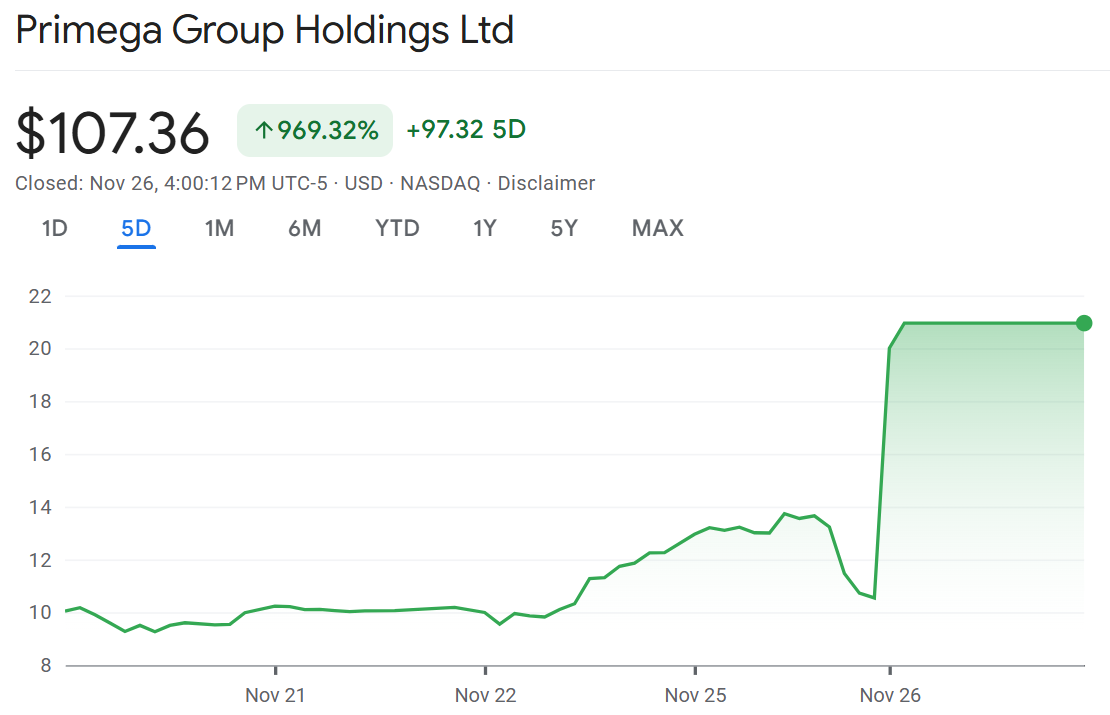
If you're a small cap short seller I figured I'd add a few thoughts again today after the latest $VTGN
(I am so happy these weren't a thing when I was aggressive on small gaps in years past).
Much like the $MF discussion last week re: circuit halts etc. my goal is to offer small thoughts here or there when outlier situations happen such as today with $VTGN. How to prepared for them, avoid, react etc.
Small caps are scary as FUCK these days (mostly for shorts).
Some thoughts while it's fresh and maybe a dose of reality & clarity for those who need it.
And, for anyone that got hurt that's still in the game, hopefully can assist on what to do moving forward.
Trading is not what it used to be in small caps. Years back when you could really scale into stuff some but this outlier risk was never really a thing, or, maybe it was but hadn't been exploited yet.
Moves like $VTGN continue to make me feel good about my decision over the last two years to really exit from the small cap space in any "capacity" trading way smaller and really waiting for any "size" until after a trend as tested, exhausted numerous times and confirmed.
Yes, obviously I still trade them but as you hear me say - no where near the size I used to trade them.
I reserve size for moves like $TTOO $MULN $NKLA ie: my bread and butter (as you've seen me post and recently A+ nature of them etc.)
Let's face it $VTGN style moves don't happen naturally:
TOO much supply TOO low -- not from sellers, but rather shorts.
If you're a short seller most times the warnings may seem like they DON'T MATTER.
Truly they don't, MOST TIMES.
But when they do matter, that's when you find out if you actually do have risk management. If you sized appropriately for the trade etc.
You don't know if you'll freeze up like I did on $KODK - easy to say you'd stop out but when you're faced with it in the moment TOTALLY DIFFERENT STORY.
You have NO CLUE how you'll react REGARDLESS of what you say you know or plan to do.
MOST times risk management is NEVER tested. MOST times we get away with being reckless until, well, we don't.
Every Sunday video I make I basically repeat how I "RETIRED" from small caps with any size, to me they are just smaller trades while I wait for the $NIO $FUBO $NKLA types to show face. It's just not worth it, even if I am right most times it's just the ONE that takes it all away.
If you do the same thing over and over expecting different results? What are you?
Personally as I've said many times on Sunday video this year I've been done chasing small cap money for a while. I prefer to let dominoes fall fall where they may and then participate in the action.
If a name shows signs that it COULD circuit halt, I'm risk adverse. It's just not worth it.
At some point if you take a step back and think about what you truly want out of this - chasing dollars for the rest of your life may not align with what makes you the most happy. What if you did that, never took a step back, never made adjustments and lost it all on a black swan?
Lots of people are crushing it, lots have great swing books. It's been a swing traders dream lately. But, if you're trying to catch up taking subpar trades where does that leave you?
THIS IS WAY DIFFERENT than prior years FOR ME. Going back 3-5 + years ago this was never really a fear. Never really a thing. Post COVID the gamified tape, the traps, the circuits you name it, sure they were there but never this crazy. This is WAY different risk than when I started all the way up to even 2020-2021. These types are even more lethal than $AMC $CLOV style moves.
When I lost on $AMC it's because I was stubborn, not because I blinked. Now? You don't even have a chance to BLINK.
Literally
9:21:20AM $51.76
9:21:21 $60 was next print.
Blink 👀
I miss a lot of home runs because I trade them too small and yeah that's frustrating as hell to know I was right and coulda banked massively, but, what about the one's you miss? $TUP squeeze AHs other day, I slept just fine.
Make sure you count your wins (ie: the ones you're glad you're not part of) just as much as you beat yourself up on your misses.
My focus continues to be sizing opportunities in mid to large cap land that are speeding up relatively to prior price action. Examples recently = $FUBO $OPEN $NIO $XPEV $RIVN $MARA $RIOT types
Outlier moves like $CVNA $AI don't interest me except once or twice on large gaps after it's been up multiple days in a row. "When they come into my wheelhouse" ie: carbon copy set ups you've seen me post over and over. Use them as a gauge of market euphoria but many times best to trade away.
Same with $TUP $YELL types. If crowds all over them, I tend to be more hands off and focus on where people are not looking vs. the ones EVERYONE wants to nail.
Truly, everything is gamified these days since COVID market -- but in 2022-2023 liquidity isn't there.
re: $KODK when I lost $1.2M+ (with $2M + draw down) I said "We will NEVER see that again but holy crap that was a close call." and guess what?
Then $HKD happened 😨
$HKD I never touched on that big move, but said same thing "Well, we'll probably never see that again"
Weeks later $MEGL
$MEGL IPO'd at $5 it opened 1000% higher at $50 I put on 1k shares with no real edge, just looking for a quick scalp of $10 points off all the "idiots" buying at $50 and leave.
My wife and I were going to pick granite for the lake house. Something that should have been fun, without worry, and relaxed. Traded the morning perfect and right before I left $MEGL opened and went into a circuit. First open was in the $80s and circuited again and it started quoting $1999 and then $19999/share. Now, I know it'd LIKELY never open here but I had a moment where I said to myself "WHAT IF?"
What if it opened at $19999 and I just worked my entire career to lose $20 million on one trade on 1000 shares? WHAT IF? Seriously, what if -- sure maybe it wouldn't open there but what if it opened $500, $1000, $2000? Was it worth it?
It ended up working out only lost $100/share on that 1000 share entry and honestly could have been flat but I had terrible Wi-Fi (Fun fact: Granite blocks Wi-Fi signals). And when you're in a granite yard, bent on an IPO with no liquidity it's not the best place to be LOL.
When I tweet that I have PTSD that's where I got it from, and that's why you see me be such a broken record every on these.
Weeks later we saw $ATXG
It started happening over and over.
Earlier this year we had $TOP
Fortunately as you saw - saw the trap first hand. Avoided it 100% and had no part in the destruction. Heck, I even got long but stopped out for .50 cents before it ramped $200/share.
I saw many lose their decade + hard work in TEN minutes. I mean really. Truly. People who were set for life, lose it in ten minutes.
After I saw that, it once again confirmed my choice of not being TOO PROUD to not nail these things like the old days. This obsession to 'figure it out.' nah, it's JUST NOT WORTH IT.
Those who listened on Sunday videos likely remember when I went over that situation. Similar to this tweet. Old me would have been TOAST. The choices I made likely saved a good chunk of my career.
Many however, did not avoid it.
This was their first "oh fuck" moment.
Most will never understand this post UNTIL you've had that "Oh fuck" moment once, maybe twice. If you survived that second time you need to make an agreement with yourself NOW.
I don't know any great traders who haven't had an "Oh fuck" moment but, I sure as hell don't know any GREAT career traders who STILL continually jump between landmines.
On Sunday video AND regularly in IU we talk about how back in day a stuff move used to be the EXIT for longs/THEY, but, not the last few years.
A exhaustion move that gets SOAKED right is VOIDED (but keep that line for later). Draw it on the chart so it's a visual reminder.
Anytime there is a big exhaustion move I watch it and watch for two things:
1. Does it dip and rip or stay heavy?
2. Upon re-test of prior exhaustion spot does it reclaim first try or stuff?
Those questions alone will save you headaches.
BECAUSE you can't answer it unless you wait to find out!
So, simply ask yourself that question before placing a trade. Put it on a post it to remember/ask yourself if you need to.
HERE'S THE THING: Most who shorted $VTGN this AM COULD NOT ANSWER THAT QUESTION.
If you took enough time to ask yourself that question, by the time you were going to answer you'd realize it was already a buck higher.
Today $3.80s exhausted out flushed, first swipe back through reclaimed. Same thing in the $5s same thing $23-$25. Not once did it STUFF at a lower level on any exhaustion moves.
SWIPE TEST is what we talk about every Sunday as well.
If it hasn't swiped back yet how do you know if it's SELLERS or just SHORTS?
If it's just shorts and it swipes back, your risk is elevated and works out best case, or, worst case it turns into today.
If it's sellers, when it swipes back it's going to stuff and stay heavy you have something to now risk off of now.
REMEMBER if I am going to short I want to be on the SAME SIDE AS SELLERS.
I don't want to be the ONLY seller.
This is why I always challenge the "Focus on your losses to get better" and really, focus on your WINNERS. Check in with yourself, did you get lucky? Is that repeatable? Was that risky as F but you got away with it? Be honest because you may not be able to ask yourself the same question next time, it'll be too late.
Some tidbits that help me:
If no A+ on scan night before - go for a walk pre market:
The longer you're on desk pre market the more likely you press a button. It is VERY rare I take a pre market trade into open. It would ONLY be the case if it was A+ set up and focus from prior days/night on scan etc. Simple fix but also double edge sword because it contradicts what I've said in past so I want to be clear - if I say to get to desk as late as possible, I still think it's important to show up and get prepared. But if you're taking sub par trades scalping for peanuts just to trade GET TO THE DESK AS LATE AS POSSIBLE. If A+ is set up I am there earlier and focused. If not, I'll check in 7AM remain out of market as long as I can. 8AM check in again unless walking but 8:15AM + I'll be on desk getting thoughts/ideas together for broadcast and day.
Only borrow X shares per ticker:
Sometimes if you borrow too many you feel like you need to use them and as most know that's never a good idea. Or, sometimes you go back on these thin outlier ones and there are none, and well, remember you borrowed what you WANTED to begin, now you're going back emotionally trying to throw good money after bad. Do you do this? If so be aware of it.
Compartmentalize your day:
Pre market trades = no size for me unless A+ set up POST EXHUASTION move. If I trade pre market 7AM and 8AM matter to me, if it doesn't agree within a few minutes MOVE ON. I don't care how much it runs how much it fades - pre market I will never have size UNLESS it's liquid and I came in with a plan ie: prior prep/scan etc. If it's a new ticker - RISK OFF. Examples of trades I'm happy to take size on if it sets up pre = $NKLA $MULN $TTOO etc.
930 to 945-10AM = Reactive trades off open but do NOT hold bias for full day long/short. Re-evaluate post 945-10AM once a trend settles vs. VWAP. If I take a REACTIVE trade off the open I am PROACTIVELY covering - if not, and market hasn't formed (which we know it hasn't) I'm at liberty of whatever it wants to swipe/flush next.
1130AM Check in = Ask myself - are the names I am holding doing what I expected? If the answer is no - I re-evaluate and likely get out. If they are sideways and stuck for an hour or two typically I size down/get out and put price alerts for areas that would interest me - otherwise I'd still be long/short until 4PM for no monetary benefit and most cases ends up costing me.
1130AM-2:30PM = Try to get off desk, go outside, get steps, check in with kiddos etc.
Ask yourself after a good morning do you typically ADD more realized 10-20% + or more than likely give back 20-30% or all of it?
Truly answer that, honestly - and then make adjustments.
4PM - MOST IMPORTANT = I'm out. GET OFF DESK. Don't even stick around to 'see' if anything moves. You take that one little 'eh just a quick scalp' and well, guess what there's a chance you're stuck until 8PM. No thanks.
Everyone is different - this is what works for me. I hate seeing these moves that take players out of the game. I would wish it upon anyone. Been there, done that. Most don't even realize the risk they take on when trading these w/o much
Much like flashing cars, flashing watches, flashing cash etc. just because everyone else is doing it and trading the "hot" ticker does not mean you need to do it too. Just because someone else made $ on stuff doesn't mean you will too.
You will always know someone who crushed it on something. That doesn't mean it was a good trade. Doesn't mean it'll work the same for you. What works for you is what fits your OWN personality.
As I've gone over in MANY Sunday videos I am just not good at managing a big portfolio. Both from a stock picking perspective but heck even from trading perspective the more capital I have the sloppier I get -- I do better with "less"
After I pulled 25-30% haircut off COVID highs in IRA / trades etc. (i.e.: millions and millions of dollars) I realized just how fast it can go away as well. I realize that this wasn't my expertise.
So, that's when I took a step back and sunk it into sought-after spots (real estate).
This never was really a worry prior to 2020-2021 now it happens all too often.
Own it, or it'll own you.
YOU ONLY NEED TO GET RICH ONCE.
The hardest part is keeping it.
I have a family, I'm 38 now - I'm not 20s like some of the hot shots without a care in the world chasing dollars like there's no tomorrow. There's a time and a place for that.
If you're similar I would challenge you to re-evaluate what and how you trade. Check into your system. Check for holes.
What small changes can you make today to help yourself tomorrow?
So, I hope this helps at least one trader. Those that watch the Sunday videos regularly or are in IU know how much I've shifted over the last two years.
The longer you sit at the table, eventually the house will win.
Small caps are a great way to build accounts but at some point you need to make the pivot.
Lastly understand where you're at in the cycle - I posted this (image below) on Friday scan:
As cycles come to an end shorts get more and more confident because they're getting away with more and more size, and more and more reckless trades. But, it's only known to be reckless until an outlier move happens.
At some point, it'll catch and the cycle starts over again 👇