
Trevor
131 posts

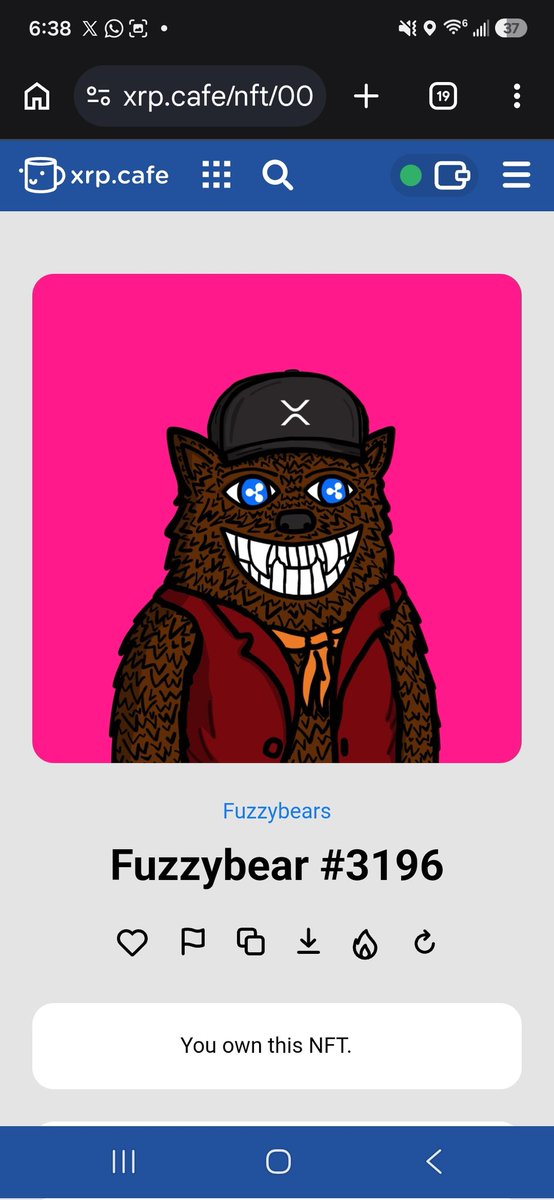
@BOSSANOVA1776 @eksrp123 @XRTWRECKS Its pretty fuckin clean 👌 like it definatly sticks out like a sorethumb a really $FUZZY THUNB
English

English


@jhuntermav I dont think you can find a better group of believers with a one in a million PROVED narrative @bearableguy123
English

I’m looking for a memecoin with the following:
✅ One in a million narrative
✅ Community of believers
✅ Sub $100M market cap
English
Trevor retweetledi

MONOLITH Turns the $XRP Ledger Into a Public Wall of Digital Ownership
MONOLITH is building a public social wall on the $XRP Ledger, giving people, brands, builders, artists, projects, businesses, and communities a permanent place to be found in one shared digital space.
The idea is simple. A user claims a coordinate on the wall. That coordinate becomes their public tile. The tile connects to a profile page, wallet proof, and a Coordinate Deed NFT tied to that specific spot. The owner can use it as a public identity marker, a project page, a brand card, a personal page, or a long-term digital location inside the $XRP ecosystem.
MONOLITH treats the wall like digital real estate. Each claimed tile has a coordinate. Each coordinate has an owner. Each owner has a public place on the wall.
For years, crypto communities have lived across scattered timelines, Discord servers, Telegram chats, project websites, wallet addresses, and token pages. MONOLITH pulls that energy into a single visual layer. It gives the ecosystem a wall people can actually explore.
A claimed tile is more than an image. It carries public display space, wallet identity, a tile page, and an on-ledger ownership record through the Coordinate Deed NFT. The tile becomes a front door. The wallet becomes the proof. The wall becomes the map.
The early version of MONOLITH already shows how this can work. Users can claim spots, view tiles, open profile pages, and see activity forming across the wall. Center real estate is filling in first, which gives the project a natural land-rush feel. The wall still has endless available coordinates, but the most visible sections are starting to develop character.
That’s where MONOLITH starts to feel different from a normal profile system. A social profile can be created anywhere. A coordinate has placement. It has location. It has scarcity in the exact spot chosen. Two users can both have pages, but they can’t both own the same coordinate.
MONOLITH is also building toward a Tile Market. The market layer will give owners a way to list, trade, sell, and build more value around their claimed spots. That turns the wall from a static display into a living ownership layer. People can claim early, build their presence, and decide what their tile becomes over time.
The long-term direction is a juiced up MySpace on the Ledger. A place where identity, media, writing, links, images, music, ownership, and public proof can sit together inside a tile. The profile is the face. The Coordinate Deed NFT is the proof. The wall is the public stage.
The project fits the broader direction of the $XRP Ledger because it uses the Ledger as more than a place to hold assets. It uses the Ledger as a record of ownership, identity, transfer, and settlement. MONOLITH is part of the shift from holding $XRP to using the rails.
The $XRP community already has builders, tokens, communities, artists, influencers, educators, businesses, and projects fighting for attention across different feeds. MONOLITH gives them a shared place to stand. If it has something to do with $XRP, it belongs on the wall.
The biggest challenge is making something this visual feel simple for normal users. Wallet actions, claiming, ownership, owner controls, public tile pages, wallet verification, profile layers, and Deed NFT handling all have to work without turning the experience into a technical mess.
MONOLITH is early, and prime real estate is already being claimed.
Claim a coordinate. Own your spot. Build your page. Show your work. Put yourself on the wall.
@monolith_xrpl
🌐 monolithxrpl.com

English
Ya so I just did a thing. Dropped 500 xrp on 3 projects I'm digging . $FUZZY $XMEN (HEROES UNITE) AND $PHINIX . I feel like even without the CLARITY act the $FUZZY community is killing it and that alone is going to attract people. We are the people .... of the ledger
English
Just for preference phantom wallet gets 10 to 17m monthly users. The xaman wallet currently has about 80 to 200k a week. So ya i wholeheartedly believe that buying $FUZZY and other projects now can set yourself up for generational wealth. And then XRP is just a bonus:)
English