Sabitlenmiş Tweet

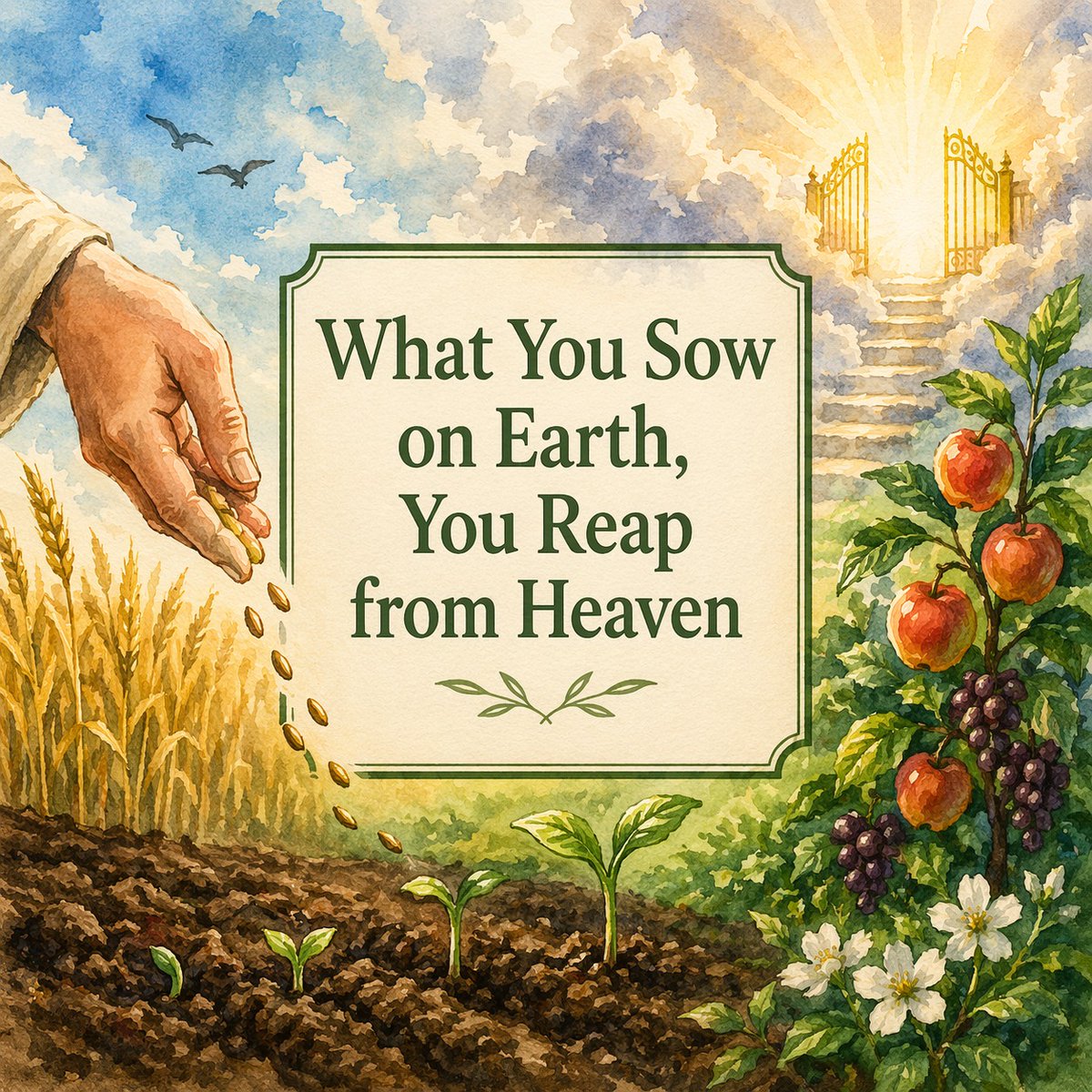
What You Sow on Earth, You Reap from Heaven
" For they sow the wind, and they shall reap the whirlwind. " Hosea 8:7
There is a quiet but persistent tension that many carry, though few express it openly. Life does not always return what it seems to promise. We are taught that effort leads to progress, that discipline leads to stability, and that if we do what is right, we will eventually see the fruit of our labour. And so we commit ourselves to this path. We work diligently. We plan carefully. We strive to build something lasting. Yet, for many, the outcome feels strangely disproportionate. It is not that there is no result at all. There is some progress, some movement. But what is gained often feels incomplete. It does not satisfy fully, and it does not remain secure. What is built feels fragile. What is earned never quite feels enough.
This creates a subtle but deep frustration. Not the frustration of failure, but the frustration of insufficiency—the sense that despite effort, something essential is missing. This tension becomes more pronounced when viewed through the lens of faith. Scripture speaks clearly of a God who provides, who blesses, and who is faithful. Yet when one compares these promises with life experience, a gap appears. We pray, yet do not always see answers. We trust, yet still feel uncertainty. We hope, yet often remain in lack.
This raises a serious question: Has God failed to fulfil His promises, or has man misunderstood how God works? The answer lies in a foundational truth established throughout Scripture: Man may sow on earth, but he does not reap from the earth. He reaps from God. This means that effort alone cannot produce true or lasting fruit. The harvest is not determined by labour itself, but by whether God grants increase. Therefore, the key to understanding why many labour yet remain without fullness is not found in analysing effort alone, but in understanding how God governs increase.
To understand this, one must begin at the origin of man's condition. In Genesis 3:17–18, after the fall of man, God declares that the ground is cursed and will produce thorns and thistles. This is not merely a statement about agriculture. It is a statement about the nature of life in a fallen world. The ground, once a source of provision, is now marked by resistance. It does not yield freely but requires toil. It produces not only what is useful, but also what obstructs and harms.
This means that man's labour is not carried out in a neutral environment, but in one that actively resists him. This reality is reinforced in Psalms 127:1: Unless the Lord builds the house, those who build it labour in vain. The builders are working. Their effort is real. Yet their labour is described as vain because it lacks divine involvement. The earth cannot be relied upon as a consistent source of blessing, regardless of how much effort is invested into it. And so the assumption that effort guarantees success begins to collapse. If the ground cannot be trusted to produce blessing, then the source of blessing must be found elsewhere.
Scripture answers this clearly: "Every good and perfect gift is from above…" (James 1:17). Provision does not ultimately originate from the ground. It comes from God. The ground is where the seed is sown, but it is not the source of life. He governs growth, multiplication, and sustainability. This reveals the limitation of man. Man can labour, but he cannot command increase. He can plant, but he cannot produce life. This is why equal effort does not produce equal outcomes. Scripture captures this reality in Haggai: You have sown much, and harvested little… You earn wages, only to put them in a bag with holes. Therefore, many of us labour and earn, yet experience continual lack. What we gain does not remain. This shows that effort without God's blessing leads not to abundance, but to insufficiency.
Without God, work is an effort without retention. Gain without stability. Progress without fullness. And yet man continues to respond in the same way—by working harder, holding tighter, and trusting himself more. But the problem is not effort. The problem is understanding. If God is the source of increase, then man must learn not only how to labour, but how to relate rightly to Him. This is where giving takes on its true meaning.
Giving is not merely a physical act. It is not simply the transfer of something from one hand to another. It is a spiritual act of alignment with GOD's will. When a man gives, it is not a loss but an acknowledgement that what he has is not sustained by his own hand. He confesses that his provision does not come from the ground, but from God.
This is why in Deuteronomy, the people were commanded to bring their firstfruits—not as payment, but as a declaration. And in Malachi, God promises not only provision, but protection: "I will rebuke the devourer for you." Because the issue is not only about producing. It is preserving. Left to itself, what man gains is consumed, diminished, or lost. But what is placed into the hands of God comes under His covering. Yet even here, God does not bypass the seed."Whatever one sows, that will he also reap" (Galatians 6:7). God remains the source, but He does not bypass the process. Without sowing, there is no harvest. This is not optional. It is the order. Where nothing is sown, nothing is reaped. Scripture does not leave this principle in abstraction. It brings it into reality.
The sluggard in Proverbs is not merely a man who refuses to work. He is a man who refuses to act when it matters. "The sluggard does not plough in season; so at harvest time he looks but finds nothing." His failure is not apparent at first. There is no immediate consequence of his delay. No loss when he chooses comfort over obedience, hesitation over action. But time exposes what he has not done. When the season changes—when the moment for harvest arrives— he suddenly desires what he never prepared for. In modern life, this is the person who keeps postponing what they know they should do. The one who waits for clarity before obedience, for security before faith, for abundance before giving. They tell themselves there will be a better time. A safer time. A more certain time. But that time never comes. And when life demands fruit—stability, provision, growth— they find themselves with nothing to show. Not because they were incapable, but because they never sowed.
The servant in Matthew 25 presents a more subtle and more dangerous condition. He is not idle. He is not unaware. He is entrusted. He has something in his hand. But instead of sowing it, he buries it. His reasoning is not laziness—it is fear. Fear of loss. Fear of failure. Fear of stepping into uncertainty. And so he chooses preservation over participation. He keeps what he has. Protects it. Holds it tightly. In modern terms, this is the person who refuses to release what is in their hands— their resources, their time, their gifts—not because they lack, but because they fear losing control. They believe that safety lies in holding on. But what they fail to see is this: What is buried does not grow. What is protected from risk is prevented from multiplication. And in the end, the outcome is not neutrality. It is a loss. Even what they had is taken away. Because in the kingdom of God, what is not used is not preserved—it is forfeited.
The people in Haggai are distinct from others. Unlike the sluggard, they are not idle; unlike the servant, they are not inactive. They are the most recognisable group of all. They are not lazy, careless, or inactive—instead, they are busy, hardworking, and earning. They build their lives, take on responsibilities, and pursue stability. And yet, their condition is described with unsettling clarity: "You have sown much, and harvested little… You earn wages, only to put them in a bag with holes."
This is not a lack of effort. This is an effort without retention. Gain without stability. Progress without fullness. In modern life, this is the person who is constantly striving—moving from task to task, goal to goal, responsibility to responsibility—yet never arriving at a place of rest or sufficiency. They are doing everything that should work. And yet, something is missing. Because while they are sowing into their own lives, they are not sowing into what God has called them to. Their effort is genuine, but it is misaligned, resulting in a cycle: they achieve gains but cannot retain them. They build, but cannot secure. They strive, but are never filled. Not because they lack discipline, but because they lack alignment with God.
These three pictures expose a reality that is difficult to confront: It is possible to delay and end up with nothing. It is possible to hold tightly and still lose everything. And it is possible to work endlessly and yet remain in a state of lack. Because the issue is not active. The issue is whether anything has truly been sown. And more importantly, whether it has been placed into the hands of God. What is not sown cannot be multiplied. And what is withheld from God remains under the limits of the earth.
But Scripture also shows the other side. In 1 Kings 17, the widow of Zarephath stands as a striking example of this principle. She was not a woman of abundance, but of extreme lack. She had only a handful of flour and a small amount of oil—just enough to prepare one final meal for herself and her son before they expected to die. At this moment of finality, she was asked to give. From a human perspective, this request appeared unreasonable. To give from abundance may be understandable, but to give from the last remaining provision seems irrational. Yet her response reveals a deeper understanding. She chose to give. What she released was not surplus, but survival. In doing so, she demonstrated that her life did not ultimately depend on what she held in her hand, but on the God who could sustain her beyond it. The result was not immediate wealth, but sustained provision. The flour did not run out. The oil did not fail. What she gave did not return as loss, but as continuity. Her act of giving did not change the ground. It positioned her under God's provision.
In 1 Kings 3, Solomon presents a different kind of sowing. He was not in lack, but in position. As king, he had the opportunity to ask for anything—wealth, power, long life, or victory over enemies. Yet his request reveals his understanding. He asked for wisdom. This was not a request for personal gain, but for the ability to lead rightly under God. In this, Solomon aligned himself not with self-interest, but with God's purposes. What he received went beyond his request. God granted him wisdom, but also added riches and honour. The return was not equal to the request—it exceeded it. This demonstrates that when a man sows rightly before God, the harvest is determined not by the size of the seed, but by the nature of God.
In 1 Samuel 1–2, Hannah's story reveals another dimension of sowing. She longed for a child and prayed earnestly for one. When her prayer was answered, she did something unexpected—she gave the child back to God. This was not a small act. It was the surrender of what she had most deeply desired. In doing so, Hannah demonstrated that her relationship with God was not based on receiving, but on trust. She did not cling to what she had been given, but released it. The result was that she had more children later. Her story shows that sowing is not limited to material provision. It includes surrendering what is most precious, trusting that God can give beyond what is released.
These lives reveal the same pattern: what is placed in God’s hands is never diminished. It is multiplied, sustained, or returned in greater measure— not by the ground, but by Him. The issue, then, is not that God has failed. The issue is that man does not understand how God works. We expect a harvest without sowing. Increase without surrender. Provision without trust. And so we remain in a cycle of effort without fullness.
The path ahead is not about striving harder; it is about finding alignment. We must recognise that the ground alone cannot sustain us and that our efforts cannot guarantee life. It is important to release what we have been holding on to and place it in God's hands, trusting Him for growth and increase. What we keep for ourselves remains limited, but what we give to God is blessed by Him.
This practice is not a one-time action; it is a way of living. We need to receive, sow, trust, and depend on God for the outcomes. These outcomes may not always align with our expectations or happen within our desired timeframe, but they will always occur according to His wisdom.
Since the beginning, the ground has been cursed. And yet man continues to look to it for life. He labours. He strives. He holds on. And still wonders why he reaps so little. But the answer has already been given. The ground cannot give what only God can.
And so the question is not how much you have or how hard you work. The question is—what have you placed into the hands of God? Because what remains in your hand stays bound to the earth. But what is surrendered to Him is no longer limited by it. You may sow on earth, but you will reap from heaven.
#Sowing #Reaping #Abundance #Giving
English