
Sabitlenmiş Tweet
PricePush
89 posts


PricePush
@TryPricePush
Localized pricing automation for #MobileApps Push smarter prices to Apple & Google Play 190+ countries | PPP adjustments
Katılım Şubat 2026
1 Takip Edilen25 Takipçiler
New on the blog: what $19.99 actually costs in 190+ countries.
A free PPP-localized reference table for App Store and Google Play, the tier multipliers behind it, and the 8 rounding rules PricePush ships.
Snapshot data, no signup.
pricepush.app/blog/app-price…
English
Under-price 80% in Brazil for 24 hours = subscribers locked in for a year at the wrong rate.
Over-price 3x in India for a week = flat conversions you'll see 3 months later, churn 6 months out.
The blast radius of a bad price push is bigger than most code bugs. Detection is slow.
pricepush.app/blog/app-price…
#indiedev #pricing
English
Google Play IAP pricing in 4 facts:
→ No tier ladder (Apple has ~900 price points per currency)
→ Arbitrary local-currency prices accepted
→ Pricing Templates removed Oct 27, 2025
→ Auto-conversion is FX, not PPP
Full walkthrough: pricepush.app/blog/google-pl…
#android #apppricing #playconsole
English
PricePush is live on Product Hunt today. If it looks useful, an upvote in the first hour matters more than the rest of the day:
producthunt.com/products/price…
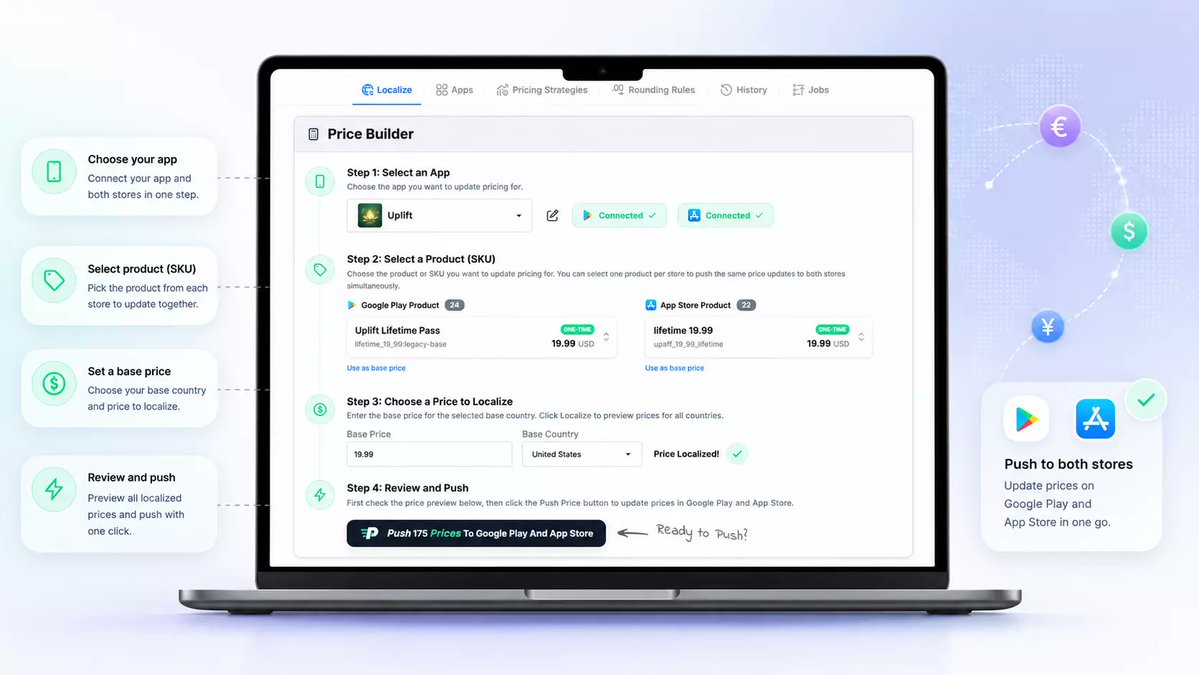
What it does: takes your base in-app price and pushes country-specific, PPP-adjusted prices to App Store Connect and Google Play in one tap. 190+ countries, both stores, custom rounding per market (₹599 in India, R$49.90 in Brazil, ¥1,500 in Japan), real API push (no Chrome extension, no DOM-clicking).
Built by an indie dev (Antonio) running it on his own 8 apps. 259+ real production pushes already on the books before today.
Free tier covers 1 app, no credit card. Founding lifetime offers still open, limited spots.

English
49 apps. 190+ countries. 777 price pushes shipped.
The wall is now live on the PricePush landing page, every icon a real indie app charging what each market can actually pay instead of an FX-converted USD price.
If you ship IAPs or subscriptions and your store pages still use one USD baseline, localized pricing is the lowest-effort revenue lift left in your stack. ~10 min per app across App Store and Google Play.
Who wants to be app #50 on the wall?
#indiedev #appstore #localizedpricing


English
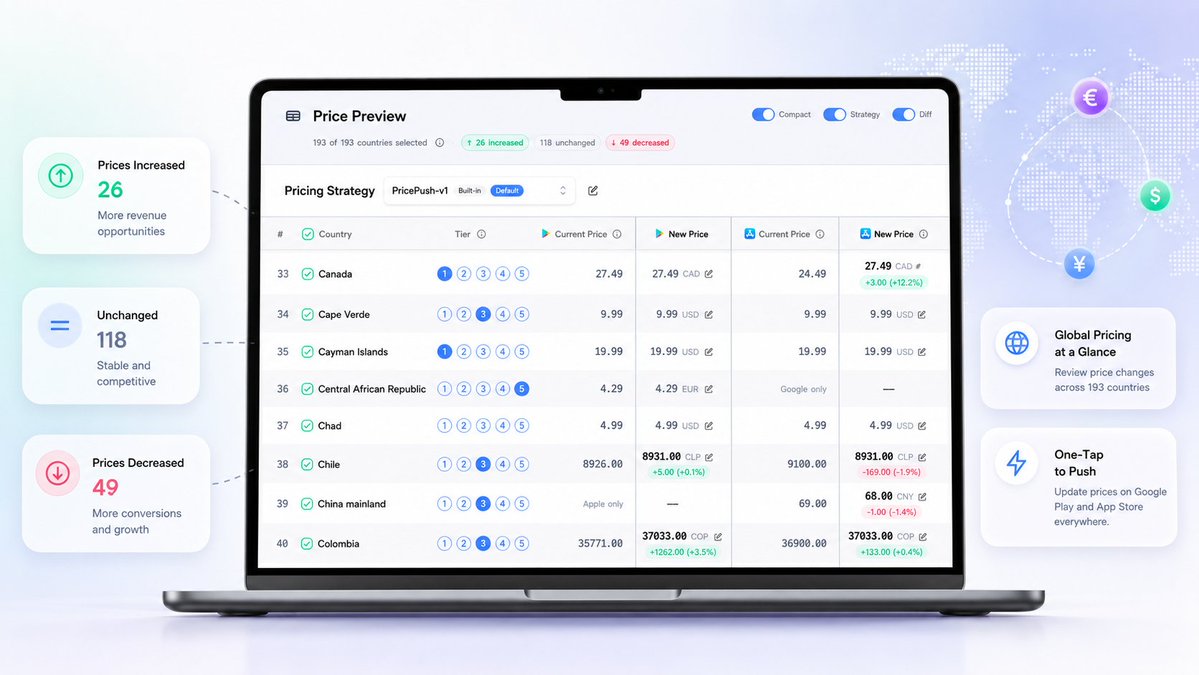
Why "I'll just script price localization with APIs and AI" rarely makes it past month one.
The pitch sounds clean. App Store Connect has an API. Google Play has an API. Pull the country list, calculate prices, push them up. A weekend project.
Here's what that weekend turns into:
1. Apple's API has strict rate limits and usage patterns that change without much warning. A naive fetch of all SKUs and their associated price tiers exhausts the limit before you've done anything useful.
2. Apple's price-point tier ladder is finite (around 900 points per currency, 43 currencies, 174 storefronts). You don't send arbitrary prices, you map your intended price to the closest valid tier. Loading and indexing the full ladder is a non-trivial engineering chunk on its own.
3. Neither store offers a built-in rollback. If you push the wrong prices, you have to reconstruct the previous state from records you hopefully kept.
4. You're holding customer App Store Connect credentials, which means encryption at rest, secure key rotation, and a credential model that survives audit.
5. You need a job queue, retry logic, and history. None of which the APIs give you.
You can absolutely build this, and several teams have. It's months of work, not a weekend. The same engineering effort could go into your actual app.
PricePush handles all of that, and the calculation engine is battle-tested on the founder's own apps. Free tier covers one app, no credit card.
#apppricing #ios #android #saas #indiedev
English
Why GDP per capita isn't enough for app pricing:
It tells you how much income exists in a country, not how much of that income translates into discretionary spend on apps.
Two countries with similar GDP per capita can have very different willingness-to-pay for software.
PPP gets closer to the right input.
#apppricing #ppp

English
Price localization for mobile apps is harder than it looks, and the work splits cleanly into two halves.
The research half: which index do you use? PPP from the World Bank, the Big Mac Index, Netflix and Spotify benchmarks, GDP per capita? Each tells a different story, and the differences matter for digital products.
The Big Mac Index is intuitive but it reflects food-industry economics: beef prices, fast-food labor, franchise real estate, local quick-service competition. None of that tells you what someone will pay for a digital subscription. The Netflix and Spotify indices are closer to relevant but anchored to dynamics most apps don't share (massive content licensing, brand pull, competitive pressure from local streaming services). For mobile specifically, PPP-derived data is the closest fit.
The execution half: actually pushing those prices to App Store Connect and Google Play. For a single app with three SKUs across both stores, that's roughly 1,050 input fields per refresh cycle. Manual is a week of work. APIs add rate limits, missing rollback features, and Apple's price-point tier ladder to model.
Done right, the lift is real. Revenue uplifts in the 20-50% range are common in international markets where the original USD anchor sat 2x+ above PPP. RevenueCat, Adapty, and Headspace have published numbers in the same range.
Full breakdown with country-by-country examples and what to ship this week: pricepush.app/blog/price-loc…
#apppricing #ppp #subscriptionpricing #ios #android
English
PricePush is on the MicroLaunch May leaderboard. Voting open 24 more days.
If you ship apps internationally and want a tool that handles PPP pricing across App Store + Google Play, an upvote helps us reach more devs.
microlaunch.net/p/pricepush
English
Competitor pricing data tools scrape what Apple displays in each storefront. That's whatever the competitor's USD anchor auto-converted to.
If the competitor never localized, that displayed price is currency math, not strategy.
Benchmarking against it copies decisions nobody actually made.
English
Charge $19.99 globally and Apple lands the Brazilian price near R$120.
That's about 4% of a typical Brazilian monthly income.
PPP-aligned, it should sit closer to R$49.90.
The gap is where international conversion quietly leaks.
#apppricing #ppp #ios
English
Pricing Templates removed by Google Play October 27, 2025.
Practical impact: per-country pricing is now strictly per-product.
10 apps × 8 in-app products × quarterly review = 80 product-level pricing decisions per quarter, on Google Play alone.
Most indie devs underestimate this until they're behind on it.
#android #playconsole #apppricing
English
PricePush 1.2.2 shipped.
→ Exchange rates refresh consistently when you switch base country (no more stale FX on first load)
→ Friendlier empty state for Google Play apps without IAPs or subscriptions
→ Fixed the "Failed to fetch settings" error new users could hit on first dashboard load
Small release, solid foundations.
pricepush.app/changelog
#apppricing #indiedev
English
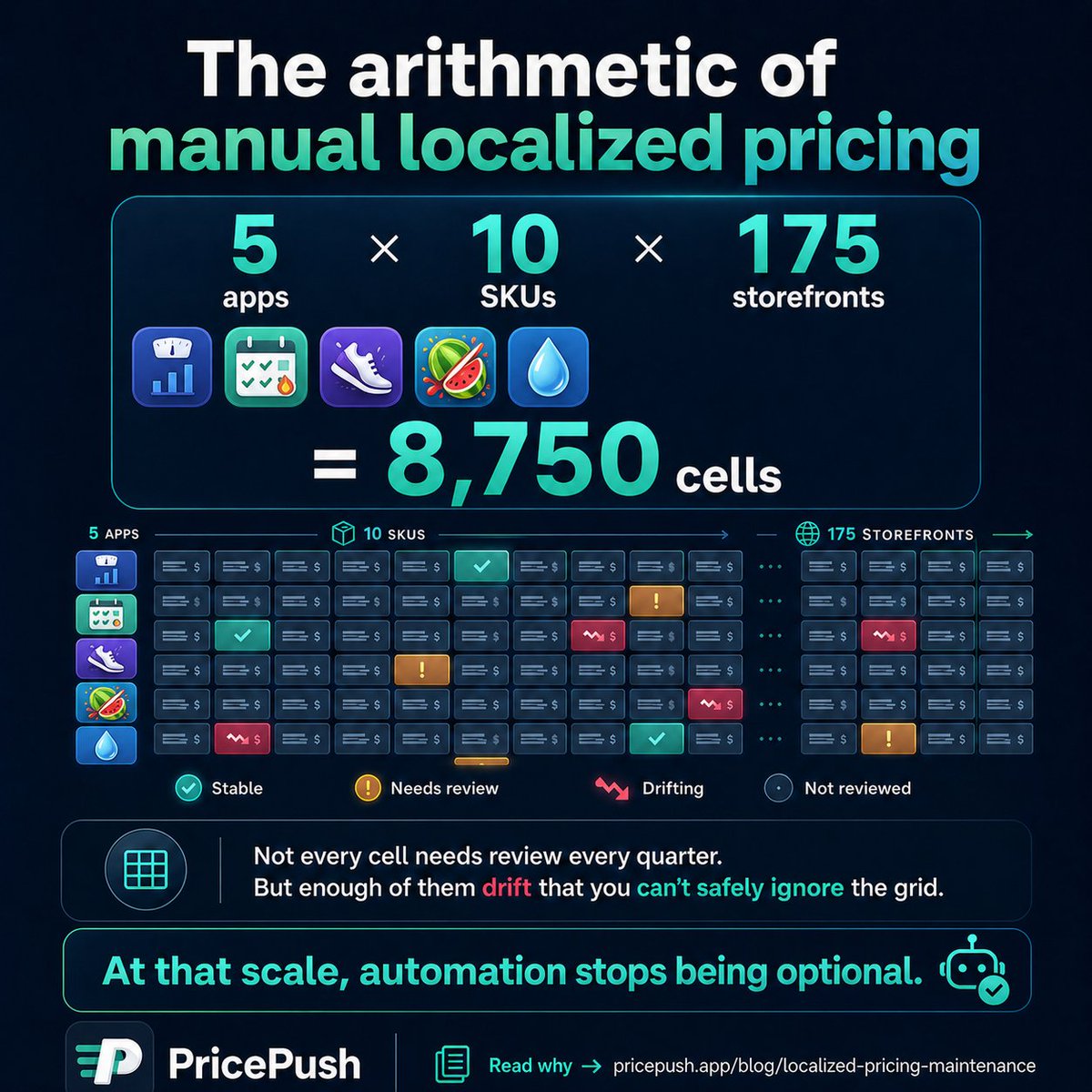
🔢 The arithmetic of manual localized pricing:
5 apps × 10 SKUs × 175 storefronts = 8,750 cells in your pricing grid.
Not all of them need review every quarter. But enough of them drift that you can't safely ignore the grid either.
At that scale, automation stops being optional.
Read why → pricepush.app/blog/localized…
#apppricing #indiedev #saas #mobileapps #appstore
English
Price localization for apps is two jobs:
1. Research the right price per country
2. Update ~1,000 input fields per app across both stores
Done right, it lifts international revenue 20-50% in markets where the USD anchor sits 2x+ above PPP.
New post: pricepush.app/blog/price-loc…
#apppricing #ppp #saas
English
Order of operations for indie subscription apps eyeing Apple's new 12-month commitment subs.
1. Localize the base price per country first. Use PPP, Big Mac, GDP-adjusted, whatever index makes sense for your audience. Round to numbers that read as native, ₹599 in India rather than the auto-converted equivalent of $19.99.
2. Pull last-30-day installs by country from your sub provider or App Store Connect Sales. The countries with healthy install volume but very low conversion are usually the ones where the price is the friction.
3. Then turn on the 12-month commitment, in those specific markets. That's the segment Apple actually built this for. Localized price plus commitment is the full product. Either alone is half the answer.
4. Watch refund rate by country for at least 60 days. If localized plus commitment is working, refunds in your top emerging markets go down. If they go up, the local price is still wrong, not the commitment.
Doing it the other way, turning on the commitment before localizing, is a retention feature that creates churn instead of preventing it.
PricePush handles step 1 across both stores (App Store Connect and Google Play Console) in a few minutes, with country-aware rounding rules and Apple price-point ladder snapping built in.
#subscriptionpricing #apppricing #appstore #indiedev
English
Apple's new 12-month commitment subs are a billing change, not a pricing change. Here's why that distinction matters for indie subscription apps.
The strategic pitch is real. Splitting an annual price into smaller monthly charges removes the upfront sticker shock that drives early-month churn on annual subs. Apple has handled the user-side transparency well: completed and remaining payments are visible in the Apple Account, and email reminders go out before each renewal.
What the new feature does not do: localize the price.
Apple has never auto-adjusted subscription prices, and the 12-month commitment doesn't change that. A $19.99 USD anchor still lands at the local equivalent of $19.99 in every country. Roughly 2x above PPP in tier-3 markets (Brazil, Mexico, Türkiye, Poland), 3x in tier-4 (India, Indonesia, Philippines, Vietnam, Egypt), 4x in tier-5 (Nigeria).
In those markets, most users simply don't subscribe at the unlocalized price. The commitment offer can't retain users it never acquired.
The practical order: localize the base price first, then turn on the commitment in markets where install volume is healthy but conversion is not.
Full breakdown with tier-by-tier math and a 4-step playbook: pricepush.app/blog/apple-12-…
#apppricing #subscriptionpricing #ios #appstore #indiedev
English