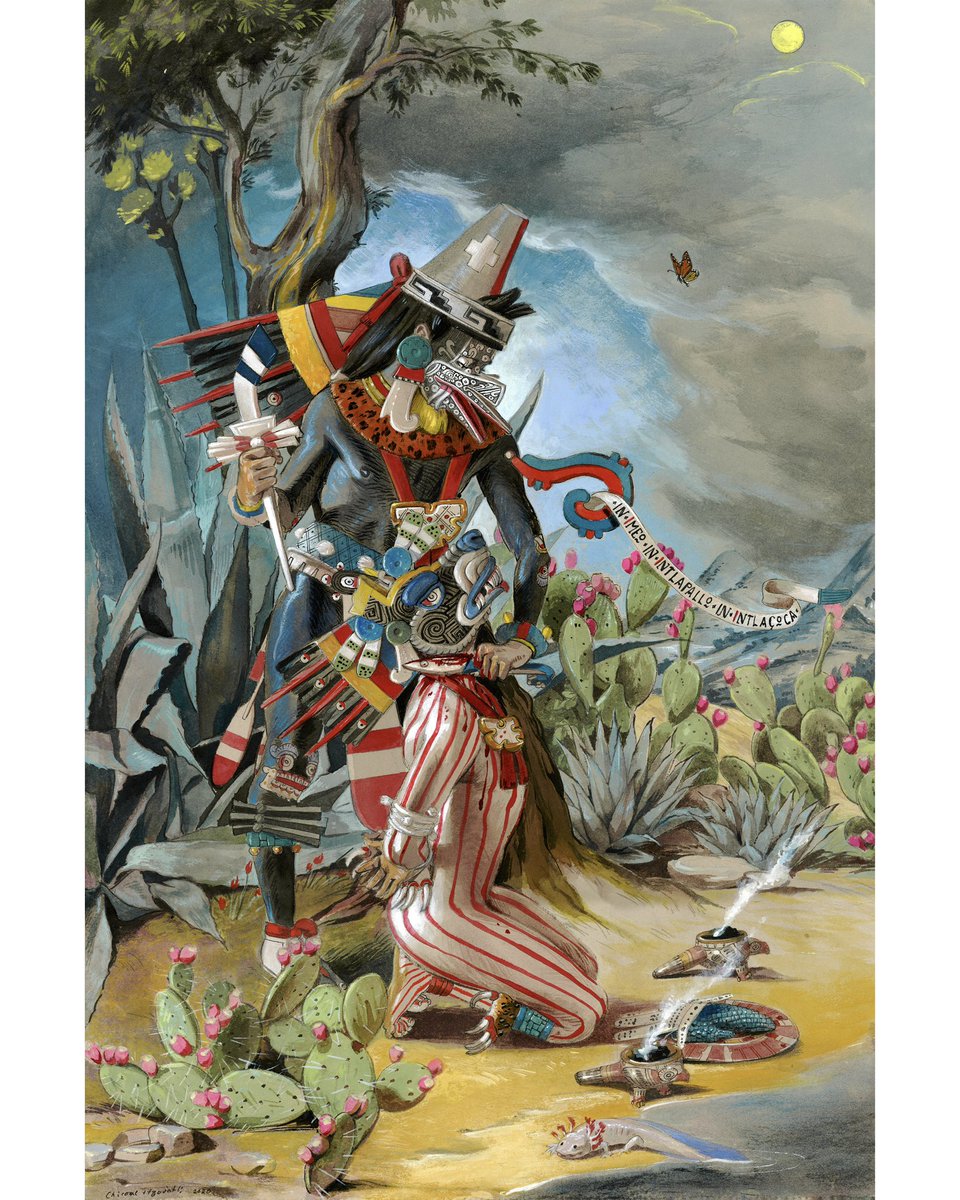
The Sun refused to move, and the world began to burn.
This painting tells a moment from an Indigenous Mexica creation story. A new Sun had been born, but it would not cross the sky. It stopped at the zenith, and the world burst into flame. The Teteo, or “Gods,” chose to offer Their own blood and life-force to give the Sun the strength to move.
Quetzalcoatl, the Lord of wind and creation, was tasked with sacrificing the gathered Teteo. But one of Them, Xolotl, the dog-“God,” became afraid and tried to escape. He transformed Himself into an axolotl, a type of salamander, then into a stalk of corn with two cobs, and finally into a maguey with twin flowers, always trying to evade the blade.
Yet Xolotl is the nahualli, or “spirit animal,” of Quetzalcoatl, His other self. In sacrificing Xolotl, Quetzalcoatl in truth sacrificed Himself. The fear of Xolotl was His own fear, and through sacrifice that fear was conquered. When Xolotl’s sacred essence rises toward the Sun as a butterfly, the offering is completed, and the Sun begins His eternal movement across the sky.
Gouache and ink on paper.
Prints are listed on my Etsy page. etsy.com/mx/listing/952…#MexicaArt#MesoamericanArt#AztecMythology#IndigenousArt#SacredArt
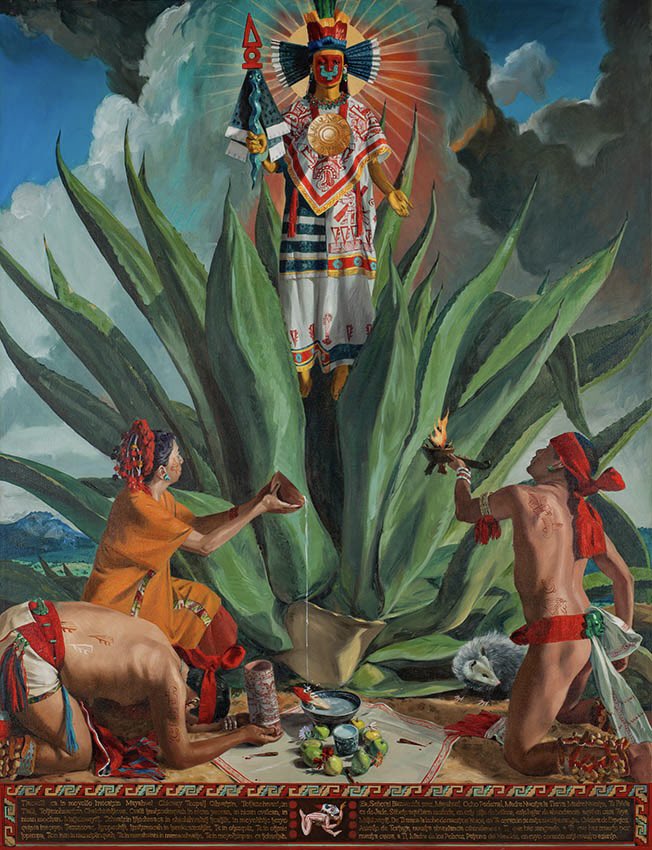
Mayahuel emerges from the maguey, wreathed in light.
In this painting She wears the regalia of Chalchiuhtlicue, the Lady of water, emphasizing aguamiel — the flowing milk of the plant — and the fertility and nourishment that sustain life.
A detail from my ongoing project exploring the Teteo through painting. etsy.com/listing/108654…
Happy Mexica New Year!!! Or, is it? Many people celebrate March 12 as the “Mexica” or “Aztec” New Year. The intention is good. People want to reconnect with the ancient calendar and with the rhythm of sacred time. But the question remains: is this date actually supported by the living traditions that still preserve the calendar?
The *tonalpohualli*, the sacred count of 260 days, did not disappear with the conquest. In several Indigenous communities it has continued to be counted generation after generation. Daykeepers still use it in ceremony and divination, and the cycle of days continues without interruption. Because of this continuity, it is still possible to know what day of the sacred calendar it is today.
What is remarkable is that different communities arrive at the same place in the cycle. The Ayöök of Oaxaca and the K’iche’ of Guatemala, for example, maintain their own languages and their own names for the days. Yet when the sequence is counted, the position in the 260-day cycle matches. The names may differ, but the structure of the calendar remains the same. If today is the 260th day in the cycle in one tradition, it is the 260th day everywhere.
This continuity is powerful evidence. It means the calendar has not survived only in books or archaeological study. It survives through practice. Through ceremony. Through the work of people who continue to keep the count of days.
For that reason, living Indigenous traditions offer an essential point of reference when we try to understand the calendar today. The sacred calendar is not something that must be reconstructed from fragments. It is something that has continued to live.
Many people who celebrate the Mexica New Year in March do so because they are searching for connection with ancestral knowledge. That impulse deserves respect. But if we truly want to reconnect with the calendar, it is worth listening to the communities who have preserved the count across centuries.
The *tonalpohualli* is not a relic of the past. It is a living system of sacred time. And through the traditions that have carried it forward, we can still learn to understand the rhythm of its days.
I just painted the sky in gouache on paper on my portrait of Mama Quilla, the Andean moon goddess. A lot left to paint! Her skirt, the owl, her crown, and her alpaca. But she’s coming along. You can see more of my pairings here etsy.com/mx/shop/MiCora…
Although I still have many worries, I think I have been quite fortunate to have a lot of love and kindness around me. With them by my side, I will continue going.
recent updates.
I started a new job at the end of February. My boss and colleagues are all very kind and have been very considerate to me. I've made up with my father and apologized to him . Recently, we've been in frequent contact, and it feels great to have family support.