UBIX.Network

1.2K posts

UBIX.Network banner
UBIX.Network

UBIX.Network

@UBIX_Network

We are #UBIX ($UBX), A Digital Universe with Endless Possibilities. #DAG #blockchain #web3 #staking Join our Telegram: https://t.co/fEx3EE16d1

Katılım Nisan 2019
443 Takip Edilen33.1K Takipçiler
UBIX.Network
UBIX.Network@UBIX_Network·
🚀 The updated Ubix.Network roadmap is here! 👉ubix.network/pdf/roadmap_20… We’re excited to present the updated Ubix.Network roadmap — a clear development plan that reflects our vision, priorities, and ambitions for the near future. 🔹 What’s new? ⭐️ Enhanced platform architecture. ⭐️Expanded ecosystem functionality. ⭐️New partnerships and integrations. ⭐️Focus on scalability and user experience. ⭐️We are also actively communicating and will continue to work with exchanges to unlock new opportunities for $UBX. We continue building technology that combines security, speed, and real-world blockchain use cases. Stay tuned for key milestones and remain with us — there are many important updates ahead! #Ubix #Blockchain #Roadmap #Crypto #Web3 #UBX $UBX
UBIX.Network tweet media
English
3
3
13
241
UBIX.Network
UBIX.Network@UBIX_Network·
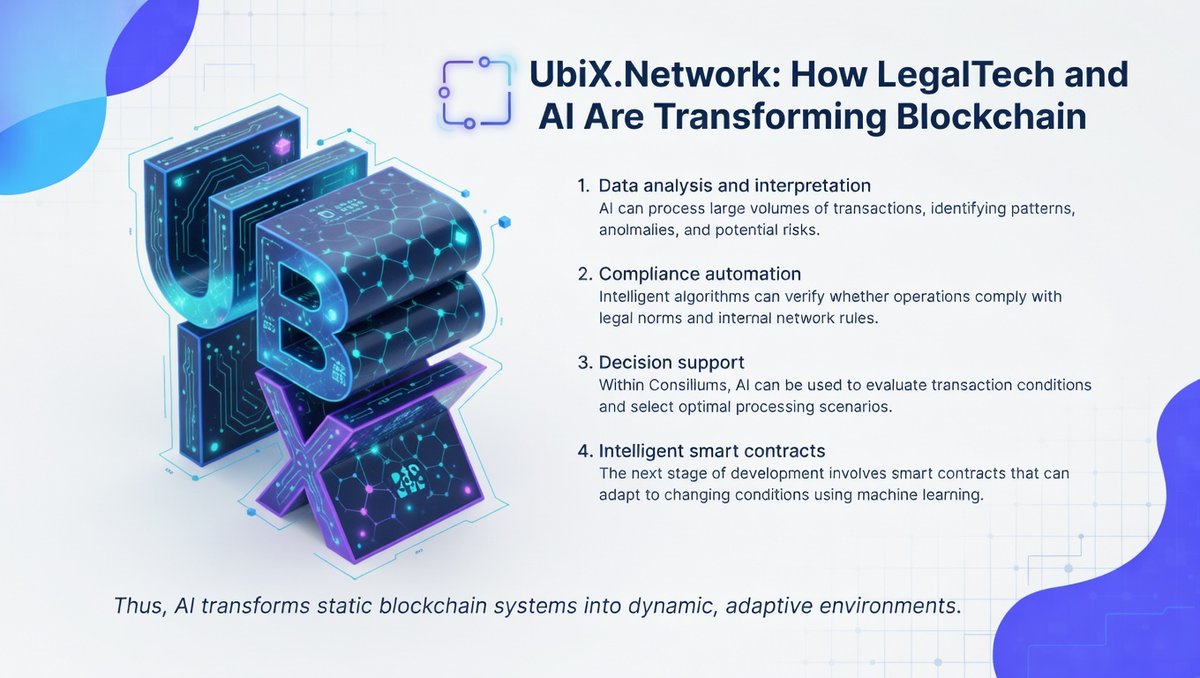
Ubix.Network: How LegalTech and AI Are Transforming Blockchain. Exciting times at Ubix.Network! 🔥 Discover how LegalTech + AI are revolutionizing blockchain:🧠 1⃣Advanced data analysis for patterns & risks 2⃣Automated compliance checks 3⃣Smarter decision support in Consiliums 4⃣Adaptive intelligent smart contracts From static chains → dynamic, adaptive ecosystems! Read More!👇 ubix.network/blog/how-legal…. #Blockchain #AI #LegalTech #Web3 #Innovation
UBIX.Network tweet media
English
0
8
20
311
UBIX.Network
UBIX.Network@UBIX_Network·
The future of blockchain is not competition — it’s integration. UBIX.Network is not just another blockchain. It’s a “network of networks,” where different blockchains (public and private) are объединяются into a single ecosystem. What does this provide? ▪️ interaction between different blockchains without intermediaries ▪️ unlimited scalability ▪️ a unified space for data and transactions UBIX is building an infrastructure where blockchains are not isolated — they work together. #UBIX #Blockchain #Web3 #Interoperability
UBIX.Network tweet media
English
1
9
23
557
UBIX.Network
UBIX.Network@UBIX_Network·
In a world where technology is evolving faster than ever, it’s especially important to be part of a community that doesn’t just follow trends—but shapes them. Ubix.Network is not just a platform; it’s an ecosystem of opportunities where every participant plays an important role.🧠 Why does this matter❓ Ubix.Network brings together innovation, decentralization, and real-world blockchain use cases. It’s a space where ideas turn into solutions, and solutions turn into value for users around the world.🌍 Your contribution is more than just participation — it’s a step toward building a global decentralize infrastructure.🛠️ Very soon, we’ll be excited to share our latest updates and news with you! 🤗 #Ubix #Blockchain #Web3 #dag
UBIX.Network tweet media
English
1
7
22
490
UBIX.Network
UBIX.Network@UBIX_Network·
Dear friends, We kindly ask you to support our project on the MEXC exchange. We would be grateful if you could transfer your $UBX (or part of it) from other exchanges to your account on the MEXC exchange. Your cooperation during this brief period is invaluable to us and demonstrates the strength and unity of the Ubix community. With gratitude, The Ubix Team 🙏
English
4
4
14
980
UBIX.Network
UBIX.Network@UBIX_Network·
What makes Ubix.Network a unique project? Ubix.Network is not just a blockchain — it is a “blockchain of blockchains.” Within a single P2P network, multiple blockchains can operate with their own rules and consensus mechanisms. 🔹 each network can have its own consensus 🔹 blocks form a DAG graph instead of a single chain 🔹 blockchains interact without intermediaries or bridges This approach makes it possible to combine public and private networks into a single infrastructure, eliminating the problem of isolated blockchains. Ubix.Network is a step toward true Web3 interoperability #dag #ubix #ubx #ubixnetwork #web3
UBIX.Network tweet media
English
1
3
22
621
UBIX.Network
UBIX.Network@UBIX_Network·
Legal Model and Legal Layer One of the unique directions in the updated white paper is the Legal-by-Design approach. 📌 This means that the selection of a consortium and the signing of transactions are accompanied by the selection of technical and legal rules. 📌 Thus, transactions and data obtain not only technical but also legal certainty — which is especially in demand in corporate and regulated industries. 📌 Ubix.Network provides for built-in legal contracts as part of the consortium (Terms and Conditions, SLA, Data Processing Policy, etc.). This makes it possible to combine the advantages of Web3 technologies with compliance with regulatory requirements.
UBIX.Network tweet media
English
1
4
18
482
UBIX.Network
UBIX.Network@UBIX_Network·
How UBIX.Network Solves the Interoperability Problem 🔗 Traditional blockchains often face compatibility challenges: ▪️ different consensus mechanisms ▪️ no unified standards for cross-chain communication ▪️ reliance on complex bridge infrastructure UBIX offers a different approach: ✔️ chain integration without third-party gateways ✔️ each chain operates within a shared DAG structure ✔️ transactions can move freely between network participants This makes the project highly attractive for real-world business use cases, where private and public blockchains need to interact seamlessly without sacrificing efficiency.
UBIX.Network tweet media
English
0
6
19
576
UBIX.Network
UBIX.Network@UBIX_Network·
Practical Aspects of Using the Ubix.Network The UBIX ecosystem provides: 🔹 The ability to create custom blockchains within the network 🔹 Configurable consensus mechanisms (Proof of Stake and others) 🔹 A Super-App architecture — a single application that integrates multiple services and dApp functionalities into one interface 🔹 Integration with existing networks and wallets (staking, token wrapping, interaction with ETH/BTC) 👉This positions UBIX not just as a protocol, but as a potential Web3 infrastructure for businesses, developers, and the community
UBIX.Network tweet media
English
0
4
17
513
UBIX.Network
UBIX.Network@UBIX_Network·
UBIX Legal Model: Legal-by-Design UBIX is one of the few Web3 projects that embed legal norms directly into the blockchain architecture. Each transaction: ▪️ is cryptographically signed, ▪️ and simultaneously constitutes acceptance of a public legal agreement. This creates a transparent legal environment in which: ▪️ rights, ▪️ obligations, ▪️ and responsibilities of network participants are clearly defined. This approach makes it possible to use blockchain in the real economy, business, document management, and government systems — not only in DeFi.
UBIX.Network tweet media
English
0
7
24
520
UBIX.Network
UBIX.Network@UBIX_Network·
L0-DAG Architecture: How the UBIX Network Works At the core of UBIX lies a hybrid DAG + blockchain architecture, where blocks form a directed acyclic graph (DAG) rather than a single linear chain. This enables: ▪️ parallel transaction processing, ▪️ significantly higher throughput, ▪️ lower fees, ▪️ improved fault tolerance. The network consists of consilium blockchains, each of which can have: ▪️ its own consensus algorithm, ▪️ its own fee structure, ▪️ its own rules and legal framework. As a result, a “blockchain of blockchains” is created, capable of horizontal scaling without sacrificing decentralization.
UBIX.Network tweet media
English
0
7
21
698
UBIX.Network
UBIX.Network@UBIX_Network·
UBIX.Network Ecosystem: Super App and Services UBIX is building a full-fledged Web3 ecosystem that includes: ▪️ Ubikiri — a super app (wallet, exchange, chat, ID, staking); ▪️ Exchange (Ubix.exchange) / Swap (cryptoreceipt.io) / Depository (Ubistake.io) — financial infrastructure; ▪️ SilentNotary / SignITNow.online — decentralized notary service / online signing service; ▪️ and more. All services are integrated through a microservice architecture, creating a unified digital environment without fragmentation. This transforms UBIX into a universal Web3 platform, rather than just a blockchain.
UBIX.Network tweet media
English
1
6
30
489
UBIX.Network
UBIX.Network@UBIX_Network·
Why UBIX.Network is Web3 + AI + Law WhitePaper (ubix.network/whitepaper) positions UBIX as an L0 infrastructure for the Web3 and AI economy, where: ▪️ AI agents operate on the blockchain, ▪️ legal norms are embedded into the protocol, ▪️ a secure, regulated digital environment is created. UBIX solves the main problem of Web3 — the gap between technology and the real legal system — by building a bridge between the crypto economy and the traditional world. This makes the project a promising foundation for: ▪️ government services, ▪️ corporate solutions, ▪️ AI platforms, ▪️ next-generation Web3 applications.
UBIX.Network tweet media
English
3
11
32
705
UBIX.Network
UBIX.Network@UBIX_Network·
The Concept of Consiliums: A Revolution in Interoperability The Whitepaper introduces the concept of Consilium — logical blockchains within a single unified network. Each Consilium: ▪️ has its own rules, ▪️ its own consensus mechanism, ▪️ its own economy, ▪️ its own access model. At the same time: ▪️ a single physical node can serve multiple Consiliums, ▪️ blocks form a unified DAG rather than separate chains, ▪️ the use of bridges is not required, completely eliminating the class of vulnerabilities inherent to cross-chain solutions. This radically solves one of the main problems of Web3 — the fragmentation of the blockchain space. Ubix.Network (ubix.network/whitepaper) effectively implements true interoperability without bridges, which is a key industry trend.
UBIX.Network tweet media
English
0
8
25
578
UBIX.Network
UBIX.Network@UBIX_Network·
Ubix.Network website update. We've moved our website to a different server. We apologies for any issue you received the last few days accessing the site. It should work reliably in all regions now. Let’s check it 🧑‍💻 ubix.network
UBIX.Network tweet media
English
0
5
16
606
UBIX.Network
UBIX.Network@UBIX_Network·
Legal Framework — Integrating Blockchain into the Legal Domain One of the unique technological distinctions of $UBX is its Legal-by-Design architecture. The project is building a system in which: ▪️legal relationships are embedded directly into the structure of transactions, ▪️a chain of legally significant events is formed. This makes it possible to: ▪️apply blockchain in government institutions, notary services, and corporate document management; ▪️create legally binding records without intermediaries; ▪️build a regulation-friendly Web3, which is critically important for mass adoption. Today, legal compatibility has become the main barrier to blockchain adoption in the real economy — and @Ubix.Network directly addresses this challenge. More details 👉 ubix.network/whitepaper
UBIX.Network tweet media
English
0
5
13
479
UBIX.Network
UBIX.Network@UBIX_Network·
UBIX.Network offers a cohesive architecture for the Web3 and AI economy, in which the L0-DAG architectural layer and the Legal Framework are inextricably linked. This makes it possible to address scalability, interoperability, and legal certainty simultaneously, while also enabling a new class of applications to be built on top of the protocol—legally meaningful AI agents and services The algebraic formalization of the protocol core provides tools for rigorous analysis and systematic evolution of the system, while the AI Web3 Framework transforms UBIX into a natural infrastructure for the next wave of AI applications focused on real-world business and regulatory environments. Let’s build more this year 💪🏻
UBIX.Network tweet media
English
2
12
30
739
UBIX.Network
UBIX.Network@UBIX_Network·
Strong take. Shared data layer + many clients - is the right direction for competition. One nuance from the legal/institutional side: most decentralized systems still have a legal-relations chain break: a post is a signed blob, but the obligations/authority/context behind it are often not formally continuous. From a legal POV it can resemble "a message in a bottle": the artifact exists, but who was acting in what capacity, under which rules, and what remedies apply is hard to reconstruct rigorously, especially once you add moderation, curation lists, reputation claims, paid distribution, or "AI agents posting for me". For decentralized social to scale, we likely need execution domains where rule acceptance and authority are explicit: "this action was taken under these community rules/ roles / dispute procedures", with evidence-grade traces that survive client churn and minimize capture games. That's essentially what we implemented. Mechanically: a domain marker ('consilium ID') inside the transaction is treated as explicit acceptance of that consilium's public contract/rules by the actor; and joining/operating a node for a consilium is treated as acceptance of the validator-side contract (duties, procedures, liability boundaries). This binds both sides- actors and validators - into a continuous legal chain, rather than a probabilistic global social layer.
English
0
0
2
171
vitalik.eth
vitalik.eth@VitalikButerin·
In 2026, I plan to be fully back to decentralized social. If we want a better society, we need better mass communication tools. We need mass communication tools that surface the best information and arguments and help people find points of agreement. We need mass communication tools that serve the user's long-term interest, not maximize short-term engagement. There is no simple trick that solves these problems. But there is one important place to start: more competition. Decentralization is the way to enable that: a shared data layer, with anyone being able to build their own client on top. In fact, since the start of the year I've been back to decentralized social already. Every post I've made this year, or read this year, I made or read with firefly.social, a multi-client that covers reading and posting to X, Lens, Farcaster and Bluesky (though bluesky has a 300 char limit, so they don't get to see my beautiful long rants). But crypto social projects has often gone the wrong way. Too often, we in crypto think that if you insert a speculative coin into something, that counts as "innovating", and moves the world forward. Mixing money and social is not inherently wrong: Substack shows that it's possible to create an economy that supports very high-quality content. But Substack is about _subscribing to creators_, not _creating price bubbles around them_. Over the past decade, we have seen many many attempts at incentivizing creators by creating price bubbles around them, and all fail by (i) rewarding not content quality, but pre-existing social capital, and (ii) the tokens all going to zero after one or two years anyway. Too many people make galaxy-brained arguments that creating new markets and new assets is automatically good because it "elicits information", when the rest of their product development actions clearly betray that they're not actually interested in maximizing people's ability to benefit from that information. That is not Hayekian info-utopia, that is corposlop. Hence, decentralized social should be run by people who deeply believe in the "social" part, and are motivated first and foremost by solving the problems of social. The Aave team has done a great job stewarding Lens up to this point. I'm excited about what will happen to Lens over the next year, because I think the new team coming in are people who actually are interested in the "social": even back when the decentralized social space barely existed, they were trying to figure out how to do encrypted tweets. I plan to post more there this year. I encourage everyone to spend more time in Lens, Farcaster and the broader decentralized social world this year. We need to move beyond everyone constantly tweeting inside a single global info warzone, and into a reopened frontier, where new and better forms of interaction become possible.
Lens@LC

Today, we’re proud to share that @masknetwork will steward the next chapter for Lens, bringing the strongest onchain SocialFi foundation to life through intuitive, consumer-ready applications.

English
921
658
4.3K
606.5K
UBIX.Network
UBIX.Network@UBIX_Network·
Strong post. One angle: "better DAOs" likely need specialized execution domains, not one generic token-voting treasury. Different tasks (oracles, disputes, lists, grants, maintenance) want different rules, quorums, and security assumptions. Your concave vs convex framing maps nicely to switchable governance modes: concave -> robust aggregation/median + anti-capture; convex ->decisive leaders with explicit checks, budgets, and fast rollback/appeal paths. A practical pattern for oracles/disputes is procedural escalation: cheap local decisions by default, with higher-cost appeal/arbitration layers when stakes/subjectivity rise, so 'cost of attack' is driven by process, not just token market cap. If useful as a testbed: we built an open protocol where communities/agents can spin up many task/jurisdiction-specific chains (we call them 'consiliums') and interconnect them, with an algebraic formalization of governance/legal-integrity invariants (à la Bourbaki approach). Happy to share + get critique.
English
0
0
0
23
vitalik.eth
vitalik.eth@VitalikButerin·
We need more DAOs - but different and better DAOs. The original drive to build Ethereum was heavily inspired by decentralized autonomous organizations: systems of code and rules that lived on decentralized networks that could manage resources and direct activity, more efficiently and more robustly than traditional governments and corporations could. Since then, the concept of DAOs has migrated to essentially referring to a treasury controlled by token holder voting - a design which "works", hence why it got copied so much, but a design which is inefficient, vulnerable to capture, and fails utterly at the goal of mitigating the weaknesses of human politics. As a result, many have become cynical about DAOs. But we need DAOs. * We need DAOs to create better oracles. Today, decentralized stablecoins, prediction markets, and other basic building blocks of defi are built on oracle designs that we are not satisfied with. If the oracle is token based, whales can manipulate the answer on a subjective issue and it becomes difficult to counteract them. Fundamentally, a token-based oracle cannot have a cost of attack higher than its market cap, which in turn means it cannot secure assets without extracting rent higher than the discount rate. And if the oracle uses human curation, then it's not very decentralized. The problem here is not greed. The problem is that we have bad oracle designs, we need better ones, and bootstrapping them is not just a technical problem but also a social problem. * We need DAOs for onchain dispute resolution, a necessary component of many types of more advanced smart contract use cases (eg. insurance). This is the same type of problem as price oracles, but even more subjective, and so even harder to get right. * We need DAOs to maintain lists. This includes: lists of applications known to be secure or not scams, lists of canonical interfaces, lists of token contract addresses, and much more. * We need DAOs to get projects off the ground quickly. If you have a group of people, who all want something done and are willing to contribute some funds (perhaps in exchange for benefits), then how do you manage this, especially if the task is too short-duration for legal entities to be worth it? * We need DAOs to do long-term project maintenance. If the original team of a project disappears, how can a community keep going, and how can new people coming in get the funding they need? One framework that I use to analyze this is "convex vs concave" from vitalik.eth.limo/general/2020/1… . If the DAO is solving a concave problem, then it is in an environment where, if faced with two possible courses of action, a compromise is better than a coin flip. Hence, you want systems that maximize robustness by averaging (or rather, medianing) in input from many sources, and protect against capture and financial attacks. If the DAO is solving a convex problem, then you want the ability to make decisive choices and follow through on them. In this case, leaders can be good, and the job of the decentralized process should be to keep the leaders in check. For all of this to work, we need to solve two problems: privacy, and decision fatigue. Without privacy, governance becomes a social game (see vitalik.eth.limo/general/2025/0… ). And if people have to make decisions every week, for the first month you see excited participation, but over time willingness to participate, and even to stay informed, declines. I see modern technology as opening the door to a renaissance here. Specifically: * ZK (and in some cases MPC/FHE, though these should be used only when ZK along cannot solve the problem) for privacy * AI to solve decision fatigue * Consensus-finding communication tools (like pol.is, but going further) AI must be used carefully: we must *not* put full-size deepseek (or worse, GPT 5.2) in charge of a DAO and call it a day. Rather, AI must be put in thoughtfully, as something that scales and enhances human intention and judgement, rather than replacing it. This could be done at DAO level (eg. see how deepfunding.org works), or at individual level (user-controlled local LLMs that vote on their behalf). It is important to think about the "DAO stack" as also including the communication layer, hence the need for forums and platforms specially designed for the purpose. A multisig plus well-designed consensus-finding tools can easily beat idealized collusion-resistant quadratic funding plus crypto twitter. But in all cases, we need new designs. Projects that need new oracles and want to build their own should see that as 50% of their job, not 10%. Projects working on new governance designs should build with ZK and AI in mind, and they should treat the communication layer as 50% of their job, not 10%. This is how we can ensure the decentralization and robustness of the Ethereum base layer also applies to the world that gets built on top.
English
818
536
3.3K
381.9K
UBIX.Network
UBIX.Network@UBIX_Network·
aiming to preserve low-latency composability without pushing everything into separate-universe L2 semantics. We implemented this direction in our network, and we also provide a strict algebraic interpretation⬇️
English
1
0
1
16
donnoh.eth 💗
donnoh.eth 💗@donnoh_eth·
native rollups (eip-8079) aim to massively simplify evm-equivalent rollups. right now, almost no one outside the original rollup team fully understands a rollup stack, and even inside a team few are really familiar with it. with native rollups, as long as there are people that understand L1, there would also be people that understand native rollups. and as long as L1 gets patched and upgraded, native rollups will be patched and upgraded, even if the original rollup team has walked away.
vitalik.eth@VitalikButerin

An important, and perenially underrated, aspect of "trustlessness", "passing the walkaway test" and "self-sovereignty" is protocol simplicity. Even if a protocol is super decentralized with hundreds of thousands of nodes, and it has 49% byzantine fault tolerance, and nodes fully verify everything with quantum-safe peerdas and starks, if the protocol is an unwieldy mess of hundreds of thousands of lines of code and five forms of PhD-level cryptography, ultimately that protocol fails all three tests: * It's not trustless because you have to trust a small class of high priests who tell you what properties the protocol has * It doesn't pass the walkaway test because if existing client teams go away, it's extremely hard for new teams to get up to the same level of quality * It's not self-sovereign because if even the most technical people can't inspect and understand the thing, it's not fully yours It's also less secure, because each part of the protocol, especially if it can interact with other parts in complicated ways, carries a risk of the protocol breaking. One of my fears with Ethereum protocol development is that we can be too eager to add new features to meet highly specific needs, even if those features bloat the protocol or add entire new types of interacting components or complicated cryptography as critical dependencies. This can be nice for short-term functionality gains, but it is highly destructive to preserving long-term self-sovereignty, and creating a hundred-year decentralized hyperstructure that transcends the rise and fall of empires and ideologies. The core problem is that if protocol changes are judged from the perspective of "how big are they as changes to the existing protocol", then the desire to preserve backwards compatibility means that additions happen much more often than subtractions, and the protocol inevitably bloats over time. To counteract this, the Ethereum development process needs an explicit "simplification" / "garbage collection" function. "Simplification" has three metrics: * Minimizing total lines of code in the protocol. An ideal protocol fits onto a single page - or at least a few pages * Avoiding unnecessary dependencies on fundamentally complex technical components. For example, a protocol whose security solely depends on hashes (even better: on exactly one hash function) is better than one that depends on hashes and lattices. Throwing in isogenies is worst of all, because (sorry to the truly brilliant hardworking nerds who figured that stuff out) nobody understands isogenies. * Adding more _invariants_: core properties that the protocol can rely on, for example EIP-6780 (selfdestruct removal) added the property that at most N storage slots can be changedakem per slot, significantly simplifying client development, and EIP-7825 (per-tx gas cap) added a maximum on the cost of processing one transaction, which greatly helps ZK-EVMs and parallel execution. Garbage collection can be piecemeal, or it can be large-scale. The piecemeal approach tries to take existing features, and streamline them so that they are simpler and make more sense. One example is the gas cost reforms in Glamsterdam, which make many gas costs that were previously arbitrary, instead depend on a small number of parameters that are clearly tied to resource consumption. One large-scale garbage collection was replacing PoW with PoS. Another is likely to happen as part of Lean consensus, opening the room to fix a large number of mistakes at the same time ( youtube.com/watch?v=10Ym34… ). Another approach is "Rosetta-style backwards compatibility", where features that are complex but little-used remain usable but are "demoted" from being part of the mandatory protocol and instead become smart contract code, so new client developers do not need to bother with them. Examples: * After we upgrade to full native account abstraction, all old tx types can be retired, and EOAs can be converted into smart contract wallets whose code can process all of those transaction types * We can replace existing precompiles (except those that are _really_ needed) with EVM or later RISC-V code * We can eventually change the VM from EVM to RISC-V (or other simpler VM); EVM could be turned into a smart contract in the new VM. Finally, we want to move away from client developers feeling the need to handle all older versions of the Ethereum protocol. That can be left to older client versions running in docker containers. In the long term, I hope that the rate of change to Ethereum can be slower. I think for various reasons that ultimately that _must_ happen. These first fifteen years should in part be viewed as an adolescence stage where we explored a lot of ideas and saw what works and what is useful and what is not. We should strive to avoid the parts that are not useful being a permanent drag on the Ethereum protocol. Basically, we want to improve Ethereum in a way that looks like this:

English
11
16
232
49.7K