Undiscovered Compounders

2.9K posts

Undiscovered Compounders banner
Undiscovered Compounders

Undiscovered Compounders

@UCompounders

Professional rock-turner. Finding the companies the market hasn't found yet, but can't ignore for long. 10+ years in the markets. Deep dives in the newsletter ↓

Join +1.8K Readers ➝ Katılım Ekim 2025
147 Takip Edilen1.5K Takipçiler
Sabitlenmiş Tweet
Undiscovered Compounders
Undiscovered Compounders@UCompounders·
My Atlas $SALT.NE deep dive is getting shared around Canadian Wall Street. Now I know where all those new subscribers are coming from. Not gonna lie, that's motivating!
Undiscovered Compounders tweet media
English
1
2
12
1.7K
Antonio (Resource Talks)
Antonio (Resource Talks)@ResourceTalks·
I asked @AshleyGoldCorp $ASHL.CN if they could/should sell (or option or w/e) some of their non-core projects to help fund drilling on the flagship. It can work sometimes, I've been told. Do you know of any small juniors that have done this successfully and/or that are trying it right now? Or does it usually end up creating more problems than it solves?
English
2
1
11
2.4K
Andrew Kuhn
Andrew Kuhn@FocusedCompound·
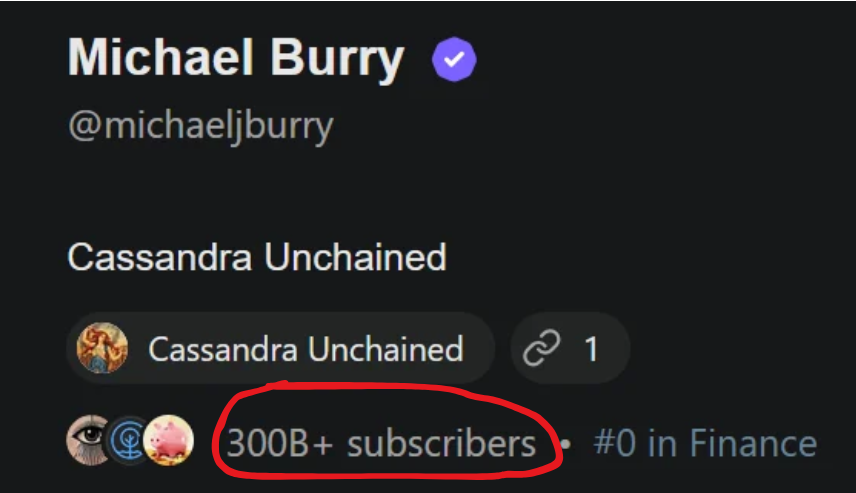
JUST IN: Michael Burry's substack crosses 300,000 subscribers He could potential be making $10 billion a month from Substack.
English
14
2
78
30.3K
Undiscovered Compounders
Undiscovered Compounders@UCompounders·
Anybody who thinks "You can't beat the pros" should read this story. 2008, deep in the subprime crisis. Every trader with a Bloomberg terminal saw a headline hit their screen: United Airlines files for bankruptcy. Of course they sold. Smart. The stock fell 75% in 15 minutes and the Nasdaq had to halt it. The filing was real, just off by one digit: it was from 2002. Someone had reposted it as new. Google picked it up, then Bloomberg, and not one of the pros who sold checked the date. This is what an efficient market looks like.
GIF
English
0
0
6
261
Undiscovered Compounders
Undiscovered Compounders@UCompounders·
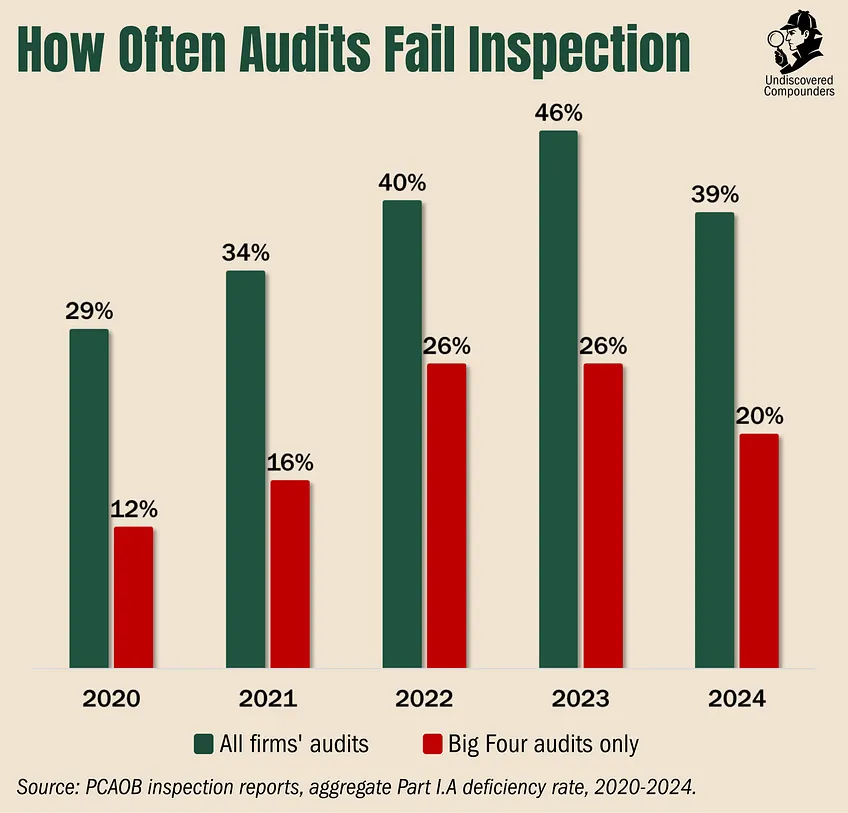
@jfjgfjk Good insight. It's both actually. Here are the 2024 numbers: - 77% were risk-based → 37% deficiency rate on average - 18% were random → 19% deficiency rate on average - 5% focused on a specific theme rather than whole engagements (not relevant for us here). Hope it helps.
English
1
0
1
26
J
J@jfjgfjk·
@UCompounders The quoted failure rate is so high that I'm thinking maybe there is a bias there. Do regulators make inspections at random or do they follow leads/suspicious situations? Curious.
English
1
0
2
214
Undiscovered Compounders
Undiscovered Compounders@UCompounders·
I hope you're sitting down. 40% of audits fail when the regulator inspects them. Even the famous Big Four? Still 20%. Never trust anyone with the slightest incentive to mislead you. Never.

Undiscovered Compounders tweet media
English
1
1
9
3.8K
Undiscovered Compounders
Undiscovered Compounders@UCompounders·
Fair point, and worth nailing down. To be fully rigorous, here's how the PCAOB defines the deficiencies I'm referring to in this chart (what they call "Part I.A"): "Part I.A of our PCAOB inspection reports discusses deficiencies, if any, that were of such significance that we believe the firm, at the time it issued its audit report(s), had not obtained sufficient appropriate audit evidence to support its opinion(s) on the public company's financial statements and/or internal control over financial reporting (ICFR)."
English
1
0
1
42
JP Insights
JP Insights@Aktiehedonist·
20% for the Big Four, and considerably higher for firms outside it. The Big Four number is broadly in line with what I experienced. The overall 39% looks surprisingly high, though. But “failed inspection” sounds more dramatic than it usually is. It does not necessarily mean the auditors missed a material misstatement or something investors should have known. A deficiency can relate to insufficient documentation, weak referencing in the working papers, or a procedure that was performed but not documented properly. None of that should be taken lightly. But there is a big difference between an audit deficiency and incorrect financial statements.
Undiscovered Compounders@UCompounders

I hope you're sitting down. 40% of audits fail when the regulator inspects them. Even the famous Big Four? Still 20%. Never trust anyone with the slightest incentive to mislead you. Never.

English
4
0
5
3.3K
Undiscovered Compounders
Undiscovered Compounders@UCompounders·
There's one thought that gives me a cortisol spike at random moments, sometimes right before I fall asleep: what don't I know that I don't know? Somewhere there's a skill I could learn in an afternoon that would save me years. A book I'll never open that holds the one idea worth more than everything else I've read. A company I've never heard of (there's always one) that ends up being the best thing I never bought. I can't price any of it. Neither can you. The opportunity cost of something you never imagined doesn't send an invoice. We fight it every day, every second we spend reading/thinking. But we can almost never tell how much we're winning. Or losing. So tell me: which skill, which idea made you think "Ok, I’ve probably won this time"?
English
0
0
2
173
Undiscovered Compounders
Undiscovered Compounders@UCompounders·
@AZbroker I think it's a matter of incentives: audit firms are slightly incentivized not to dig too deep, to the point where something like a third of audits got flagged as incomplete by the regulator. I don't see AI changing that. x.com/UCompounders/s…
Undiscovered Compounders@UCompounders

I hope you're sitting down. 40% of audits fail when the regulator inspects them. Even the famous Big Four? Still 20%. Never trust anyone with the slightest incentive to mislead you. Never.

English
1
1
2
89
Undiscovered Compounders
Undiscovered Compounders@UCompounders·
My performance, and that of some people I know, completely disagrees with you. Most are trash, you're completely right. But it's just about finding the one at $50M that becomes a $500M, or even a $5B (and holding it, of course). I like to say that the main job of a micro-cap investor is sorting through garbage. And when you come across a company that doesn't belong in any bin, it was worth the 200 others you just spent eliminating. But tbh I've had this debate dozens of times, and in almost every case, logical arguments won't convince anyone. Risk is, first and foremost, a matter of perception, and no logical law governs it. It depends entirely on the person. The quality of a strategy also depends on the strategist. The only thing that really matters is that each person is comfortable with their strategy and happy with their performance. That's the only relevant fact. The rest is just opinion.
English
1
0
0
18
JiuJitsu
JiuJitsu@jiujitsu199·
@UCompounders Well, I think there is a sweet spot. Because, if you go to nano-cap or microcap stocks, like 10M to 100M, most of them are trash. If you go to 1B companies, I think that is where the money is. Find a 1 B company that is going to be 2B is easier than finding a 10 M to 20 M, IMO
English
1
0
0
15
Undiscovered Compounders
Undiscovered Compounders@UCompounders·
That's exactly why I focus on small caps, and why 98% of finX should too. Their arguments were true 50 years ago, they're still true today, and they'll still be true in 100.
English
2
2
13
1.7K
Undiscovered Compounders
Undiscovered Compounders@UCompounders·
That's just a stock-picking problem. If you're here to hold an index and chill, you're right (note that simply applying a quality screen, like profitability, to a small-cap index outperforms the S&P 500). If you're here to spend time deeply analyzing companies and taking bets, small caps are objectively better. Not to mention it's easier to know and deeply understand a $300M market cap company inside out than a $300B one. And that's before even talking about competition. I have seen mispricings in the small-cap world that I could never find in the large-cap world. And if I'm going to spend the time anyway, I'd rather spend it where my stock picker skills have the best chance of being rewarded.
English
1
0
1
29
JiuJitsu
JiuJitsu@jiujitsu199·
@UCompounders Disagree, small caps are way way riskier than big caps. Riskier in a sense that if you pick 100 companies, a much higher percentage will be down by 50% 5 years later. Taking concentration in that subclass puts the odds against you.
English
1
1
0
38
Undiscovered Compounders
Undiscovered Compounders@UCompounders·
@PhilipDayUK I completely agree. From what I've observed, the social belonging / identity angle plays a huge role in this, set against the opportunity cost of just managing your own money, invisible to anyone who isn't looking for it.
English
0
0
0
21
Philip Day
Philip Day@PhilipDayUK·
@UCompounders If you work for a big financial institution and you are good... you are playing on hard mode with other people's money and get crumbs from the wins. Why not quit and do it with your own money? Uncapped upside as it compounds.
English
1
0
1
34
Undiscovered Compounders
Undiscovered Compounders@UCompounders·
Yes, that was my point at the end. It's a trade-off that can be worth it, and probably is worth it for most investors. That said, I don't see how the big watchlist idea works as a counterargument. Going through filings, finding a potential candidate, and setting an alert at an absurdly low price is pretty cheap in terms of time. It's the step from the alert triggering to actually entering the position + plus everything that comes after that's costly, and that's what falls into my argument imho.
English
1
0
2
46
I, Bayes
I, Bayes@i_bayes·
@UCompounders Perhaps we don't always need to track a company perfectly. That's what a wide margin of safety for. It's more likely to get a bargain from a big watchlist, sometimes (not often) they are quite obvious.
English
1
0
1
45
Undiscovered Compounders
Undiscovered Compounders@UCompounders·
I'm a full-time investor and I still can't track more than 10 companies perfectly. I'm working 90h/week, investing is literally my life, and 10 is my honest ceiling: the business, the sector it lives in, the people, the regulation, etc. If you're doing this alone, you can't truly know 20. If it's not even your job, don't even think about 10. That's not a flaw in itself. Diversification is protection against ignorance. Just don't kid yourself. You're more likely to pay for it with bad behavior driven by uncertainty. But that trade-off can be worth it.
English
2
0
15
513
Undiscovered Compounders
Undiscovered Compounders@UCompounders·
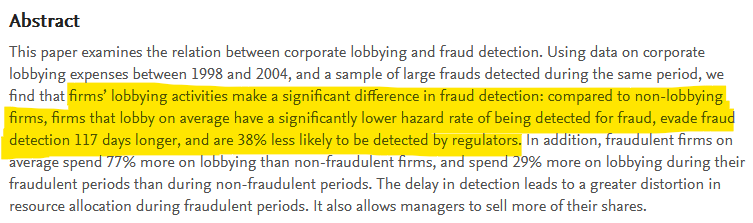
Fraudulent firms spend 77% more on lobbying than clean ones. And it works: they're 38% less likely to get caught. So if you own one that lobbies, just make sure it lobbies well.
Undiscovered Compounders tweet media
English
0
0
5
577
Undiscovered Compounders retweetledi
Undiscovered Compounders
Undiscovered Compounders@UCompounders·
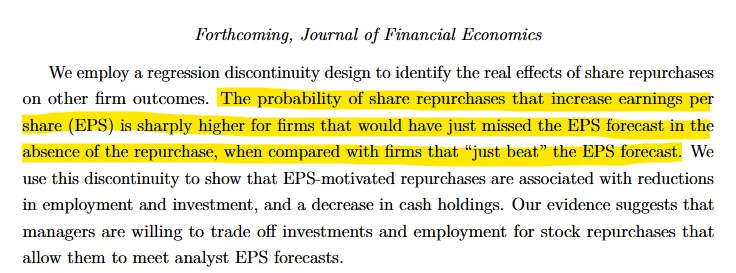
Boardroom, real conversation (paraphrased): - "Boss, we're about to miss the EPS target. Barely. What do we do?" - "Can't move the numerator. Buyback the denominator." - "Won't investors notice?" - “No. We'll call it returning value to shareholders. They'll call us good capital allocators."
Undiscovered Compounders tweet media
English
3
2
21
2.1K
Undiscovered Compounders
Undiscovered Compounders@UCompounders·
Half of FinTwit says buy the dip. The other half says buying the dip is how you catch a falling piano. Both halves have receipts. Both halves have smart people in them. But of course, both halves can't be right. (This is your regular reminder that "smart people agree" has never once been a valid data point.) Be your own smart guy, or borrow someone else's data. Never, ever, their conviction.
English
1
0
9
437
Undiscovered Compounders
Undiscovered Compounders@UCompounders·
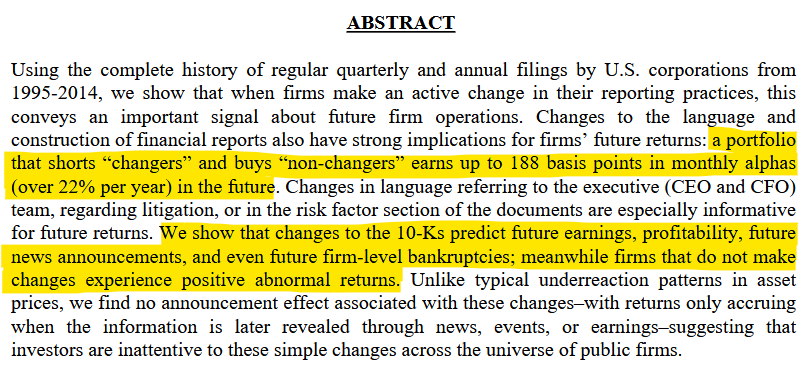
Wow. A strategy that: - goes long companies whose 10-K language doesn't change and, - shorts the ones that rewrite it, earned over 22% a year. What level of investing is that?
Undiscovered Compounders tweet media
English
9
23
507
43.4K