The Unheard African Podcast (TUA)

23 posts

The Unheard African Podcast (TUA) banner
The Unheard African Podcast (TUA)

The Unheard African Podcast (TUA)

@UnheardAfrican

Questioning the norm. Where the Unheard Speak. Your Platform. Your Voice. Your Africa.

Nairobi, Kenya Katılım Nisan 2025
12 Takip Edilen17 Takipçiler
The Unheard African Podcast (TUA)
The Unheard African Podcast (TUA)@UnheardAfrican·
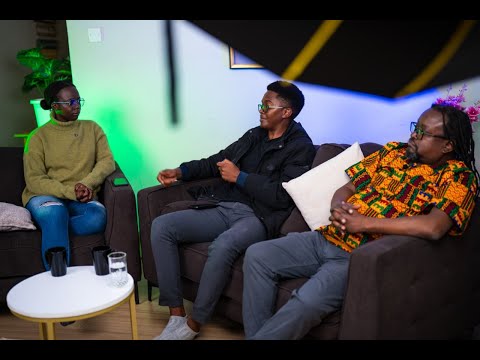
A snippet from our latest episode of The Unheard African Podcast. The conversation only gets deeper from here. Watch and listen to the full episode now on YouTube and Spotify. #African #podcast #TUA
English
0
3
3
71
The Unheard African Podcast (TUA)
The Unheard African Podcast (TUA)@UnheardAfrican·
🎙️ Episode 3 drops Monday at 9AM. Set your reminder. This conversation is not comfortable but it’s necessary The world applauds electric cars, clean energy transitions, & net-zero pledges. But beneath the applause lies a harder question: who absorbs the cost? #TuanaSisi
The Unheard African Podcast (TUA) tweet media
English
1
4
6
71
The Unheard African Podcast (TUA)
The Unheard African Podcast (TUA)@UnheardAfrican·
From cobalt extraction in the Congo to carbon offset schemes that uproot communities, the so-called green revolution often mirrors old patterns of exploitation wrapped in eco-friendly language. Is this climate justice, or extraction redesigned?
English
0
1
2
35
The Unheard African Podcast (TUA)
The Unheard African Podcast (TUA)@UnheardAfrican·
Moral hazards happen when systems reward bad behavior or fail to punish it. When citizens watch elites loot billions with impunity while small offenders face harsh penalties, a rational thought emerges: “The system is corrupt, why should I be the only saint?” That mindset spreads
English
0
1
2
30
The Unheard African Podcast (TUA)
The Unheard African Podcast (TUA)@UnheardAfrican·
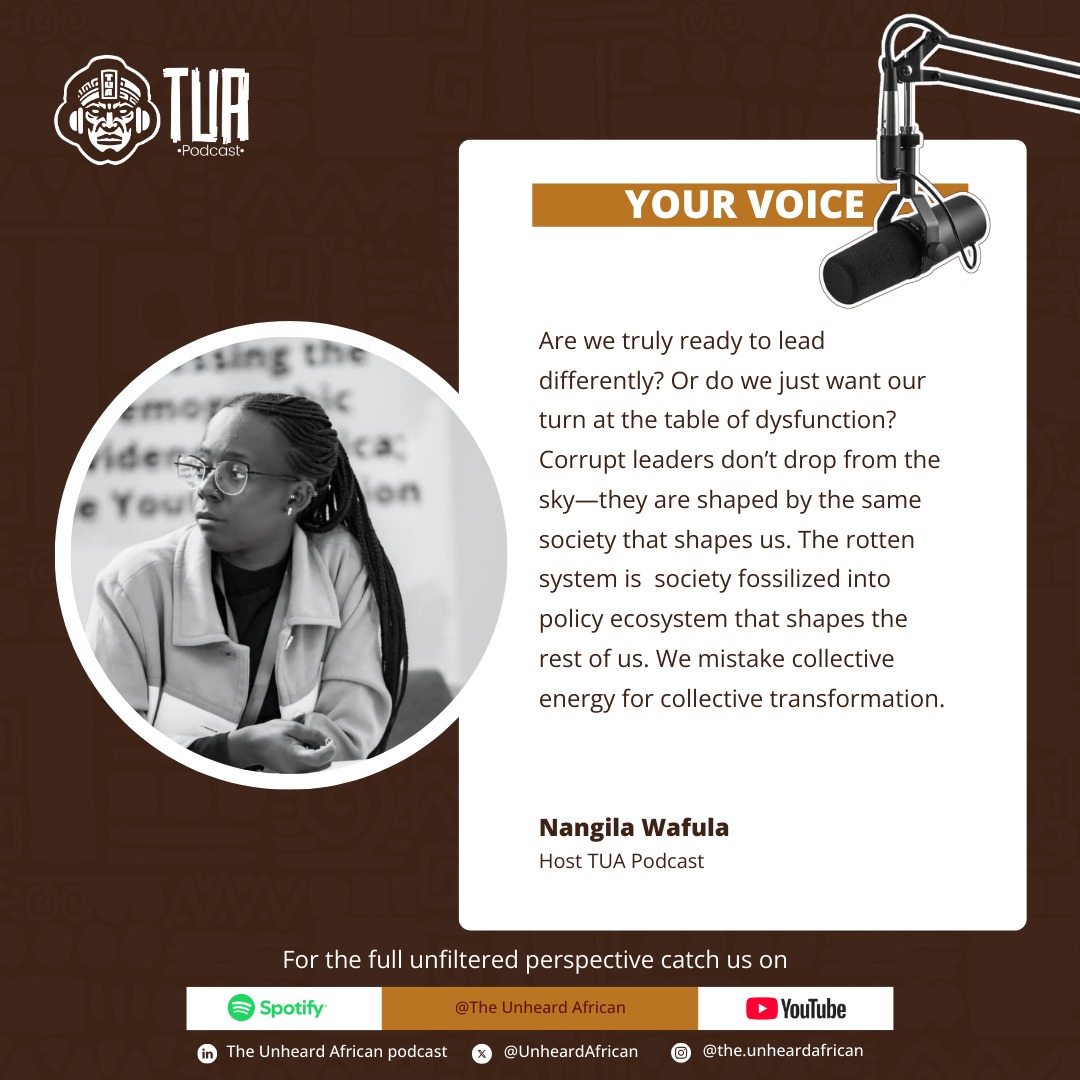
Moral absolutism and the Youth Political Dilemma. For the full unfiltered perspective, catch us on Spotify and YouTube. YouTube: @ The Unheard African Podcast Spotify: @ The Unheard African
English
0
1
1
24
The Unheard African Podcast (TUA) retweetledi
The Unheard African Podcast (TUA)
The Unheard African Podcast (TUA)@UnheardAfrican·
Episode 2 is back, refreshed, and reintroduced. We explore moral absolutism and the youth political dilemma through honest, thought-provoking dialogue. Watch these snippets and catch the full episode on Spotify and YouTube through. Our handles are #TheUnheardAfricanPodcast
The Unheard African Podcast (TUA) tweet mediaThe Unheard African Podcast (TUA) tweet mediaThe Unheard African Podcast (TUA) tweet mediaThe Unheard African Podcast (TUA) tweet media
English
0
3
3
83
The Unheard African Podcast (TUA) retweetledi
#LandIsNotProperty Mwalimu Wandia
We are going to be hammered with propaganda and gaslighting next year at levels never witnessed before. Kenyans who do not arm themselves with knowledge and history are going to struggle. We will also have to be so careful, very careful, with consumption of social and mainstream media. It is going to be bad, bad, bad, and politicians will shower money to render people blind.
Ndung'u Wainaina@NdunguWainaina

Just reminder, That stolen billions are not disappearing into thin air. It is being converted into the political money war chest. The punitive tax and debt are being placed on the backs of the Kenyan people, while the stolen billions are being used to secure political survival.


English
0
118
219
6.1K
The Unheard African Podcast (TUA) retweetledi
Mwende
Mwende@mwende_kyalo_·
At the point when colonisation in all its forms stop...and when the effects of colonisation wear off. When the pungent scent of colonisation is no longer in our clothes, our hair, our financial institutions, our building designs, our homes, our curriculum, our music, our, our
samora kipp@SamoraKipp

@wmnjoya At what point will we stop blaming colonialism and start being responsible for our destiny as Africans, 100 years, 200 years?

English
18
611
1.9K
37.3K
The Unheard African Podcast (TUA) retweetledi
#LandIsNotProperty Mwalimu Wandia
The frequency with which I have heard the phrase: "Kenyans (parents/teachers) have misunderstood what CBE is," is very disturbing. Very disturbing. That's because from the beginning, the Ministry was deliberately very vague on what CBE was. I challenge every Kenyan who keeps saying "that's not what CBE is," to look for the curriculum framework and read it. That document does not explain what CBE actually is, what competence means in education, or how it is supposed to address the challenges 8.4.4. could not address. The bulk of that document is spent on explaining subjects. And as you read it, remember that that was the only document the government had in 2018. And we replaced a whole entire system on that document. Then, go to the conversations in the media in 2017 to 2019, and you will see that I kept asking KICD: what theories are you using for competence? Where's the research? When you say Singapore implemented it, can you point me to the documents? And, in addition, I had access to KICD court affidavits with the reference list for competency. I'm sorry, the documents they cited did not discuss CBC. In fact, one in particular was about how African governments were being duped into promoting CBC. Yes, I got that document from KICD. Yesterday, @m_ogada told me that that's how policy in Africa is done these days. There's no documentation. Things are whispered in international conferences abroad, brought to cabinet meetings in Africa, and we're promised things like "nurturing talent." When you question the educational value of "nurturing talent," you find there's no documentation. So the government then says "you don't understand," and Kenyans, because they believe the government is pure, hardworking, not corrupt and full of integrity, they call you names and believe the problem is good policy without implementation. To this day, there is no academic publication on the concept of competence that considers competence a beneficial education approach. That's why NGOs had to hurriedly appoint "evidence managers" and why KICD sent officials to international academic conferences so that they could be registered in the abstracts, implying that competence was an international conversation. Eventually, I even realized that KICD was using my criticism to build a portfolio of policies, and that's why I stopped going to the media houses. So there's really nothing to go on. And I wrote that in my submission to the working party. The submission is available online. If Kenyans are misunderstanding what CBC is for, it's because the government has never explained what it actually is. GoK explains what CBE supposedly does in the classroom, but it still has never said what competence is. What was done with CBE was evil psychological genius. It's like me saying "here is a wonderful bottle of juice, it will make you clever." Then I ensure you never check if anything is in the bottle. And if people start speculating that maybe the bottle is empty, I start accusing you of never interacting with the contents of the bottle, so what do you know. Ever heard of the European story of the Emperor's new clothes? Thank God for the internet. Look for it. Because that's what happened here. Some education officials probably belong in jail.
English
2
37
70
2.6K
The Unheard African Podcast (TUA) retweetledi
BRAVIN YURI
BRAVIN YURI@BravinYuri·
If you want to know why the West is always interested in comtrolling narratives in Kenya and why Kenya matters, this should paint a picture. There are a lot of things that Kenyans don't even understand about their own country. This is what colonisers hid in the Kenyan archives.
English
52
864
1.7K
71.7K
The Unheard African Podcast (TUA) retweetledi
Jodi X
Jodi X@Jo_XX94·
African lives are cheap under imperial capitalism. We have become so desensitised to Black Africans dying in Sudan, Congo, the Sahel and many parts of the continent. It’s the normal state of affairs for Africa, “just another African war”.
English
72
6.6K
16K
229K
The Unheard African Podcast (TUA) retweetledi
Jaseme Lang'o 🇰🇪
Jaseme Lang'o 🇰🇪@JaphethOrieny·
Wadau, here is an opportunity for a fellow youth. Tunataka mtu mcreative na mwenye akona passion for Afrika. #TUAnaSISI. Join us and help in amplifying stories, voices, realities, and opinions of fellow Africans from across the continent.
Nairobi, Kenya 🇰🇪 English
0
1
2
177
The Unheard African Podcast (TUA) retweetledi
#LandIsNotProperty Mwalimu Wandia
The actors who most determined how schools developed in Kenya were not the missionaries. It was the settlers. The settlers kept campaigning against the government funding schools for Africans. Of the three East African colonies, Kenyan education for Africans was the least funded. The missionaries didn't mind school for Africans to read the bible and evangelize, but the settlers said NO education AT ALL, because 1. Africans will become big-headed and refuse to work on the lands which the settlers had grabbed 2. They will refuse to occupy the bottom rung of the apartheid economy that the settlers had envisioned for Kenya The religious instruction in school was a compromise for pacifying the settlers to grudgingly accept a little schooling for Africans. When the colonial government realized that they needed Africans who can read and write to help with colonial administration, the settlers reluctantly accepted on condition that 1. religion is taught to control the morality of African students 2. Standard 4 is the highest level of education for Africans 3. Africans should learn in vernacular. English was reserved for African elites. And the settlers were powerful because they were in the legislature, but most of all, they were club buddies with whom the colonial officers spent their free and leisure time. So settlers could walk into the colonial office at their will, and many times they travelled to London to give instructions to the Colonial Office. But Kenyan thirst for schooling was unstoppable. Kenyans raised funds to go to Makerere where a university was starting, and found scholarships and free education in countries like India, Pakistan and Russia. Eventually, the Colonial Office had to tell the settlers that denying Africans university education was not going to stop them from getting it. So the settlers came up with a compromise. Again. To start a TVET called the Royal Technical College. The settlers wanted the highest education level for Africans to be a higher TVET diploma and not degrees. But Britain and America were thinking Cold War - they couldn't stomach the possibility that Africans would go to Russia for further study. So another compromise. Let the degrees offered at RTC be offered by the University of London, so that we can control what Africans learn through curriculum and the management of the degrees. But the independence was unstoppable, so was Africans search for further education. Eventually, the TVET called RTC started offering degrees, and the school was later renamed The University of Nairobi. After independence, the settlers' talking points were taken up by Ministry of Education. Since the 60s, MoE has told us we have to go to TVET, degrees make graduates big-headed and not work, that we need to "regulate" in the name of "quality" which people go to university. But the problem has never been whether Africans have degrees or jobs. It's that our economy is still the settler economy, where the majority of Kenyans are supposed to be just labor for an elite few. That settler colonial logic still runs our economy and our school system.
English
18
318
543
30.7K
The Unheard African Podcast (TUA)
The Unheard African Podcast (TUA)@UnheardAfrican·
@lewis_ngunyi and @MutemiWaKiama challenge what leadership should (and shouldn’t) look like. From redefining power to questioning imposed models of leadership, this are the key insights from our latest episode that will make you rethink it all. 🎙️
The Unheard African Podcast (TUA) tweet mediaThe Unheard African Podcast (TUA) tweet media
English
0
0
1
5