Victor Chapela

761 posts

Victor Chapela banner
Victor Chapela

Victor Chapela

@VChapela

CEO @ Contextful (stealth) - AI, Information Theory, Active Inference, Physics, Entrepreneurship

Palo Alto, CA Katılım Mart 2008
380 Takip Edilen857 Takipçiler
Victor Chapela
Victor Chapela@VChapela·
@alexolegimas And higher education is also status-driven and relational. So probably that should also be included.
English
0
0
0
11
Victor Chapela
Victor Chapela@VChapela·
@alexolegimas Alex, great essay. I would add that status-driven, relation-economy includes things like live entertainment (sports, concerts) and hospitality (dining out, tourism). If so, that red layer is already growing fast and will speed up significantly.
English
1
0
0
24
Alex Imas
Alex Imas@alexolegimas·
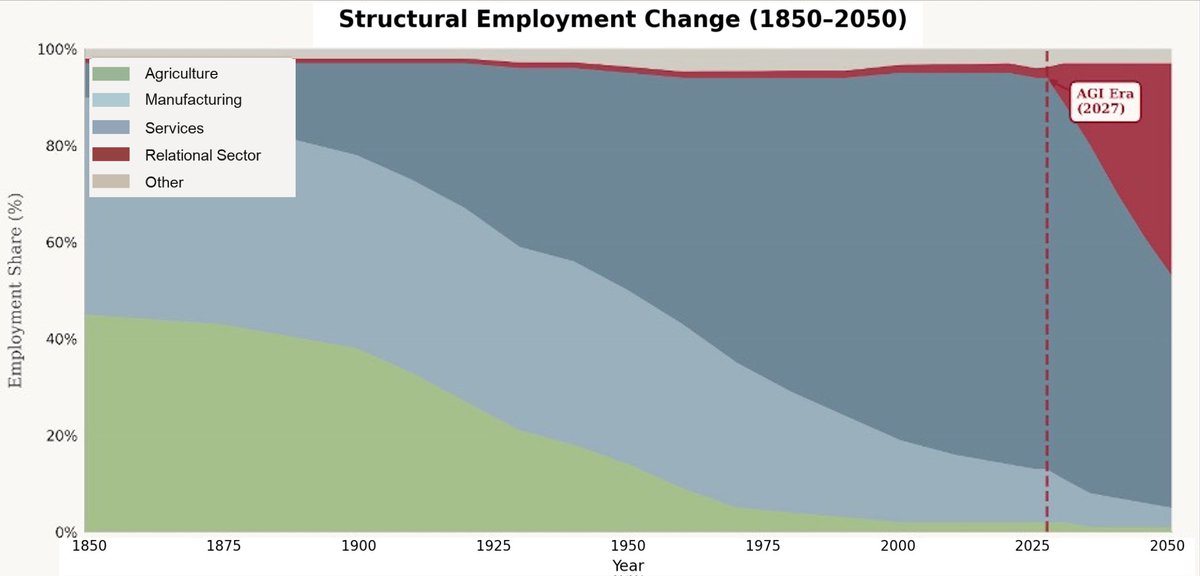
New essay on the economics of structural change and the post-commodity future of work. 1. Almost any question about the impact of advanced AI on the economy needs to start at the same place: what is still scarce? Answer that, and the analysis becomes pretty straightforward. This essay explores what becomes scarce if AI really can replicate most of what humans do in production, and what this mean for the future of jobs. 2. My conjecture, working through the economics: labor reallocates across sectors, and the sector it reallocates to has properties that keep labor a meaningful share of the economy. Ultimately this is about the structure of demand itself. For this, we have to go back to Girard, Augustine and Rousseau: once people's base needs are met, their preferences shift to comparative motives (e.g., status, exclusivity, social desirability). This motive is inherently non-satiated. 4. The key paper is Comin, Lashkari, and Mestieri (Econometrica 2021). As people get richer, they don't buy proportionally more of everything. They shift spending toward sectors with higher income elasticity. They estimate income effects account for 75%+ of observed structural change. 5. The ironic consequence: the sector that gets automated becomes a smaller share of the economy, not a larger one. Agriculture got massively more productive and its share of employment collapsed. Manufacturing too. The "stagnant" sectors absorb the spending and the jobs. 6. So the question is: which sectors have high income elasticity in a post-AGI world? I argue it's what I call the relational sector. Categories where the human isn't just an input into production, it is part of the value. 7. Why does the relational sector have high income elasticity? Because human desire has a mimetic, relational dimension. We don't just want things for their intrinsic properties. We want what others want, and we want it more when others can't have it. Girard, Rousseau, Augustine, and Hobbes all saw this. 8. In work with Kristóf Madarász, we showed this experimentally: WTP roughly doubles when a random subset of others is excluded from the good. And in new work with Graelin Mandel, AI involvement kills the premium. Human-made art gains 44% from exclusivity; AI-made art only 21%. 9. This all comes together for the core argument. The sector that absorbs spending as AI makes commodity production cheap is one where human provenance is part of the value, and demand for it grows faster than income. Exactly the profile that keeps labor meaningful. 10. To be clear about the claim: I'm NOT saying aggregate labor share must rise. It may fall. The claim is about sectoral composition, i.e., where expenditure and employment go once commodities get cheap, and the fact that the sector that will absorb reallocated labor maps to a substantial component of human preferences and desire. 11. If you're interested in the formal model, a linked companion technical note works out all the economics. Read the essay here: aleximas.substack.com/p/what-will-be…
Alex Imas tweet media
English
155
461
2.5K
862.2K
Victor Chapela
Victor Chapela@VChapela·
Yes, totally agree with the concept of relational economy expanding.
Alex Imas@alexolegimas

New essay on the economics of structural change and the post-commodity future of work. 1. Almost any question about the impact of advanced AI on the economy needs to start at the same place: what is still scarce? Answer that, and the analysis becomes pretty straightforward. This essay explores what becomes scarce if AI really can replicate most of what humans do in production, and what this mean for the future of jobs. 2. My conjecture, working through the economics: labor reallocates across sectors, and the sector it reallocates to has properties that keep labor a meaningful share of the economy. Ultimately this is about the structure of demand itself. For this, we have to go back to Girard, Augustine and Rousseau: once people's base needs are met, their preferences shift to comparative motives (e.g., status, exclusivity, social desirability). This motive is inherently non-satiated. 4. The key paper is Comin, Lashkari, and Mestieri (Econometrica 2021). As people get richer, they don't buy proportionally more of everything. They shift spending toward sectors with higher income elasticity. They estimate income effects account for 75%+ of observed structural change. 5. The ironic consequence: the sector that gets automated becomes a smaller share of the economy, not a larger one. Agriculture got massively more productive and its share of employment collapsed. Manufacturing too. The "stagnant" sectors absorb the spending and the jobs. 6. So the question is: which sectors have high income elasticity in a post-AGI world? I argue it's what I call the relational sector. Categories where the human isn't just an input into production, it is part of the value. 7. Why does the relational sector have high income elasticity? Because human desire has a mimetic, relational dimension. We don't just want things for their intrinsic properties. We want what others want, and we want it more when others can't have it. Girard, Rousseau, Augustine, and Hobbes all saw this. 8. In work with Kristóf Madarász, we showed this experimentally: WTP roughly doubles when a random subset of others is excluded from the good. And in new work with Graelin Mandel, AI involvement kills the premium. Human-made art gains 44% from exclusivity; AI-made art only 21%. 9. This all comes together for the core argument. The sector that absorbs spending as AI makes commodity production cheap is one where human provenance is part of the value, and demand for it grows faster than income. Exactly the profile that keeps labor meaningful. 10. To be clear about the claim: I'm NOT saying aggregate labor share must rise. It may fall. The claim is about sectoral composition, i.e., where expenditure and employment go once commodities get cheap, and the fact that the sector that will absorb reallocated labor maps to a substantial component of human preferences and desire. 11. If you're interested in the formal model, a linked companion technical note works out all the economics. Read the essay here: aleximas.substack.com/p/what-will-be…

English
0
0
0
27
Victor Chapela
Victor Chapela@VChapela·
Zach - thanks for answer, thoroughness in your model. I will keep trying to help you falsify. Probably best course of action for me is not to try to replicate your model. I believe what you've built is solid enough. Probably you can upload to your git so that we can tweak and test. My take is that we need to assume the model is correct given the implications. However, in parallel, we want to try and be ready to disprove it fast. A few focused questions/suggestions to help tighten the dynamical side: - can you share the differential equations (+any inertial terms) and the ensambles integration scheme? - How is the effective damping/quality factor Q handled? The observed monotonic relaxation suggests strong overdamping, any reason for why reduced coupling doesn’t instead increase Q and allow resonant rebound? - Have you tested reversible or bounded coupling degradation pathways (like thermal equilibrium or dynamo feedback)? This could distinguish transient anomalies from irreversible cascade. - The ensembles seem to treat AAM/OAM as secondary, adding broadband stochastic excitation from those sources might reveal whether the tight clustering holds or tails open up - Blind out-of-sample tests on pre-2020 data or multi-stable potentials with finite barriers could quantify escape probabilities thoughts?
English
2
0
4
193
Zacharias
Zacharias@zachariaspro·
Like clockwork.
Zacharias tweet media
English
32
24
250
18.7K
Victor Chapela
Victor Chapela@VChapela·
@naval No. Problem space is different. Coding is assembling existing algorithms and known interfaces into a new product. Research is creating new algos, interfaces, equations, experiments. Novelty requires agency. AI currently has none. Code can be mediocre and still execute perfectly.
English
0
0
0
48
Naval
Naval@naval·
Vibe coding is here. Vibe research is next.
English
1.1K
993
14.4K
746.7K
Victor Chapela
Victor Chapela@VChapela·
@nobulart Craig, great tweet, spot on. These events emerge from chaotic nonlinear dynamics. Timing and state-transitions are as unpredictable as the classic three-body problem. We're wired to hunt for simple causality and short-term patterns, then boldly extrapolate them.
English
0
0
1
194
Craig Stone
Craig Stone@nobulart·
TL;DR: Geomagnetic excursions do not arise from periodic forcing. They are infrequent, noise-activated escapes from a metastable, partially phase-locked state. Their statistics are accessible to modeling; their timing is not.
English
17
15
161
17.1K
Craig Stone
Craig Stone@nobulart·
When several metronomes are placed on a common movable surface, each begins with its own rhythm. There is no coordinating signal, no external clock, and no instruction for order. Yet their motion converges. The oscillators settle into a shared rhythm that none of them possessed individually. This behavior is not an anomaly but an expression of a general principle: weakly coupled oscillatory systems tend toward phase organization. The phenomenon is known as phase locking, and it appears wherever interacting cyclic processes are allowed to exchange even minimal influence. Its mathematical description was formalized by Kuramoto in the context of chemical oscillations, but the underlying idea is far older: collective order can arise without centralized control. What matters in such systems is not perfect synchrony. More commonly, the system settles into a state of partial synchronization, in which the components maintain a stable phase offset rather than coinciding exactly. The oscillators are neither independent nor identical. They are locked, but imperfectly so. Crucially, such phase-locked states are often metastable. They represent preferred configurations of the system, yet they are separated from large excursions by a finite stability barrier. As long as fluctuations remain small, the system remains confined near its equilibrium phase. But random perturbations, accumulating over time, may eventually push it beyond that barrier. When this occurs, the loss of phase stability is abrupt. The system does not drift gradually into failure; it escapes. This mode of failure is probabilistic rather than deterministic. It is governed by the statistics of noise rather than by intrinsic periodicity. In physical terms, it corresponds to Kramers escape: the thermally or stochastically activated crossing of a potential barrier. Waiting times are irregular, clustering is common, and long intervals of apparent calm coexist with sudden bursts of activity. The relevance of this framework becomes apparent when one turns to the geomagnetic field. [1/3]
English
13
38
192
14.9K
Victor Chapela
Victor Chapela@VChapela·
Life maximizes energy dissipation into entropy and converts a fraction of that into persistent order. Why would humans be different? Why would AI be different?
English
0
0
0
46
Victor Chapela
Victor Chapela@VChapela·
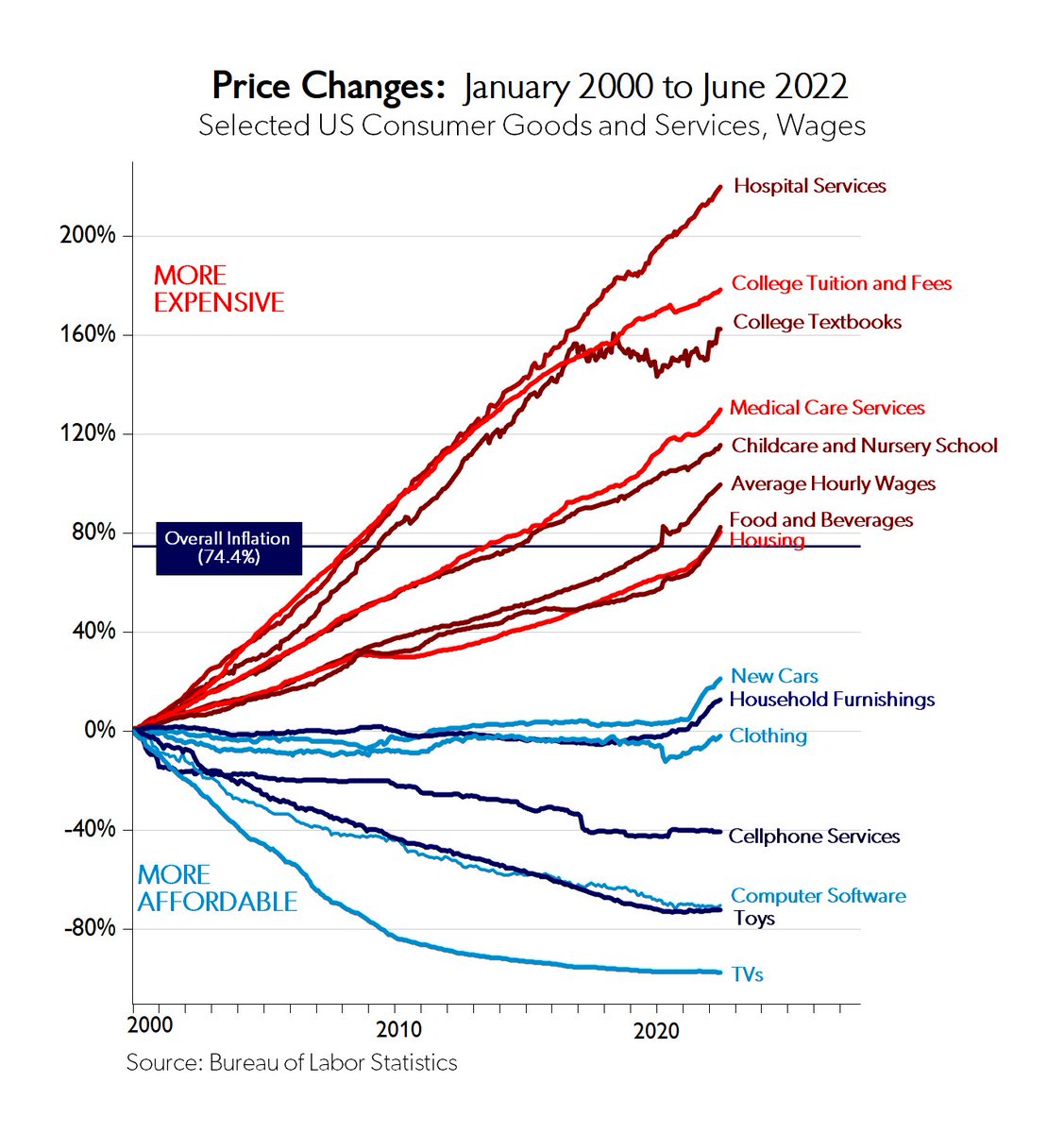
My take: regulatory capture kills industries to protect money-making oligopolies like the healthcare, high-education, and food industries in the US. I believe in this graph regulation alone is not the culprit (if it was the root-cause banks and stock exchanges —highly regulated industries— would also be more expensive and less efficient)
English
0
0
0
23
Peter Hague
Peter Hague@peterrhague·
The optimists and pessimists both have a point, to an extent. What I keep coming back to is this chart. Western societies have profoundly buggered up the supply of critical goods and services, whilst at the same time producing a technological cornucopia. Trick is to make the red stuff behave more like the blue stuff. This is both a technological and a political problem.
Peter Hague tweet media
English
190
237
1.6K
582.2K
Farzad 🇺🇸 🇮🇷
Farzad 🇺🇸 🇮🇷@farzyness·
What is a uniquely human quality, trait, or skill that AI & Robots won't be able to execute on in the next 10-20 years? The more valuable this unique thing is, the more likely it'll be a huge economic need.
English
223
4
212
47.8K
Victor Chapela
Victor Chapela@VChapela·
@cremieuxrecueil These correlations miss the main point: some spices have antibiotic properties. I would believe that original spices were used as a preservation mechanism and will directly correlate with temperature and hygiene. (And those that don’t use spice have other preservation mechanisms)
English
3
0
18
2.6K
Crémieux
Crémieux@cremieuxrecueil·
When I first saw this graph, the main thing that stood out to me was that Japan uses the least spice in their food. Even Brits put more spice in their food!
Crémieux tweet media
English
203
116
1.6K
102.8K