Bill Luby

9.2K posts

Bill Luby banner
Bill Luby

Bill Luby

@VIXandMore

Volatility, VIX products, options, ETPs and random musings about wine, music, travel, AI, etc. Bot slayer. Never investment advice. https://t.co/dO8lFhLFTa

San Francisco, California Katılım Mayıs 2007
915 Takip Edilen20.1K Takipçiler
Bill Luby retweetledi
عبدالعزيز المقبل
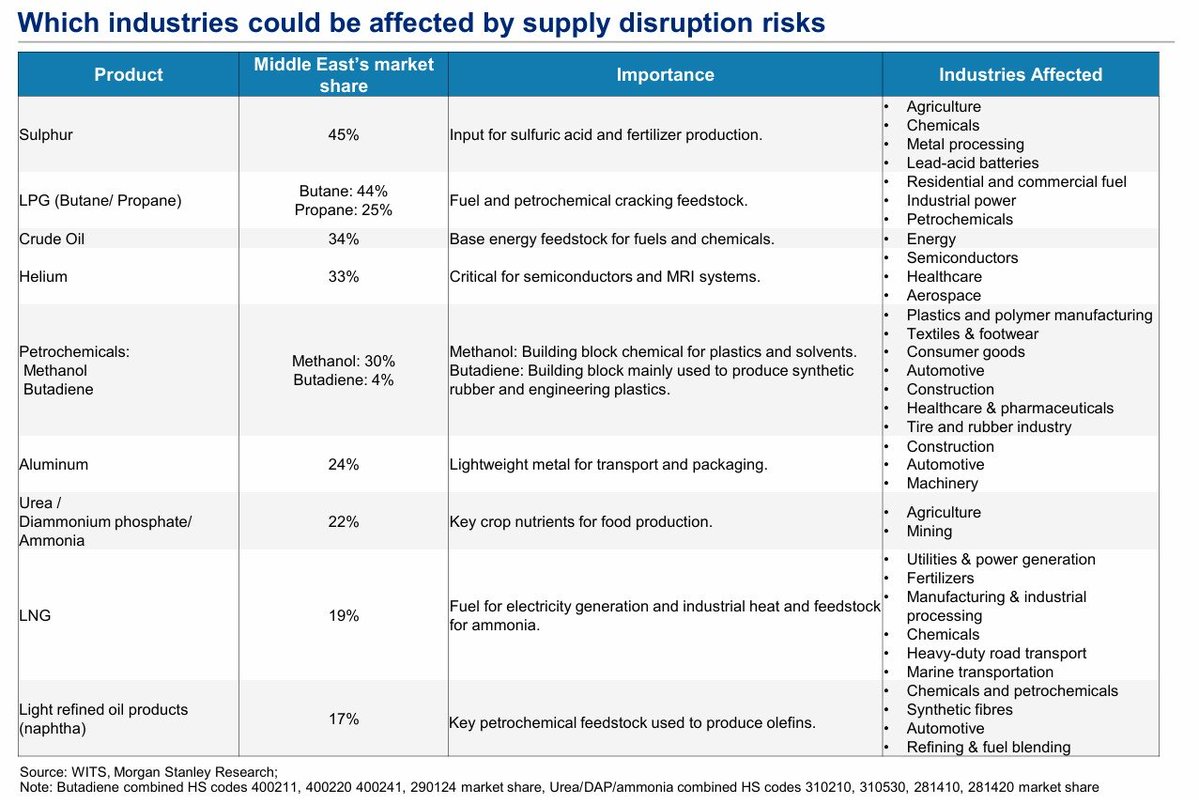
Morgan Stanley published this chart about massive disruptions in industries across the board
عبدالعزيز المقبل tweet media
English
12
502
1.4K
92.8K
Bill Luby
Bill Luby@VIXandMore·
Shanaka has been putting out a lot of excellent content lately
Shanaka Anslem Perera ⚡@shanaka86

Seven clocks are running. None of them negotiable. All of them counting down to the same weeks. The planting clock. Mid-April is the biological deadline for corn and soybean planting across the US Midwest. Every day that passes without nitrogen becoming affordable and available narrows the window for corn. USDA projects corn falling to 94 million acres from 98.8 million. Soybeans rising to 85 million from 81.2 million. The seeds that go into the ground in the next three weeks determine America’s grain harvest in October. The decision is irreversible. The USDA clock. March 31. Prospective Plantings. The report that converts farmer intentions into official data. Every acreage number, every corn-soy ratio, every nitrogen-dependent calculation becomes a published fact that traders, governments, and food agencies will use to model global supply for the next twelve months. The number arrives in twelve days. The FAO clock. April 3. The Food Price Index. The first global reading that captures post-Hormuz commodity prices across cereals, vegetable oils, dairy, meat, and sugar. The 2022 peak was 159.7 in March 2022 after Ukraine. This reading will incorporate oil above $100, urea at $610, LNG halted, packaging repriced, and freight surcharges of $500 to $1,500 per container. The number that determines whether the UN declares a food emergency arrives in fifteen days. The pharmaceutical clock. India’s API inventory buffers are two to three months, measured from the war’s onset on February 28. Late May is the depletion window. Methanol at 87.7 percent Hormuz exposure feeds the solvent chain for paracetamol, ibuprofen, metformin, and antibiotics. Once buffers deplete, the shortage becomes a patient access crisis for the 47 percent of US generics that originate in India. The China crude clock. FGE NexantECA confirmed China is drawing commercial reserves at up to one million barrels per day. The draw sustains refinery operations for four to six weeks from March 19. Mid-April to late April is the exhaustion window. After that, China faces three options: accelerate Russian pipeline imports, reroute at massive premium, or crack open the strategic petroleum reserve. The third option reprices every commodity on the planet. The helium clock. SK Hynix and Samsung hold two to three months of helium inventory. Late May to early June is the depletion window. South Korea imports 64.7 percent of its helium from Qatar. Ras Laffan is offline. If helium buffers deplete before alternative supply arrives, semiconductor fabrication faces rationing. The AI hardware supply chain hits a physical wall measured in months, not quarters. The insurance clock. Solvency II requires 30 to 60 days of zero incidents before P&I clubs can reinstate war risk coverage. Even after a ceasefire, the insurance normalisation takes six to sixteen months based on the Red Sea precedent of 26 months and counting. The logistics system lags the financial relief rally by the longest duration of any clock in this crisis. Seven clocks. The shortest expires in twelve days. The longest runs for over a year. The planting window, the USDA report, the FAO index, the drug buffers, the Chinese crude draw, the helium inventory, and the insurance cycle are all counting down simultaneously. None of them pause for diplomacy. None of them respond to presidential directives. None of them read sealed packets. The calendar is the only actor in this war that has never lost a negotiation. open.substack.com/pub/shanakaans…

English
0
0
1
2.5K
Bill Luby retweetledi
Michael McNair
Michael McNair@michaeljmcnair·
Gold and silver are not acting well in a period of rapidly rising geopolitical risks. We have an Iran War, Strait of Hormuz blockade, rising volatility. In the old framework, that setup should be close to ideal for gold. But once you understand what is now driving gold, this move makes perfect sense. Something fundamental changed after the US and Europe froze Russian reserves in 2022. For decades, surplus countries parked their excess savings in US dollar assets, mostly Treasuries. The freezing of Russian reserves combined with the current administration's explicit push to discourage foreign countries from parking excess savings in US financial assets, forced surplus countries to rethink where they store reserves. And those countries haven't changed their domestic policies that generate the excess savings, so those savings have to be placed somewhere. The result is that gold and silver have increasingly become the obvious “neutral” reserve assets. That’s why gold decoupled from the three factors that used to explain it…real interest rates, volatility, and liquidity. Now reserve accumulation flows have become the primary driver. That shift has a consequence I don’t think most investors have thought through. If gold is now primarily driven by reserve flows from surplus countries, then gold has become pro-cyclical. Reserve growth is driven by export revenues, trade surpluses, economic growth in surplus economies. When the global economy is strong and surplus countries are generating large export revenues, their excess savings grow, their reserve accumulation accelerates, and gold catches a bid. When that surplus generation is disrupted, the bid weakens or reverses. This is exactly what is happening with the blockade of the Strait of Hormuz. The GCC countries are major reserve/gold buyers and now their export revenues are collapsing. They likely need to liquidate some reserves to cover fiscal obligations, and gold is one of their most liquid assets. Even if the reserve sales aren’t excessive yet, the market can see their reserve accumulation has stalled and probably reversed. That flow, which was a meaningful source of gold demand, has gone to zero at best. There are also secondary effects on other surplus economies. China is the world's largest oil importer. An energy shock of this magnitude slows Chinese growth, and compresses Chinese surpluses, which slows Chinese reserve accumulation. That same growth shock ripples through Korea, Taiwan, Japan, and the rest of Asia. The whole chain that has been driving gold higher, surplus countries generating excess savings that need a home outside the dollar system, is being disrupted by an event that in the old model would have been unambiguously bullish for gold. This doesn't mean the structural case for gold is broken. The dollar standard is still ending. Surplus countries still need an alternative to Treasuries and gold is still the most obvious destination. But it does mean gold is going to be more volatile along that structural trend than most people expect, and the volatility will correlate with global growth and surplus generation rather than with the old drivers. Gold rallies when surpluses expand. Gold sells off when surpluses contract. Even if the reason for the contraction is rising geopolitical risk that, under the old model, should have sent gold to the moon.
English
184
534
3K
519K
Bill Luby retweetledi
Michael McDonough
Michael McDonough@M_McDonough·
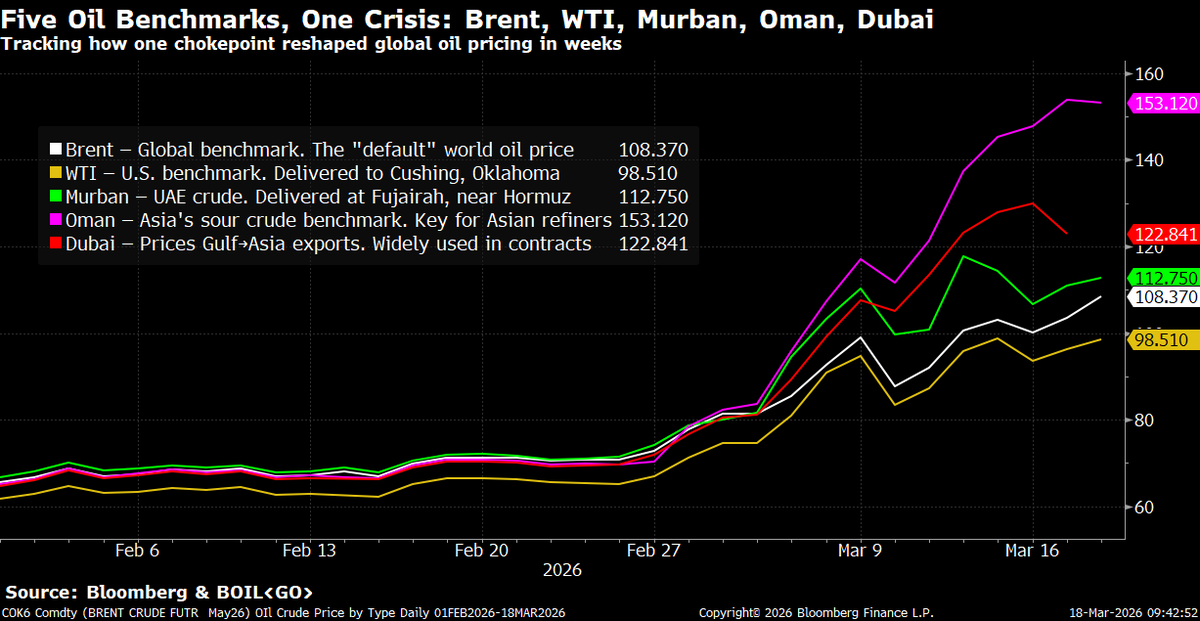
🛢️There's a lot being said about oil prices right now, so I put this chart together to help explain the major crude benchmarks and why they're all behaving differently. ⚪Brent (white) — The world's "default" oil price. Most global trade is priced off this. When the news says "oil is at $108," they mean Brent. 🟡WTI (yellow) — The U.S. benchmark, based on crude delivered to Oklahoma. It's the lowest line on the chart because American oil doesn't need to transit the Strait of Hormuz. 🟢Murban (green) — Crude from Abu Dhabi, delivered at Fujairah port, which sits just outside the Strait. Even though it technically doesn't have to pass through the chokepoint, drone strikes have hit Fujairah and nearby ports, pushing insurance and shipping costs up. 🟣Oman (purple) — The key benchmark for heavier crude sold into Asia. Many refineries in China, Japan, and South Korea are built specifically to process this grade. It's the highest line on the chart because Asian buyers are competing fiercely for a shrinking pool of cargoes. 🔴Dubai (red) — Used to price most long-term Gulf→Asia export contracts. It tracks alongside Oman as a measure of how hard Asian markets are being squeezed. The story isn't any single price — it's the gap between them. In late February these five lines were within $6 of each other. Now the spread between WTI and Oman is over $50. Since the U.S.-Israeli strikes on Iran began Feb 28, the Strait of Hormuz has effectively been closed. Daily transits have fallen from a historical average of ~138 ships to fewer than 5. The IEA has called it the largest disruption to global energy supply in history. Iran's IRGC has warned that not "a litre of oil" will pass for U.S. allies, while selectively allowing some Iranian, Indian, and Pakistani tankers through. Saudi Arabia is rerouting oil to its Red Sea port at Yanbu, and the UAE is using a pipeline to Fujairah — but combined pipeline capacity is only 3.5–5.5 million barrels/day vs the 20 million that normally flows through the Strait. Meanwhile, the 400 million barrel emergency reserve release by IEA members covers roughly 4 days of global consumption. Japan's refiners get ~95% of their crude from the Gulf. China receives 45% of its oil via Hormuz. South Korea, India, Thailand, Pakistan, and Bangladesh are all severely exposed. The wider the spread between the Asian benchmarks and Western ones on this chart, the more you're seeing that pain in real time.
Michael McDonough tweet media
English
37
426
1.3K
310.9K
Bill Luby retweetledi
Shanaka Anslem Perera ⚡
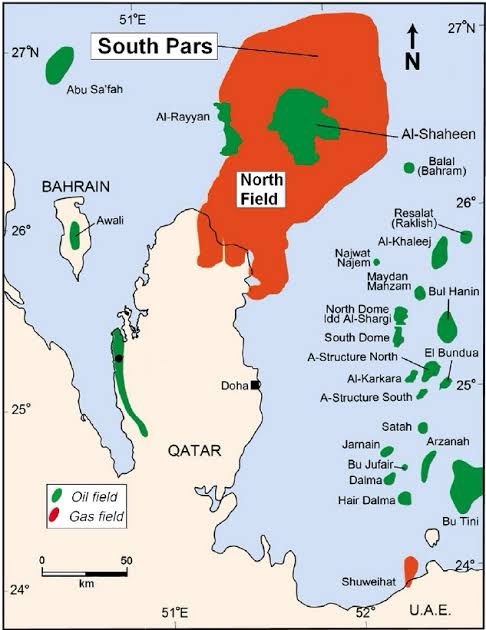
BREAKING: They just hit the factory. Israeli strikes set fire to Phase 14 processing facilities at South Pars today. Iran’s oil ministry and Tasnim confirmed the blaze. Partial production suspension. An estimated 12 million cubic metres per day of gas output affected. South Pars is the largest gas field on Earth. It produces 70 to 80 percent of Iran’s total gas output. That gas is not just fuel. It is the hydrogen feedstock for the Haber-Bosch process that synthesises ammonia, which becomes urea, which becomes the nitrogen that half the planet’s agriculture depends on. South Pars gas feeds Iranian fertiliser production at its molecular root. The Hormuz permissioned chokepoint was already blocking the shipping route. Now the strikes are hitting the production source. The war is attacking the nitrogen supply chain at both ends simultaneously. This is the escalation that collapses every remaining optimistic scenario. The hopeful case for the global food system was always: the strait reopens, fertiliser flows resume, planting windows are partially salvaged. South Pars burning removes even that. If the strait reopened tomorrow morning and every provincial command stood down and every insurer reinstated cover by afternoon, the gas field that feeds the feedstock that feeds the ammonia that feeds the urea is on fire. The molecule cannot ship because the strait is blocked. The molecule cannot be produced because the factory is burning. Two chokepoints on the same supply chain. Both compromised on the same day of the same war. South Pars shares its geological reservoir with Qatar’s North Dome field. Qatar’s output is steady. Qatar’s fertiliser production is unaffected. But Qatar’s exports also transit through Hormuz. Qatar’s urea also requires passage through the permissioned chokepoint that the Mosaic Doctrine’s 31 provincial commands control via sealed packets and VHF radio. The world’s two largest producers of the gas that becomes the nitrogen that grows the food are now compromised at different points on the same chain: Iran at the source, Qatar at the route. Nineteen days. The Supreme Leader killed. The intelligence minister reportedly eliminated. The diplomatic negotiator and Basij commander dead. Over 2,000 targets. Missile production degraded 90 to 95 percent. Bushehr confirmed zero radiation by the IAEA. And now the gas field that anchors the nitrogen feedstock chain is burning. NOLA urea is $683. It will not go down. It may go up. Because the market just learned that the war is not only blocking the molecule from reaching the ship. It is destroying the facility that creates the molecule in the first place. The Mosaic provincial commands do not need South Pars to run the strait. They need radio handsets and sealed orders. But the world needed South Pars at full capacity for the day the strait eventually reopened. That day just became worth less. The post-war recovery that commodity desks were pricing as a sharp rebound now has a damaged gas field sitting between the ceasefire and the molecule. The strikes are justified. The nuclear programme that threatened ten bombs is gone. The military degradation is historic. But the same war that eliminated the nuclear threat is now eliminating the agricultural feedstock that the post-war world will need to recover. The molecule is trapped behind a doctrine at sea and burning on land. The soil waits for nitrogen. The nitrogen waits for gas. The gas field is on fire. And the strait is still closed. Full analysis: open.substack.com/pub/shanakaans…

Shanaka Anslem Perera ⚡ tweet media
English
126
938
1.9K
915.9K
Bill Luby retweetledi
Jason Goepfert
Jason Goepfert@jasongoepfert·
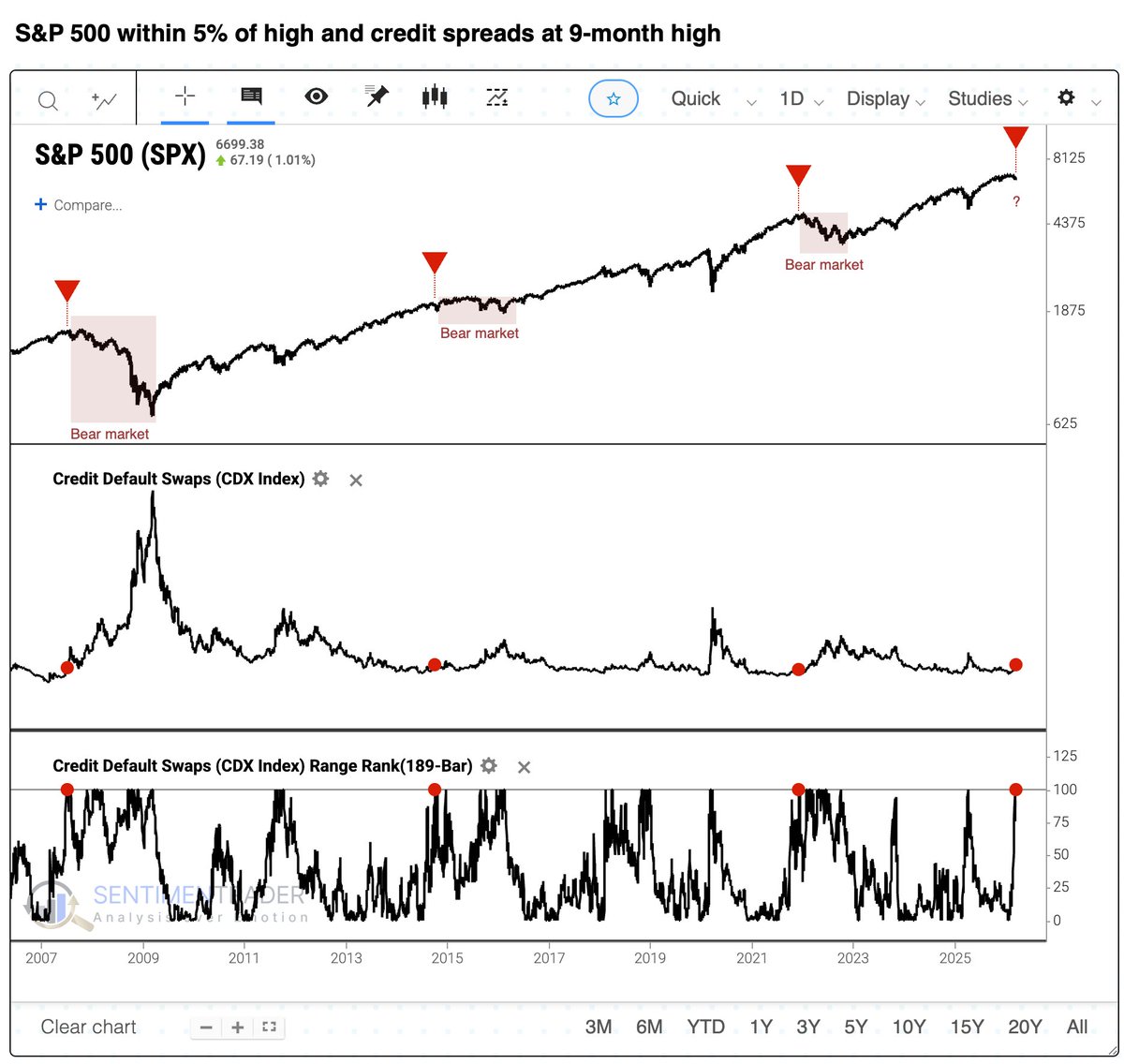
The bond market is getting twitchy. Over the past 20 years, when credit spreads blew out but the S&P 500 wasn't even beyond a pullback yet, it was 3-for-3 in bear markets. h/t @sentimentrader
Jason Goepfert tweet media
English
85
311
1.5K
309.5K
Bill Luby retweetledi
Matt Fernley
Matt Fernley@matt_fernley·
I think the most dangerous thing that I see in markets currently is this assumption that, as soon as the war ends, commodity production will just switch back on again. It won’t. It can’t. Commodity production is not like a manufacturing plant where you just line up your raw materials, flick a switch and production restarts again. Restarting oil and gas production, for instance, can take several months, depending on the assets. Some simple wells may only take a few days or a few weeks, but offshore fields or LNG facilities can take weeks or months. Delays are caused by the need to repressurise systems, inspect equipment and ensure the safety integrity. Reservoir behaviour can also change during shut-ins, requiring careful ramp-up to avoid damage or flow issues. So, this assumption that fields will just restart production immediately is not realistic. For LNG plants it takes weeks to cool down the cryogenic systems. It's a similar situation in aluminium, as I discussed in previous posts. When you idle an aluminium smelter, the molten aluminium in the pots freezes. It can then take 6 months+ to restart a plant. While not as bad as oil&gas and aluminium, turning a urea plant back on can take 2-3 weeks. It takes 1-2 weeks to restart ammonia plants and then another 7-14 days to restart the urea plant around it. Likely it will take 1-4 weeks to restart the petrochemicals and plastics plants, and the oil refineries will also take a similar amount of time to restart. And those factors don’t even consider that the world’s shipping fleets are now mispositioned and it will take weeks in many cases for those ships to reposition themselves to the right places. So this assumption the market’s making that, as soon as peace breaks out, everything will go back to normal is very dangerous. Supply disruption is into its third week now. Even if the war stopped tomorrow, it would be several months before supply of many of these commodities will be re-established. And that’s simply not being priced into commodity prices or economic expectations, in my view.
Matt Fernley tweet media
English
29
155
503
46.9K
Bill Luby retweetledi
Amir Handjani
Amir Handjani@ahandjani·
1. Here is where things stand on Sunday before markets open on Monday. A breakdown on what's actually happening with shipping through the Persian Gulf. 2. Less about oil prices and more about the ships that move oil. War risk insurance on a tanker through Hormuz went from $200K a voyage to over $1M over the last two weeks. 3. Most insurers didn't reprice, they just walked away because the risk was too extreme. Nobody wants to take the risk of getting hit by an Iranian drone or missile as they are crossing the Straits of Hormoz 4. Freight rates for supertankers hit $800K a day. That's four times what they were two weeks ago. 5. Even at those rates, owners can't get the insurance they need to legally operate. 6. There are pipelines that have been built specifically for this purpose. A. Saudi to the Red Sea. B. Fujairah to the Gulf of Oman. Both bypass the Straits. Both are supposedly running at max capacity. 7. They cover maybe a third of what normally flows through the Straits. This leaves a structural deficit 12 million barrels a day. 8. This means that the price of everything you buy is about to go up from gas at the pump, groceries, consumer good, plastic and even clothes.
English
13
166
429
74.4K
Bill Luby retweetledi
Bob Elliott
Bob Elliott@BobEUnlimited·
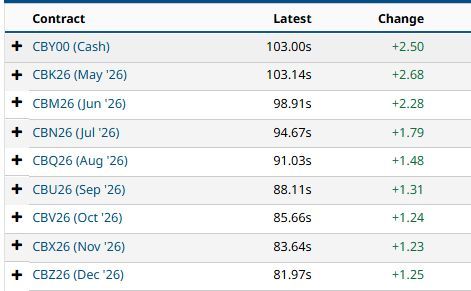
The oil curve is now pricing in a far more extended oil shock than what we saw in '22. Dec contracts now pricing oil 40% higher to end '26 relative to the 60 bucks to start the year.
Bob Elliott tweet media
English
52
241
1.2K
256.1K
Bill Luby retweetledi
Senator Thom Tillis
Senator Thom Tillis@SenThomTillis·
This ruling confirms just how weak and frivolous the criminal investigation of Chairman Powell is and it is nothing more than a failed attack on Fed independence. We all know how this is going to end and the D.C. U.S. Attorney’s Office should save itself further embarrassment and move on. Appealing the ruling will only delay the confirmation of Kevin Warsh as the next Fed Chair.
English
2.7K
881
5.2K
557.7K
Bill Luby retweetledi
LiveSquawk
LiveSquawk@LiveSquawk·
Iran Gives Approval To Indian Govt For Two LPG Tankers To Sail Through Strait Of Hormuz – RTRS Sources
English
3
9
42
11.4K
Bill Luby retweetledi
Tom McClellan
Tom McClellan@McClellanOsc·
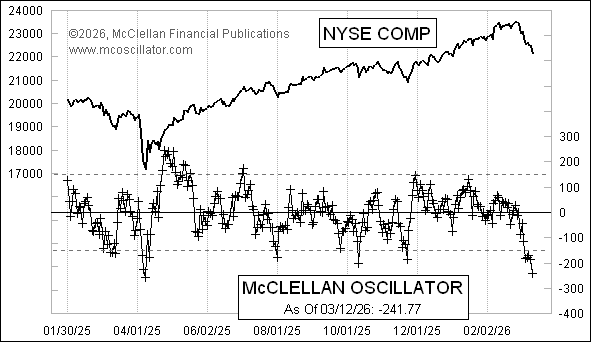
NYSE's McClellan A-D Oscillator as of March 12 is now as oversold as what we saw with the April 2025 tariff crash.
Tom McClellan tweet media
English
59
206
1.2K
160.5K
THE SHORT BEAR
THE SHORT BEAR@TheShortBear·
Iran does not and is not planning to win militarily. They are more than happy and in fact taunting Trump to make him continue. Every day the US loses $1b on war expense + losing dozens of billions in the stock market. Now add on top the recession odds going higher by 50% over past days and see the result as well via private credit imploding. They know exactly how to play Trump, right where it hurts, his overconfidence, his hubris... They are making sure the midterms are gone, his presidency and that the US gets hurt the most it can... They can not reach the shore, but they can hit markets. They know his image is the most important thing, they know he would rather tripple down and blow up. Same thing during the business career, start with some wins, then do something stupid, tripple down... Seen it in NYC and with the casino project, same pattern. Market starting to price this in I am afraid.
English
87
83
1.1K
82.9K
Bill Luby
Bill Luby@VIXandMore·
@McFaul Sad to think that morality and values can ever go out of fashion
English
0
0
2
315
Michael McFaul
Michael McFaul@McFaul·
Call me old fashioned but I still believe that morality and values should play a role in the formulation and execution of US foreign policy.
English
208
519
4K
57.4K
Bill Luby
Bill Luby@VIXandMore·
@VixCentral May your family be safe and the costs minimal.
English
1
0
2
377
Eli Mintz
Eli Mintz@VixCentral·
@VIXandMore Optimism when it comes to geopolitics in the middle east is very rarely warranted. If it helps, my family members in Israel, who are constantly in and out of shelters, also understands that this war may go on for a while and is willing to suffer the costs.
English
2
0
7
873
Bill Luby
Bill Luby@VIXandMore·
Both Iran and the U.S. believe that their best course of action is to escalate attacks and drag the war out as long as possible, on the assumption that time is on their side. The further we go down this path, the worse the off-ramp options are. Hard to be optimistic here.
English
5
0
25
2.6K