ValueHodler

295 posts

ValueHodler banner
ValueHodler

ValueHodler

@ValueHodler

Just a chill guy using X as notepad. HODL!

Katılım Mart 2024
725 Takip Edilen111 Takipçiler
ValueHodler
ValueHodler@ValueHodler·
@shiri_shh Now imagine a social network but for Claude coders to chat with each other while waiting for outputs
English
0
0
0
579
ValueHodler retweetledi
Ryan Cohen
Ryan Cohen@ryancohen·
The Hollow Men American capitalism is rotting from the head down. We have replaced the "Owner-Operator"—the risk-taker-with a new, parasitic class of corporate bureaucrat: The Risk-Free Insider. By "Insider," I am not referring to a specific title. I am referring to the entire administrative state that has captured the modern corporation. This includes the Directors who exist solely to collect fees, the Executives who exist solely to collect bonuses, and the Managers who exist solely to hire consultants. These are the hollow men of the boardroom. They are masters of PowerPoint. They wear the right suits. They say the right buzzwords about "governance" and "ESG." But they are mercenaries fighting a war with someone else’s ammunition. In a functioning economy, authority is tied to liability. If you make a bad decision, you lose your own money. That fear of loss is the only thing that keeps a business honest. It forces you to cut waste, obsess over the customer, and stay late to fix what is broken. Today, we have severed that link. We have rigged the game so that heads, the Insider wins; tails, the shareholder loses. If the stock goes up, the Insider collects a massive performance bonus. If the stock crashes due to their own incompetence, they are fired with a "Golden Parachute" worth tens of millions. They are gambling with the house’s money, and they never leave the table poorer than they arrived. This looting starts in the boardroom. We have normalized a "Country Club" culture where directors are selected based on social profiling rather than their ability to build a business. The modern board member is often a professional tourist—paid an average of $350,000 a year. Let’s be brutally honest about what that number represents. The average director is paid nearly five times the GDP per capita of the United States. They earn more for attending four quarterly lunches than the vast majority of Americans earn in five years of hard labor. And for what? Most of these directors are "over-boarded," sitting on three or four boards simultaneously. They treat directorships as a gig economy for the elite. They fly in, rubber-stamp a compensation package they didn't read, and fly out. They collect checks from companies they do not understand, do not use, and certainly do not love. They are not there to ask hard questions. They are there to be collegial. They are there to protect the other Insiders. And what happens when these boards hire executives who also have no personal capital at risk? We get the Delegation Economy. When a Risk-Free Insider faces a crisis—bloated expenses, a broken supply chain, or a stale product—they do not roll up their sleeves. They hire a consultant. They pay a strategy firm millions of shareholder dollars to produce a 100-page deck telling them what they already know. This is not management. It is intellectual money laundering. They use shareholder capital to buy an insurance policy for their own careers. If the plan fails, they can blame the consultants. They delegate the work because they are terrified of the responsibility. They would rather preside over a slow, comfortable decline than risk a bold mistake. While American Insiders are busy optimizing their severance packages, our global competitors are optimizing their products. They are not slowed down by bureaucracy. They are not waiting for a slide deck. They are outworking us. If we continue to fill our C-suites with administrators instead of operators, we will lose our edge. We will see iconic American franchises hollowed out by fees, managed for the benefit of the Insiders, while the true owners—the shareholders—are left holding the bag. The time for polite governance is over. If we want to save the American economy from mediocrity, we must demand a return to the "Owner’s Mentality." We need leaders who treat shareholder capital with the same reverence they treat their own savings. The era of the Risk-Free Insider must end.
English
2.6K
5.5K
20K
2.6M
ValueHodler
ValueHodler@ValueHodler·
The technology is real. The valuations are not. This distinction has bankrupted more investors than any bear market. Railroads worked. Fiber optics worked. The internet worked. The companies that laid the track did not.
English
0
0
1
17
ValueHodler
ValueHodler@ValueHodler·
@realroseceline Amazon is the largest customer of its own infrastructure right? AWS runs their retail, ads, and logistics stack. If external AI demand disappoints, Amazon still fills enormous capacity internally.
English
0
0
1
131
Rose Celine Investments 🌹
Rose Celine Investments 🌹@realroseceline·
Thoughts on $AMZN $AMZN reported a solid quarter on the surface. Revenue up 14% on a base this large is not normal. At this scale, mid teens growth means they are effectively adding the equivalent of a massive standalone company every year. AWS reaccelerated to 24%, which is a big deal. That is the profit core. Advertising grew 22%, becoming one of the most valuable high margin assets inside of $AMZN. Guidance of 11% to 15% growth was fine. But what shook the stock was capex. $200b in 2025, up roughly 50%. That’s not just money to maintain the business. It’s building AI infrastructure like data centers, chips, etc. It’s $AMZN saying the next decade is being built right now, and we’re not going to be the ones who underinvest and regret it later. The market is asking a simple question. Where is the return? We are watching the largest capital deployment cycle in tech history. $AMZN, $MSFT, $GOOG, $META are all spending aggressively. Nobody wants to wake up in 5 years and realize they are structurally behind. This is offensive and defensive at the same time. But big demand and big spending do not automatically create big returns. What matters is the return on the capital being deployed today. If AI meaningfully expands AWS margins and deepens customer lockin, this spending will look brilliant in hindsight. If compute becomes more commoditized and competition intensifies, returns compress. Interestingly, even the beneficiaries of this AI spend like $NVDA are down. That tells you this is not about one company missing a quarter. It is about uncertainty around how trillions of dollars of AI infrastructure ultimately earn their returns. $WMZN is still growing, AWS is still strong and so is advertising. But the real debate is not about revenue beats. It is whether $200b of incremental capital earns an attractive incremental return. That is the only thing that will matter five years from now. 🌹
English
19
12
205
22.7K
ValueHodler
ValueHodler@ValueHodler·
@realroseceline In investing, you never know if you're 65-35 or 50-50. You have to hold conviction without a solved distribution.
English
0
0
0
54
Rose Celine Investments 🌹
Rose Celine Investments 🌹@realroseceline·
Decisions over outcomes Many years ago during the poker boom I used to play pretty seriously, and I did something that completely confused people at the table. If we got all the money in on the flop and my opponent was on a flush draw, two spades in their hand and two on the board, they had 9 outs with two cards to come. That is about 35% equity, which makes me roughly a 65% favorite. So I am going to lose more than 1 out of 3 times. Not because I misplayed the hand, but simply because that is how probability works. In those spots I would actually cheer for the spade. And when it came, which it absolutely should around 35% of the time, I would smile and even high five them. It drove people crazy because they could not understand why I was celebrating a loss. But the money was already in good and the decision was already made. Me begging the deck not to bring a spade does not turn 65% into 90%. The math was locked in the moment the all chips went in. What bothered most people was not the loss, it was their ego. When the spade came they felt unlucky. I never felt unlucky because I already accepted that 35% was part of the deal. Amateurs celebrate outcomes, professional celebrate decisions. If you only feel good when you win the pot, you will never survive a positive expected value game, because positive expected value guarantees losses along the way. If I can repeatedly get into 65% situations, I do not need to win every hand. I just need to keep playing and over time the edge compounds. Think of it, would you flip coins where it lands on tails 65% of the time? The stock market is no different. You can buy something with favorable odds, understand the business deeply, and still watch it drop. That does not invalidate the decision, it just means the 35% showed up. Most investors do not fail because they cannot analyze. They fail because they cannot emotionally handle variance. They confuse a bad outcome with a bad decision. The goal was never to avoid the 35%, the goal was to keep playing the 65%. 🌹
English
5
11
136
7.9K
ValueHodler
ValueHodler@ValueHodler·
Compute is a commodity. Commodities don't capture value.
English
0
0
0
11
ValueHodler
ValueHodler@ValueHodler·
@naval Expectations only ratchet up. They never ratchet down. 25% growth becomes a disaster when the market prices 30%. The business didn't fail. The baseline moved.
English
0
0
0
10
Naval
Naval@naval·
Expectations are a one-way ratchet.
English
261
188
3.4K
188.7K
ValueHodler
ValueHodler@ValueHodler·
@signulll Jobs aren't income infrastructure. They're meaning infrastructure. Most people never built an alternative. When AI removes the job, it doesn't remove the void.
English
0
0
0
18
signüll
signüll@signulll·
a job was the emotional scaffolding holding adulthood together. that concept now has the potential to disappear entirely which has all sorts of second/third order ripple effects you can't even grasp.
English
130
146
2.3K
108.9K
ValueHodler
ValueHodler@ValueHodler·
@naval Markets repriced this months ago. AI companies trade at multiples of automation value, not intelligence value. Imitation that executes captures everything. Imitation that only convinces captures nothing.
English
0
0
1
12
Naval
Naval@naval·
AI is the great automator, and to automate, it must first imitate. The imitation fools people into thinking it’s alive.
English
726
641
8.6K
339.8K
ValueHodler
ValueHodler@ValueHodler·
The "too hard pile" is the highest-ROI decision in investing. Most edge comes from what you don't own. This looks like fiber optic overbuild circa 2000: $4B in capex chasing $400M depreciation means the capital cycle is front-loaded. The question isn't if GPUs earn returns. It's whether the owners survive long enough to see them.
English
0
0
0
22
Rose Celine Investments 🌹
Rose Celine Investments 🌹@realroseceline·
Thoughts on $NBIS They reported about $30m in profit which exists because of a roughly $600m revaluation gain. Strip that out and the business would have lost about $570m. Operating expenses for the year were about $1.1b, up 130%. Depreciation alone was roughly $400m, up more than 400%. Capex was about $4b. That is not a normal growth story. $NBIS building massive infrastructure very fast. This is not a software business where margins expand as revenue grows. This is hardware that starts depreciating the moment you plug it in. Whether customers show up or not, the depreciation runs every quarter. So yes, in the short term, it is a problem. They are spending billions before the revenue base supports it and operating expenses are still more than double revenue. That means the core engine is burning serious money and relying on accounting gains to soften the optics. But the more important question is not whether this year looks ugly. The real question is whether that $4b of capital earns attractive returns over time. If demand ramps operating leverage could be enormous. Infrastructure businesses look terrible before they scale and then suddenly margins flip. But if demand slows or utilization lags, you are sitting on billions of depreciating assets that cannot hide. In that case, $NBIS becomes a capital destruction story. And here is where it gets uncomfortable. Nobody really knows which way this goes. Not investors, not analysts, and honestly, not even the management. They are making a very complicated massive forward bet. This business is extremely complex because you need to understand depreciation deeply, compute pricing per hour, cost of energy, technological change, etc. It is not simple and it is not intuitive. That is why most people never go to the back of the report. They post the cute colorful revenue growth slide from the front of the ER. They share the adjusted numbers and highlight the headline report. They do not post the page that shows $4b in capex and a $570m operating loss hiding behind the so called “revaluation gain”. Because the back pages are much harder, if you study the math and economics, they force you to admit how much uncertainty there really is. And when something is this complex, maybe the real edge is admitting that if you cannot clearly explain how it makes money and earns high returns on capital, you probably should not pretend you understand it. The more I study this business the less I understand it and the more I realize it belongs in the “too hard” pile. 🌹
Rose Celine Investments 🌹 tweet media
English
52
13
259
42.5K
ValueHodler
ValueHodler@ValueHodler·
@naval The companies that sell to every tribe don't compete. They own the infrastructure every tribe needs to function. Monopoly beats tribalism.
English
0
0
0
11
Naval
Naval@naval·
People who don’t organize into tribes get wiped out by people who do.
English
1.6K
6.9K
54.1K
3.9M
ValueHodler
ValueHodler@ValueHodler·
@signulll Supply shocks reveal who owns the board. Monopolies that control primitives print cash in any environment. Everyone else competes.
English
0
0
0
9
signüll
signüll@signulll·
this is going to sound dramatic as hell but the world you knew is pretty much over. very recently i think we crossed a one way bridge as a species & most people on earth haven’t realized that fact yet. imho there are now non trivial odds the economy gets drastically disrupted in the next 24 - 36 months via a giant supply shock followed by a demand shock.
English
307
306
5.5K
492.7K
Neesh 🥭
Neesh 🥭@Neesh774·
turn that "i told you so" into 20 bucks introducing Wager • prediction markets with your friends
English
610
163
8.8K
4.1M
ValueHodler
ValueHodler@ValueHodler·
@nachunja I believe this $200B figure is also cumulative.
English
1
0
0
221
Cute Baby
Cute Baby@nachunja·
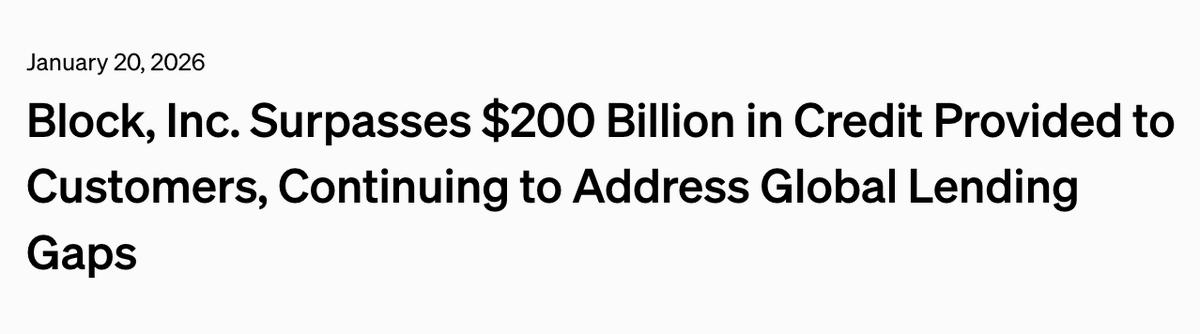
$XYZ – $200B in Credit Provided It's $200B in "unsecured" loan, which makes it even more crazy. For size context, US Small Business Administration (SBA), originated $38B in 2024.
Cute Baby tweet media
English
4
0
33
2.9K
Cute Baby
Cute Baby@nachunja·
Okay, it’ll play out like this: 10% cap on credit card interest → some people will get less or no credit from card companies → those people still needs credit → they find out about @CashApp Borrow and BNPL (modern day credit) → @CashApp MAUs explode Fintech as a group might actually catch a bid $XYZ $KLAR $DAVE $AFRM
Rapid Response 47@RapidResponse47

🚨 BREAKING

English
3
1
17
4.1K
ValueHodler
ValueHodler@ValueHodler·
@nachunja @Square Catalyst 11: credit card APR capped at 10%, issuers lower approvals, marginal borrowers will come to alternative loans and BNPL
English
0
0
1
56
Cute Baby
Cute Baby@nachunja·
$XYZ – 11 Catalysts & 7 Risks for 2026 ///////////// Catalysts ///////////// /// 1. World Cup /// @Square will be a solid second-order beneficiary. First order effects are airlines, hotels, etc. 5.5M international visitors expected across Vancouver, Seattle, SF, LA, Houston, Dallas, ATL, Miami, Toronto, Boston, Philly, and NJ. All strong Square cities. All those visitors need to eat. QSRs all over the city will see a strong boost. You think all those people are going to cook in their Airbnbs and pack their food? Of course not. They’ll be eating out. For weeks. Square’s dominant position in QSRs should show up in the numbers. /// 2. Tax Refunds /// Piper Sandler predicts 2026 refunds to be 32% larger, especially among middle-income households ($60k–$400k). 2025 refunds for Cash App were soft, making comps easier. Tax refunds are a big one-time inflow into the Cash App ecosystem that typically boosts spending and risk tolerance. /// 3. One Big Beautiful Bill Act (OBBBA) tax provisions /// a. Back-dated Tax Cuts and Jobs Act (TCJA) b. Increased child credit c. No tax on tips & overtime d. No tax on auto loan interest All of these help the average Cash App user. /// 4. (Continued) Proof-of-Execution /// Product development and launch cadence accelerated hard in H2 2025. There’s no reason to think it slows in 2026. More likely, it accelerates. Whether that cadence converts into top-line growth is unknown, but Investor Day guidance shows management expects it to. /// 5. Proto (Bitcoin Mining Rig) /// First @protomining shipments went out in Q3 ‘25. There’s a good chance we see more this year. Yet the market is pricing in zero contribution. Any development is pure upside. /// 6. GTM compounding + intl GTM /// Field Sales Headcount 2009–2024 : 0 2025e : 150 2026e : 300 Square had zero field sales for 15 years. Building this team is a foundational shift and should materially impact growth. Square ramped US field sales in 2025 and launched international field sales in October, starting with the UK. /// 7. Neighborhood /// Potentially a game-changing, company-changing product. What is Neighborhood? It’s the crystallization of 10+ years of trying to meaningfully connect Square and Cash App. Initial pushback was: “Square consumers ($8 lattes, $20 burgers) and Cash App consumers (lower-income demographic) don’t overlap—so not bullish.” And that’s exactly the point. Neighborhood is meant to pull Square consumers from 5M Square Sellers into downloading Cash App for the first time. The lack of overlap is the advantage. This could supercharge the next leg of Cash App growth. /// 8. Historically low multiples /// EV/GP multiples used to be 50x. It was 3x not too long ago. Bottom is in, imo. /// 9. AI beneficiary /// While most companies sprinkled in cute AI features, Block went all-in. Top to bottom, across the org, and across products. First wave of AI winners were CapEx names. Second (or third) wave should be companies that best implement AI to drive growth. @blocks is in that group. /// 10. Oil & Rates /// Both trend down in 2026. • Oil supply continues rising as Venezuelan refining ramps • A dovish Fed Chair is coming in, focused on lowering rates • The administration just announced $200B quasi-QE for MBS Square and Cash App’s demographic feels oil & rate relief more than mid-high income demographic. Lower required spending = higher discretionary spending. /// 11. Mid-terms /// Expect a lot of noise in an election year, but both parties must appeal to lower-middle-income voters—the core Cash App user and Square SMB base. Kamala previously floated giving SMBs tens of thousands for pure voter appeasement. Trump is talking tariff “stimmy checks.” Expect similar tactics from both sides in 2026. ///////////// Risks ///////////// /// 1. Sub-par results /// Regardless of catalysts, if February earnings disappoint, it’s over for the stock. After an Investor Day full of promises, the first print matters. If it’s bad, 2026 is done. /// 2. Cost discipline (lack thereof) /// Unless Block significantly outperforms, Jack will always be known as the infamous Twitter-CEO. Distracted CEO with no real interest in shareholder value. Block is on a short leash. Any slip in discipline will be punished. /// 3. Borrow lapping (growth decel) /// Cash App’s current growth is heavily driven by Borrow’s explosion. Once Borrow laps, can @CashApp still grow +20%? /// 4. Lack of investor interest /// ’25 Q4 had half-dozen very strong positive catalysts. $XYZ blew past them like it’s nothing. Stock actually went down. Major blue balls. Even if catalysts hit in 2026, will anyone care enough to buy? /// 5. Reverting back to the mean /// Is the surge in cadence and morale just from the extravagant company event? Will they revert back to the mean and become lackadaisical? /// 6. Economic slowdown /// Square and Cash App are effectively leveraged bets on the US economy. A downturn hits hard. The reverse is also true. /// 7. Afterpay losing share /// Affirm is running circles around Afterpay. Klarna and Sezzle are hungry. Afterpay is growing, but underwhelming vs peers. Can @nmolnar regain momentum? To summarize: Catalysts 1. World Cup 2. Tax Refunds 3. OBBBA 4. (Continued) Proof-of-Execution 5. Proto (Bitcoin Mining Rig) 6. GTM compounding + intl GTM 7. Neighborhood 8. Historically low multiples 9. AI beneficiary 10. Oil & Rates 11. Mid-terms Risks 1. Sub-par results 2. Cost discipline (lack thereof) 3. Borrow lapping (growth decel) 4. Lack of investor interest 5. Reverting back to the mean 6. Economic slowdown 7. Afterpay losing share For me, I'm bullish.
Cute Baby tweet media
English
5
2
27
2.4K
Miles 🌞
Miles 🌞@milessuter·
I asked for your feature requests, and heard you all loud and clear: STRC, STRD, STRK, & STRF are now listed on @CashApp Investing. 2026 we are making Cash App the best place for all things bitcoin again. Keep the requests coming, much more still to come!
Nathan C. Perry@NathanCPerry

.@milessuter: if you’re serious about the Cash App Bitcoin Maxi thing, then why aren’t all BTCTCs, $MSTR’s preferred shares, and $SATA listed? Why are y’all letting Robinhood lap you on this?

English
93
118
1.3K
215.7K