Vinayak G Kudva

13.3K posts

Vinayak G Kudva banner
Vinayak G Kudva

Vinayak G Kudva

@Vgkud

Coding professionally since 200406. Small software business owner - 202108 ~ 202502 Returning to my roots. Rise, Fight, Code, Conquer.

Kārkala,Udupi,Karnātakā,Bhārat Katılım Mayıs 2019
841 Takip Edilen435 Takipçiler
Vinayak G Kudva retweetledi
IT Unprofessional
IT Unprofessional@it_unprofession·
I liquidated my entire 401K yesterday morning. The financial advisor on the phone begged me to reconsider. He used words like tax penalty and catastrophic compound interest loss. I told him fiat currency is a collective hallucination. I took the $85K and drove straight to a commercial restaurant supply warehouse. I bought exactly 12,000 pounds of iodized table salt. It took 4 trips in a rented moving truck to transport it to my basement. Historically, salt was used to pay Roman soldiers. When the central banking system collapses next Tuesday, I'll be the wealthiest warlord in the tri-state area. My basement is currently a massive, white, moisture-absorbing desert. I have to wear protective eyewear just to do laundry. My neighbor asked why I was carrying 50-pound bags of sodium into my house for 9 straight hours. I told him I'm curing meats. I'm not curing meats. I'm hoarding the currency of the apocalypse. He'll be begging me for seasoning by November.
English
327
266
5.1K
661.8K
Vinayak G Kudva retweetledi
Parimal
Parimal@Fintech03·
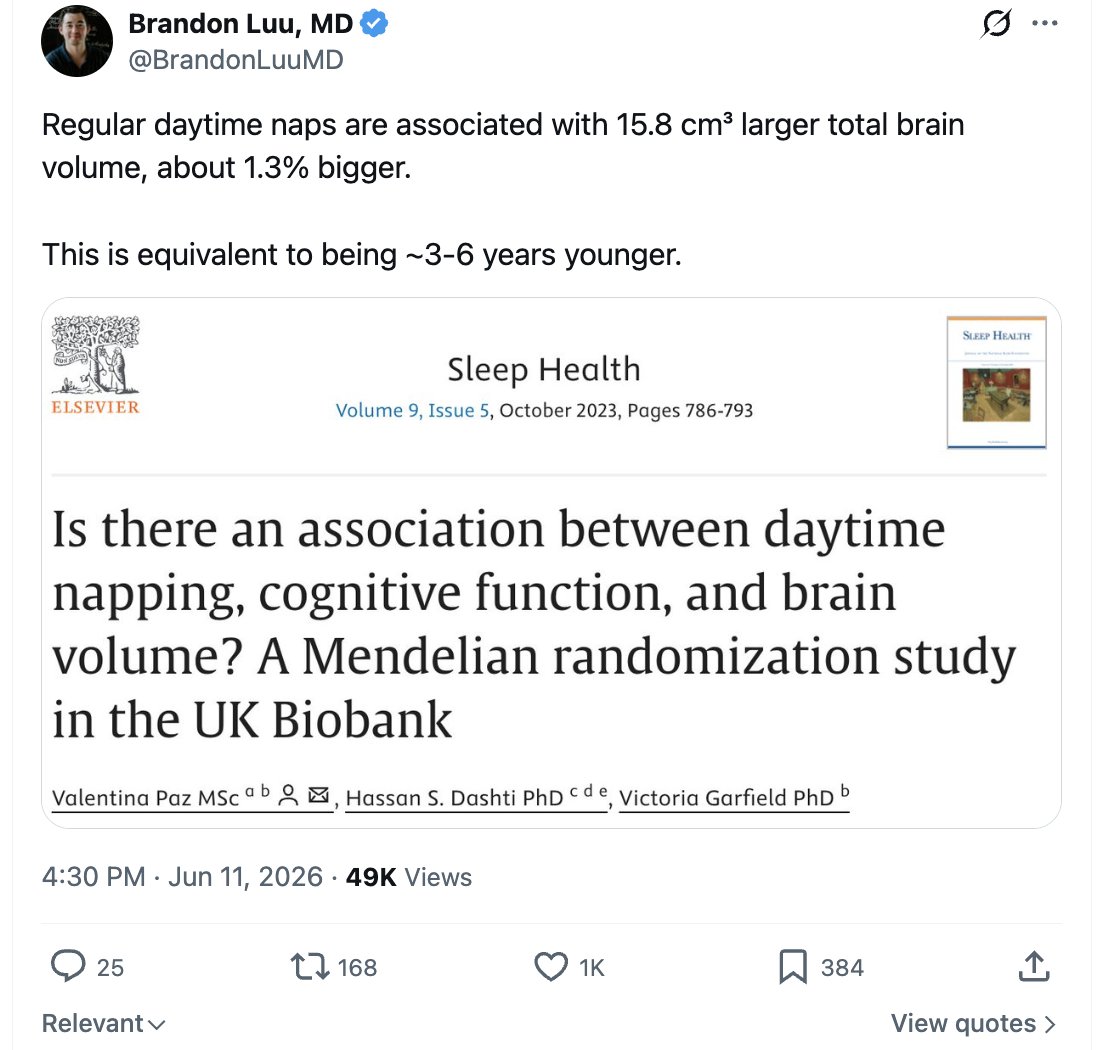
Modern sleep studies show that if a daytime nap exceeds 20-30 mins, we enter deep, slow-wave sleep. Waking up from this causes sleep inertia, leaving us groggy, destroying our night sleep & messing up our insulin sensitivity. Ancient India prevented this through a mandatory post-lunch ritual called Vama-Kukshi. Vama means left & Kukshi means womb/side. The protocol mandates that after a midday meal, we must lie down specifically on our left side for a short duration (traditionally calculated as the time it takes to take 8 to 16 deep breaths, ~15-20 mins). Lying on our left side keeps the stomach below the esophagus, preventing acid reflux. More importantly, it activates the Pingala Nadi (the right nostril breathing channel, connected to the sympathetic nervous system), which stimulates digestion, while keeping the brain in a state of light, restorative rest rather than letting it plunge into a deep, heavy slumber. The Sushruta Samhita explicitly warns that long, heavy sleeping during the day destroys metabolic health (causes Kapha & Meda/fat accumulation). But a short Vama-Kukshi, a quick, left-sided power nap was prescribed to restore mental clarity, relieve stress & preserve vitality (Ojas). It is the exact ancient counterpart to the modern 15 min "power nap."
Parimal tweet media
English
30
679
3K
102.9K
Vinayak G Kudva retweetledi
Mukul Dekhane
Mukul Dekhane@dekhane_mukul·
The lost train of Tinsukia. This is too hilarious. Remember there was a case of a missing tank in Ahmednagar some years back. The Indian Railways did one better.....they had a complete train missing for nearly 40 years. This is how it happened: The Lost Train. This rake was discovered on on 18th December 2019 lying at a small station about 40 kms short of Tinsukia main. Tinsukia itself is about 480 kms NE of Guwahati and about 80 kms from the Arunachal border. Apparently sometime in 1976 or so, the rake had been placed at one of the disused sidings temporarily, as there was no place available along the platforms at the station, which in any case was a very small one. Railway records show that the train had reached there at 11:08 AM on 16th June 1976. The engine ('power' in railway parlance) was disconnected from the rake and brought back to the station to assist in placing of certain goods wagons. Heavy rains and flooding took place with effect 11:31 AM, the same day. Enquiries ordered by the Railway Board reveal, at that point of time, the railway staff was totally involved in maintaining traffic continuity, track repairs and tackling the immediate flooding problem; as almost the entire station had been submerged in 5-6 feet of water. The passengers all had alighted and had made their way to their destinations, obviously with some difficulty. And with some help from the local villagers. During this period the Station Master too moved out on posting as also some of the staff. In the meantime people forgot about this rake as it was about 2 kms from the main station, at a limb and in a deserted place. Slowly vegetation took over the entire area. The remnants of the track leading to the rarely used siding, which had not been washed away in the flood, soon disappeared under bushes, shrubs and weeds. Snakes, birds and wild animals found it an ideal home, much like sunken ships in which marine life abounds. Time went by. Most of the older lot of railway men retired and others passed away. No one remembered the train. Daniel Smith, the engine driver emigrated to Australia in September 1976. On 5th December 2019, a satellite picture by one of the NASA satellites which was mapping the forest cover in the Asia-Africa region, captured somewhat obscure, hidden and not too clear pictures of this rake, under a thick forest canopy. Suspecting it to be the site of an Indian, camouflaged 'rail mobile' ICBM rake, it was forwarded to the Pentagon. Abnormal activity of a number of satellites over this area was then noted by ISRO, NTRO and Indian intelligence agencies. In the meantime Russian and Chinese double agents in the Pentagon informed their handlers, in their mother countries, about the 'ICBM Train' discovered by NASA. In a bizarre sequence of events, RAW got this information from agents on their payroll in Russia and China. Now alarm bells started ringing. Could it be a rogue action by an Indian ‘Dr Strangeglove' type of person-- civilian or military? Inquiries began at the Indian end. The PMO, DIA (Defence Intelligence Agency), NIA (National Investigation Agency), the MoD (Ministry of Defence) and the CCS (Cabinet Committee on Security) got involved. By an internal memo, the IHQ, the Military Space Command and SFC (Strategic Forces Command), all denied the placement of any such train/rake at the location being given. But subsequent aerial recce and pics taken by own satellites, IAF and the ARC (Aviation Research Center), all confirmed that a well camouflaged rake actually was there. Ultimately a ground party of SF including MARCOS and GARUD's was sent along with a senior intelligence officer from the NSA's office to the site in an hush-hush operation. And that is the story of the Lost Train! Unbelievable!!!! 💐🎉💐
English
63
267
1K
52.3K
Vinayak G Kudva
Vinayak G Kudva@Vgkud·
@Star_Knight12 The SSRF only fires when an app has rewrites() with external destinations or middleware doing NextResponse.rewrite() to a remote host..
English
0
0
0
668
Prasenjit
Prasenjit@Star_Knight12·
Next.js just got its worst vulnerability ever, CVSS 8.6. → affects versions 13.4.13+, 14.x, 15.x, and 16.0.0–16.2.4 → attackers can access your internal services, cloud credentials, API keys, and admin panels → no authentication needed → one crafted request is all it takes → roughly 79,000 instances are exploitable right now → vercel-hosted apps are safe, self-hosted are not upgrade to 15.5.16 or 16.2.5 immediately.
English
123
317
2.5K
861.5K
Vinayak G Kudva retweetledi
Parimal
Parimal@Fintech03·
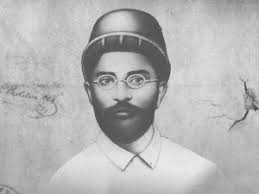
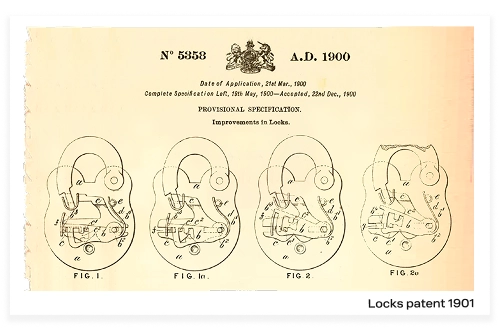
The British Empire controlled the oceans, the gold, & the law, but they could not get past a single bolt of Bombay steel. This is the story of a failed lawyer turned mechanical insurgent who turned the humble door lock into a weapon of national pride, forcing the King’s finest locksmiths to admit they were officially locked out of India. Before the name Godrej was synonymous with furniture & rockets, it belonged to Ardeshir Godrej, a man who failed so miserably at law that he decided to start a war against British steel. Ardeshir Godrej began his career as a lawyer, but his professional life ended almost as soon as it started. In his very 1st case, he realized his client was lying. Ardeshir, possessing a terminal case of honesty, refused to defend him & walked out of the courtroom. He realized he was not built for the flexible truths of the law. He wanted to build something that was objectively, mathematically true. He turned to the 1 thing that never lies: Mechanical Engineering. At the time, the Indian market was flooded with British-made locks. But these locks had a colonial flaw, they used steel springs that would rust & snap in the humid Indian monsoon. Ardeshir wanted to make 1 that made British tech look like a toy. In a small shed in Lalbaug, Bombay, he invented the 1st lever-based lock. By removing the vulnerable spring & using a complex arrangement of levers, he created a mechanism that did not just lock, it secured. He called it the Gordian lock (a nod to the Gordian Knot that no 1 could untie). It was the 1st time an Indian product was marketed as being Unpickable. As the brand grew, the British remained skeptical. They believed native engineering could not possibly surpass the legendary locksmiths of Wolverhampton. To prove his point, Ardeshir began issuing public challenges. He invited British experts & even officers from the Royal Navy to pick his locks. In a devastating Bombay fire, while other safes melted and destroyed their contents, a Godrej safe was recovered from the ashes. When opened, the documents inside were intact & undamaged, proof of its superior fire-resistant design. The very empire Ardeshir was trying to bypass was forced to rely on his rebel steel for their own security. Ardeshir was a ghost in the corporate world. He never sought luxury. He donated 3 lakh rupees (a fortune in those days) to the Tilak Swaraj Fund in 1920. He was a Capitalist Revolutionary. Every time we hear the click of a Godrej lock today, we are hearing the echo of a failed lawyer's revenge. It is the sound of a mechanism that was built to be so honest, so stubborn, & so unbreakable that even the mightiest empire in the world had to admit they were locked out.
Parimal tweet mediaParimal tweet media
English
13
246
711
32.3K
Vinayak G Kudva
Vinayak G Kudva@Vgkud·
Inspiring. ...
Parimal@Fintech03

In 1894, Lala Lajpat Rai realized a terrifying truth: Indians were funding their own slavery by keeping money in British banks. His response? He built a Financial Fortress called Punjab National Bank, a bank run by rebels that cut off the British Empire’s capital oxygen. This is the story of how banking became an act of revolution. In the 1890s, Lala Lajpat Rai (The Lion of Punjab) looked at the balance sheets of the British-run banks (like the Presidency Banks) & realized something terrifying. Millions of Indians were depositing their life savings into British banks. The British then used that exact same money to: - Fund the British Indian Army to suppress Indian protestors. - Build railways to export Indian raw materials to Manchester. - Lend money back to Indian businessmen at exorbitant interest rates. It was almost like: "Indian capital is being used to tighten the chains on Indian necks." Lajpat Rai did not go to a banker. He went to Dyal Singh Majithia, a visionary philanthropist. They met in a small room in Lahore with a few others... lawyers, teachers, & traders. They decided to start a bank that was Solely Indian. No British directors, no British shareholders, & no British capital. When they opened the 1st office in Anarkali Bazar, Lahore, on May 19, 1894, the board of directors consisted of men who were on the Watchlist of the British Intelligence. PNB was not just a bank; it was an Intelligence Hub for the Swadeshi movement. The British expected the bank to fail within 6 months. They believed Indians lacked the discipline to manage a complex financial institution. To gain the public's trust, the founders did something radical. They insisted on extreme transparency. While British banks were secretive, PNB published its books clearly to show that not a single rupee was leaving Indian soil. Indian businessmen started moving their accounts to PNB as an act of protest. It was the 1st time in history that Banking became a form of Satyagraha. By moving their money, they were cutting off the capital oxygen of the British administration. Lala Lajpat Rai was the 1st to open an account at the bank. His younger brother joined the Bank as a Manager. Authorised total capital of the Bank was Rs. 2 lakhs, the working capital was Rs. 20000. It had total staff strength of 9 & the total monthly salary amounted to Rs. 320. Everyone had the vision that the bank should cater to the small Indian trader whom the British banks ignored. PNB became the backbone of the Indian industry in the North. It funded the 1st gen of Swadeshi textile mills, sugar factories, & iron foundries that the British refused to support. PNB was headquartered in Lahore. When Partition happened, it lost its Heart. Its buildings, gold vaults, & records were stuck in a new, hostile country. Unlike other institutions that collapsed, PNB’s management worked tirelessly to ensure that every Indian refugee who had an account in Lahore could withdraw their money in Delhi. They moved their registered office to Delhi just weeks before the borders closed. PNB became the Financial Lifeboat for millions of displaced Punjabis, helping them restart their businesses from scratch in a new India. PNB was not built for profit; it was built for Protection. Lala Lajpat Rai knew that political freedom is a myth if we are financially dependent on our oppressor. Every time we see a PNB branch today, remember: we are not looking at a corporate building. We are looking at a Financial Bunker that was built to stop the British from using Indian money to buy the bullets used against Indians.

English
0
0
0
25
Vinayak G Kudva retweetledi
Nav Toor
Nav Toor@heynavtoor·
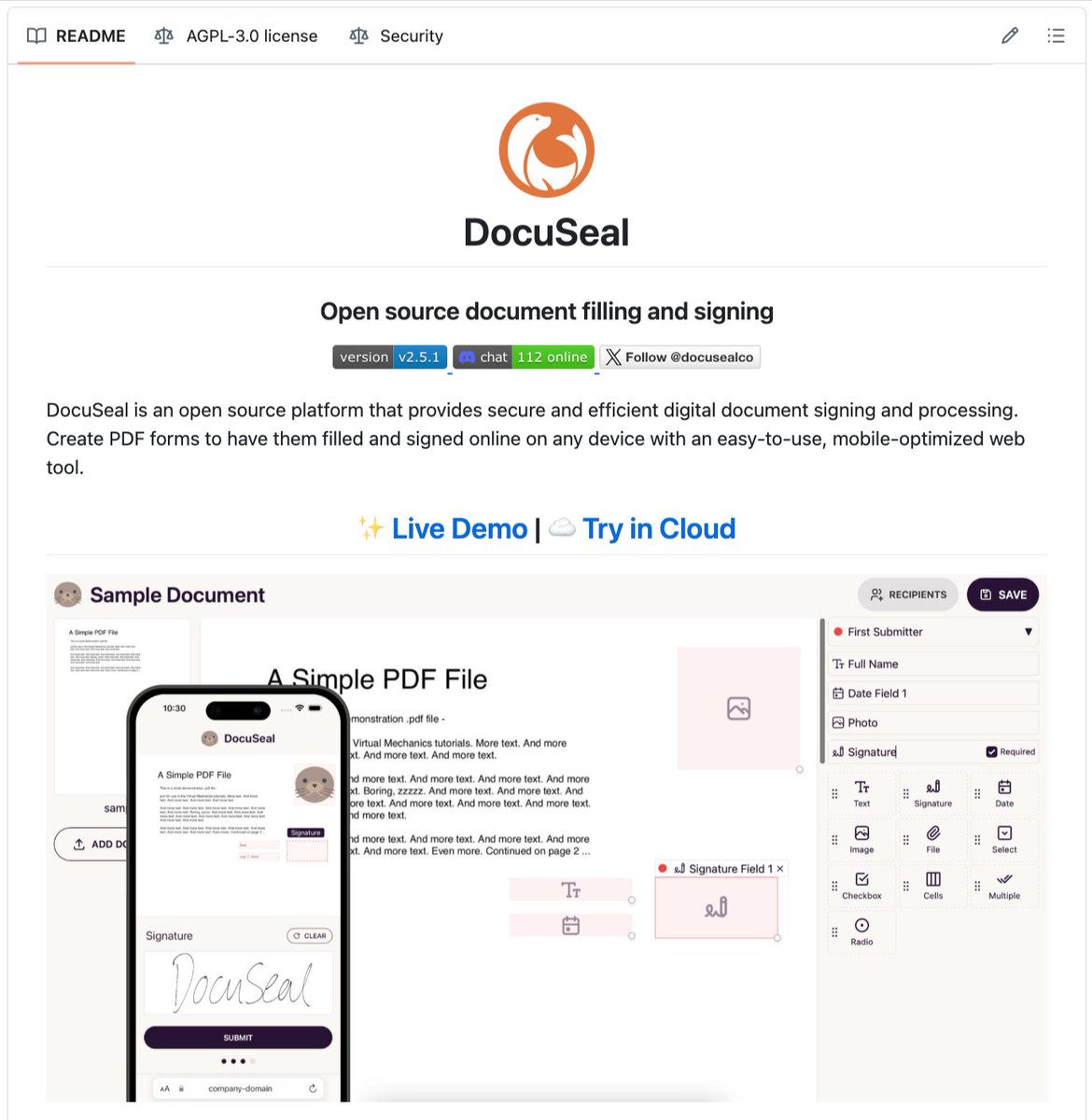
DocuSign Personal: $10 to $15 per month. DocuSign Standard: $25 to $45 per user per month. DocuSign Business Pro: $40 to $65 per user per month. A 10-person team on Business Pro pays $4,800 to $7,800 a year. To put signatures on PDFs. A team of 50 pays $24,000 to $39,000 a year. And there is a 100-envelopes-per-year cap on most plans. Send more contracts and you pay extra. Need SMS delivery? $0.40 per send. Need ID verification? $2.50 per attempt. Need premium support? $5,000 to $50,000 per year add-on. You are rationing digital signatures in 2026. DocuSign is a $10 billion company built entirely on this pricing model. Now meet DocuSeal. A free and open source alternative to DocuSign. Created in 2023 by a Ruby developer named Alex who was simply trying to sign one document and realised every solution online was overpriced or required a subscription. Three weeks later he had a working alternative. He pushed it to GitHub under the AGPL-3.0 license. Today it has 11,800+ stars and over 1,000 forks. Bootstrapped. No VCs. No paywalls. Here is what DocuSeal does: - Upload any PDF and turn it into a fillable, signable form - Drag and drop signature fields, dates, checkboxes, file uploads, and 13 field types - Send to multiple signers with custom signing order - Automated email reminders - Mobile signing on any device - PDF signature verification built in - Audit trail for every document - Bulk send and templates - Full API access - Self-host with one Docker command Here is what DocuSeal costs: Zero. Forever. Unlimited documents. Unlimited signers. Unlimited storage. DocuSign limits envelopes. DocuSeal doesn't. DocuSign charges per SMS. DocuSeal doesn't. DocuSign charges for ID checks. DocuSeal doesn't. DocuSign sees your contracts on their servers. DocuSeal doesn't. Here is the wildest part: The median DocuSign contract per Vendr is $17,250 per year. One Reddit thread has people saying "they want me to pay $4.80 per e-signature." Self-host DocuSeal on a $5 cloud server and a 50-person team can sign as many contracts as they want without paying a single dollar. Your contracts never leave your server. Your client lists. Your NDAs. Your employment agreements. None of it touches a third-party company. For individuals who only sign a few contracts a year, you save $180. For small teams of 10, you save up to $7,800 a year. For a 50-person company, you save up to $39,000 a year. Your documents. Your signatures. Your server. 100% Open Source. (Link in the comments)
Nav Toor tweet media
English
145
402
3.9K
1.1M
Vinayak G Kudva retweetledi
Raghunath Mashelkar
Raghunath Mashelkar@rameshmashelkar·
Thanks Parimal @Fintech03 for recalling these historic battles. As Chairman of @WIPO SCIT Committee, I remember emphasising to the assembly of 190 member states that knowledge generated by my ancestors in ‘laboratories of life’ has to be treated ON PAR with knowledge generated in ‘formal research laboratories’ of the west. Traditional Knowledge was not considered as a knowledge at all in the International Patent Classification System till then, which was then was forced to change. Please read and hear my first hand account of this battle in share.google/LcHXZT6eDhbdud… youtu.be/ga6TYwXfUyg?si…
YouTube video
YouTube
Parimal@Fintech03

In the 1990s, India was facing a Biological Colonization. If Dr. R.A. Mashelkar had not stepped in, we might have ended up paying a royalty to a US corporation every time we used turmeric on a wound/exported Basmati rice. In 1997, a Texas-based company called RiceTec was granted a patent by the USPTO (US Patent & Trademark Office) for Basmati Rice lines & grains. They claimed they had invented a superior strain of rice. Mashelkar realized that if this patent stood, Indian farmers would be barred from selling their own rice under the name Basmati in the US. It was a theft of Geographical Intellectual Property. He did not just shout Injustice. He assembled a team to find Genetic Fingerprints. They proved that the new rice was actually derived from Indian germplasm that had existed for centuries. The USPTO was forced to strike down the majority of the claims. 2 researchers at the University of Mississippi were granted a patent for the use of turmeric in healing wounds. To a Western patent officer, this was a novel invention. To an Indian, it was something their grandmother did every day. Mashelkar produced an ancient Sanskrit text as Prior Art. The USPTO demanded a translation. He provided evidence from the Journal of the Indian Medical Association dating back to 1953 + ancient Ayurvedic texts. This was the 1st time in history that a patent granted to a US entity was successfully challenged & revoked based on the Traditional Knowledge of a developing country. Mashelkar also realized that India could not fight 10000 legal battles every yr. He needed a Scalable Solution. Patent officers in the West were not malicious; they were just Data Blind. They could not read Sanskrit/Tamil/Persian. If a discovery was not in an English journal, it did not exist in their system. He hired 100s of experts (Ayurveda practitioners, IT engineers, & Patent lawyers). They took 500000+ formulations & converted them into a digitized Shloka to Code format. The data was rendered in English, French, German, Japanese, & Spanish. Today, India has signed agreements with the USPTO, the European Patent Office, & others. Before an officer grants a patent, they run a TKDL Scan. If the herb/method is in the library, the patent is rejected instantly.

English
34
533
1.7K
35.4K
Vinayak G Kudva retweetledi
Parimal
Parimal@Fintech03·
In the 1990s, India was facing a Biological Colonization. If Dr. R.A. Mashelkar had not stepped in, we might have ended up paying a royalty to a US corporation every time we used turmeric on a wound/exported Basmati rice. In 1997, a Texas-based company called RiceTec was granted a patent by the USPTO (US Patent & Trademark Office) for Basmati Rice lines & grains. They claimed they had invented a superior strain of rice. Mashelkar realized that if this patent stood, Indian farmers would be barred from selling their own rice under the name Basmati in the US. It was a theft of Geographical Intellectual Property. He did not just shout Injustice. He assembled a team to find Genetic Fingerprints. They proved that the new rice was actually derived from Indian germplasm that had existed for centuries. The USPTO was forced to strike down the majority of the claims. 2 researchers at the University of Mississippi were granted a patent for the use of turmeric in healing wounds. To a Western patent officer, this was a novel invention. To an Indian, it was something their grandmother did every day. Mashelkar produced an ancient Sanskrit text as Prior Art. The USPTO demanded a translation. He provided evidence from the Journal of the Indian Medical Association dating back to 1953 + ancient Ayurvedic texts. This was the 1st time in history that a patent granted to a US entity was successfully challenged & revoked based on the Traditional Knowledge of a developing country. Mashelkar also realized that India could not fight 10000 legal battles every yr. He needed a Scalable Solution. Patent officers in the West were not malicious; they were just Data Blind. They could not read Sanskrit/Tamil/Persian. If a discovery was not in an English journal, it did not exist in their system. He hired 100s of experts (Ayurveda practitioners, IT engineers, & Patent lawyers). They took 500000+ formulations & converted them into a digitized Shloka to Code format. The data was rendered in English, French, German, Japanese, & Spanish. Today, India has signed agreements with the USPTO, the European Patent Office, & others. Before an officer grants a patent, they run a TKDL Scan. If the herb/method is in the library, the patent is rejected instantly.
Parimal tweet media
English
170
2.6K
6.4K
143K
Vinayak G Kudva retweetledi
UxG
UxG@UxGsol·
This guy literally hacked Polymarket with a hair dryer 💀 Happened in Paris. On Polymarket, temperature bets were settled using a single sensor near Charles de Gaulle Airport. He figured out the exact location, showed up in person, and placed a bet on an “impossible” outcome 22°C when the market expected 18°C. Then he pulled out a hair dryer and heated the sensor. The artificial spike got recorded as the daily high → market settled → he cashed out. Did it twice. Walked away with ~$34K. While everyone’s arguing over indicators and alpha, this guy is out here doing IRL market manipulation.
UxG tweet media
English
296
771
14.2K
1.8M
Vinayak G Kudva retweetledi
Aakash Gupta
Aakash Gupta@aakashgupta·
There's a physicist at Stanford named Safi Bahcall who modeled this exact principle and the math is wild. He calls it "phase transitions in human networks." When you're stationary, your probability of a lucky event is limited to your existing surface area: the people you already know, the places you already go, the ideas you've already been exposed to. Your opportunity window is fixed. When you move, your collision rate with new nodes in a network increases nonlinearly. Double your movement (new conversations, new cities, new projects) and your probability of a serendipitous encounter doesn't double. It roughly quadruples. Because each new node connects you to their entire network, not just to them. Richard Wiseman ran a 10-year study at the University of Hertfordshire tracking self-described "lucky" and "unlucky" people. The single biggest differentiator wasn't IQ, education, or family money. Lucky people scored significantly higher on one trait: openness to experience. They talked to strangers more, varied their routines more, and said yes to invitations at nearly twice the rate. The "unlucky" group followed the same routes, ate at the same restaurants, and talked to the same 5 people. Their networks were closed loops. No new inputs, no new collisions. Luck isn't random. Luck is surface area. And surface area is a function of movement. The lobster emoji is doing more work than most people realize. Lobsters grow by shedding their shell when it gets too tight. The growth requires a period of total vulnerability. No protection, no armor, soft body exposed to the ocean. That's the cost of movement nobody posts about. You have to be uncomfortable first. The new shell only hardens after you've already moved.
@D9vidson

a moving man will meet his luck 🥀

English
505
13.9K
67.2K
4.6M
Vinayak G Kudva retweetledi
Jason Fried
Jason Fried@jasonfried·
A bespoke software revolution? I don't buy it. It'll exist. It already exists. Small consultants and big consulting firms have made custom software for years. It almost always sucks. It’s bloated, confusing, and because the client pays, it’s built wrong in all the ways. Who’s excited about bespoke software? Software makers! Of course they're excited about building bespoke software — that's what they do. X is full of them. Your feed is full of people who love making software talking about making software. Of course they’re excited about the revolution. Echo, echo, echo... Most people don’t like computers. Nobody in tech wants to say that out loud. People tolerate computers. They use them because they have to. Given the choice, most would rather not think about them at all. So when someone suggests that AI means everyone will build their own custom tools, ask who "everyone" is. The three-person accounting firm drowning in client paperwork? They want the paperwork gone, not a new system to maintain. The regional logistics company with 40 trucks? They want the routes optimized, not Joe spouting off about this new system he’s been messing around with. The law firm billing 70-hour weeks? They want leverage on their time, not a software project to design. They don’t hate technology. But building and maintaining their own critical systems isn’t their wheelhouse, regardless of how much faster and easier it’s become. It's another job on top of the job. Will these people use AI? Absolutely, for all sorts of things. Will some outliers go deep and build real custom systems? Sure, but they're almost always people who already had some pull toward software. The curiosity was already there. They were dabblers before. Giving everyone access to software building tools doesn't mean everyone becomes a builder. A powerful excavator doesn't turn a homeowner into a contractor. Most people just want the hole dug by someone else. They don’t want the responsibility either.
English
235
360
2.7K
351.8K
Vinayak G Kudva
Vinayak G Kudva@Vgkud·
If you sell APIs.. make sure your documentation is AI ready . Make it easy for AI to read your api doc webpage.. It will increase adoption..
English
0
0
1
37
Vinayak G Kudva
Vinayak G Kudva@Vgkud·
One wonders at the miracle that is human body..
Aakash Gupta@aakashgupta

A human consumes about 2,000 calories per day. Over 20 years, that’s roughly 17,000 kWh of total food energy. Training GPT-4 consumed an estimated 50 GWh of electricity. That’s 3,000 humans worth of “training energy” for a single model run. And GPT-4 is already dead. OpenAI retired GPT-4o from ChatGPT on February 13th. The model that took 50 GWh to train got less than two years of flagship status before replacement. The human you spent 17,000 kWh “training” for 20 years produces economic output for the next 40 to 60 years. The amortization window on GPT-4 was shorter than a car lease. Now look at what replaced it. GPT-5.2, released December 2025, is OpenAI’s current default. The GPT-5 series consumes an estimated 18 Wh per average query according to the University of Rhode Island’s AI Lab, up to 40 Wh for extended reasoning. That’s 8.6 times more electricity per response than GPT-4. With 2.5 billion queries hitting ChatGPT daily and GPT-5.2 now the default model, the inference math gets staggering fast. Even at a blended average well below 18 Wh, you’re looking at daily electricity consumption that could power over a million American households. This is what Altman is actually doing. OpenAI hit $13 billion in annual recurring revenue but still isn’t profitable. They need you to think of AI energy consumption as natural and inevitable, the same way you think about feeding a child, because the alternative framing is that they’re burning through enough electricity to rival small countries while racing to build 1-gigawatt Stargate data centers. The food analogy makes the energy costs feel biological and unavoidable instead of what they are: an engineering and business choice that scales with every model generation. The comparison sounds clever at a fireside chat in India. It falls apart the second you do the arithmetic.

English
0
0
0
55
Vinayak G Kudva retweetledi
Aakash Gupta
Aakash Gupta@aakashgupta·
A human consumes about 2,000 calories per day. Over 20 years, that’s roughly 17,000 kWh of total food energy. Training GPT-4 consumed an estimated 50 GWh of electricity. That’s 3,000 humans worth of “training energy” for a single model run. And GPT-4 is already dead. OpenAI retired GPT-4o from ChatGPT on February 13th. The model that took 50 GWh to train got less than two years of flagship status before replacement. The human you spent 17,000 kWh “training” for 20 years produces economic output for the next 40 to 60 years. The amortization window on GPT-4 was shorter than a car lease. Now look at what replaced it. GPT-5.2, released December 2025, is OpenAI’s current default. The GPT-5 series consumes an estimated 18 Wh per average query according to the University of Rhode Island’s AI Lab, up to 40 Wh for extended reasoning. That’s 8.6 times more electricity per response than GPT-4. With 2.5 billion queries hitting ChatGPT daily and GPT-5.2 now the default model, the inference math gets staggering fast. Even at a blended average well below 18 Wh, you’re looking at daily electricity consumption that could power over a million American households. This is what Altman is actually doing. OpenAI hit $13 billion in annual recurring revenue but still isn’t profitable. They need you to think of AI energy consumption as natural and inevitable, the same way you think about feeding a child, because the alternative framing is that they’re burning through enough electricity to rival small countries while racing to build 1-gigawatt Stargate data centers. The food analogy makes the energy costs feel biological and unavoidable instead of what they are: an engineering and business choice that scales with every model generation. The comparison sounds clever at a fireside chat in India. It falls apart the second you do the arithmetic.
Chief Nerd@TheChiefNerd

🚨 SAM ALTMAN: “People talk about how much energy it takes to train an AI model … But it also takes a lot of energy to train a human. It takes like 20 years of life and all of the food you eat during that time before you get smart.”

English
411
3.2K
14K
1.3M
Gautham R Shenoy
Gautham R Shenoy@gautshen·
An advice that I give every junior engineer in my team. While you are young or when you just get married, get the following 1. A Term Life Insurance of 2+ Cr 2. A medical insurance of 20+ Lakhs with Accidental cover The premiums will be less. And should anything unforeseen occur, your family is taken care of.
🚨Indian Gems@IndianGems_

Age: 32 Job: Software engineer Salary: ₹2 Lakh per month Total earnings till age 50: ₹4.32 crores But if I die sliding on a pothole Govt will pay ₹5 lakh to my family😭

English
3
2
19
1.7K
Vinayak G Kudva retweetledi
Hodlius ₿ Maximus
Hodlius ₿ Maximus@MAKS_Diogenes·
old but gold
English
16
98
538
15.7K