Vikash Kumar ✈️GTC

1.8K posts

Vikash Kumar ✈️GTC banner
Vikash Kumar ✈️GTC

Vikash Kumar ✈️GTC

@Vikashplus

Building Human-embodied Intelligence. CEO @MyoLabAI | Sr. research scientist @OpenAI @GoogleAI @AIatMeta | @berkeley_ai @UWcse #MuJoCo | Ad. Prof. @CMU_Robotic

NewYorkCity Katılım Şubat 2016
825 Takip Edilen6.3K Takipçiler
Sabitlenmiş Tweet
Vikash Kumar ✈️GTC
Vikash Kumar ✈️GTC@Vikashplus·
📢Life is a sequence of bets – and I’ve picked my next: @MyolabAI It’s incredibly ambitious, comes with high risk, & carries unbounded potential. But it’s a version of the #future I deeply believe in. I believe: ➡️AI will align strongly with humanity - coz it maximizes its own growth & impact ➡️It will transform the world as profoundly as the internet ➡️Like the internet, it will ultimately disappear into the background of our daily lives Most of what we see today are transient wins - short-term products riding the first waves of capability. Not transients, I’m betting on the signals that will endure. Just as the cellphone became the personal gateway to the internet era, I believe the future of AI will be 𝐩𝐞𝐫𝐬𝐨𝐧𝐚𝐥𝐢𝐳𝐞𝐝, 𝐜𝐞𝐧𝐭𝐫𝐚𝐥𝐢𝐳𝐞𝐝, & 𝐝𝐞𝐞𝐩𝐥𝐲 𝐡𝐮𝐦𝐚𝐧-𝐜𝐞𝐧𝐭𝐫𝐢𝐜. The interface—the #canvas—of this era is still waiting to be defined. With MyoLab, I’m placing my bet on the 𝐥𝐢𝐟𝐞𝐥𝐢𝐤𝐞 𝐡𝐮𝐦𝐚𝐧 𝐝𝐢𝐠𝐢𝐭𝐚𝐥 𝐭𝐰𝐢𝐧 as that interface. We’ve assembled a world-class team with the conviction and grit to make this future real. We’re building a new kind of AI: embodied, personal, and lifelike. Most already believe lifelike digital twins are inevitable. We’re just accelerating the timeline. Today, we’re releasing an early research preview of the first instantiation of #HumanEmbodiedIntelligence at myolab.ai We’d love for you to try it and share your feedback. 𝐓𝐡𝐢𝐬 𝐢𝐬 𝐦𝐲 𝐛𝐞𝐭. 𝐖𝐡𝐚𝐭’𝐬 𝐲𝐨𝐮𝐫𝐬?
myolab.ai@MyolabAI

All forms of intelligence co-emerged with a body, except AI We're building a #future where AI evolves as your lifelike digital twin to assist your needs across health, sports, daily life, creativity, & beyond... myolab.ai ➡️ Preview your first #HumanEmbodiedAI

English
18
20
113
27.3K
Vikash Kumar ✈️GTC retweetledi
Vikash Kumar ✈️GTC
Vikash Kumar ✈️GTC@Vikashplus·
In the Bay next week for GTC (Mar 16–19)✈️ Looking forward to meeting old friends, founders, researchers, & engineers building in Embodied AI.
Vikash Kumar ✈️GTC tweet media
English
3
1
7
984
Robert Scoble
Robert Scoble@Scobleizer·
@Vikashplus x.com/Scobleizer/sta… My AI says we should meet up. Would love that!
Robert Scoble@Scobleizer

This is who it wants me to see next week: Glad the report was useful! Here are my picks, thinking specifically about what would give you the best signal, content, and connections: TOP 5 COMPANIES TO MEET 1. Wayve (@wayveai) — Booth + Demo Rides CEO Alex Kendall is giving a keynote, and they're offering demo rides of their AV2.0 system. Wayve is doing what nobody else is — end-to-end learned driving, not rules-based like Waymo. This is physical AI applied to the real world at scale. Getting in that car would be incredible content and a window into where autonomous driving actually goes next. Profile: x.com/wayveai 2. Noble Machines (@NobleMachines) — Booths #941, #3303, and more They're LAUNCHING at GTC with 4 booths, 3 robots, and 2 live demonstrations. This is a company at the exact moment you love to find them — right before the world notices. General-purpose robots doing real-world industrial work. Their CEO Wei Ding just did an interview with A3's managing editor. This is the Scoble sweet spot: early, real, and about to matter. Profile: x.com/NobleMachines 3. CoreWeave (@CoreWeave) — Booth 913 + CoreWeave House The most important AI infrastructure company not named NVIDIA. IPO-bound, powering the biggest AI training runs. Their CoreWeave House keynote watch party on March 16 is where the insiders will be. Speakers Chen Goldberg and Corey Sanders are doing a deep dive on full-stack optimizations for large-scale training. If you want to understand the infrastructure layer that makes everything else possible, this is it. Profile: x.com/CoreWeave 4. Modular (@Modular) — Booth #3004 Chris Lattner (@clattnerllvm) — the creator of Swift, LLVM, and MLIR — is attending. They're showing DeepSeek V3.1 running live on Blackwell, plus Mojo GPU programming. Lattner is one of the most important infrastructure architects alive. Modular is building the programming layer that AI will run on for the next decade. The booth will have live Mojo demos — this is deep tech that matters. Profile: x.com/Modular 5. Enchanted Tools (@EnchantedTools) Their Mirokaï humanoid robots will be ROAMING the convention center — not stuck in a booth. This is the most visually striking, shareable thing at GTC. A French robotics company building character-driven humanoid robots that interact with people naturally. Great content opportunity, and a different philosophy from the industrial robots everyone else is showing. Profile: x.com/EnchantedTools TOP 5 PEOPLE TO MEET 1. Vikash Kumar (@Vikashplus) He's flying in specifically for GTC and posted he's "looking forward to meeting founders, researchers, & engineers building in Embodied AI." He's a leading embodied AI researcher (likely from Meta FAIR or similar). The people who work at the intersection of robotics and foundation models are the ones who know where physical AI goes in 5 years. He's open to meeting — take him up on it. Post: x.com/Vikashplus/sta… Profile: x.com/Vikashplus 2. Louis Castricato (@lcastricato) — Overworld AI He's in SF for GTC with "a sneak peek of our upcoming release" and explicitly said he's "happy to compare notes" on world models, interactive AI, and "whatever wild announcements come out this week." World models are one of the most important emerging areas in AI — the idea that AI can simulate and predict the physical world. Overworld is building this. Early look at their release could be a scoop. Post: x.com/lcastricato/st… Profile: x.com/lcastricato 3. Art Sokolov (@ArtSokolov) He's doing a live demo at the Humanoid booth with his KinetIQ system — two robots coordinating together to fulfill requests from humans. This is practical multi-robot coordination, not a canned demo. Built on the NVIDIA Robotics stack. This is the kind of person building the actual software that makes humanoid robots useful. Great demo to see and film. Post: x.com/ArtSokolov/sta… Profile: x.com/ArtSokolov 4. @dr1337 Bringing a CL1 demo to GTC (in SF March 14-22). This post got 32 likes from the Neuroscience list — high engagement for that community. The CL1 appears to be a neural interface / brain-computer interface device. This is the most "future" thing at GTC and exactly the kind of thing nobody else will be covering. He's offering demos — take one. Post: x.com/dr1337/status/… Profile: x.com/dr1337 5. @kimmonismus Traveling to the USA for the first time specifically for GTC — and that post got 49 likes, which means this person has a real following. Sometimes the best perspective comes from someone seeing something with fresh eyes. International AI community members often have insights about what's happening outside the Silicon Valley bubble. Worth a conversation. Post: x.com/kimmonismus/st… Profile: x.com/kimmonismus Honorable mentions: • @TheHumanoidHub — Your guide to the robotics floor. They've mapped every robotics exhibitor. • @sundeep (Groq) — "See you at GTC!" — Groq's inference speed story is important. • Lin Qiao (@lqiao, Fireworks AI CEO) — On the GTC Live pregame panel with Michael Dell and CoreWeave. The "AI is Essential Infrastructure" conversation. • @MidnightCaptl — Had a meeting with NVIDIA and is "so excited" — 77 likes. Clearly knows something. Worth asking what got them so hyped. Have an amazing GTC! 🚀

English
1
0
0
67
Ryan Hickman
Ryan Hickman@ryanmhickman·
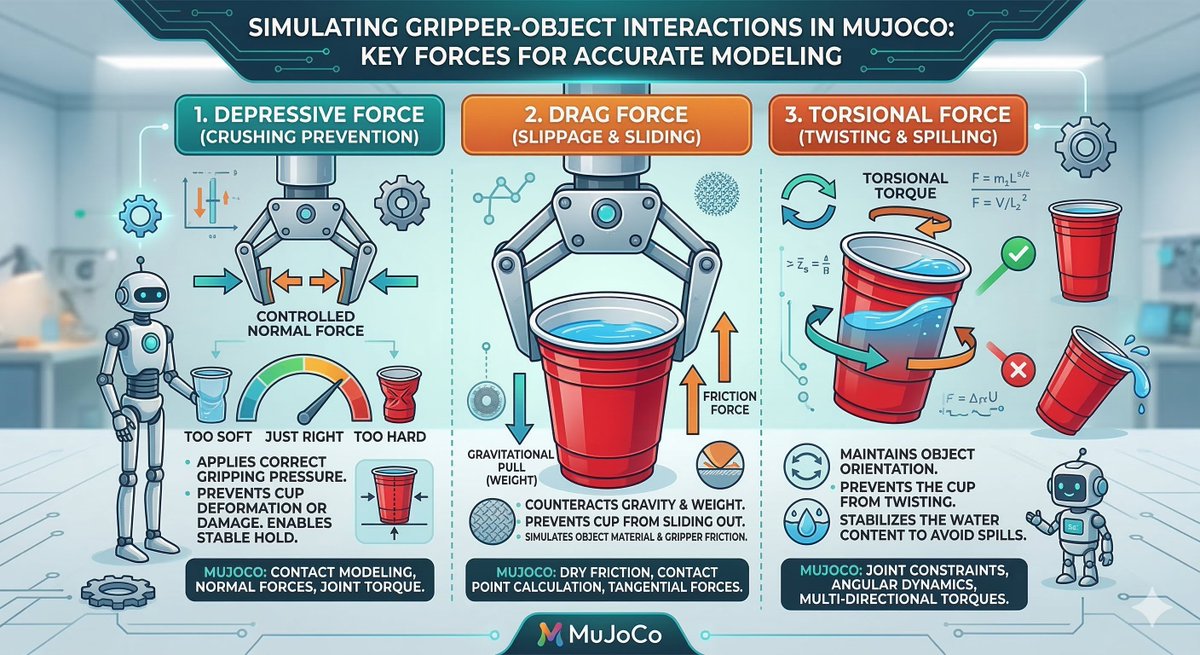
@Vikashplus Here's Nano Banana 2 trying to explain some of the physical forces that would be required for MuJoCo to simulate a parallel gripper grabbing a Solo cup with water. We're going to need to spill a lot of drinks before world models correctly capture all this 🫗
Ryan Hickman tweet media
English
1
0
0
92
Vikash Kumar ✈️GTC
Vikash Kumar ✈️GTC@Vikashplus·
VLAs aligns Action with Vision and Lang The choice is "Action" is very important to understand here. in VLAs, "A" is typically a semantic high level plan that typically benefit VLAs scaling laws. The main challenge of robotics is low level actions -- for which we still need to rely on either a library of low level skills or teleoperation based in-domain datasets -- both of which doesn't scale as well.
English
0
0
1
32
W. Tianyue
W. Tianyue@Modern_Gangster·
@Vikashplus Vikash, do you think VLAs also won't "solve" robotics? The data scaling problem might never go away (sim2real VLAs may be good attempts tho). World models feel promising because training data scales naturally, and if you leverage the high-level cues well, systems may work.
English
1
0
0
36
Vikash Kumar ✈️GTC
Vikash Kumar ✈️GTC@Vikashplus·
What happed to HOG an SIFT feature in Computer Vision… is now happening to Inverted pendulum & zero moment points in locomotion! I’m genuinely curious what the discussion will be like during this year’s Dynamic Walking conference 🤨🤔
Siyuan Huang@siyuanhuang95

You might have seen the WuBOT performing at the 2026 Spring Festival Gala; however, most high-dynamic extreme motions you see are executed by overfitted tracking policies. Until now, training a unified policy capable of performing various extreme motions with a high success rate remained an unsolved challenge. We spent an entire year digging into the barrier between general tracking and extreme physical behaviors. After burning through dozens of G1 robots, we finally identified the bottleneck of learning and physical executability. With these discoveries, we developed OmniXtreme: the first general policy that can execute diverse extreme motions, including consecutive flips, extreme balancing, and even breakdancing with rapid contact switches! This capability is achieved by pre-training a flow-based generative control policy and then post-training with actuation-aware residual RL for complex physical dynamics—a step we found critical for successful real-world transfer. This work is a joint collaboration with @UnitreeRobotics. Together, we are pushing the physical limits of humanoid robots. It is incredibly exciting to see a general "robot gymnast" and "robot breakdancer" come to life! It was also our first time publishing a paper with XingXing, which was an enlightening experience. The model checkpoints are now released—we welcome you to play with them! 📦 📄 Paper: arxiv.org/abs/2602.23843 🌐 Project: extreme-humanoid.github.io 💻 Code: github.com/Perkins729/Omn…

English
1
0
21
3.4K
Vikash Kumar ✈️GTC
Vikash Kumar ✈️GTC@Vikashplus·
❌THIS TABLE IS WRONG In my 16 years of hand manipulation research, I’ve bought multiple of these hands & have personally worked on 5 amongst the listed Esp, reliability is WRONG for most, & over engineered to fit the arguments of the author I’ll write a neutral blog soon⏱️
Bernt Bornich@BerntBornich

These guys get it (equally true for rest of robot, for safety and ability to learn thru failure, not just sim2real gap) Adding NEOs hands: DOF: 22 (44 active tendons per hand, fully actuated) Ratio: 8:1 (w/tendons, 1X custom high-torque motors) Sim2Real Gap: Low (10-15% friction, high stiffness) Force Transparency: High (motor currents) Reliability: High (3.5m cycles at nominal load)

English
5
6
106
16.2K
Sudhir Pratap Yadav
Sudhir Pratap Yadav@sudhirPyadav·
@Vikashplus True but even if sensors are near end points to quickly detect force/touch, it requires high frequency control to respond to it quickly and if inertia is high the bandwidth reduces. Also one point we can make transparent system compliant without going through force senor loop.
English
1
0
0
48
Sudhir Pratap Yadav
Sudhir Pratap Yadav@sudhirPyadav·
@Vikashplus @ChongZitaZhang So hardware should be low impedance, we can increase impedance easily in software but can't decrease it. I agree we need high torque but we need high torque and high transparency both. If I need to pick one (for now) I will go with high transparency and learn with less load.
English
1
0
2
168
Vikash Kumar ✈️GTC
Vikash Kumar ✈️GTC@Vikashplus·
❌ NOT TRUE @ChongZitaZhang A finger ≠ a leg In legged locomotion, low gear ratios help with impact tolerance, store kinetic energy, and back-drivability under heavy load. Unlike legs, hand constraints & requirements are different - high torque density - high positional controllability - brutal space constraints The real trade offs for hands are: - Low gear ratio → back drivability, responsiveness, - High gear ratio → torque density, stability, compactness 🟠So is high ratio bad? **Its depends** -- high gear ratios improve static precision & torque density, but reduce dynamic responsiveness & back drivability Infact, biological hands are not low-impedance torque sources either. Like duality of photons, human hands sometime act as precise, while other times acts as force manipulators. Perhaps we need a "Heisenberg Uncertainty Principle" but for Hands.
C Zhang@ChongZitaZhang

Before reading I didn't know the landscape of dex hand is so bad. In modern legged locomotion, a gear ratio of 100 would already means [not usable] -- forceful actuation is not repeatable. I can't believe in manipulation where precision is more important, they do this.

English
6
7
59
9.6K
Vikash Kumar ✈️GTC
Vikash Kumar ✈️GTC@Vikashplus·
Akin to how neither wave nor particle nature of photon alone is enough to understand / manipulate light, neither positional nor torque alone arguments will serve us well while designing/controlling hands. Hands aren’t just a hardware design problem, for there are enough hand hardware - not enough functional hands!! Hands are a challenging control problem - that selectively leverages the system for positional or force based reasoning depending on the situation. The example you provided is an excellent demonstration of the maturity of our control strategy! 👌
English
0
0
1
49
mortenlysgaard
mortenlysgaard@mortenlysgaard·
@Vikashplus @ChongZitaZhang When humans thread a needle, they reduce the DOF of their arms+hands greatly by fixing and leaning onto things. We use pinch grips so that opposing finger force implicitly controls position with high precision. I think force control is much more important than position.
English
1
0
0
54
Vikash Kumar ✈️GTC
Vikash Kumar ✈️GTC@Vikashplus·
@lzyang2000 Clutches are great to change system inertia. Clutches on a high DoF system is also a great engineering challenge!! 🤪
English
0
0
0
258
Lizhi(Gary) Yang
Lizhi(Gary) Yang@lzyang2000·
I remember suggestions in lab of using clutch mechanisms for humanoid robot joints haha, but kudos to anyone who can pull this off
Vikash Kumar ✈️GTC@Vikashplus

❌ NOT TRUE @ChongZitaZhang A finger ≠ a leg In legged locomotion, low gear ratios help with impact tolerance, store kinetic energy, and back-drivability under heavy load. Unlike legs, hand constraints & requirements are different - high torque density - high positional controllability - brutal space constraints The real trade offs for hands are: - Low gear ratio → back drivability, responsiveness, - High gear ratio → torque density, stability, compactness 🟠So is high ratio bad? **Its depends** -- high gear ratios improve static precision & torque density, but reduce dynamic responsiveness & back drivability Infact, biological hands are not low-impedance torque sources either. Like duality of photons, human hands sometime act as precise, while other times acts as force manipulators. Perhaps we need a "Heisenberg Uncertainty Principle" but for Hands.

English
1
0
0
451
Vikash Kumar ✈️GTC
Vikash Kumar ✈️GTC@Vikashplus·
A useful concept to build intuition Solving for the entire system dynamics (earth under all forces of the universe) might be an overkill in terms of compute Additionally the numerical precision needed with be insane Featherstone Rigid body dynamics might be the easier solution here 🤓
English
0
0
1
46
jaisel
jaisel@jaiselsingh·
@Vikashplus @ChongZitaZhang @Vikashplus I was discussing this With Kendall who told me to say “locomotion is just manipulation with a very large object” heh. because can’t compliant also mean soft not back drivable
English
1
0
0
179
Vikash Kumar ✈️GTC
Vikash Kumar ✈️GTC@Vikashplus·
@DanielXieee @ChongZitaZhang Agreed. Manufacturing cost and feasibility is also an important factor. The Pareto trade offs, as well as the roots of the system dynamics depends on all participating pieces of the system.
English
0
0
1
133
Quanting Xie
Quanting Xie@DanielXieee·
High gear ratio doesn't necessarily mean better precision. There’s a 'curse of small manufacturing' where smaller features lead to a higher signal-to-noise ratio in the geometry. When your manufacturing tolerance is a significant fraction of your tooth size, the resulting backlash actually degrade the static precision you were trying to solve for
English
1
0
2
203
Vikash Kumar ✈️GTC
Vikash Kumar ✈️GTC@Vikashplus·
Positional accuracy depends on - sensing resolution - actuation strength & resolution Given an actuator, increasing gear ratio can deliver better positional accuracy. (Reason a clock hour hand has more positional accuracy than the second hand ; even without a sensor) Given a capable controller (hardware+software), better sensing accuracy will deliver better positional control due to improved sensory feedback loop. Given an actuator, lower the load inertia faster the system response time. Low inertia and fast response time requires responsive and high resolution control system, otherwise the system looses controllability (becomes bang bang in the limit) 🎲It’s all a trade off at the playground of the designer who is designing the overall system.
English
1
0
1
137
Enes Erciyes
Enes Erciyes@MEnesErciyes·
@Vikashplus @ChongZitaZhang Why is low-inertia, low gear ratio a tradeoff with positional accuracy as long as the actuator generates enough torque? I think we have low inertia actuators but we adjust our gains depending on the task
English
1
0
0
68
Vikash Kumar ✈️GTC
Vikash Kumar ✈️GTC@Vikashplus·
@sudhirPyadav Not all hands are geared. Force transparency depends both on - transmission mechanism - & where the sensor is positioned in the transmission pipeline
English
1
0
1
144
Sudhir Pratap Yadav
Sudhir Pratap Yadav@sudhirPyadav·
@Vikashplus But the argument about transparency seems legit, high gear actuators do behave rigidly.
English
1
0
0
397
Vikash Kumar ✈️GTC
Vikash Kumar ✈️GTC@Vikashplus·
I don't think there is debate on importance of force during manipulation -- over 40% of the human grasps are force+form closure. Literature strongly supports and backs it. The important point to recognize here is that 1. Even human dexterity required complex intersection of STRONG morphological (not all joints are independent/alike) as well as computational priors (brain cant control individual DoFs and relies heavily on priors). 2. For human level dexterity we need a balance of force as well as precision. We have excelled under extreme engineering challenges. HANDS present one.
English
0
0
2
78
C Zhang
C Zhang@ChongZitaZhang·
@Vikashplus when we fold clothes, we want the garment to deform correctly under our forces. When we lift heavy boxes, we do not care about positional controllability at all. It seems to me that force controllability is more important.
English
1
0
0
271