
CVB
98 posts



The answer to this question is simple: the medical system does not make it an objective to prevent disease. They only treat diseases that already exist or very high risk individuals. Only once preventing disease is an actual stated objective will they use first principles to achieve it
English

talked to 3 cardiologists since this and im left with the obvious question:
why isnt the entire population on statins?
LDL cholesterol is cumulative damage and irreversible
the lower it is the better (without threshold)
it seems to be extremely positive EV for anyone?
mert@mert
chat how does one fix extremely high LDL cholesterol
English

Today is a monumentous day for quantum computing and cryptography. Two breakthrough papers just landed (links in next tweet). Both papers improve Shor's algorithm, infamous for cracking RSA and elliptic curve cryptography. The two results compound, optimising separate layers of the quantum stack. The results are shocking. I expect a narrative shift and a further R&D boost toward post-quantum cryptography.
The first paper is by Google Quantum AI. They tackle the (logical) Shor algorithm, tailoring it to crack Bitcoin and Ethereum signatures. The algorithm runs on ~1K logical qubits for the 256-bit elliptic curve secp256k1. Due to the low circuit depth, a fast superconducting computer would recover private keys in minutes. I'm grateful to have joined as a late paper co-author, in large part for the chance to interact with experts and the alpha gleaned from internal discussions.
The second paper is by a stealthy startup called Oratomic, with ex-Google and prominent Caltech faculty. Their starting point is Google's improvements to the logical quantum circuit. They then apply improvements at the physical layer, with tricks specific to neutral atom quantum computers. The result estimates that 26,000 atomic qubits are sufficient to break 256-bit elliptic curve signatures. This would be roughly a 40x improvement in physical qubit count over previous state-of-the-art. On the flip side, a single Shor run would take ~10 days due to the relatively slow speed of neutral atoms.
Below are my key takeaways. As a disclaimer, I am not a quantum expert. Time is needed for the results to be properly vetted. Based on my interactions with the team, I have faith the Google Quantum AI results are conservative. The Oratomic paper is much harder for me to assess, especially because of the use of more exotic qLDPC codes. I will take it with a grain of salt until the dust settles.
→ q-day: My confidence in q-day by 2032 has shot up significantly. IMO there's at least a 10% chance that by 2032 a quantum computer recovers a secp256k1 ECDSA private key from an exposed public key. While a cryptographically-relevant quantum computer (CRQC) before 2030 still feels unlikely, now is undoubtedly the time to start preparing.
→ censorship: The Google paper uses a zero-knowledge (ZK) proof to demonstrate the algorithm's existence without leaking actual optimisations. From now on, assume state-of-the-art algorithms will be censored. There may be self-censorship for moral or commercial reasons, or because of government pressure. A blackout in academic publications would be a tell-tale sign.
→ cracking time: A superconducting quantum computer, the type Google is building, could crack keys in minutes. This is because the optimised quantum circuit is just 100M Toffoli gates, which is surprisingly shallow. (Toffoli gates are hard because they require production of so-called "magic states".) Toffoli gates would consume ~10 microseconds on a superconducting platform, totalling ~1,000 sec of Shor runtime.
→ latency optimisations: Two latency optimisations bring key cracking time to single-digit minutes. The first parallelises computation across quantum devices. The second involves feeding the pubkey to the quantum computer mid-flight, after a generic setup phase.
→ fast- and slow-clock: At first approximation there are two families of quantum computers. The fast-clock flavour, which includes superconducting and photonic architectures, runs at roughly 100 kHz. The slow-clock flavour, which includes trapped ion and neutral atom architectures, runs roughly 1,000x slower (~100 Hz, or ~1 week to crack a single key).
→ qubit count: The size-optimised variant of the algorithm runs on 1,200 logical qubits. On a superconducting computer with surface code error correction that's roughly 500K physical qubits, a 400:1 physical-to-logical ratio. The surface code is conservative, assuming only four-way nearest-neighbour grid connectivity. It was demonstrated last year by Google on a real quantum computer.
→ future gains: Low-hanging fruit is still being picked, with at least one of the Google optimisations resulting from a surprisingly simple observation. Interestingly, AI was not (yet!) tasked to find optimisations. This was also the first time authors such as Craig Gidney attacked elliptic curves (as opposed to RSA). Shor logical qubit count could plausibly go under 1K soonish.
→ error correction: The physical-to-logical ratio for superconducting computers could go under 100:1. For superconducting computers that would be mean ~100K physical qubits for a CRQC, two orders of magnitude away from state of the art. Neutral atoms quantum computers are amenable to error correcting codes other than the surface code. While much slower to run, they can bring down the physical to logical qubit ratio closer to 10:1.
→ Bitcoin PoW: Commercially-viable Bitcoin PoW via Grover's algorithm is not happening any time soon. We're talking decades, possibly centuries away. This observation should help focus the discussion on ECDSA and Schnorr. (Side note: as unofficial Bitcoin security researcher, I still believe Bitcoin PoW is cooked due to the dwindling security budget.)
→ team quality: The folks at Google Quantum AI are the real deal. Craig Gidney (@CraigGidney) is arguably the world's top quantum circuit optimisooor. Just last year he squeezed 10x out of Shor for RSA, bringing the physical qubit count down from 10M to 1M. Special thanks to the Google team for patiently answering all my newb questions with detailed, fact-based answers. I was expecting some hype, but found none.
English

what is the best tooling for 24-7 inference/agent-driven research? im trying factory but it stops and asks me questions even though i have 'auto' mode on.
tbh i think this is an even bigger killer app than LLM chatbots. who else is out there doing it?
English
CVB retweetledi
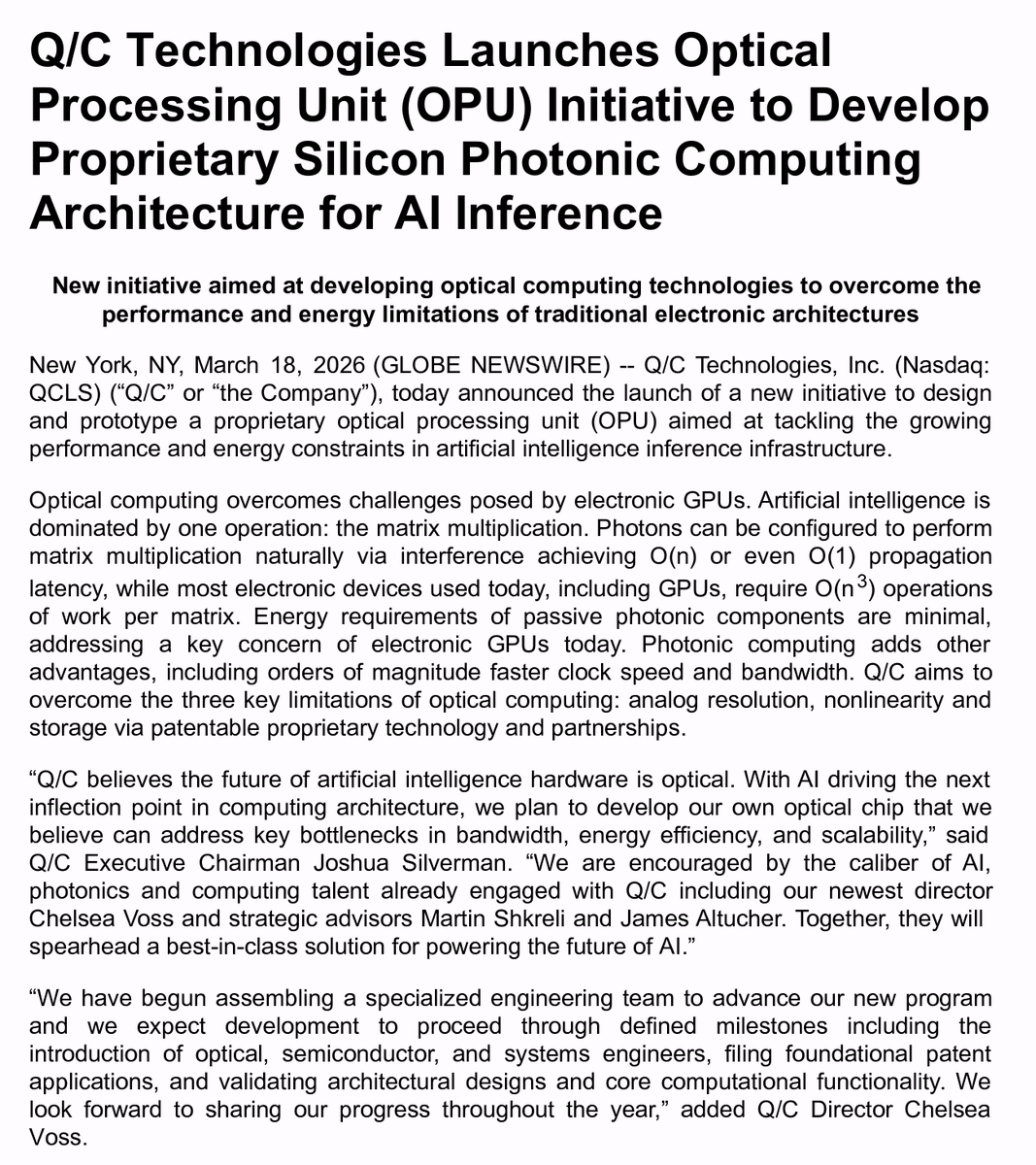
I spoke with many companies when I was at the NVDA GTC conference this week. Optical is where 100s of billions of dollars is being spent. Even Jensen on stage said this. The goal at $QCLS is to be the first optical ASIC chip performing the valuable (for AI) function of matrix multiplications. Happy to answer any questions on this.
Corey Cicero@CoreyCicero
@LSonderheim007 @jaltucher @MartinShkreli $QCLS IS Going To $100.00
English
CVB retweetledi
going to make an optical computer for AI $QCLS
faster matmuls
less energy
QED
English
CVB retweetledi

@Vincent7Dimarco Excuse me? 16m market cap with $100m offering means the biggest dilution hurdle is behind them? Lol I got a newsflash for u that won't be their only equity offering. Strap up and buy this when they have to RS again.
English


I should also mention that the $99/month for supervised FSD will rise as FSD’s capabilities improve.
The massive value jump is when you can be on your phone or sleeping for the entire ride (unsupervised FSD).
Sawyer Merritt@SawyerMerritt
NEWS: Tesla has officially discontinued Autopilot in the U.S. and Canada. All new car purchases now come standard with Traffic-Aware Cruise Control. The online configurator has now been updated to allow buyers to choose the $99/month FSD subscription, while still offering the option to purchase FSD outright for $8,000 until February 14th. New Tesla vehicles purchases still come with a 30-day free trial of FSD (Supervised).
English
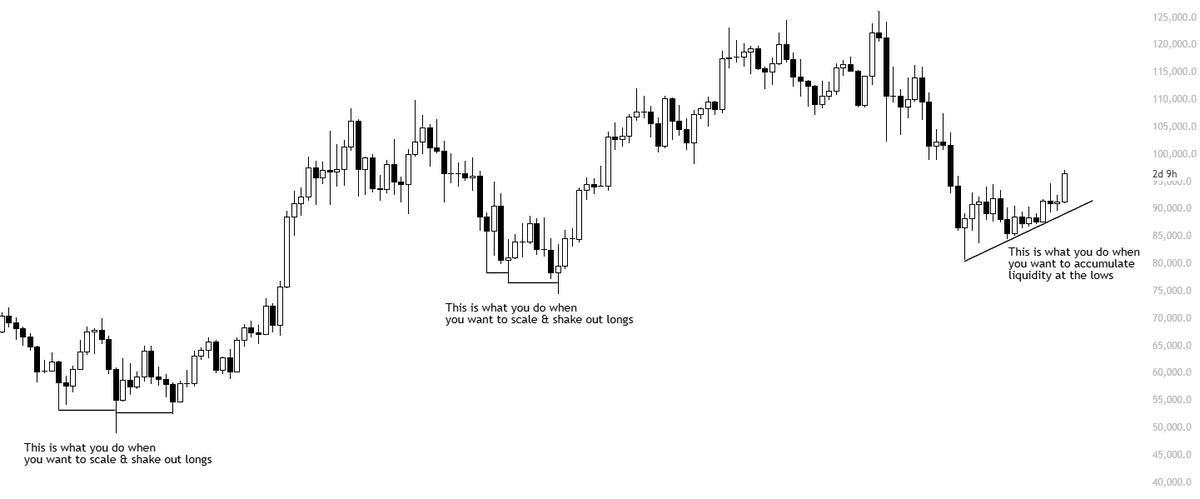
@KillaXBT @CryptoDarkSide4 In your video you mentioned another 70 days to the pivot high, do you think this last meaningful upside retest will range for that long? or quick and violent like you suggest here.
English

Agreed, an that's the thing about bear market retests.
They are usually quick violent & a 1 time thing which occur. In my eyes, this the last meaningful upside retest we will see this year.
The final LH before new lows. But again, retail who missed the move upwards will most definitely buy the entire way down again.
English
@hataf_capital @MartinShkreli interesting one to cover on a stream
English

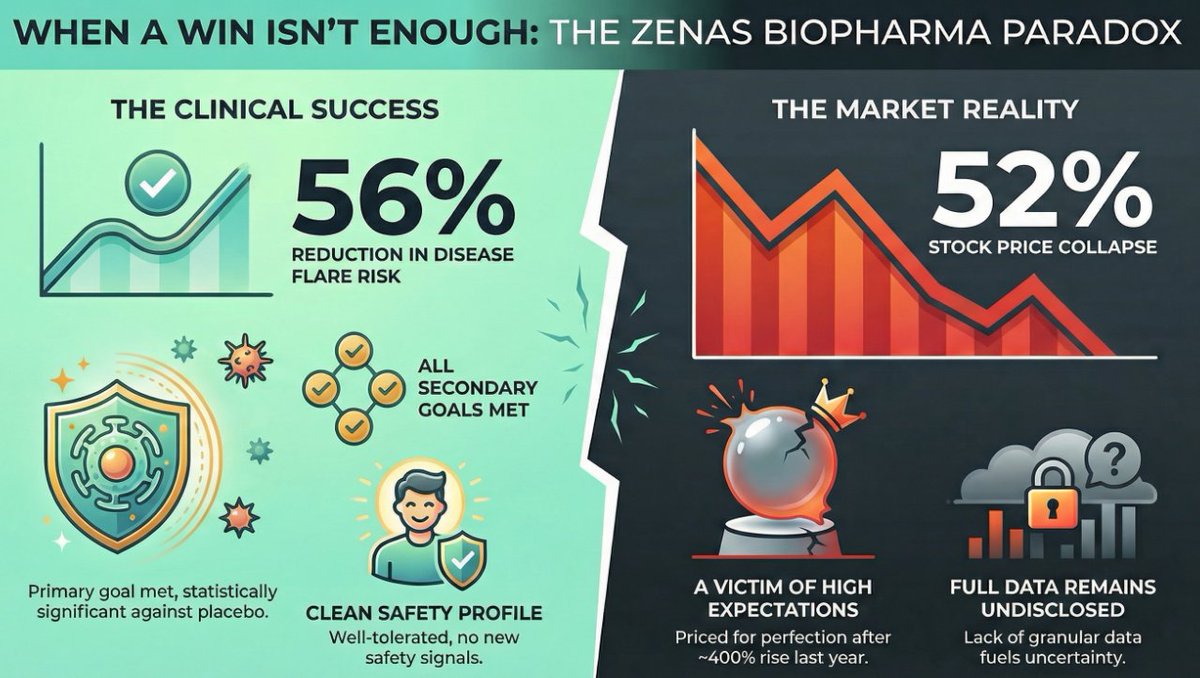
$ZBIO: When a Phase 3 "Win" Leads to a 52% Collapse
By Hataf Capital
The biotech sector just delivered a brutal lesson in "priced for perfection." Waltham-based Zenas BioPharma $ZBIO saw its market cap slashed in half today despite its lead asset, obexelimab, technically meeting its primary endpoint in the Phase 3 INDIGO trial for IgG4-Related Disease.
Here is the analytical breakdown of why the market is punishing a "successful" trial:
The "Success" vs. The Expectation
Zenas reported a 56% reduction in the risk of IgG4-RD flare compared to placebo. While statistically significant and clinically meaningful, this figure seemingly failed to satisfy a market that had driven the stock up nearly 400% over the last year. In the high-stakes world of biotech, a "win" that doesn't dominate often triggers a "sell the news" event especially when the valuation is stretched.
Clinical Data Highlights
Primary Endpoint: Met (56% risk reduction).
Secondary Endpoints: All four key metrics hit, including investigator-assessed flare reduction.
Safety Profile: No new safety signals; well-tolerated as a subcutaneous injection.
The Missing Link: Full data remains undisclosed, with Zenas planning a reveal at a future medical event. The lack of granular data today may be fueling investor uncertainty.
The Path Ahead
CEO Lonnie Moulder remains bullish, positioning obexelimab as a potential first-line therapy. The regulatory roadmap is now the focus:
U.S. FDA: BLA filing expected in Q2 2026.
EU EMA: MAA filing targeted for H2 2026.
Zenas is a victim of its own pre-trial momentum. While the drug works, the 52% pre-market crash suggests that institutional investors were looking for a "knockout" blow to the disease that simply didn't materialize in the top-line percentages. All eyes now turn to the full data set to see if the secondary metrics hold enough weight to justify a recovery.
English

JUST IN: Vanguard says Bitcoin is still a speculative digital "toy."


English

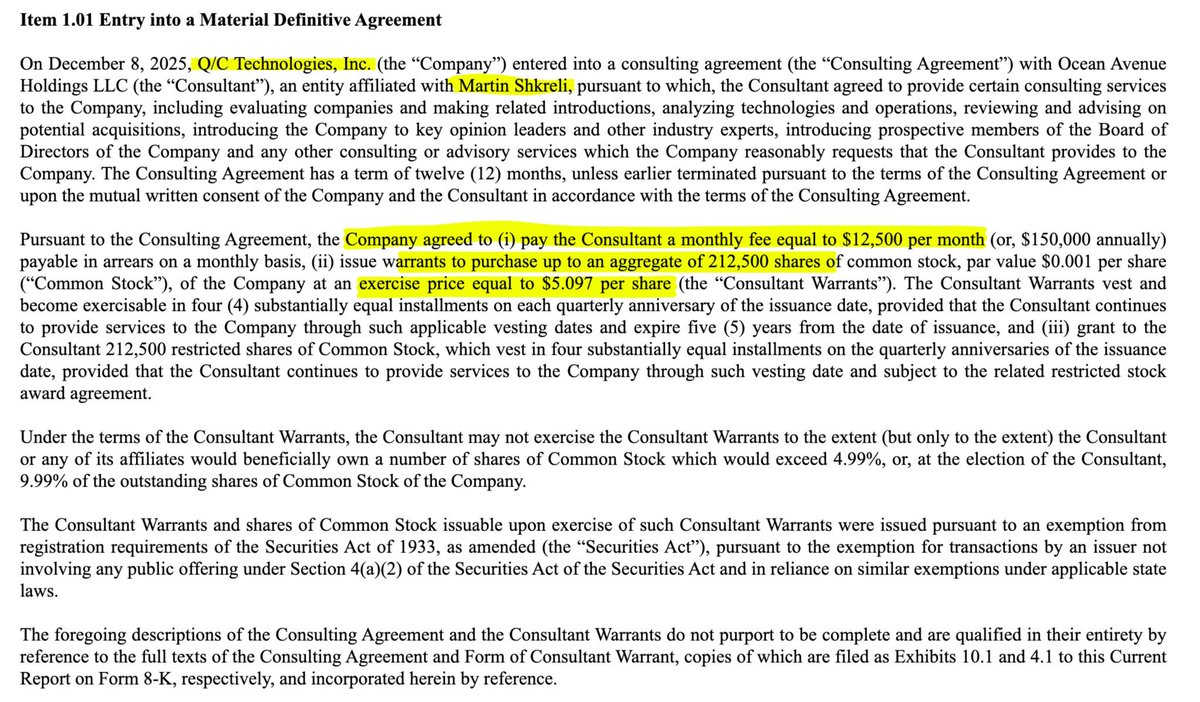
@SPAC_Infleqtion It looks like his incentives are tied directly to the share price. What am I missing
English
Dropping a TON of charts this week
What stocks do you want an analysis on? 👇📈
English
my favorite quantum shorts:
1) QBTS - can't even be called quantum computing
2) RGTI - didn't make it through low hurdle DARPA
3) IONQ - insane house of cards
4) BTQ - scamco
5) LAES - scamco
English