Virendra Codes

1.4K posts

Virendra Codes banner
Virendra Codes

Virendra Codes

@VirendraCodes

👨‍💻 Virendra | Data Engineer Intern |🧠 AI Enthusiast | Tech Innovator | 🚀 Passionate about Building the Future with Technology #coding #AI #Tech #Developer

Pune Katılım Haziran 2024
247 Takip Edilen77 Takipçiler
Virendra Codes
Virendra Codes@VirendraCodes·
Same event→sort→sweep skeleton also solves the Skyline problem and closest-pair-of-points. Learn it once, reuse it everywhere. If you're prepping for interviews, "Meeting Rooms II" is basically a line sweep in disguise. #DSA #DataStructures #CodingInterview #Algorithms
English
0
0
1
5
Virendra Codes
Virendra Codes@VirendraCodes·
Gotcha: when a meeting ends and another starts at the exact same time, process the −1 before the +1. Get this tie-break wrong and you'll double count a room that was actually free. This trips people up in interviews constantly.
English
1
0
1
5
Virendra Codes
Virendra Codes@VirendraCodes·
Most devs solve "max overlapping meetings" with nested loops. O(n²). There's a cleaner way: Line Sweep. One sort, one pass, O(n log n). Here's how it works 🧵
Virendra Codes tweet media
English
1
0
1
17
Virendra Codes
Virendra Codes@VirendraCodes·
The other piece people skip: checkpointing. Without it, a job restart = duplicate rows in your table. With it, every file gets processed exactly once, even after failures. Question for you: are you still polling, or have you moved to event notifications #DataEngineering
English
0
0
1
4
Virendra Codes
Virendra Codes@VirendraCodes·
Event-driven ingestion flips the model. S3 fires an event the moment a file lands → pushes it to SQS ADLS does the same via Event Grid Your engine (Databricks Auto Loader, Snowpipe) just listens to the queue instead of asking storage "anything new?" every few seconds.
English
1
0
1
15
Virendra Codes
Virendra Codes@VirendraCodes·
Your S3 bucket just got 50,000 new files dumped into it overnight. If your pipeline is still doing a directory LIST to find what's new, you're burning money and time on something solved years ago. Here's how real ingestion pipelines actually detect new files 🧵
Virendra Codes tweet media
English
1
0
1
46
Virendra Codes
Virendra Codes@VirendraCodes·
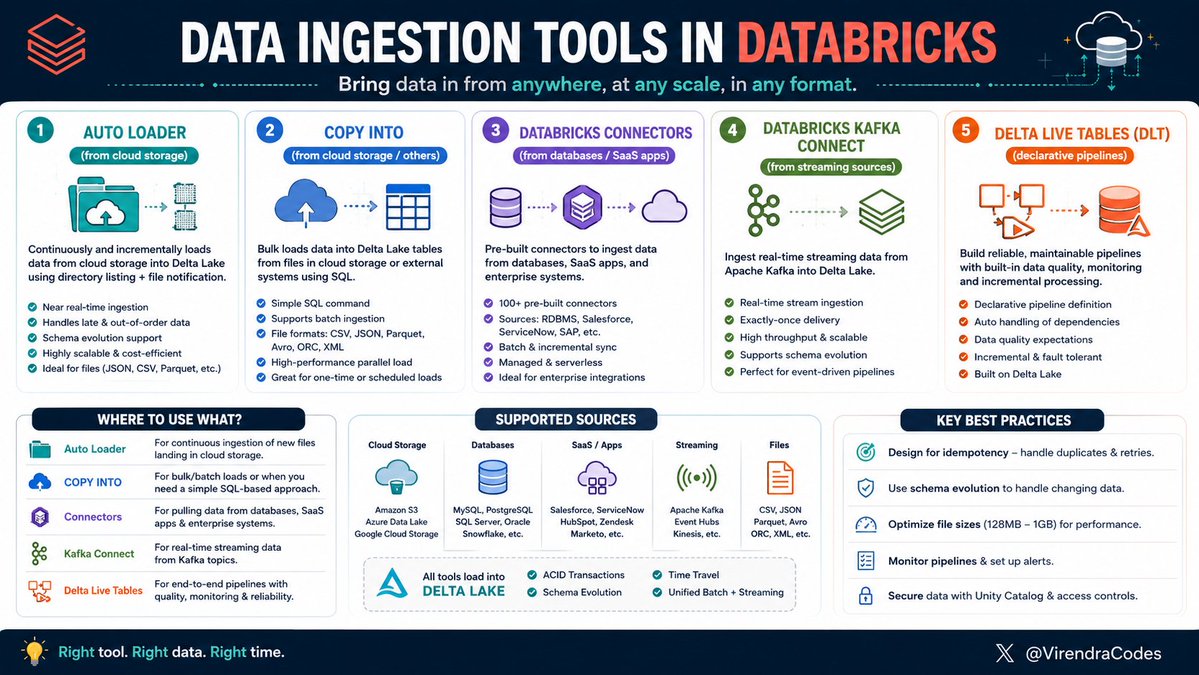
The one line that separates junior from senior ingestion code: MERGE INTO target USING source ON id MATCH... That single MERGE makes your pipeline idempotent — safe to rerun after failures without duplicating data. #DataEngineering #ApacheSpark #Databricks
English
0
0
1
28
Virendra Codes
Virendra Codes@VirendraCodes·
The batch vs streaming decision isn't about which is "better." Batch: cheap, simple, hours of latency. Fine for daily reports. Streaming (Kafka, CDC): near real-time, but adds real operational cost. Don't use Kafka to ingest a table that updates once a day.
English
1
0
1
15
Virendra Codes
Virendra Codes@VirendraCodes·
Your data pipeline doesn't break at the transformation layer. It breaks at ingestion. Bad schema handling, no idempotency, silent duplicate loads — most "data quality issues" are actually ingestion problems wearing a disguise. 🧵
Virendra Codes tweet media
English
2
0
2
45
Virendra Codes
Virendra Codes@VirendraCodes·
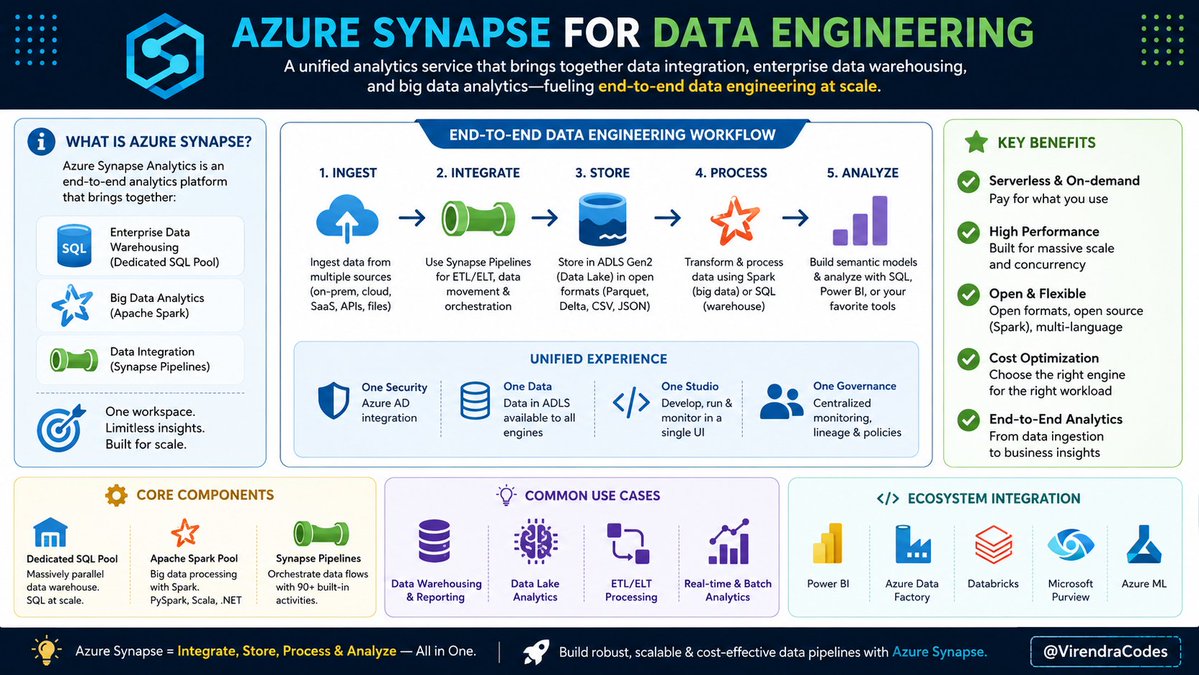
If you've worked with Teradata, dedicated SQL pool will feel familiar — same hash/round-robin distribution key logic under the hood. Which engine do you reach for first: Synapse, Databricks, or Fabric? Genuinely curious what teams are standardizing on in 2026. #DataEngineering
English
0
0
1
28
Virendra Codes
Virendra Codes@VirendraCodes·
The counterintuitive part: serverless SQL scales to zero, dedicated doesn't. So teams that provision a dedicated pool for occasional reporting end up paying for idle compute 24/7. Rule of thumb: predictable heavy BI → dedicated. Ad-hoc exploration → serverless.
English
1
0
1
9
Virendra Codes
Virendra Codes@VirendraCodes·
Most people think Azure Synapse is "just Databricks with a Microsoft badge." It's not. It's a warehouse and a lake engine stitched into one workspace — and that difference changes how you architect pipelines. Here's what actually matters if you're building on it 🧵
Virendra Codes tweet media
English
1
0
1
40
Virendra Codes
Virendra Codes@VirendraCodes·
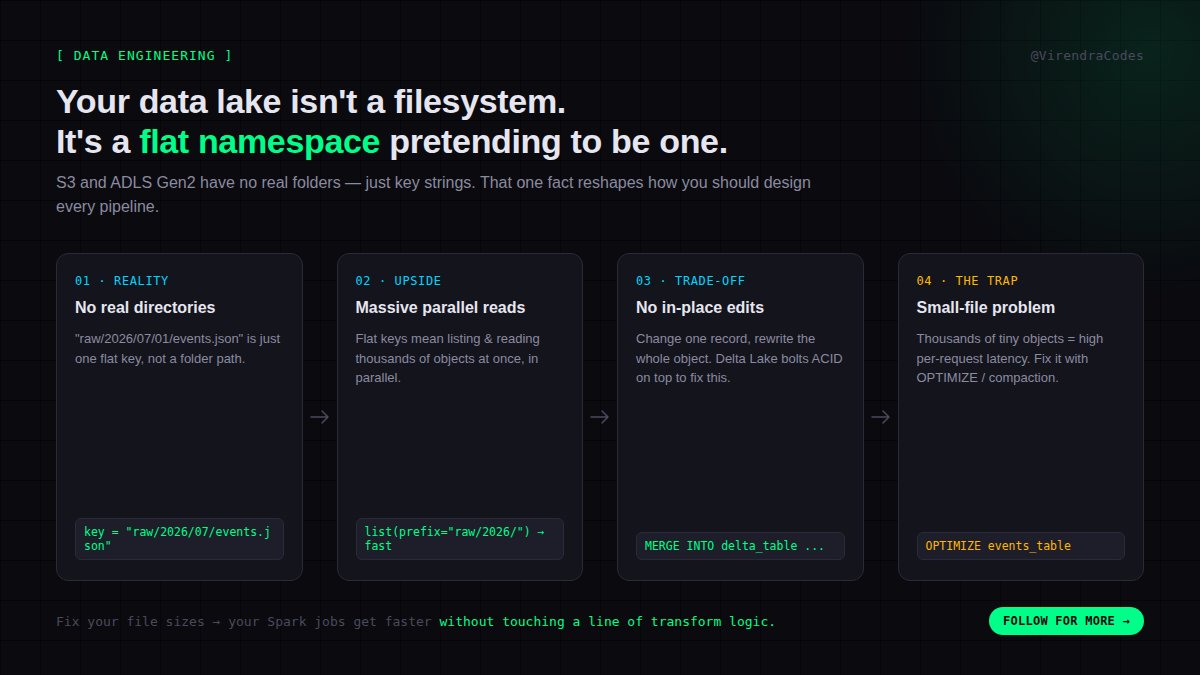
Quick gut check for your own pipelines: are you writing lots of small files, or few well-sized ones? Fix it and your Spark jobs get faster without touching a single line of transformation logic. Follow @VirendraCodes for more data engineering posts. #DataEngineering #ApacheSpark
English
0
0
1
6
Virendra Codes
Virendra Codes@VirendraCodes·
The trap most people hit: the small-file problem. Streaming writes create thousands of tiny objects. Each read has real per-request latency, so querying 10,000 tiny files is way slower than querying 100 well-sized ones. This is why Databricks runs OPTIMIZE and auto-compaction.
English
1
0
1
14
Virendra Codes
Virendra Codes@VirendraCodes·
Because there's no real hierarchy, object storage can list and read thousands of "files" in parallel instantly. But it also means there's no in-place edit. Change one record and you're rewriting the whole object. That's exactly why Delta Lake exists.
English
1
0
1
12
Virendra Codes
Virendra Codes@VirendraCodes·
Your data lake is not a filesystem. It just looks like one. S3 and ADLS Gen2 have no real folders. What you see as "raw/2026/07/events.json" is just a flat key string. There is no directory tree underneath. 🗂️ Here's why that single fact changes how you should design pipelines 🧵
Virendra Codes tweet media
English
1
0
1
13