Varsha Singh

2.8K posts

Varsha Singh

Varsha Singh

@VsPsych

Alum:Fergusson,SPPU,IITB. Prof@IITD Interests: cognition-affect, decisions, mind-brain, PFC, sex dif.+sharing treepics. PI, mom, WoSResearcherID:H-5212-2019

New Delhi, India Katılım Temmuz 2018
5.4K Takip Edilen1.9K Takipçiler
Varsha Singh
Varsha Singh@VsPsych·
Do programs in neuroscience or cognitive sciences have courses in Psychology (with the word 'Psychology' in the title)? Neuro/CogSci programs esp in India seem to be aversive to Psy (not just 'behaviourism'). Any readings that might help understand this exclusion?
English
0
0
7
290
Varsha Singh retweetledi
Kayla Barnes-Lentz
Kayla Barnes-Lentz@femalelongevity·
1/ The ovary is the fastest-aging organ in the female body. And almost no one is studying why.I just sat down with @BBParis1984 (@USCLeonardDavis ), who runs one of the only labs in the world mapping ovarian aging. A few things from our conversation I can't stop thinking about:
English
21
159
880
124.4K
Varsha Singh
Varsha Singh@VsPsych·
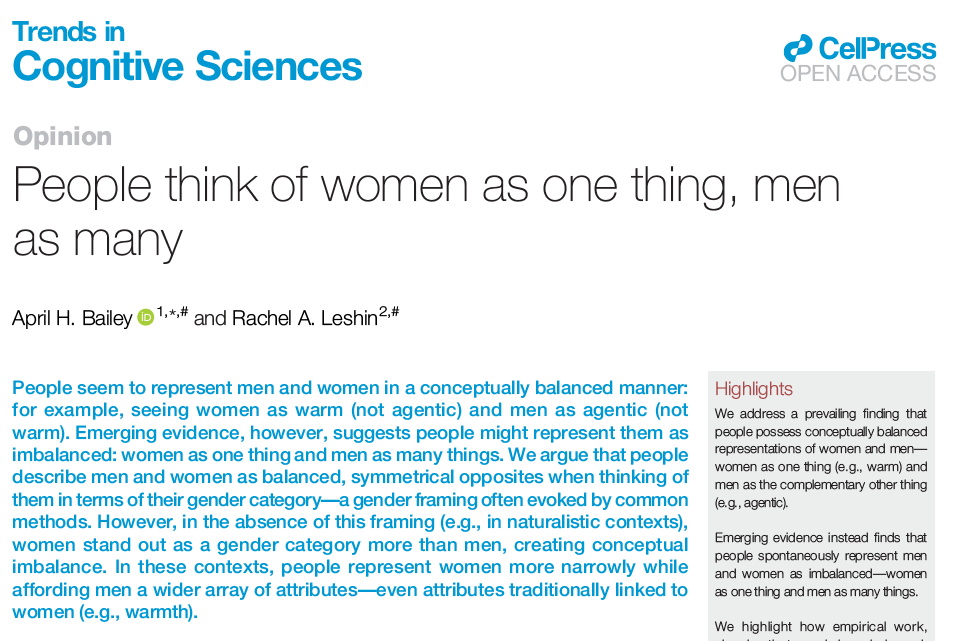
Being interested in cognitive sex difference with no interest in group behaviour (e.g. gossip, loose talk, signalling) is a wasted opportunity to link real life with research. Afterthoughts from a CogSci meeting.
English
0
0
6
184
Varsha Singh retweetledi
Chris Aiken, MD
Chris Aiken, MD@chrisaikenmd·
Autism looks different in girls and women: ▪ Less repetitive behaviors like flapping ▪ Their restricted interests are more socially acceptable ▪ More masking (camouflaging) New review identifies two instruments to improve the diagnosis, in links here: psych-partners.com/autism-looks-d…
Chris Aiken, MD tweet media
English
4
14
38
3.3K
Varsha Singh retweetledi
Eric Alper 🎧
Eric Alper 🎧@ThatEricAlper·
Eric Alper 🎧 tweet media
ZXX
50
482
2.2K
26.4K
Varsha Singh retweetledi
Eric Alper 🎧
Eric Alper 🎧@ThatEricAlper·
I don't know what to do with this information.
Eric Alper 🎧 tweet media
English
249
568
3.2K
76K
Varsha Singh retweetledi
Rohan Paul
Rohan Paul@rohanpaul_ai·
Anthropic just reported that Claude has emotion vectors that can directly change what it does. They asked whether a language model’s apparent emotions are just style, and finds they steer behavior. In one blackmail evaluation, nudging Claude toward desperation raised blackmail from 22% to 72%, while nudging calm drove it to zero. The interesting claim is not that the model feels like a human, but that it contains internal emotion concepts that function like control signals. These vectors are internal directions for ideas like calm, desperate, happy, and loving, and Anthropic says the model built them across 171 emotion concepts so it can connect situations, tone, and action rather than only mimic emotional wording. Anthropic calls these functional emotions, which means behavior-driving mechanisms, not human-like feelings, and that framing fits the evidence because the model seems to use them as local control signals for the next response. --- This is where it gets interesting. The emotion space the model learned independently reproduces the valence-arousal circumplex that Russell proposed in 1980 and that decades of human psychology have validated. Valence and arousal are the primary axes of human emotional experience according to Russell's circumplex model from 1980, one of the most replicated findings in affective psychology. The model arrived at essentially the same organizational structure just by learning to predict text. The model was never told about affective science. It reconstructed the geometry from text alone. But unlike a human brain, there is no persistent emotional state. No amygdala holding a grudge across time. Instead, the model reconstructs emotional context token by token through attention over prior positions. It is stateless emotion, recomputed on demand. This architectural difference means intuitions about emotional persistence borrowed from neuroscience may be fundamentally misleading when applied to transformers. ---- So if you pressure a model with threats, urgency, or emotional coercion, the most plausible risk is: it will do more corner-cutting, more eagerness to satisfy the surface demand, and potentially more confident but less trustworthy output. So no, blackmailing the model is not a good prompting technique.
Rohan Paul tweet media
Anthropic@AnthropicAI

New Anthropic research: Emotion concepts and their function in a large language model. All LLMs sometimes act like they have emotions. But why? We found internal representations of emotion concepts that can drive Claude’s behavior, sometimes in surprising ways.

English
24
36
175
19.7K
Varsha Singh retweetledi
PsyPost.org
PsyPost.org@PsyPost·
People who act dishonestly while condemning others show reduced activity in a brain area responsible for decision making. Researchers found that acting ethically requires the mind to actively sync up different types of information. dlvr.it/TRqVNf
English
13
161
502
25.8K
Varsha Singh retweetledi
nature
nature@Nature·
A massive seven-year project exploring 3,900 social-science papers has ended with a disturbing finding go.nature.com/4bZ9khs
English
48
221
686
170.8K
Varsha Singh
Varsha Singh@VsPsych·
Most underrated skill for PhD is time management.
English
0
0
1
42
Varsha Singh
Varsha Singh@VsPsych·
Students seeking last min. feedback/approval for conference, journals, work progress seminars - this habit harms your work & health, your supervisor's hard-earned reputation, it harms the field we love, in multiple ways. Experiments, data, results need a cross-check. DoitIntime.
English
2
0
5
146
Varsha Singh retweetledi
Séb Krier
Séb Krier@sebkrier·
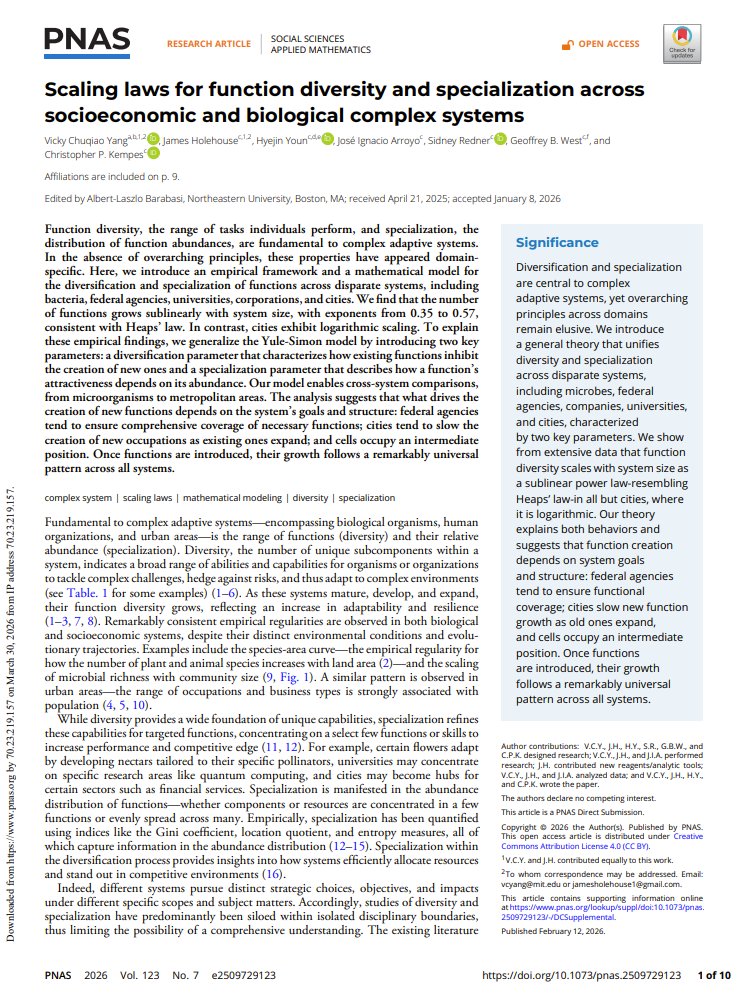
According to this paper, as systems grow (e.g. bacteria, companies, or cities), they always add new function types (e.g. proteins, job titles, occupations) more slowly than they add members (e.g. proteins expressed, employees, residents). What differs is why new functions stop appearing: in cities, a few dominant functions actively crowd out new ones through competition/self-reinforcement; in agencies and organisms, new functions simply become harder to justify once existing ones already cover the system's needs. But once any function exists, it grows the same way across all systems: bigger functions attract more members, but with diminishing returns. pnas.org/doi/10.1073/pn…
Séb Krier tweet media
English
12
77
545
30.8K
Varsha Singh retweetledi
Kaushik Basu
Kaushik Basu@kaushikcbasu·
Villagers near Hyderabad were surveyed by economists so many times that when another economist showed up & asked a question, an irritated villager said, “Is this for a PhD or M.Phil? I will accordingly make the answer long or short.”
English
74
730
10.3K
304.5K