
Web3 Association

299 posts

Web3 Association banner
Web3 Association

Web3 Association

@W3Association

🎯 Fixing the incentives with Web3 🤔 Thinking about incentives, governance and economics ✍️ Analysing treasuries, funding processes, organisations and money

Katılım Haziran 2023
386 Takip Edilen117 Takipçiler
Web3 Association
Web3 Association@W3Association·
georgelovegrove.substack.com/p/web3-and-dem… The system of money is broken. Silvio Gesell is an economist you have likely never heard of. But his understanding of the problems of money are of paramount importance if we want to fix the global economy. Gesell's solution? Demurrage money. Money that has carrying costs - which means it cannot be stored without some form of gradual loss. Applying his ideas to Web3 has been exciting, as the application of demurrage in Web3 could result in making some of the most impactful and incentive aligned economic systems that have ever existed. We've just finished an article to discuss the ideas and opportunities for Web3 and demurrage money
Web3 Association tweet media
English
0
3
3
323
Web3 Association
Web3 Association@W3Association·
Suggestions for an initial implementation of demurrage in a Web3 network have now been aggregated into a new document. This resource combines together the suggestions from the previous pieces of analysis. We’ve also been making improvements to the other resources over the last week.
Web3 Association tweet media
English
1
2
4
246
Web3 Association
Web3 Association@W3Association·
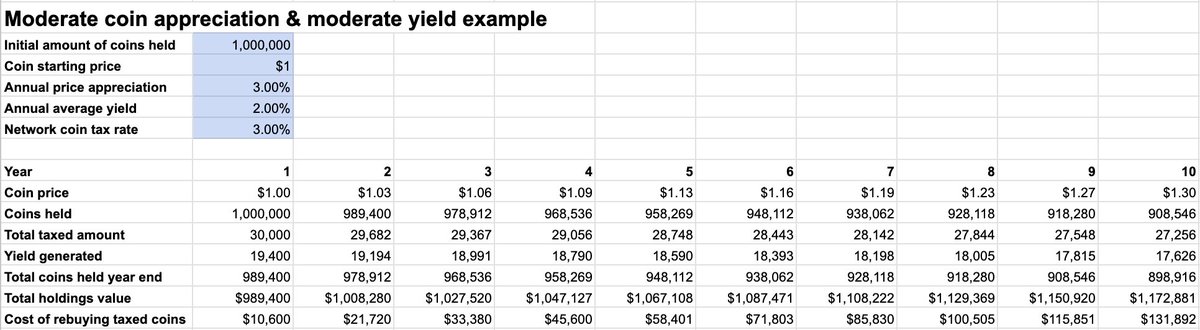
We've added some data modelling to showcase what happens when you implement a network coin tax against different annual yields (generated from financial protocols) and coin price appreciation rates. These simple examples help to highlight how holders of the network coin are able to generate a positive return on investment whilst their coin ownership is reducing. This means that the network coin is dispersing over time as it gets harder to maintain a large holding. It is difficult for a network to accurately maintain stable prices for the network coin. If the network can't achieve this reliably it could cause inflation - which reduces demand for the network coin! Deflation is far more desirable as it creates more demand for the network coin AND the network can then use the network coin tax to capture this unearned income. The better a network is at evaluating price appreciation the more accurately it could capture that unearned income in the future. However in the short to medium term, giving holders some gains from price appreciation can help to increase the amount of capital that is invested in the network. Investment will be important in a highly competitive market. Couple this with a circular treasury funding process that improves and grows the ecosystem and you have one of the most powerful flywheels for growing a Web3 network. Investment returns for holders 🤝 meaningful and reliable treasury income to fund ecosystem initiatives.
Web3 Association tweet media
English
1
2
4
292
Web3 Association
Web3 Association@W3Association·
The demand for the network coin can be important for a number of areas, including the consensus mechanism, network governance, compensation for node operators and when paying for network usage. A suppressed and low value network coin can create a number of risks for the network as a low value makes it easier to accumulate larger amounts of the network coin which can then be used to attack the network. Another relevant factor is that Web3 networks are digital, meaning anyone is able to very quickly exchange one asset to another. These factors make it very important to understand how much demand there is for the network coin and how this changes over time due to different variables. Sudden changes in demand could result in systemic failure. So demand needs to be reliable enough that the network doesn't become fragile to sudden activity changes. The network needs to do everything it can to avoid situations where the demand for the network coin could quickly drop to the extent that it can jeopardise the networks stability. This is why it’s important to think about the use cases that are important for the network and that the network coin could help with fulfilling as a responsibility. Currently we believe that financial liquidity and contract collateral are the most compelling candidates to help with improving the long term demand and price stability for the network coin. We’ve added a page about understanding the importance of demand for the network coin and reorganised and updated the stable demand for the network coin resource to better discuss these issues.
Web3 Association tweet media
English
1
2
3
81
Web3 Association
Web3 Association@W3Association·
Using the network coin as financial liquidity (such as for token asset exchanges and within single asset borrowing and lending) is a compelling use case for the network coin. But there's more... we’ve now added contract collateral as a 2nd compelling use case that is synergistic with the financial liquidity use case. Contract collateral could be used to increase the trust between any two parties that are entering a contractual agreement. Examples could include the exchange of any goods or services or as a guarantee that someone will comply with the terms of usage when participating within a digital service like a social network. This is a highly compelling use case as it provides people with a permissionless way to increase trust when interacting with other people and services in the network. Contracts could also use the financial liquidity that people have deposited as the collateral! Someone could deposit the network coin and another token as a token exchange liquidity pairing. Then they could use that liquidity as their own contract collateral. The value of contract collateral to protect and enforce an agreement is increased when the collateral is locked up and cannot be removed by the owner whilst the agreement is still in place. This creates a situation where it becomes desirable for people to keep an amount of collateral locked up in perpetuity that they can utilise as a guarantee in multiple agreements. If the network coin is being used as financial liquidity it is being used productively to create efficient financial markets. If it is then also being used as contract collateral it means it will be used for even more use cases - and result in even more productive usage. The network coin is a perfect candidate for contract collateral as it is something that is designed and implemented as a mission critical piece of network infrastructure. Everyone requires the network coin to use the network, making it a reliable and ideal form of collateral to use for increasing trust in any new contractual agreements. Both financial liquidity and contract collateral incentives are two compelling complimentary use cases that can help with generating longer term demand for the network coin.
Web3 Association tweet media
English
1
2
4
172
Web3 Association
Web3 Association@W3Association·
We’re improving our resources about network coins and tokens as potential forms of Web3 money. One of these resources involves sharing some more thoughts about whether the network coin is necessary for the operation of a Web3 network. The short answer is yes it is required. It is hard to see a situation where tokens or external funding would be a reliable mechanism for maintaining a mission critical Web3 network at scale in the near term. Even if you had very cheap node operation costs this doesn’t mean you can have free transactions and run the network as a public good. As this would leave the network open to spam and denial of service attacks. You would need an environment where you can reliably deter people from spamming the network such as through some form of Proof of Human mechanism or reputation and collateral based solution and then you would also need an environment where electricity and node operation is extremely cheap. In this type of environment you might be able to consider how a Web3 network could operate without a network coin. This type of environment does not currently exist. So for now, the network coin is the simplest way to create a circular and reliable economy that can align the incentives between the node operators and users of the network.
Web3 Association tweet media
English
1
2
3
70
Web3 Association
Web3 Association@W3Association·
Across the resources we have removed the usage of the term “network money” and replaced it with “network coin”. Money is most well known for being a universally accepted medium of exchange for goods and services. Our analysis helps to provide strong rationale that the network coin is not a great candidate for trying to become a globally adopted medium of exchange. Instead the network coin should focus on ensuring the network is always operational by being as simple and reliable as possible from an implementation and governance perspective. Tokens are highly suitable for fulfilling the responsibility of being a medium of exchange and many communities can create and govern their own mediums of exchange in any manner they prefer. Web3 networks help to remove the need for banks as centralised middlemen in the exchange process. Instead, a group of distributed node operators helps to maintain a decentralised financial ledger. The network coin is better described as a fungible asset that is focussed on the facilitation of economic activity. There is nothing stopping people from using the network coin as a medium of exchange, but this doesn’t mean the implementation needs to encourage that type of usage when tokens can more effectively able to focus on the specific requirements and use cases of each community that needs a system of money.
Web3 Association tweet media
English
1
2
5
171
Web3 Association
Web3 Association@W3Association·
We've refined the advantages and opportunities page from the demurrage money resources. Two main additions: Reduce money based inequality Demurrage helps to reduce the amount of inequality there is for users of demurrage money. It becomes harder and harder to hold a large amount of demurrage money due to the ongoing loss. This helps to prevent long term consolidation. Granular incentive mechanisms A network coin tax is a great way to simulate demurrage in a Web3 network. And the way you apply that coin tax can be extremely granular. You can have different rates for different use cases. These incentive mechanisms can help with encouraging people to use their network coins as productively as possible. The most compelling use case for these incentive mechanisms we've identified so far, at least for a digital asset network, is to try and create highly efficient financial markets.
Web3 Association tweet media
English
1
2
3
239
Web3 Association
Web3 Association@W3Association·
This resource has now been updated, as inflation and deflation were not the right terms! Expansionary and contractionary have replaced these terms across the resource.
English
0
0
0
20
Web3 Association
Web3 Association@W3Association·
What monetary policy should a Web3 network adopt for handling money supply changes? Stable prices are an important goal for any medium of exchange. However network money doesn’t need to fulfil the responsibility of being a global medium of exchange. Network money benefits from being in demand for more use cases than just transaction fees. If network money is going to be used in financial protocols, which can help to create longer term demand for the money, then these use cases also benefit from price stability. Broadly speaking, the supply mechanism approaches include fixed, deflationary, inflationary and elastic. ⬇️ A supply that is deflationary can be problematic as it can lead to drastic increases in the price of network money. An economy that is growing can lead to an increasing demand for money. Couple this with a supply of money that is shrinking and this could lead to excessive price increases and instability that also makes network money excessively storable. This can disincentivise investment and usage. A network coin tax could help with counteracting this and this monetary policy creates a better justification for a higher taxation rate. However you can achieve this without excessive price appreciation by using a fixed supply approach. 🔒 A fixed supply approach is inherently appealing as it is highly simple and doesn’t introduce any added implementation or governance complexities. For most ecosystems starting out a fixed supply approach would likely make the most sense. If the economy generally grows a small amount each year and the demand for network money increases with that growth there is an ongoing justification to maintain a sufficiently high network coin tax. The price of network money will gradually rise but people will also gradually pay a small taxation rate that circulates through the economy. ⬆️ An inflationary supply approach becomes more compelling in situations where the average growth of the economy is relatively high. The faster the growth of the economy the less stable network money prices would be on a fixed supply approach as the demand would be increasing quickly whilst the supply stayed the same. An inflationary rate that is conservative and that is below the growth of the demand for network money would help to reduce the severity of any price instability. This could help with making network money more suitable as a form of financial collateral. ↕️ An elastic supply approach is the most complex supply mechanism to implement into a global Web3 network. These networks will increasingly become mission critical. So implementing a supply change mechanism that can be gamed or maliciously influenced is not an acceptable outcome. It is difficult to identify any single reliable metric that would be enough on its own to automate the process of expanding or contracting the supply. If a demurrage money still resulted in an economy that had big expansions and contractions the benefit of implementing an elastic supply mechanism could warrant the risk. Overall, a fixed supply approach is a great starting point for any Web3 network and this approach provides a compelling justification for maintaining a high network coin tax to counteract the price appreciation of the network money. This is highly beneficial for funding ecosystem initiatives that can rapidly improve and grow the ecosystem. Inflationary and elastic supply approaches both have their merits and can be more easily considered when more data and trends have been revealed from these emerging Web3 networks.
Web3 Association tweet media
English
2
2
3
160
Web3 Association
Web3 Association@W3Association·
The first version of our resources about demurrage money and implementing it in Web3 is complete! Learn about demurrage and Web3 money here - money.web3economy.io Share any ideas or feedback, we’ll continue to iterate and improve upon this work over the year!
Web3 Association tweet media
English
0
2
4
68
Web3 Association retweetledi
George Lovegrove | Economics & Politics
I think this is a really important thought around monetary supply policy. If the supply of money grows at a faster rate than economic growth you get asset price increases. The problem with this are well known - it drives wealth inequality, as it is beneficial for people who already have assets and bad for people that don't. This becomes a form of unearned income for people who own assets already that is difficult to prevent and capture in a tax system. However if the inflation of money supply is always less than the growth in demand for the money, the money is what will increase in price and not external assets. This creates an entirely different scenario. The network has full control over taxing the network coin. Similar to inflation above the economic growth rate the network money price appreciation is a form of unearned income. But a Web3 network can respond to that problem by increasing the network coin tax. This means the community can capture some or all of the upside of that price appreciation for the benefit of the ecosystem. It is a similar situation to the land value tax being suggested in Georgism. A network coin tax that is charged on an appreciating asset like network money can prevent or at least minimise people receiving unearned income. If you inflate the money supply above the economic growth rate you make it much harder to capture this unearned income as it dissipates into every storable asset that exists across the world that is increasing in price. You'd now have to tax those assets to capture the unearned income back. Not very easy or desirable. So out of the two choices you should always be conservative with money supply increases! The network can capture the price appreciation for the benefit of the collective through the network coin tax that is simulating demurrage. Keen to hear any counter rationale to this. I think it's a pretty good step forward in thinking about monetary supply changes.
George Lovegrove | Economics & Politics@lovegrovegeo

Demurrage money can work with any monetary supply policy! For Web3 networks the most compelling solution in the short term is a fixed money supply. This makes it easier to maintain a higher network coin tax. Once the ecosystems start growing a community can monitor how fast the price increases are for network money. The faster the price increases the more that an inflationary or elastic supply mechanism might be warranted. Network money is highly suitable for financial protocols such as a token exchange liquidity pairing. In these situations price stability is important as if the price of network money was increasing too fast people would be reluctant to provide liquidity for token pairs. It could be more profitable to just buy and hold network money and leave it idle due to the price appreciation. An inflationary monetary policy does not mean the price of network money will go down as the demand for network money could be increasing at a faster rate than the inflationary supply rate. Demurrage money could have a dramatic impact on increasing economic activity and growth, and in that event the demand for network money could grow at a fast pace. After thinking about how supply could be handled and how it helps to maintain a higher network coin tax I'm more bullish than ever on implementing demurrage money in a Web3 network. The adopted supply mechanism can likely provide a reliable way to sustain a 1-3% network coin tax rate and the implications of that for funding ecosystem initiatives and global public goods is enormous.

English
1
2
2
185