WalterWX

14.4K posts

WalterWX banner
WalterWX

WalterWX

@WalterWX

Follow the crisis—it's not over until the debt is purged • Unfollow the surveillance state—'nothing to hide' wont keep it off of you • Stand by & hear Fukumimi

Amsterdam - NL Katılım Eylül 2011
3.8K Takip Edilen392 Takipçiler
WalterWX
WalterWX@WalterWX·
I missed this one. NATO is missing something immensely much bigger.
Jürgen Nauditt 🇩🇪🇺🇦@jurgen_nauditt

It is simply incredible: During large-scale NATO exercises on the strategically vital Swedish Baltic island of Gotland, Ukrainian drone pilots—acting in the role of the aggressor—repeatedly and completely "annihilated" the Swedish (and, by extension, NATO) troops. The exercises had to be halted three times because, under real-world conditions, the Swedish units would have already been eliminated. Pilots using the call signs "Tarik" (1st "Azov" Corps) and "Karat" reported that while the Swedish troops possess potential, they must massively improve their drone technology, tactics, and—above all—their understanding at the leadership level. Sweden’s Supreme Commander, General Michael Klässon himself, emphasized that all NATO armies urgently need to learn from the Ukrainians how modern drone warfare is conducted—noting that the "fastest way" is the direct adoption of Ukrainian experiences. Source: Reporting by the Associated Press (AP) news agency, which was on the ground (May 2026, during the Aurora 26 exercises). After more than four years of intense, high-tech warfare in Ukraine—featuring countless drone attacks, daily lessons learned on the battlefield, and thousands of documented missions—it is truly staggering that large segments of NATO apparently still fail to grasp the fundamental nature of modern warfare.

English
0
0
0
7
WalterWX
WalterWX@WalterWX·
Hoor de merel! Nee, ik slaap…
Aakash Gupta@aakashgupta

Your brain has a circuit that doesn't know you live in a city. Its only job is to monitor whether birds are still singing. When they stop, something dangerous is nearby. When they continue, the coast is clear. This wiring predates primates. These kids are being sedated by the oldest safety signal in the mammalian nervous system. The Max Planck Institute tested this in 2022 with 295 participants. Six minutes of birdsong reduced anxiety and paranoia with medium effect sizes. Six minutes of traffic noise increased depression by the same margin. The effect worked on people who had never left dense urban environments. Their bodies responded to a signal their conscious minds had never learned. King's College London ran a larger study. 1,292 participants, real-time mood tracking through a phone app, 26,856 assessments over three years. Hearing or seeing birds improved mental wellbeing for up to eight hours afterward. The effect held for people diagnosed with depression. Trees, plants, and waterways didn't explain it. The birds themselves were the variable. Now here's where Italy connects to Finland. 95% of parents in the Finnish city of Oulu let their babies nap outside starting at two weeks old. A 2008 study confirmed the children took longer, deeper naps outdoors. Parents reported letting them sleep in temperatures as low as -15°C. 66% said their babies were more active afterward compared to indoor naps. The practice started as a public health initiative from Nordic maternity clinics in the early 1900s and became cultural infrastructure. The Italian kindergarten in this video is running the same program the Nordic countries have been running for a century. Outdoor naps, natural soundscapes, no white noise machines, no blackout curtains. Meanwhile, American kindergartens have been eliminating nap time entirely to squeeze in more instruction. A UMass study showed that children who skipped naps forgot 12% of what they learned that morning. The nap itself was the learning. The irony is that the countries spending the least on sleep technology for children are producing the best sleep outcomes. No sound machines. No apps. Just birds.

Nederlands
0
0
1
20
WalterWX retweetledi
Carel Brendel
Carel Brendel@CarelBrendel·
6/ Samenvattend. In juli 2025 misdraagt de achterban van Utrecht4Palestine and New Neighbours zich bij een raadsdebat, in mei 2026 krijgen beide clubs toestemming voor een kranslegging bij het verzetsmonument en blijkt burgemeester Dijksma zelfs bereid om een krans te leggen.
Nederlands
41
136
538
33.5K
WalterWX
WalterWX@WalterWX·
China thinks –not unreasonably– that it’s in the pocket:
Arnaud Bertrand@RnaudBertrand

This is an extraordinary document written by the research arm of China's spy agency (the powerful MSS, basically the CIA and the FBI all wrapped in one) that absolutely zero media has picked up on. As far as I can see, I'm the first person to write about it even though it was published (in Chinese) on May 13th on chinadiplomacy.org.cn, a website of China's Ministry of Foreign Affairs. The document contains perhaps the most authoritative description of where China thinks its relationship with the U.S. stands, and where it’s headed. The title of the report is “The Great Global Transformation and the Path to U.S.–China Coexistence” and I provide a full translation of it in my article, the link of which is at the bottom of this post. To summarize briefly the most important - and, perhaps, surprising - aspect of the document: China's spy agency - the one institution whose entire job is to worry about the U.S. threat - has largely stopped worrying. That's really what transpires from the document. They use a strategic framework borrowed from Mao's "protracted war" theory and, according to this framework, America's offensive phase is finished and China weathered the storm intact. The question is no longer "how do we survive America?" but "how do we manage America?" - and they're proposing a six-step relationship recovery program. I'll let you read the full document as well as my analysis of it here: open.substack.com/pub/arnaudbert…

English
0
0
1
94
WalterWX
WalterWX@WalterWX·
The Japanese, rightly, saved their cats — as can we. Let’s just do it.
Anish Moonka@anishmoonka

Toru Miyazaki gave 11 cats with advanced kidney disease an experimental injection. 15 others didn’t get it. A year later, 9 of the 11 treated cats were alive. Only 3 of the 15 untreated cats survived. He just filed for approval, and the drug fixes a defect only cats have. Most cats die from one thing: their kidneys fail. By age 10, 4 in 10 cats already have chronic kidney disease, and by age 15, the rate doubles to 8 in 10. Once diagnosed, a cat has about 2 years left. The reason kidney disease hits cats so hard is a broken protein in their blood. All mammals carry a protein that helps the kidneys clean out waste. In humans and dogs, the protein floats freely and goes to work when the kidneys are in trouble. In cats, it stays stuck to another protein and can’t get loose. So the waste piles up, and the kidneys eventually give out. Miyazaki originally found the protein in 1999, back when he was at the University of Tokyo. He figured out the cat-specific glitch in 2015. The paper he published in the Veterinary Journal in February laid out the trial. The injection is a working version of the missing protein. His company, the Institute for AIM Medicine, filed the approval paperwork with Japan’s Ministry of Agriculture on April 24, 2026. If the review clears, the drug goes on sale in spring 2027. The 30-year lifespan figure in the tweet is Miyazaki’s own projection of what cats could reach without kidney disease. The trial only ran a year, and the average cat today lives 15. Most die from the same disease this injection treats. The research almost died in 2020. After running out of funding during COVID, Miyazaki went public. Cat owners across Japan responded by sending in 300 million yen, around 2 million dollars total. He resigned from the University of Tokyo and worked on the drug full time. The treatment in front of regulators today exists because cat lovers refused to let the research die.

English
0
0
0
17
WalterWX
WalterWX@WalterWX·
Turns out, completely unexpected, that we all have TWO brains. And that your gut-feeling doesn’t only physically exist but it actually runs part of the show. A-ma-zing:
Ihtesham Ali@ihtesham2005

A neurobiologist at Columbia spent 30 years proving that the gut has its own brain, and the day he finally published the book that named it, almost every psychiatrist in America stopped returning his calls. His name is Michael Gershon. He runs the Department of Anatomy and Cell Biology at Columbia University Medical Center in New York, and the field he built from the ground up is called neurogastroenterology in short brain-gut axis. The book that announced it to the world was published in 1998, and the title alone tells you everything about what he was up against. He called it The Second Brain. The claim sounded like science fiction in the 1990s. Gershon was saying that the human gut contains its own fully functional nervous system, with around 100 million neurons embedded in the walls of the alimentary canal, which is the nine-meter tube running from your esophagus to your anus. That is more neurons than your entire spinal cord, and more than your entire peripheral nervous system put together. The gut was not just digesting food. It was running its own intelligence, with its own reflexes, its own memory, and its own way of deciding what to do without asking the brain in your head for permission. The medical establishment treated this as borderline heretical when he first started publishing it. The brain was supposed to be the command center. Everything else was supposed to be the periphery. A second brain in the belly did not fit the architecture anyone had been taught. Then the data started piling up, and it was impossible to argue with. The first finding that broke the old model was about serotonin. You might have heard Andrew Huberman talking about it on his podcasts. Serotonin is the neurotransmitter associated with mood, well-being, sleep, and depression. Every antidepressant on the market targets it. The assumption for decades was that serotonin was a brain chemical, produced in the brain, regulated in the brain, and responsible for what happened inside the brain. Gershon's lab showed that 90 to 95 percent of the body's serotonin is not produced in the brain at all. It is produced in the gut, by specialized cells called enterochromaffin cells embedded in the intestinal lining. Your stomach and intestines are the largest serotonin factory in the human body, and the brain in your skull is producing only a tiny fraction of what is circulating below your neck. The second finding was even harder to swallow. The vagus nerve is the longest cranial nerve in the body, running from the base of the brain down through the neck, the chest, and into the abdomen, where it branches into the gut. For most of the 20th century, doctors assumed the vagus was the brain's way of giving orders to the digestive system, in the same way the brain gives orders to the rest of the body. The actual measurements showed almost the opposite. Roughly 90 percent of the fibers in the vagus nerve are carrying signals upward, from the gut to the brain, and only a small fraction are carrying signals downward. Your gut is sending nine times more information to your head than your head is sending to your gut. The bandwidth is wildly asymmetrical, and almost all of it is going in a direction the medical textbooks had quietly been wrong about for decades. The implication of those two findings together is what changed psychiatry. If most of your serotonin is being produced in your gut, and most of the information flowing through your vagus nerve is moving from your gut to your brain, then your mood is being shaped from the bottom up far more than it is being directed from the top down. The feeling of dread before a difficult meeting. The sudden clarity after a good meal. The low-grade anxiety that will not go away no matter how much you talk through it. All of it is downstream of signals that started below your diaphragm. A 2019 study at McMaster University put the final piece in place. Researchers gave mice oral antidepressants and watched what happened. The drugs activated the vagus nerve from the gut side, and the gut-to-brain signaling was what produced the antidepressant effect. When they cut the vagus nerve and tried the same drugs, the antidepressant effect disappeared completely. The drug was not working on the brain directly. It was working on the gut, and the gut was working on the brain. The follow-up research on the microbiome made the connection even tighter. Mice raised in completely sterile environments with no gut bacteria produced about 60 percent less serotonin in their intestines than normal mice. When the bacteria were reintroduced, serotonin production returned to normal. The trillions of microorganisms living in your digestive tract are not passengers. They are running the factory that makes the chemical your antidepressant is trying to manipulate. The most haunting line from Gershon's interviews is the one I keep coming back to. He said the second brain does not do philosophy or poetry, and it cannot help you write a novel. But it is the brain that decides whether you wake up in the morning feeling like the day is full of possibility or feeling like something is wrong before anything has even happened. The mood you assume your conscious mind is generating from your thoughts is mostly being generated underneath you, by a nervous system you cannot feel and cannot consciously access, in an organ you have spent your entire life thinking about as a digestion machine. The decision your gut makes about how you are going to feel arrives in your head a fraction of a second before your brain catches up to it. The conscious thought is the explanation your mind invents for a verdict that has already been reached somewhere lower. You did not feel uneasy because you were thinking dark thoughts. You started thinking dark thoughts because your gut was already uneasy.

English
0
0
1
16
WalterWX
WalterWX@WalterWX·
The sheer stupidity of Trump’s US is staggering:
Gandalv@Microinteracti1

The Wrong Side of History Has a Very Specific Smell By Gandalv / @Microinteracti1 Ben Hodges is not a man who wastes words. The former commanding general of US Army Europe has spent the better part of three years telling anyone who would listen that Ukraine was going to win, that Russia was going to lose, and that the only real question was how much unnecessary dying would happen in between. He has now added a postscript, and it is not a comfortable one: America, he says, is going to deeply regret what it failed to do. He is, of course, absolutely right. Ukraine is not merely surviving this war. It is industrialising it. The country that Russia expected to fold in 72 hours has spent three years building one of the most sophisticated drone warfare ecosystems on the planet, developing long-range strike capabilities that have genuinely rattled the Kremlin, and producing battle-hardened soldiers who have forgotten more about modern combined-arms warfare than most NATO generals have ever learned. When this war ends, Ukraine will not be a grateful, shell-shocked recipient of Western charity. It will be the single most capable and battle-tested defence industry in the World. Full stop. And the United States, which spent the last stretch of this conflict flirting with the aggressor, slow-walking ammunition, blocking long-range strikes, and sending its president to Mar-a-Lago to take phone calls from Putin like a middle manager hoping to avoid a performance review, will have precisely zero claim on any of that. Now imagine the day it ends. Imagine a billion people in the streets. Kyiv, Warsaw, Tallinn, Berlin, London, Tokyo, Seoul, every city that understands what it means when a free country refuses to die. The flags, the tears, the noise of it. The sheer, thunderous relief of a world that held its breath for years and can finally exhale. It will be one of those moments that gets burned into the collective memory of a generation, the kind that people will tell their grandchildren about with the particular pride of having been on the right side. And America will watch it on television. Not as a liberator. Not as the arsenal of democracy, the role it once played and once deserved. It will watch as the country that looked at the greatest struggle for freedom in a generation and decided, at the critical moment, to see which way the wind was blowing before quietly backing the wrong horse. The Stars and Stripes will not be waving in Maidan that day. Ukrainian children will not be naming their sons after American presidents. The defence contracts, the partnerships, the strategic relationships, the soft power that the United States spent eighty years accumulating as the world’s indispensable nation: all of it auctioned off for nothing. There is a particular kind of shame that comes not from doing something terrible, but from failing to do something obvious. The historical record does not grade on a curve, and it has no sympathy for anyone who says they were confused about which side was which. Russia invaded. Ukraine bled. The rest of the world chose. America, under its current management, is choosing badly. And when that billion people starts dancing, the silence from Washington will be the loudest sound in the room.

English
0
0
0
10
WalterWX
WalterWX@WalterWX·
China’s housing boom — ehm, sorry, BUST.
Alexander Stahel 🌻@BurggrabenH

I explained the Chinese real estate & debt crisis in much detail in 2024 on my Substack. Nothing has changed since. China is in what we call "the largest balance-sheet recession the world has ever seen". And it will take years to get out of it and assuming the CCP's investment-led growth model does not dig the next hole in the meantime - a likely. The FT published added some colour to it two days ago: "Housing is important to every economy. But to China, it’s extra important. According to the PBoC, 96% of urban households own a home, and 41% own at least two. The average household owns 1.5 properties. And as such, property constitutes around 70% of China’s private wealth. The comparable figure for the US is around 30%. So when Chinese property prices fall, the authors make a pretty compelling case that this has all sorts of particularly bad economic spillovers. And fall they have. The negative wealth effect is substantial, and “effects are amplified by elevated household debt, much of which consists of mortgage obligations”. This — and the weaker income expectations that the falls generate — goes some way to suppressing consumption. Moreover, declining land-sale revenues constrain local government budgets, “limiting their capacity to finance developmental projects and maintain existing public infrastructure”. And this is even before any credit impacts from rising non-performing loans and mortgages on bank balance sheets are considered. Tl;dr: bad bad bad. Of course, China isn’t the first soon-to-be-global-economic-hegemon-East-Asian-power staring down demographic oblivion to have piled its savings into a property boom. Back in 1991, the world was fretting over the rise and rise of Japan. And the Japanese were buying Japanese residential real estate at outlandish prices. Japan’s house prices peaked back in 1991 and spent the next 30 years on a downward trajectory. We’re only a few years into the Chinese property bust, and its ultimate trajectory is both unknown and unknowable. But Rogoff and Yang have pulled together some cool data they kindly shared with Alphaville, allowing us to make this chart below. So far, it looks like prices in Chinese cities are falling at around the same pace as they did over the first five-to-10 years of Japan’s bust. Japan’s property crash is associated with a lost decade (or two) of economic growth. In the 10 years leading up to 1991, Japanese real annual GDP growth averaged 4.4%. In the subsequent 10 years it averaged only 0.9% per annum. The same numbers for China, with 2021 marking its property zenith, are 7.0% per year and 4.6% per year (so far). If the IMF’s forecasts turn out right, this latter number will fall to around 4.0% per annum. While the levels are different, the before-and-after drop looks comparable. Was it housing wot dun it? Rogoff and Yang reckon that a 40% decline in house prices translates into a total consumption loss of 2-4% of GDP. Not nothing, but not a single answer explaining life, the universe and wiggles in the decadal pace of real economic growth. To get here, they construct a historical dataset comprising subnational data across 47 prefectures, and input and output data at granular industry levels. They then use this to examine the macroeconomic implications of Japan’s real estate bust. And the authors argue that: a housing bust can generate substantial adverse effects on the economy via real channels. . . . overbuilding during the boom can trigger a demand-driven recession with limited reallocation and low output. Unlike financial channels, which amplify shocks through leverage, bank balance sheets, credit constraints, or fire sales, real channels operate directly through investment, consumption, labour markets, or productivity. In Japan’s case, the housing market collapse depressed activity through three key real channels: investment, consumption, and sentiment. This is all pretty intuitive. But using city-level and household-level Chinese data plus some whizzy maths, they put meat on the bone for these three channels. They find that Chinese cities that overbuilt housing the most are less keen on new building, suppressing investment. Sounds legit. Chinese household consumption is estimated to be more responsive to house price changes than it was in either Japan or the US given its outsized role in private wealth. And it looks to the authors like people have scrambled to rebuild precautionary savings they thought they had amassed in property. Understandable. Then, on the sentiment side, Rogoff and Yang use an LLM to gauge market perceptions of the housing market. And by incorporating city-specific perceptions, they double the estimated effect of house price changes on consumption. Huh. While China is not Japan, 1991 was not 2021, and a *lot* of other things are/were going on, it’s interesting to see that the overall magnitude and pace of property price falls — as well as the aggregate drop in the pace of headline GDP growth — has (so far) been spookily similar. And as for the big question — are we there yet? "If China’s adjustment unfolds in a similar way as Japan’s, it would mean China has not gone half way through the transition. By contrast, if China’s path is eventually comparable to the United States, it appears to have already covered roughly two-thirds of the adjustment before reaching the bottom." So more to come.

English
0
0
0
13
WalterWX
WalterWX@WalterWX·
Everything-Drones is the new normal and it happened in, what was it, less than five years. Everything expensive is, or will soon become, obsolete.
Gandalv@Microinteracti1

The West Has Already Lost the Drone War. It Just Hasn’t Noticed Yet. Here is something that should ruin your Monday. A Ukrainian AI drone engineer has gone on record to explain, calmly and with considerable evidence, that Western military planning is not behind the times. It is not lagging. It is not in need of reform. It is dead. Obsolete. A relic propped up by expensive acronyms and men in uniforms who still think the tank is the apex predator of land warfare. Yaroslav Azhnyuk, founder of AI drone company The Fourth Law, has done the maths. FPV drones now account for somewhere between 70 and 80 percent of frontline casualties in Ukraine. Not artillery. Not missiles. Not the armoured columns that NATO has spent forty years and several fortunes preparing to counter. Small, cheap, autonomous flying machines that cost about as much as a decent restaurant dinner and kill with the precision of a surgeon. But here is where it gets genuinely terrifying. China can produce four billion FPV drones per year. Ukraine, a country that has been at war for three years and is building faster than anyone in the West, manages four million. That is the kind of number that makes you want to lie down on the floor and stare at the ceiling for a while. The West is not losing the AI arms race because it lacks the technology. It is losing because it is still arguing about procurement frameworks while the future arrives, uninvited, at four hundred kilometres per hour with a shaped charge attached. Latest 👇 gandalv.substack.com/p/ukraine-the-…

English
0
0
0
13
WalterWX
WalterWX@WalterWX·
@brivael Surprisingly, nobody mentions China’s market ‘communism’ seems to be doing quite well. Sure, it’s not communism — but if non-state-run free markets is supposed to be the ONLY system that will actually function (I agree) then how do you explain China? Or, smaller scale, Singapore?
English
0
0
0
15
Brivael Le Pogam
Brivael Le Pogam@brivael·
La prochaine fois que tu vois une âme perdue défendre le socialisme économique ou le communisme comme un modèle de vertu, partage lui ce post. Ça évitera peut-être une nouvelle boucherie. « On n'a jamais vraiment essayé le vrai communisme. » Si. On a essayé. Une vingtaine de fois. Sur quatre continents. Pendant un siècle. Et on a les chiffres. Chine, Grand Bond en avant (1958–1962). Les historiens indépendants ayant accédé aux archives provinciales convergent sur une fourchette de 30 à 45 millions de morts. Frank Dikötter (Université de Hong Kong), à partir des archives du PCC, retient 45 millions, dont 2,5 millions battus à mort ou exécutés par la milice. Yang Jisheng, ancien journaliste de l'agence Xinhua, dix ans d'enquête, retient 36 millions dans Stèles. L'historien chinois Yu Xiguang, vingt ans de recherche, monte à 55 millions. Pour donner une échelle : c'est la totalité des morts de la Seconde Guerre mondiale, concentrée sur quatre ans, dans un seul pays, sans guerre. URSS. Holodomor 1932–1933, famine planifiée en Ukraine, reconnue comme génocide par le Parlement européen le 15 décembre 2022. Goulag, Grandes Purges 1936–1938, déplacements forcés de populations entières. Le bilan retenu par le Livre noir du communisme tourne autour de 20 millions de morts pour l'ensemble de la période. Cambodge, Pol Pot. Environ 2 millions de morts en moins de quatre ans, soit près d'un quart de la population. S-21, Choeung Ek, évacuation forcée des villes en quelques jours. Corée du Nord, Vietnam, Europe de l'Est, Afrique communiste, Amérique latine. Encore plusieurs millions cumulés. Bilan global retenu par le Livre noir du communisme : environ 100 millions de morts. Chiffre repris en 2006 par la résolution 1481 de l'Assemblée parlementaire du Conseil de l'Europe, et en 2023 par une résolution au Parlement européen. On peut discuter la marge — 80, 90, 100 millions selon les méthodologies — mais comme l'écrivait Laurent Joffrin dans Libération, pourtant pas suspect de complaisance avec la droite : à 60 millions au lieu de 100, le communisme deviendrait-il présentable ? Et le contre-exemple « doux » ? Venezuela. Pas de goulag, pas de famine planifiée. Juste l'application méthodique du programme. Résultat sur dix ans : le PIB s'est contracté de plus de 75 % entre 2014 et 2021 — la plus grande contraction économique en temps de paix depuis 45 ans selon l'Institute of International Finance. Inflation annuelle de 130 060 % en 2018 selon la Banque centrale du Venezuela elle-même, dépassant 1 000 000 % la même année selon le FMI. Près de 8 millions de personnes — soit environ 25 % de la population — ont quitté le pays. Le plus grand exode de l'histoire de l'hémisphère occidental sur les 50 dernières années selon l'OEA et le HCR. En 2024, 82 % des Vénézuéliens vivaient dans la pauvreté, dont 53 % en extrême pauvreté. Zéro exception. Zéro contre-exemple. À chaque fois la même mécanique. Une caste auto-proclamée vertueuse s'empare du pouvoir au nom du peuple, et finit en nomenklatura planquée dans des datchas pendant que 99 % de la population fait la queue pour du pain. Quand Maduro distribuait ses CLAP — boîtes alimentaires rationnées et militarisées — c'était la même logique que Brejnev dans les magasins réservés de la nomenklatura, soixante ans plus tard, sous un drapeau différent. Hayek avait tout prédit en 1944, dans La Route de la servitude. Et Mises encore avant, en 1920, avec le problème du calcul économique : quand tu remplaces les prix du marché par la planification centrale, tu détruis l'unique mécanisme capable d'agréger l'information dispersée dans des millions de têtes. Il te faut donc une autorité qui décide à la place de tous. Cette autorité ne peut pas connaître ce qu'elle prétend planifier, donc elle impose par la contrainte. Et comme ça échoue toujours — voir Venezuela, qui a appliqué la séquence à la lettre : contrôle des prix par la Fair Prices Act de 2014, puis nationalisations, puis hyperinflation, puis rationnement militarisé — il faut contraindre de plus en plus fort pour survivre. La tyrannie n'est pas un dérapage du socialisme. C'est son équilibre logique. Le capitalisme de marché n'est pas parfait. C'est juste le seul système connu dans l'histoire où des millions d'inconnus coopèrent sans qu'une caste armée les y oblige. Les morts de Kolyma, du Laogai, de S-21 et des rues de Caracas vous demandent de ne pas recommencer. J'adore me tromper, ça me permet d'apprendre. Si tu penses que je me trompe sur un point précis, dis-le moi dans les commentaires, je lis tout.
Brivael Le Pogam tweet media
Français
221
3K
6.8K
157.8K
WalterWX
WalterWX@WalterWX·
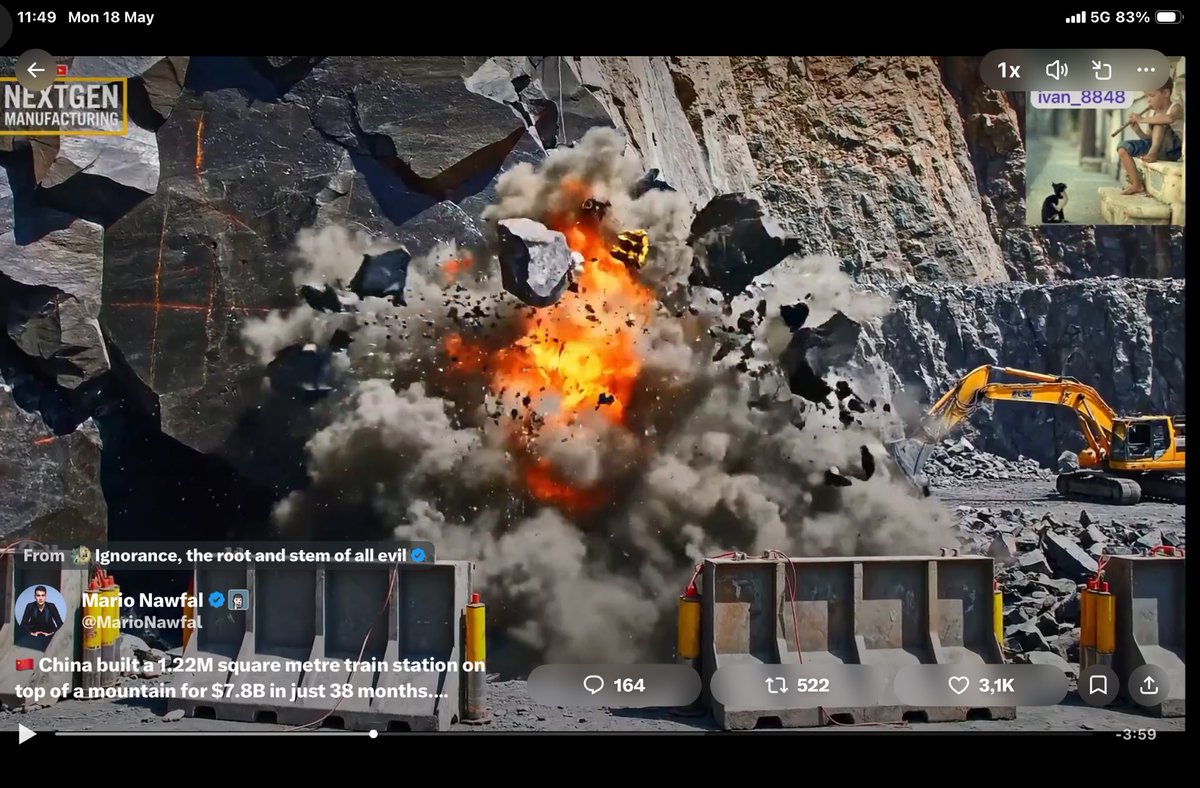
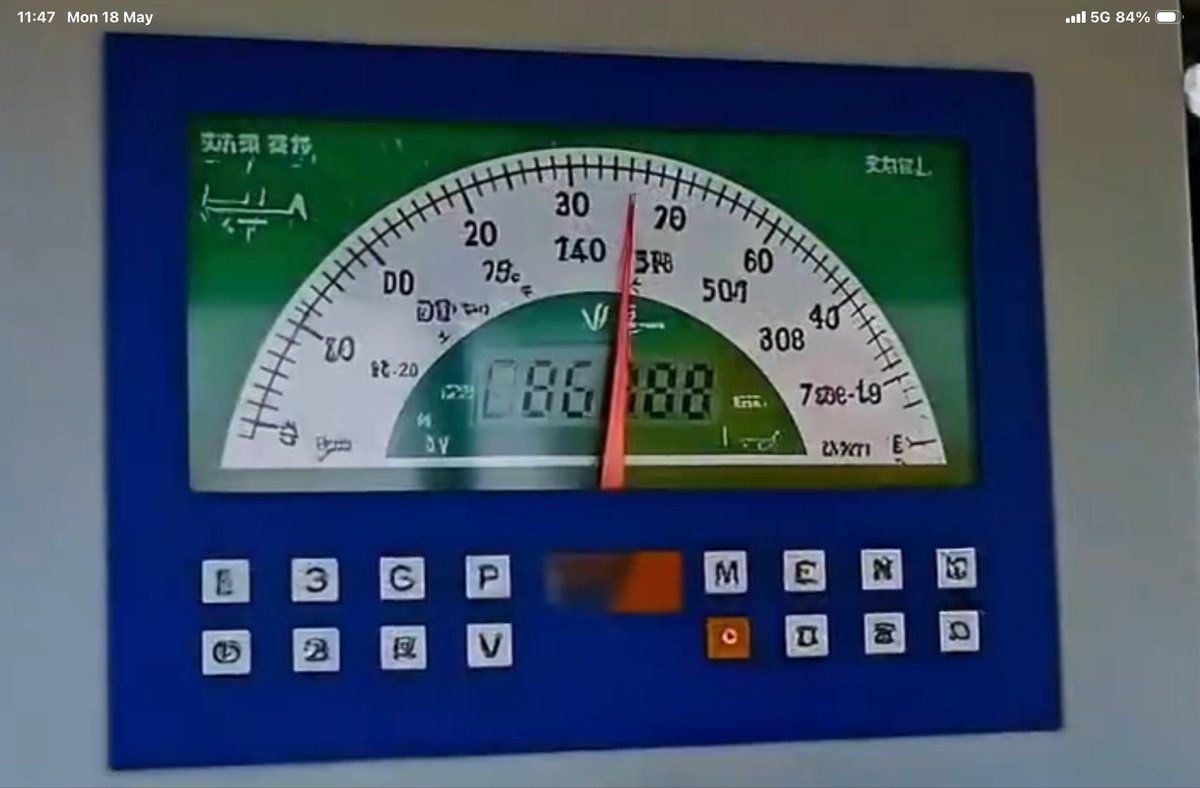
First I thought this was AI. And this promovideo does indeed +also+ contain AI segments. Check the stills: you don’t blow up rock using dynamite rods dangling +in front of it+, the blast itself is fake, as is the control panel). BUT THE STATION DOES EXIST. It’s China’s century.
WalterWX tweet mediaWalterWX tweet mediaWalterWX tweet media
Mario Nawfal@MarioNawfal

🇨🇳 China built a 1.22M square metre train station on top of a mountain for $7.8B in just 38 months. The roof alone weighed 16,500 tonnes. They assembled it on flat ground, then hydraulically lifted the entire thing 57 metres into the air.


English
1
0
0
36
WalterWX
WalterWX@WalterWX·
@Microinteracti1 Perhaps, for the other seven in eight people, you could have explained what IBS actually stands for and what it even IS?
English
0
0
0
5
Gandalv
Gandalv@Microinteracti1·
One in eight people in Northern Europe has IBS. Most of them are managing it with antacids and stress reduction advice. There are three dietary interventions with solid clinical evidence behind them that most GPs have not mentioned and most patients have not heard of. This article covers those interventions. It also covers what ultra-processed food is actually doing to your gut wall. Read the whole story: 👇 open.substack.com/pub/gandalv/p/…
Gandalv tweet media
English
3
6
24
4.6K