Tan Wang
14 posts


Tan Wang
@Wangt97
Ph.D. Student @NTU | 📈Google Phd Fellowship | 2022 Intern@Microsoft | 🐶2023 Summer Intern@Google

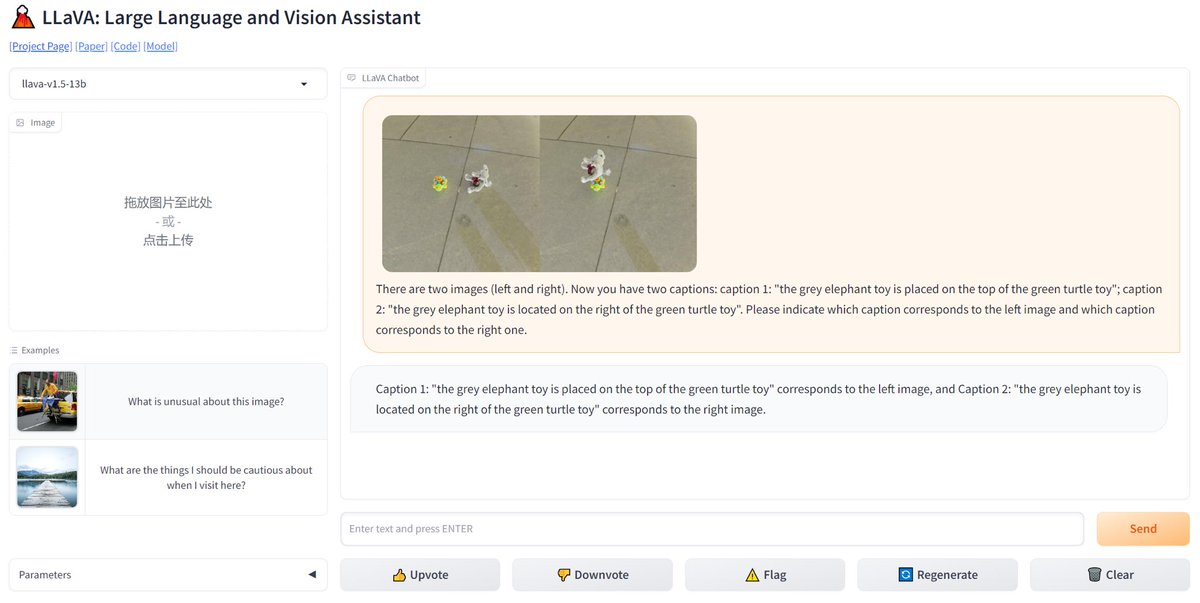
🚨 BREAKING: GPT-4 image recognition already has a new competitor. Open-sourced and completely free to use. Introducing LLaVA: Large Language and Vision Assistant. I compared the viral parking space photo on GPT-4 Vision to LLaVa, and it worked flawlessly (see video).

DisCo: Disentangled Control for Referring Human Dance Generation in Real World paper page: huggingface.co/papers/2307.00… Generative AI has made significant strides in computer vision, particularly in image/video synthesis conditioned on text descriptions. Despite the advancements, it remains challenging especially in the generation of human-centric content such as dance synthesis. Existing dance synthesis methods struggle with the gap between synthesized content and real-world dance scenarios. In this paper, we define a new problem setting: Referring Human Dance Generation, which focuses on real-world dance scenarios with three important properties: (i) Faithfulness: the synthesis should retain the appearance of both human subject foreground and background from the reference image, and precisely follow the target pose; (ii) Generalizability: the model should generalize to unseen human subjects, backgrounds, and poses; (iii) Compositionality: it should allow for composition of seen/unseen subjects, backgrounds, and poses from different sources. To address these challenges, we introduce a novel approach, DISCO, which includes a novel model architecture with disentangled control to improve the faithfulness and compositionality of dance synthesis, and an effective human attribute pre-training for better generalizability to unseen humans. Extensive qualitative and quantitative results demonstrate that DISCO can generate high-quality human dance images and videos with diverse appearances and flexible motions.
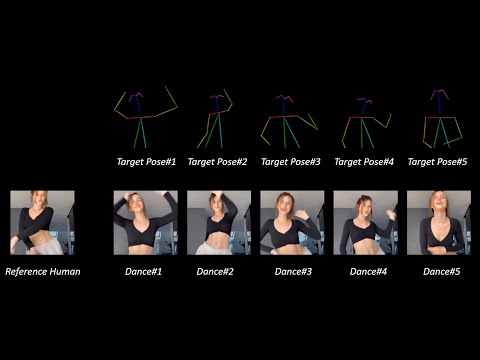
DisCo: Disentangled Control for Referring Human Dance Generation in Real World paper page: huggingface.co/papers/2307.00… Generative AI has made significant strides in computer vision, particularly in image/video synthesis conditioned on text descriptions. Despite the advancements, it remains challenging especially in the generation of human-centric content such as dance synthesis. Existing dance synthesis methods struggle with the gap between synthesized content and real-world dance scenarios. In this paper, we define a new problem setting: Referring Human Dance Generation, which focuses on real-world dance scenarios with three important properties: (i) Faithfulness: the synthesis should retain the appearance of both human subject foreground and background from the reference image, and precisely follow the target pose; (ii) Generalizability: the model should generalize to unseen human subjects, backgrounds, and poses; (iii) Compositionality: it should allow for composition of seen/unseen subjects, backgrounds, and poses from different sources. To address these challenges, we introduce a novel approach, DISCO, which includes a novel model architecture with disentangled control to improve the faithfulness and compositionality of dance synthesis, and an effective human attribute pre-training for better generalizability to unseen humans. Extensive qualitative and quantitative results demonstrate that DISCO can generate high-quality human dance images and videos with diverse appearances and flexible motions.