Daniel Banasik

253 posts

Daniel Banasik banner
Daniel Banasik

Daniel Banasik

@WaveTheoryPhycs

Software architect and independent researcher focused on cosmology and theoretical physics. Working on Wave Theory.

Lesser Poland, Poland Katılım Mayıs 2025
194 Takip Edilen168 Takipçiler
Sabitlenmiş Tweet
Daniel Banasik
Daniel Banasik@WaveTheoryPhycs·
Dark matter or MOND? Actually there may be a third option. Standard galactic modelling treats gravity as equilibrating instantaneously. Relaxing that assumption — treating curvature propagation as a fully dynamical, relativistic process — reproduces flat rotation curves from baryons alone, benchmarked against MOND and ΛCDM on 175 SPARC galaxies. Full paper + code: zenodo.org/records/199634…
Daniel Banasik tweet media
English
0
0
7
90.9K
Daniel Banasik
Daniel Banasik@WaveTheoryPhycs·
The curvature of the universe isn’t undetectable. It’s been hiding in galactic dynamics all along — and we measure it every day under the cover we call G, the gravitational constant. G = c²/πR. Not a constant of nature. The curvature of the cosmos.
English
0
0
0
60
Daniel Banasik
Daniel Banasik@WaveTheoryPhycs·
No dark matter. No new fields. No free parameters. Just the base curvature of spacetime — the same R that fixes the Hubble constant — showing up in 175 galaxies across the SPARC catalog.
English
1
0
1
67
Daniel Banasik
Daniel Banasik@WaveTheoryPhycs·
The universe is curved. We just can’t see it the usual way.
Daniel Banasik tweet media
English
2
5
60
167.7K
Daniel Banasik
Daniel Banasik@WaveTheoryPhycs·
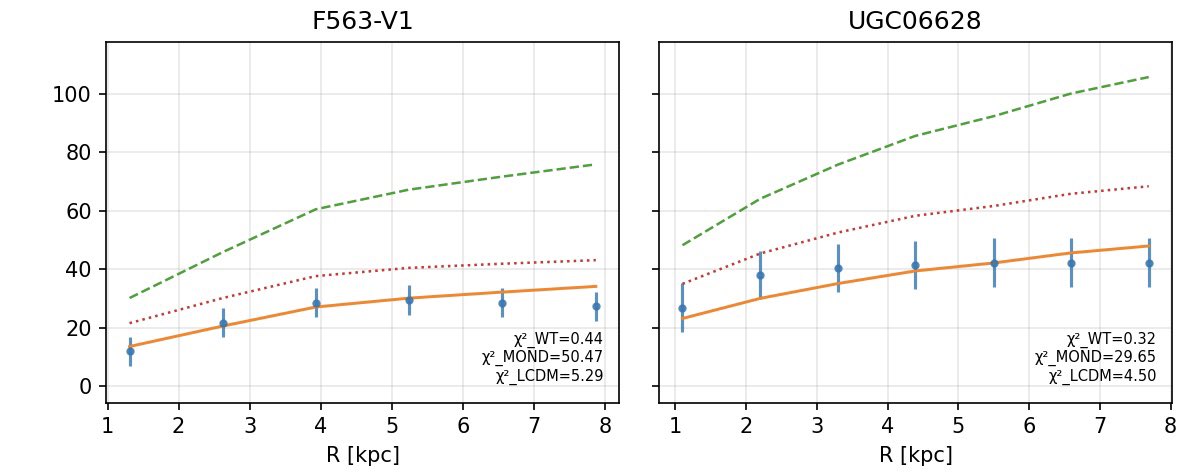
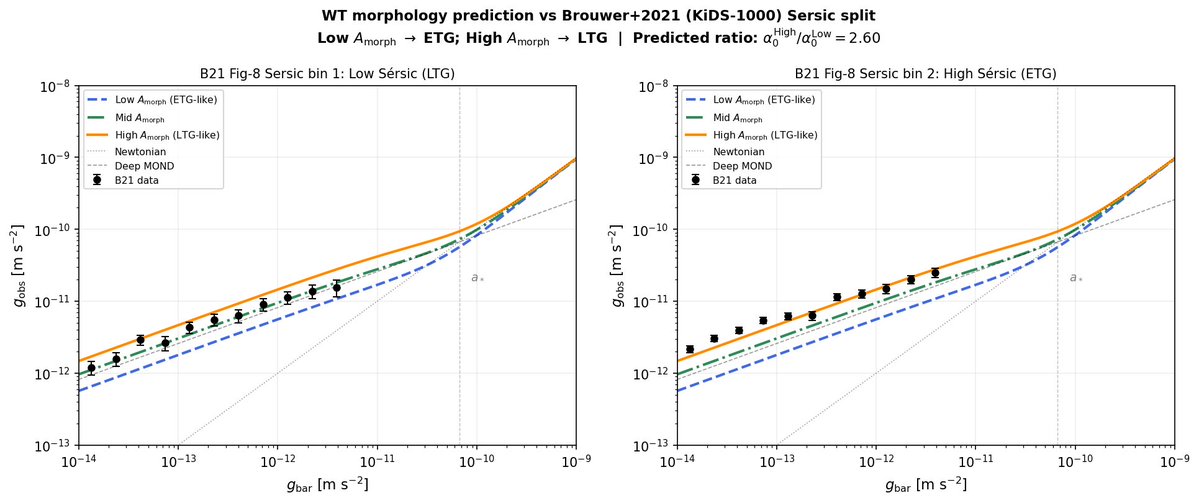
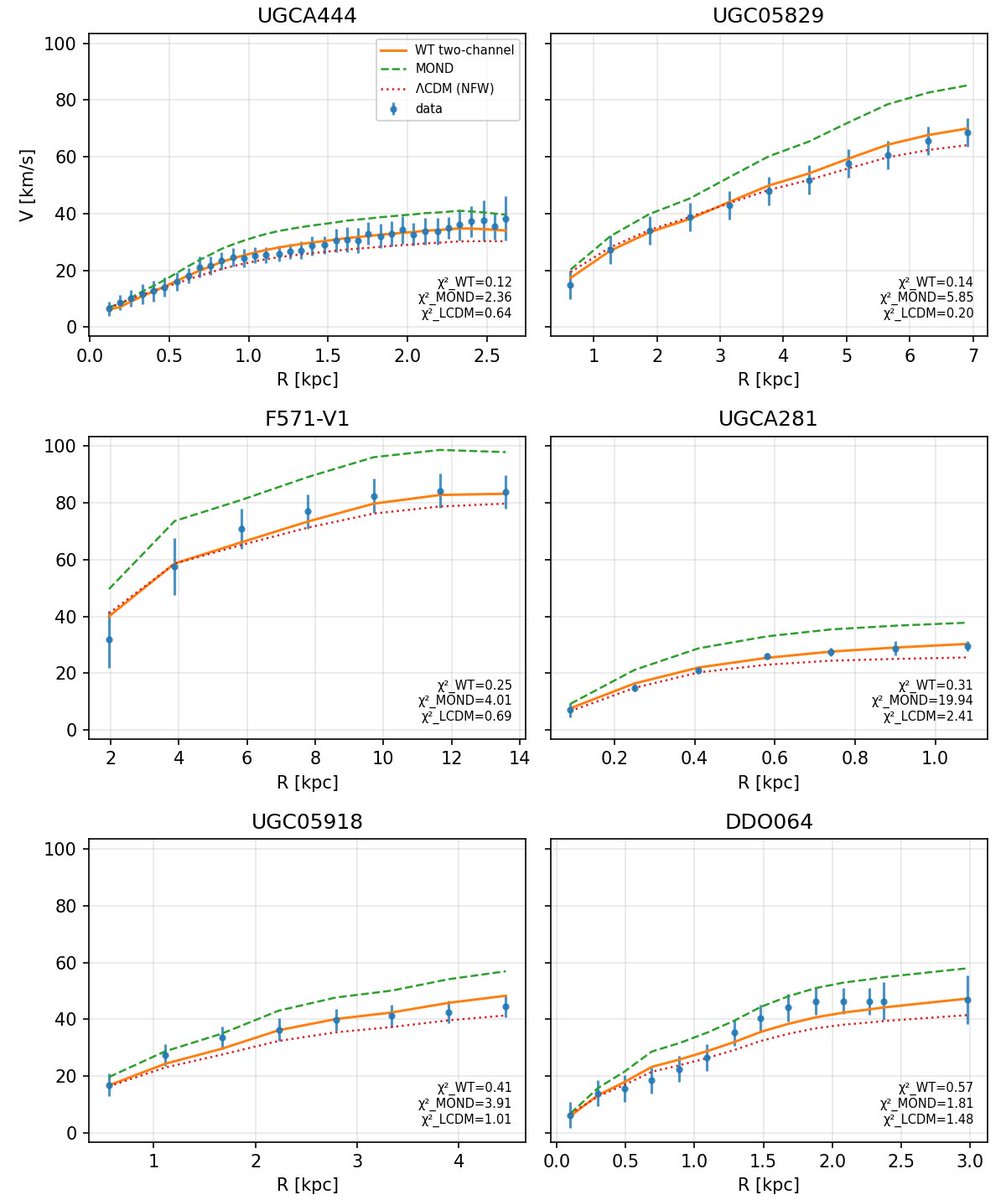
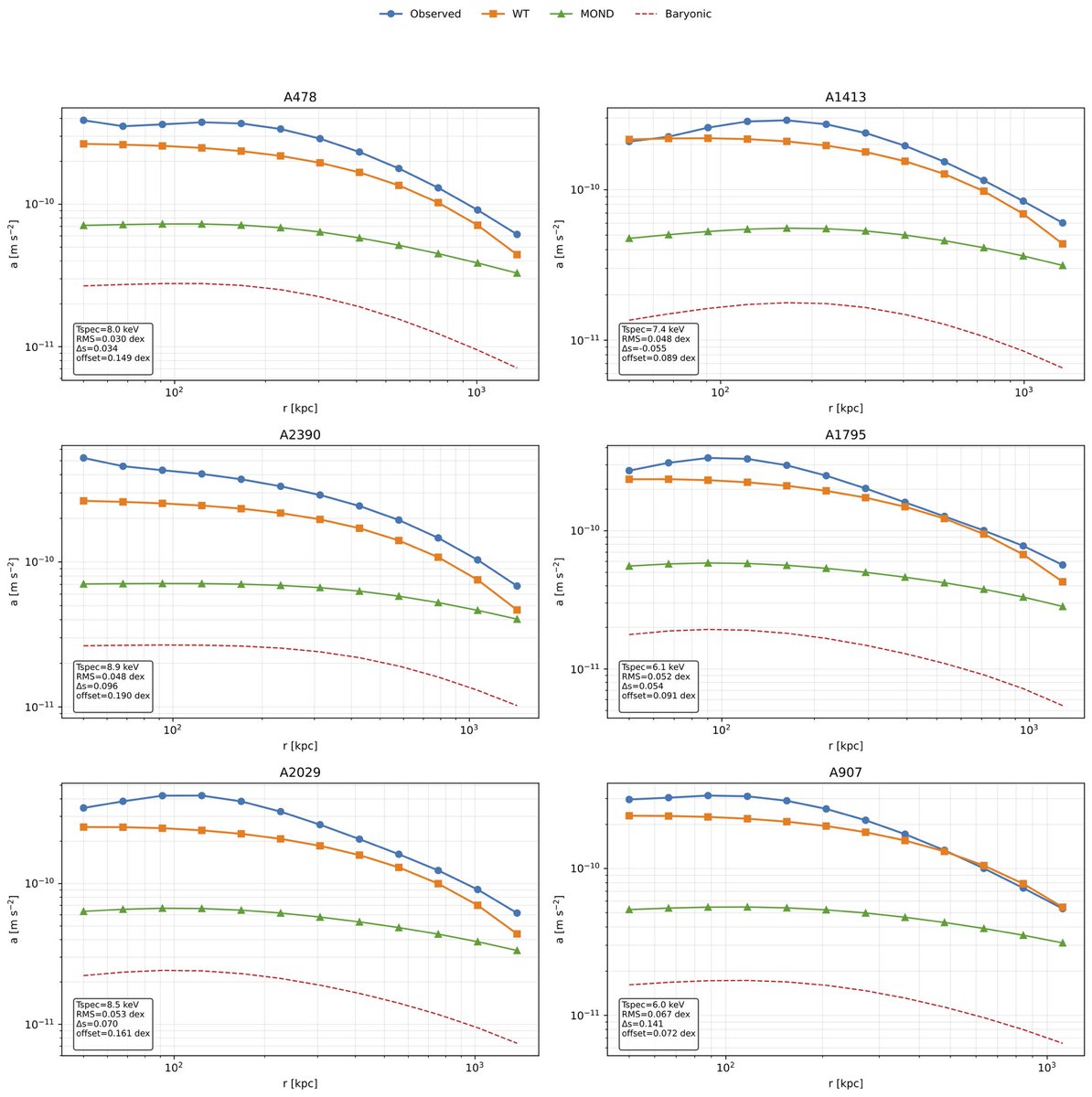
When the universe is modeled as an expanding 3-sphere, curvature transports outward from baryonic mass the way ripples spread from a stone. At large radii the transport reorganizes — the geometry takes over — and a flat velocity profile follows from the shape of space itself, not from hidden mass. Three plots below. Left: two gas-dominated dwarfs. Center: weak gravitational lensing across the KiDS-1000 survey, split by galaxy morphology. Right: two galaxy clusters at megaparsec scales. Orange is the prediction. Green is MOND. Red is LCDM. The acceleration gap isn’t a missing-mass problem. It’s a geometry problem — and the geometry already exists. Full paper + code: zenodo.org/records/199634…
Daniel Banasik tweet mediaDaniel Banasik tweet mediaDaniel Banasik tweet mediaDaniel Banasik tweet media
English
2
4
97
232.2K
Daniel Banasik
Daniel Banasik@WaveTheoryPhycs·
Dwarf galaxies have humbled every gravity model. Too baryon-poor for the mass to explain the motion. Too diffuse for standard scaling relations to hold cleanly. However, when we consider curvature transport geometry, at low surface densities, the transport reorganizes earlier — the shell regime sets in closer to the center — and the flat velocity profile follows naturally from the geometry alone. Six dwarfs below: orange curve is the prediction. Numbers are in the corners. Full paper + code: zenodo.org/records/199634…
Daniel Banasik tweet media
English
0
0
11
21.7K
Daniel Banasik
Daniel Banasik@WaveTheoryPhycs·
@skdh Yea, I tried that. Accidentally used my pigeon and it came back. Classified as „Payment declined”. 😅
English
1
0
4
336
Sabine Hossenfelder
Trying to pay an invoice from Germany in 2026: Oh no, they sent it by Stripe! Don't have any of these payment providers, so pay by credit card. Your payment provider declined the transaction. Try the other two credit cards. Your payment provider declined the transaction. Why do I have 3 of these in any case? Ok, so use the virtual Revolut card then. Not enough money on the card. Recharge from bank account. Payment provider declined the transaction. Recharge by Google Pay? Google Pay not working. Why not? Ah, the credit card is expired. Replace the credit card? Your payment provider declined the transaction. (Tried to charge virtual card via Google Pay and Google Pay via the virtual card. Didn't work, unfortunately...) Ok, some other way to recharge the virtual card? Wires money from bank account to PayPal and then from PayPal to Revolut and then to Stripe from Revolut. Payment declined😭 Add to trusted merchants. Try again. It goes through 🥳 Would be easier to send cash with a pigeon at this point.
English
155
53
1.5K
67.9K
Daniel Banasik
Daniel Banasik@WaveTheoryPhycs·
The mechanism may yet be hidden in GR itself. Differential rotation in a galaxy winds curvature transport onto two-dimensional shells, changing the scaling of gravitational acceleration from 1/r² to 1/r geometrically. Clusters lack that differential rotation structure, so the mechanism operates differently — at cluster scales, the relevant transition is between gravitational and cosmological curvature regimes near 1 Mpc, where the local gravitational field and the background expansion reach equilibrium. The acceleration scale may emerge from the geometry of that boundary and relativistic curvature transport , not from law modification .
English
0
0
1
28
Cliff Burgess
Cliff Burgess@CburgesCliff·
His theory modified F=ma once accelerations were sufficiently small. (It is bcs the threshold is acceleration that MOND does such a good job of predicting where rotation curves start to flatten for galaxies if differing sizes.) But accelrations are higher in clusters than in galaxies.
English
3
0
3
472
Greg Egan
Greg Egan@gregeganSF·
Astronomers have shown that the gravitational acceleration galaxy clusters exert on each other obeys an inverse square law, 1/r^n with n = 2.1±0.3, on distance scales of the order of 100-750 Mega light-years. This rules out many theories of “Modified Newtonian Dynamics”.
English
16
22
236
45.8K
Daniel Banasik
Daniel Banasik@WaveTheoryPhycs·
@helloquacken @martinmbauer No. We observe gravitational lensing which we assume is caused by missing mass. So we postulate existence of dark matter. None of above carries the weight of the prove.
English
1
0
0
38
#1 deer hater
#1 deer hater@helloquacken·
@WaveTheoryPhycs @martinmbauer Aight but we’ve observed dark matter through gravitational lensing and been able to separate it from inter cluster gas so I mean it is there
English
1
0
0
56
Martin Bauer
Martin Bauer@martinmbauer·
The reason there are more physicists working on dark matter than on alternative theories isn’t because they like it better, but because alternative explanations provide a worse fit across a wide range of observations
Greg Egan@gregeganSF

Astronomers have shown that the gravitational acceleration galaxy clusters exert on each other obeys an inverse square law, 1/r^n with n = 2.1±0.3, on distance scales of the order of 100-750 Mega light-years. This rules out many theories of “Modified Newtonian Dynamics”.

English
27
10
196
28.7K
Daniel Banasik
Daniel Banasik@WaveTheoryPhycs·
@skdh I have a different idea for this: what if we consider relativistic curvature transport? It may be far fetched but one thing we know and do not apply to galaxy dynamics is the fact that nothing travels faster than c. Why spacetime curvature should?
English
0
0
0
7
Sabine Hossenfelder
Sabine Hossenfelder@skdh·
A group of astrophysicists has reanalyzed the masses of galaxy clusters and they say that we might not need dark matter after all.
English
205
161
1.6K
60.3K
Daniel Banasik
Daniel Banasik@WaveTheoryPhycs·
Ciemna materia czy MOND? Może istnieje trzecia opcja. Standardowe modele galaktyczne traktują grawitację jako zakrzywienie czasoprzestrzeni powstające natychmiastowo: masa zakrzywia czasoprzestrzeń , zakrzywienie wyznacza drogę dla obiektów. Jest to uproszczony mechanizm. Okazuje się, że potraktowanie propagacji krzywizny jako w pełni dynamicznego, relatywistycznego procesu pozwala odtworzyć obserwowalne prędkości rotacji galaktyk wyłącznie z użyciem obserwowalnej materii - bez dodawania ciemniej materii (LCDM) czy modyfikowania grawitacji (MOND). Pełny artykuł i kod: zenodo.org/records/199634…
Daniel Banasik tweet media
Polski
0
0
0
77
Daniel Banasik
Daniel Banasik@WaveTheoryPhycs·
Six galaxy clusters. One formula — derived entirely from the geometry of curvature transport on an expanding three-sphere, calibrated on spiral galaxies. No parameter adjustment for clusters. The orange curve is the prediction. The blue dots are the data. Full paper + code: zenodo.org/records/199634…
Daniel Banasik tweet media
English
0
0
0
94
Daniel Banasik retweetledi
Amazing Physics
Amazing Physics@amazing_physics·
BREAKING: Scientists Confirm Discovery of Ninth Planet in Our Solar System In a historic announcement that rewrites astronomy textbooks, researchers have officially confirmed the existence of a ninth planet in our solar system - a mysterious ice giant lurking in the frozen outskirts beyond Neptune. Dubbed "Planet Nine", this world is estimated to be 5-10 times more massive than Earth and follows an extraordinarily elongated orbit that takes 10,000-20,000 years to complete a single trip around the Sun. Located an average of 20 times farther from the Sun than Neptune, its discovery comes after nearly a decade of mathematical modeling and painstaking observations of peculiar gravitational effects on Kuiper Belt objects. The planet's existence was first theorized in 2016 by Caltech astronomers, but only now has direct observational evidence been obtained using advanced telescopes capable of detecting such a faint, distant object. Unlike Pluto (now classified as a dwarf planet), this new world meets all criteria for full planetary status, with enough mass to dominate its orbital neighborhood. Its composition likely resembles an "ice giant" like Uranus or Neptune, with a thick atmosphere surrounding a rocky core. This discovery marks the first true solar system expansion since Neptune's identification in 1846, opening new frontiers in planetary science. Researchers are now racing to learn more about Planet Nine's formation, composition, and potential moons - while also searching for even more distant worlds that may be hiding in our solar system's uncharted territories. #PlanetNine #SolarSystem #
Amazing Physics tweet media
English
168
451
2.1K
150K
Daniel Banasik retweetledi
Maciej Kawecki - This Is IT
Maciej Kawecki - This Is IT@kawecki_maciej·
To są historie, które realnie mają szansę zmienić ten kraj. Naprawdę głęboko w to wierzę, i traktuję jako nadrzędny cel tego, co robiliśmy. Takiej energii jak z Marcinem to na planie naszych wywiadów chyba jeszcze nie było! Chłopak jest matematykiem. Zanim świat dostrzegł wszechobecną moc AI, on to zrobił. 12 lat temu zaprojektował z zespołem algorytm, który walczy z defraudacją miliardów dolarów rocznie. Dziś jego biznes wart jest miliardy. Jest drzazgą w oku oligarchów i karteli. Mimo tego wszystkiego zachował gigantyczną młodzieńczą energię. Z dystansem podchodzi nawet do własnej okładki Forbes. Marcin Markiewicz, gdy zapytałem go, czy weźmie w środku wakacji udział w spotkaniu z polskimi młodymi talentami nie zastanawiał się nawet minuty. Poniesieni energią część rozmowy z Marcinem nagraliśmy na kamerze VHS ❤ Zobaczcie pod linkiem poniżej rozmowę z Marcinem. Marcin, dziękuję Ci za to co robisz! Zgadzam się z tym, co na scenie powiedział Marcinowi Andrzej Dragan „jeśli ktoś ma zmienić ten kraj, to nie politycy a tacy ludzie jak Wy”. Wywiad: youtu.be/d6F9nfUikwk
YouTube video
YouTube
Polski
8
53
220
6.9K