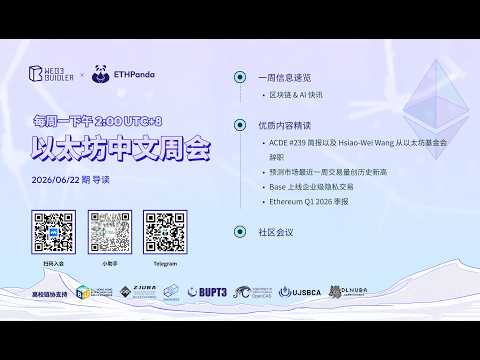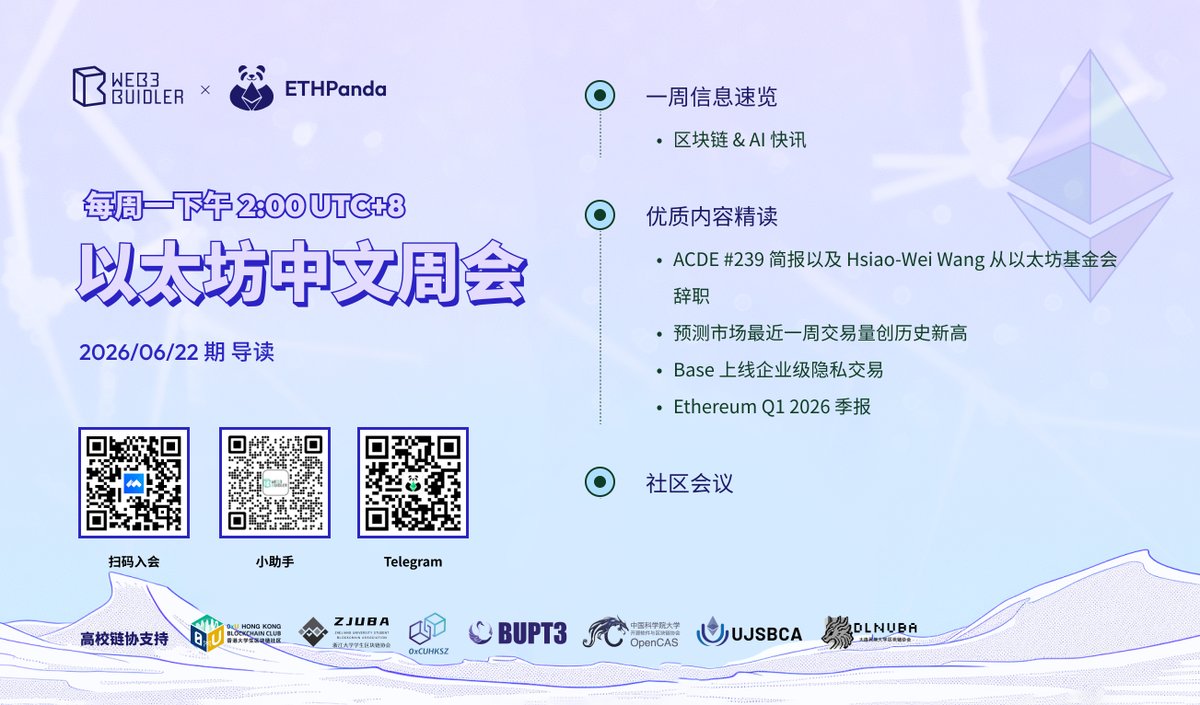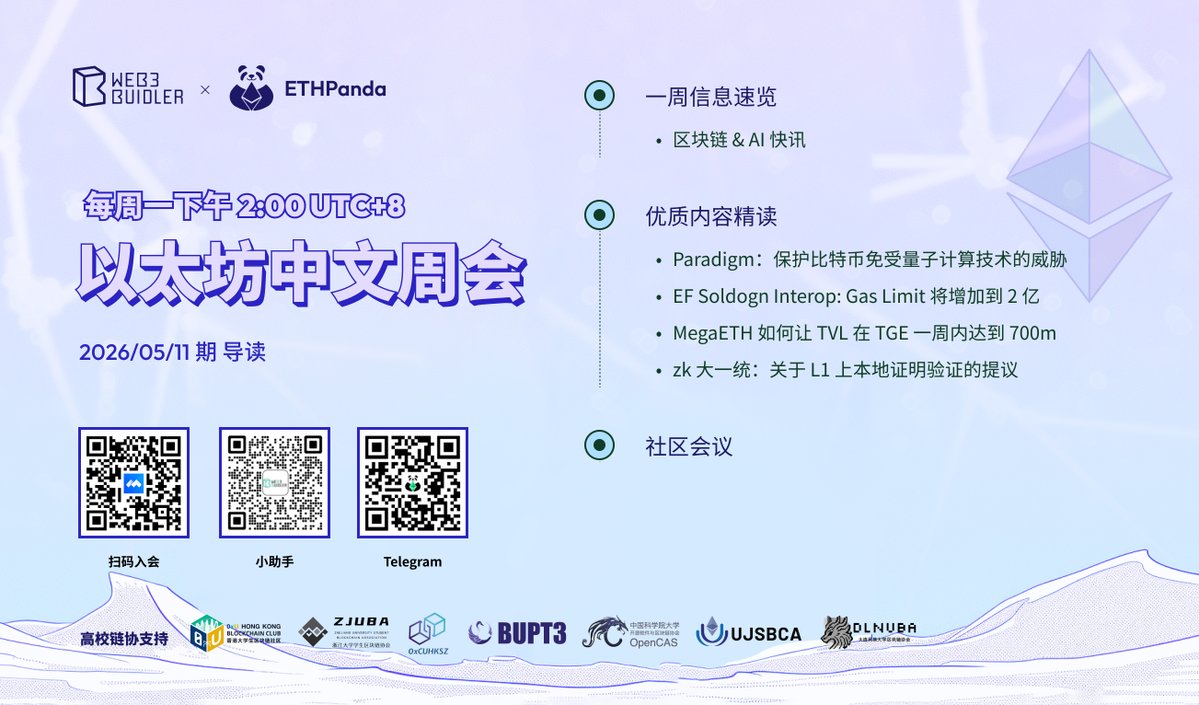
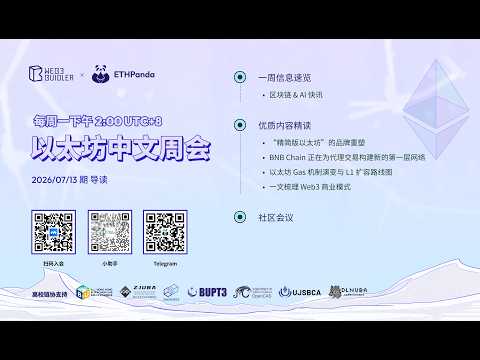
感谢大家参与 26/07/13 期 @Web3BuidlerTech 联合 @ETHPanda_Org 带来的每周简报,我们的分享已上传!
本周会议主要内容:区块链 & AI 快讯、“精简版以太坊”的品牌重塑、BNB Chain 正在为代理交易构建新的第一层网络、以太坊 Gas 机制演变与 L1 扩容路线图,等等。
视频:youtu.be/sGTAzWaj6xk
YouTube
中文
Web3Buidler.Tech
834 posts

@Web3BuidlerTech
https://t.co/7mkKvBNK5h 是一个聚焦 Web3 与 AI 融合创新的技术共建社区。 ⏰ 每周一下午 2 点线上分享: ▪️ Web3 一周要闻回顾与热点提纯; ▪️ 最新核心研报(Crypto + AI)深度精讲; ▪️ 前沿 AI Agent 技术与 Web3 实战解析。

This year, the EF is decreasing its budget by roughly 40%, which entails some difficult decisions. The goal of the decreases was set out in the Treasury Management Policy last year: the EF is transitioning into being a long-term-oriented endowment-based organization, shifting from its pre-2026 average of spending ~15% of its remaining funds each year, toward a post-2030 target of ~5% per year. Often, when an organization goes through something like this, people try to pretend that nothing of great value was lost, that it is an efficiency increase, that the only people cut are unproductive dead weight, and everyone else stopped partying, studied the blade, entered cracked S-tier beast mode, and this was sufficient to make up for the downside. I will not try to pretend this. I respect my EF colleagues far too much to pretend that there was not much that is lost. They are brilliant people. They are dedicated engineers of whom some have worked on the Ethereum protocol for nearly a decade. They have brought a bright light to the Ethereum ecosystem with their code, their words, their warmth as human beings and their actions. My dearest hope is that they find a path that brings them fulfillment and happiness whether inside Ethereum or outside. Hopefully many will be able to bring their excellent talents and mindset to the wider Ethereum ecosystem, or the even wider CROPS world. Instead, I will try to explain what *are* some of the grand sacrifices being made. The Ethereum Strawmap is no small thing. It is an extremely ambitious undertaking seeking to replace and augment almost every part of the protocol - consensus, proofs, privacy, account model, state, and more. This is the third iteration of Ethereum, in the same way that the Merge was the second, even if the shipping style is less Big Bang and more one-piece-at-a-time. On top of this, the EF is increasing its role in the Access Layer. We are not compromising on Ethereum being a Deeply Impressive protocol, something worthy of its place in a world with quantum computing, rockets to Mars and powerful biotech and AI, and capable of meeting the challenges that this era will bring. Some of the deficit will be recovered through more work happening outside the EF. But not all. So what are the grand sacrifices that will enable a leaner effort to accomplish all of this? I will give a few examples (though far from an exhaustive list): * The multi-client model will shift in the direction of multiple clients existing less for _redundancy_, and more for _specialization_. Up to this point, redundancy has been the main security strategy: if one client has a bug, if it has less than 33%, the chain keeps going and does not even stop finalizing. We are increasingly exploring moving more pieces of the protocol to a different security strategy: AI-assisted formal verification. Some smaller pieces of Ethereum (eg. BLS libraries) have worked this way already for a long time. But soon many more parts of Ethereum will likely function on this model. This may greatly reduce resource requirements of shipping a large number of EIPs. The resources saved by client teams can ideally instead be used to better serve different specialized user needs, including EF Access Layer goals. * PSE (Privacy and Scaling Explorations) is winding down as a unit. The number of people working on ZKPs for privacy and scaling is probably as high as ever, but they are working less on "exploration" and more on *implementing* ZKP-based privacy and scaling into the Protocol and Access Layer * Devcon will likely over time become smaller-scale, somewhat more spartan, much lower-deficit than previous years, in addition to other changes in vision in line with the Mandate. * Fewer beyond-Ethereum megaprojects coming from EF. As I announced earlier this year, I am taking on some of the responsibility of doing projects in this category that I consider valuable with my personal funds. * EF institutional work is reducing in scope, specializing more specifically on creating replicable test cases of highly CROPS-friendly deployments, even if at smaller scale. These do not explain all departures; in some cases they do not explain departures at all and rather explain _reduced need for new spending_. But they are a large part of the strategy at play. In the longer term, I personally favor a "soft lean-and-done" approach to Ethereum: once the Strawmap is completed, generally stick to security fixes and small high-value changes, and have a much higher bar for considering new feature additions to the protocol. This allows Ethereum to remain capture-resistant without demanding very large budgets. Learn less from multimillion-line-of-code behemoth projects, more from bitcoin. The past years have been a challenging era for Ethereum. However, the ecosystem is adapting, both inside the EF and outside, and I am confident that Ethereum is very well-positioned to succeed and thrive. firefly.social/post/x/2069408…