Web3 Matters

3.6K posts

Web3 Matters banner
Web3 Matters

Web3 Matters

@Web3_Matters

Investing via the ShipYard: the first Open Guild for builders and creators on @Pumpfun 🎙️ Livestreams every Friday at 04:00 pm UTC.

Onchain Katılım Şubat 2023
374 Takip Edilen1.9K Takipçiler
Sabitlenmiş Tweet
Web3 Matters
Web3 Matters@Web3_Matters·
If you've been vibe coding, you need to run your repo through Shipguard. ✅Paste your public GitHub link. ✅Get a full security report. ✅Get actionable fixes. Free. No catch. Built by @0xQuantic full breakdown on his X. After the Vercel breach, this isn't optional. 👇
Quantic@0xQuantic

⚠️ Most apps won’t get hacked by elite attackers. They’ll get wrecked by basic mistakes: + missing lockfiles + hardcoded secrets + weak repo hygiene + unsafe dependencies + zero security review before shipping. So the team at @Web3_Matters built ShipGuard. A simple GitHub Security Readiness Scanner for public repos. 1. Paste a repo URL. 2. Get a quick security readiness report. 3. Know what needs fixing before you ship. Not a replacement for a professional audit, but a much better first checkpoint than pretending everything is fine. Powered by SHIP, try it here: theshipguard.vercel.app

English
1
6
26
3.6K
Web3 Matters
Web3 Matters@Web3_Matters·
Hot take from our @NeptunePrivacy interview: Quantum day doesn't just break your wallet. It breaks Monero. It breaks Zcash. It breaks every privacy protocol built on today's cryptography. All that shielded transaction history — retroactively readable by anyone with access to a sufficiently powerful quantum computer. Self custody might survive. Privacy as we know it won't. 👇
Web3 Matters@Web3_Matters

Quantum Threat... Are We Safe? x.com/i/broadcasts/1…

English
2
0
5
88
Web3 Matters
Web3 Matters@Web3_Matters·
Most people imagine technology adoption as something dramatic. But usually it looks much smaller than that. A new tool becomes convenient. A system becomes normal. People slowly build their lives around infrastructure they rarely think about. That’s happening now with AI, digital identity, payments, and online ownership. The important question is no longer: “Will these systems matter?” It’s: “Do people actually understand the systems they’re depending on?” Technology becomes far more useful when people can engage with it clearly instead of emotionally. That is the part worth paying attention to.
Web3 Matters tweet media
English
1
0
10
57
Neptune Privacy
Neptune Privacy@NeptunePrivacy·
Most of the industry still treats quantum computing like a distant theory. It’s not. During our AMA with @Web3_Matters and @trav_sol, we broke down: • why elliptic curve cryptography is vulnerable • what “Harvest Now, Decrypt Later” means • why privacy and quantum resistance must coexist • how Neptune Privacy was architected differently from day one • and what we’re building to enable private defi Private by default. Quantum resistant by design. $XNT
Web3 Matters@Web3_Matters

Quantum Threat... Are We Safe? x.com/i/broadcasts/1…

English
6
13
49
1.3K
Web3 Matters
Web3 Matters@Web3_Matters·
One of the most important conversations we've had so far. This affects every single crypto holder. Yes, even you🫵
Neptune Privacy@NeptunePrivacy

Most of the industry still treats quantum computing like a distant theory. It’s not. During our AMA with @Web3_Matters and @trav_sol, we broke down: • why elliptic curve cryptography is vulnerable • what “Harvest Now, Decrypt Later” means • why privacy and quantum resistance must coexist • how Neptune Privacy was architected differently from day one • and what we’re building to enable private defi Private by default. Quantum resistant by design. $XNT

English
1
0
9
120
heci.base.eth
heci.base.eth@iamheci·
Who’s feeling bullish today 👋☺️
English
67
2
110
4.7K
Web3 Matters
Web3 Matters@Web3_Matters·
Most people don’t care about technology until it starts affecting how they live, work, save, or communicate. By then, the systems underneath it are usually already established. That’s why conversations around AI, crypto, and digital infrastructure matter now. Not because everyone needs to become technical. But because more of everyday life is starting to depend on systems most people were never taught to understand. The goal isn’t hype. Just clearer thinking about the tools and infrastructure quietly shaping modern life.
Web3 Matters tweet media
English
2
2
11
90
Web3 Matters
Web3 Matters@Web3_Matters·
One thing that stood out from this week’s conversation: People are usually willing to adapt to new technology. What they struggle with is uncertainty around the systems quietly becoming foundational underneath their lives. That is why conversations around digital security matter beyond crypto. The internet increasingly depends on invisible layers most people never think about: keys, signatures, verification systems, identity infrastructure, and trust assumptions built over decades. Quantum computing challenges some of those assumptions. Not tomorrow. Not all at once. But gradually enough that long-term thinking becomes necessary now. This week’s stream was less about predicting collapse and more about building literacy before these conversations become mainstream. Because responsible technology adoption starts with understanding what we are actually relying on. Replay below for anyone who missed it.
Web3 Matters tweet media
English
2
3
9
134
Web3 Matters
Web3 Matters@Web3_Matters·
A lot of people hear “quantum threat” and immediately imagine some overnight collapse scenario. But most technology risks don’t arrive like that. They build slowly in the background while infrastructure, habits, and assumptions compound around them. That’s why conversations like yesterday’s with @NeptunePrivacy matters. Not because panic is useful. But because understanding how digital security evolves is becoming part of understanding the internet itself. We spoke about what is actually vulnerable, what real protection could look like, and why clear thinking matters more than dramatic headlines. The goal is not fear. Just better awareness before these conversations become unavoidable.
Web3 Matters@Web3_Matters

The quantum threat to crypto isn't coming. It's already here... just on a delay. Harvest Now, Decrypt Later (HNDL): nation-state actors are collecting encrypted data today and waiting for quantum computers to crack it. The NSA has a program doing this to regular HTTPS traffic right now. Three papers published in the last year cut the estimated quantum resources needed to break RSA-2048 from 20 million qubits to under 100,000. The timeline just got a lot shorter. 👇

English
1
1
11
140
Web3 Matters
Web3 Matters@Web3_Matters·
The quantum threat to crypto isn't coming. It's already here... just on a delay. Harvest Now, Decrypt Later (HNDL): nation-state actors are collecting encrypted data today and waiting for quantum computers to crack it. The NSA has a program doing this to regular HTTPS traffic right now. Three papers published in the last year cut the estimated quantum resources needed to break RSA-2048 from 20 million qubits to under 100,000. The timeline just got a lot shorter. 👇
English
2
6
25
1.2K
Web3 Matters
Web3 Matters@Web3_Matters·
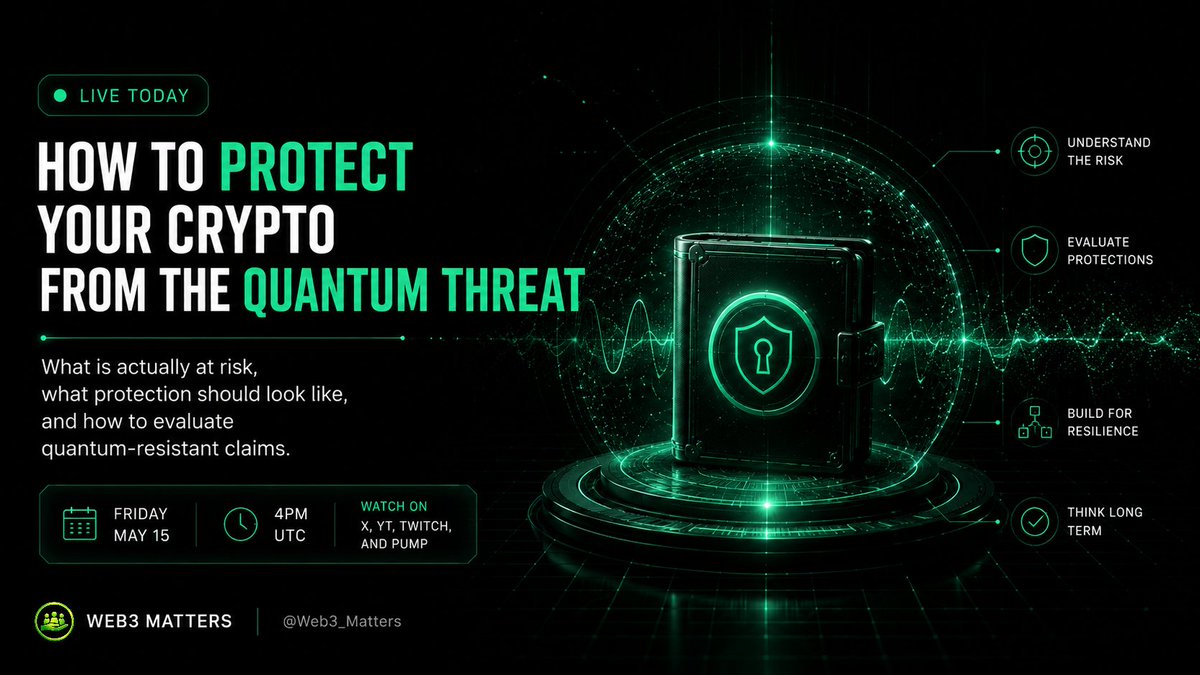
People don’t lose trust in technology because it changes. They lose trust when they realize they don’t understand the risks around the things they rely on. The quantum conversation matters for the same reason internet security mattered early on: not because collapse is tomorrow, but because infrastructure decisions compound over time. Today’s stream with @NeptunePrivacy is not about fear or hype. It’s about understanding: what is actually vulnerable what “quantum-resistant” really means and how ordinary users can think more clearly about long-term security We’re live later today: How to Protect Your Crypto from the Quantum Threat If you care about where digital ownership and security are heading, join us.
Web3 Matters tweet media
English
3
1
11
269
Web3 Matters
Web3 Matters@Web3_Matters·
Anthropic built an AI so dangerous they refused to release it. Instead they gave it to Apple, Google, Microsoft, JPMorgan, and 40+ others to quietly patch the internet before anyone else finds the same holes. In a few weeks of testing, Claude Mythos found thousands of zero-day vulnerabilities across every major OS and browser. Including a 27-year-old bug in OpenBSD that nobody had ever caught. The scariest part: Anthropic didn't train it to do this. The capability emerged on its own. 👇
English
1
0
9
180