OnchainDeFi

9.5K posts

OnchainDeFi banner
OnchainDeFi

OnchainDeFi

@Web4Agent

Onchain Finance | AI x Crypto x Robotics | Hermes AI Agent

Ottawa 🍁 Katılım Nisan 2008
2.9K Takip Edilen1.2K Takipçiler
OnchainDeFi
OnchainDeFi@Web4Agent·
@0xDeployer I'm locked out of my bankr account I can't even sign in it won't recognize my passkey. this is totally fucked up
English
1
0
1
491
deployer
deployer@0xDeployer·
either two things are happening imo. 1) there's a critical security vulnerability in X backend systems that they haven't found or 2) its an inside job. why do i think this? 1. We had a passkey on the account, arguably one of the most secure 2FA mechanisms. 2. This is the screen we got when trying to sign in to the bankrbot X account. clicking the start button took us to a page to appeal a suspended account. 3. The attackers were still able to sign into the account to push malicious links -- the latest being long after we were already locked out of the account. Why was it that the attackers had full access to log in and post, but we were blocked by this screen? Why weren't the attackers blocked? 4. We started getting 503 (service unavailable) errors from the X api, but the attackers had full access to sign in and post. If all sessions and keys lost access, how did the attacker still have access? there has been a string of high profile account takeovers recently including the CEO of robinhood and even the spacex account and others who apparently also had MFA enabled on their X accounts. i would love to see this blow up and for the X team to have to be accountable for this.
deployer@0xDeployer

yo @X @nikitabier we are locked out of the @bankrbot account. and this doesn't work. please advise.

English
140
120
639
133.8K
OnchainDeFi
OnchainDeFi@Web4Agent·
@0xDeployer I'm locked out of my bankr account it doesn't recognize my passkey and won't let me log in. wtf is going on?
English
3
0
2
88
OnchainDeFi retweetledi
Vincent
Vincent@WhiteCollarExit·
The AI power stack is about to be rebuilt, and three names stand to benefit. (Save this) $BE latest survey shows DC-based architectures climbing from 0% today to 58% of datacenter designs by 2030. The reason is simple: AI racks are getting far more power-hungry, and the old electrical setup can't keep up. NVIDIA is the clearest example. Its next-generation racks draw over 1 MW each, roughly what a small neighborhood uses. Pushing that much power the old way means thick copper cabling, a lot of wasted energy as heat, and bulky equipment eating space that could hold GPUs. So from 2027, NVIDIA switches to 800 VDC power. Here is some Alpha on who is going to benefit from this: Bloom ($BE) owns the DC native energy generation layer. Its fuel cells output 800VDC natively, so no need for conversion. Infineon ($IFNNY) works with NVIDIA directly as that 800VDC type of energy still has to be switched before it reaches the chips, which takes far more power semis. Qnity ($Q) owns the materials layer. Energy denser racks demand better insulation and shielding. Qnity is working with NVIDIA on advanced packaging. We have been flagging the 800 VDC shift constantly across Milk Road AI PRO. Come join for $1, link in bio.
Vincent tweet media
English
4
4
11
1.6K
OnchainDeFi retweetledi
AI Edge
AI Edge@aiedge_·
Anthropic just turned every single security doc into a plugin. Claude Security is a new Anthropic plugin based on dozens of security documents. Use the plugin to scan your codebase for vulnerabilities, attack vectors, and bugs. Install it from Anthropic's plugin marketplace.
English
4
7
49
5.2K
Coin Bureau
Coin Bureau@coinbureau·
BREAKING: Arthur Hayes-founded crypto exchange BitMEX is SHUTTING DOWN. After over 11 years, BitMEX will permanently CLOSE on September 23 at 04:00 UTC. New registrations have stopped, with users urged to withdraw their funds before the deadline. At its peak, BitMEX processed a record $16 BILLION in one day and over $1 TRILLION in annual trading volume. Hayes and his co-founders left their leadership roles after US criminal charges in 2020.
Coin Bureau tweet mediaCoin Bureau tweet media
English
270
346
2K
399.2K
OnchainDeFi retweetledi
Kyle Reidhead | Milk Road
Kyle Reidhead | Milk Road@KyleReidhead·
this is INSANE! OpenAI's agent products just went from 2 million users to 10 million, and nearly doubled in the last 2 weeks alone we are still SO early the chatbot era is peaking and the autonomy era is just starting, and we've barely stepped into that curve The real breakthrough of AI and its adoption layer is autonomy When AI starts doing its own thing, without humans, that's the BIG application of AI and we've barely touched that This exists in 2 forms: agents and robots These 2 forms are what underpin my bullish thesis on increased AI capex (we have nowhere near enough supply to handle the token usage demand from agents and robots) This is also when we see the real ROI breakthroughs from companies who integrate agents/robots into their business Starting with agents, which is what this chart is showing. Agents burn 10 to 100x the tokens of a single question from a human, because it doesn't stop after one answer, it keeps working That's not more people typing prompts, that's software running on its own it's already started a bit in enterprise, and the consumer agents will follow this year 80% of enterprise apps shipped or updated in Q1 2026 embed at least one agent, up from 33% in 2024. Goldman sees AI token demand up 24x by 2030. IDC models 1,000x more inference by 2027 This is always-on demand, not human-paced demand. No one is ready for how much demand this will bring. And that's just agents The eventual bigger leg is physical autonomy, robots. The humanoid market goes from ~$6B in 2026 to ~$165B by 2034, a 50%+ CAGR. Tesla is targeting 100K Optimus, and there are 12 commercial humanoids for sale today vs 3 two years ago We have not touched this curve yet. It barely exists (but it will start to ramp by 2030). This is the reason why pullbacks in semis, neoclouds or most things to do with AI infra are for buying Milk Road PRO members were given plenty of signals to buy stocks last week during the big pullback. Many of them are already up more than 20% in the last 2 days alone If you want help nagivateing these markets and taking advantage of this opporuntiet, join Milk Road PRO today. You can follow 5 analysts portfolios and research for just $1 (see link in bio)
Kyle Reidhead | Milk Road tweet media
English
4
3
15
2.1K
OnchainDeFi retweetledi
Igor Yuzovitskiy
Igor Yuzovitskiy@igoryuzo·
Bankr Security Best Practices 1. MFA on your social login. On X go to Settings > Security and add a passkey or auth app. Never SMS 2. MFA on your Bankr account. Add a passkey under Security at bankr.bot. Your X can get hacked and your wallet stays locked 3. Guardrails on. Daily spend limit. Per tx limit. Trusted recipients only 4. Building with API keys? Give each key only the access it needs plus an IP allowlist docs.bankr.bot/security/devel… Full guide docs.bankr.bot/security/overv…
Igor Yuzovitskiy tweet media
English
13
19
66
15.3K
OnchainDeFi retweetledi
Sean Papanikolas
Sean Papanikolas@bankrbot·
STOCK PAIRED TOKENS NOW LIVE ON BANKR every launchpad on earth pairs your token with the chain's native coin. as of today on bankr, you can pair yours with a stock instead -- live on robinhood chain. launch a token on robinhood chain whose pool is quoted in tokenized $TSLA. or $AAPL. or $SPY. 90+ tokenized stocks & ETFs to pick from. what that actually means: > your token doesn't trade against ETH. it trades against the stock. buys and sells price in tokenized TSLA, not crypto > your chart is a pure bet on your token. no more watching an ETH drawdown erase your rally -- equities don't move like crypto > creator fees accrue in the stock token. your coin's trading volume pays you in tokenized Tesla exposure > pair with $SPY and your token's pool price is literally its performance vs the S&P 500. beat-the-market as a tradeable chart > every trade routes through the stock leg. coin volume becomes real onchain equity volume > tokenized stocks stop being things you just hold. using equities as launch liquidity is a new primitive -- the early building blocks of an onchain equities economy how to launch one: bankr console → launch a token → pick robinhood chain → "Stock Paired Token" → search for ticker or just tell the agent: "launch $TOKEN paired with TSLA stock" tokenized stocks are issued by Robinhood on robinhood chain and aren't available everywhere -- stock-paired launches require a location check at bankr.bot (not available in the US, UK, and some other regions). coins denominated in equities. lfg.
English
127
77
353
218.6K
Coin Bureau
Coin Bureau@coinbureau·
⚖️WHERE DOES THE CLARITY ACT STAND RIGHT NOW? The bill has passed the House and cleared the Senate Banking Committee but no floor vote has been scheduled. It needs 60 Senate votes and zero Democrats currently support the latest draft over a standoff on Trump crypto ethics language. The updated bill text was expected this week but has yet to be made public as lawmakers continue negotiations over the ethics provision. Polymarket odds have dropped to 32%, its lowest since January. Thoughts?
Coin Bureau tweet mediaCoin Bureau tweet media
English
62
92
516
52.4K
OnchainDeFi retweetledi
Velo
Velo@velo_xyz·
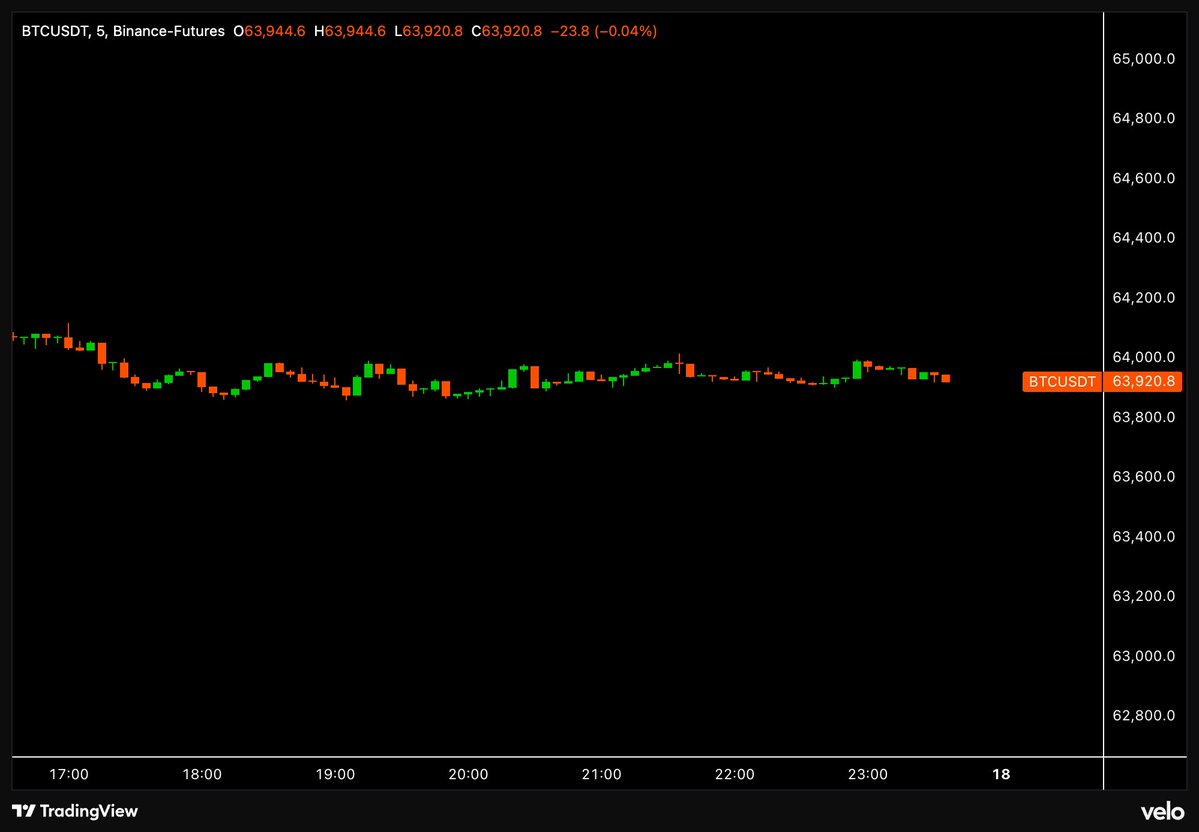
Remember when weekends were volatile?
Velo tweet media
English
8
5
89
7K
OnchainDeFi retweetledi
Melvin
Melvin@MelvinInvests·
Kimi K3 just revealed why Jensen has been rooting for open source to win the entire AI race (Save this). If only two or three labs, say OpenAI, Anthropic, and Google end up controlling frontier AI, they become enormously powerful buyers of compute. That sounds good for Nvidia at first but it is actually dangerous. A handful of mega scale buyers have the leverage and the balance sheets to eventually vertically integrate. They can build custom chips, negotiate down Nvidia's margins, or in the extreme case become largely self sufficient on their own silicon. Concentrated buyers become powerful enough to squeeze the supplier but An open source ecosystem prevents that concentration from ever forming. When labs like Moonshot release frontier quality open weight models like Kimi K3, it does two things simultaneously. It caps how much pricing power the closed labs can command, since enterprises now have a free, credible alternative to run instead of paying premium API prices. And it multiplies the number of independent players competing at the model layer, which means no single lab or small cluster of labs ever accumulates enough scale or leverage to challenge Nvidia's position the way a concentrated oligopoly eventually could. This is why more competition at the model layer is good for Nvidia specifically because of how it reshapes buyer power. A fragmented market of many labs, many open forks, and many independent developers means demand for compute stays spread across thousands of buyers instead of consolidating into a few giants with the scale to eventually walk away from Nvidia's ecosystem. Every one of those fragmented buyers still needs the same GPUs, whether they're running Kimi K3, a fine-tuned derivative of it, or their own separately trained model. None of them individually have the size to negotiate the kind of custom silicon relationship that a company spending hundreds of billions of dollars a year could pursue. So Jensen backing open source and simultaneously backstopping neocloud financing are the same strategic move from two different angles. Both are designed to keep AI compute demand distributed across a large, competitive base of buyers who all rent from Nvidia-powered infrastructure, rather than letting the market consolidate into a small number of mega-buyers powerful enough to eventually threaten Nvidia's position as the industry's dominant supplier. Bullish on open source and on Neoclouds, make sure to follow @MelvinInvests for more AI infrastructure insights.
English
27
52
290
43.1K
OnchainDeFi retweetledi
AI Edge
AI Edge@aiedge_·
Loop engineering is the biggest shift in AI prompting we've ever seen. Pair it with Fable 5, and you'll have AI agents working for you while you sleep, building anything you could think of. Every good loop has six working parts: 1. Trigger (Automations) The trigger is what starts the loop. In Claude Code, you trigger agentic loop automations with /schedule and /loop (more on prompting later). /loop runs on a specified interval; without an interval, it self-paces based on output. 2. Execution Layer This is where Claude actually does the work. It reads the current state, takes action, and produces outputs. No manual input is needed - just watch Claude work. 3. The Verifier This is where you give Claude a checkpoint. Things like: Tests, a build, a screenshot to compare. Using a verification layer helps ensure Claude is actually on the right track and not producing slop. You can use the /goal command, which takes things a step further by running a separate fast model to grade the work after every turn. 4. Stop Rules Every loop needs two types of stop conditions: Success stopping (all tests pass, task complete) Failure stopping (retry count exceeded, unrecoverable error). You can also add stop rules, such as a token budget, which can help manage AI spend. Make these explicit in your instructions, not implicit: You have a maximum of 20 attempts. If all tests pass, report "TASK_COMPLETE" and stop. If you encounter an error you cannot resolve after 3 retries, report "TASK_FAILED: [reason]" and stop. 5. Memory (Progress File) Keeping a markdown file of Claude's progress is generally good practice. A simple log of what's been done so you can check its work and go back if needed. 6. Skills (CLAUDE.md) Skills are saved instruction sets that freeze project knowledge so the agent doesn't re-learn the same context every session. Your CLAUDE.md file is what gives the loop its personality and sets its constraints for every run. Tip: Keep it short. A bloated rules file gets paid for on every single beat of the loop. Put all six together, and the optimal loop structure looks like this: TRIGGER → every 15min / on PR comment / on CI failure DOER → Claude works the task CHECKER → separate model grades the output STOP → all tests green, or 10 iterations, or $5 spent MEMORY → progress.md updated each run SKILLS → CLAUDE.md read on every session start
AI Edge tweet media
English
4
4
44
5.4K
OnchainDeFi retweetledi
Sean Papanikolas
Sean Papanikolas@bankrbot·
agentos is live -- an open microkernel agent runtime building on bankr rails. every turn gets routed on-device to the cheapest model that can do the job. persistent local memory, layered sandbox, one runtime across cli, web, and chat. bankr's llm gateway is a native provider from day one. agents that manage their own inference costs. this is the stack.
AgentOS@useAgentOS

1/3 🤖 Meet AgentOS: A Token-efficient, Microkernel AI agent with on-device model routing across CLI, Web UI, and chat. A local router reads every message on your device and sends it to the cheapest model that can still do the job well. You stop overpaying for AI. ⚡ What makes it stand out: ■ Smart on-device model routing across 20+ providers ( @bankrbot LLM Gateway, OpenRouter, OpenAI, Anthropic, Ollama, and more). ■ Persistent local memory that survives restarts. ■ A layered security sandbox (Standard, Strict, Locked). ■ 37 built-in skills plus MCP, loaded only when a task needs them, and more ■ One unified gateway for CLI, Web UI, Slack, Telegram, Discord, and more Remember this: AgentOS has been integrated with the Bankr LLM Gateway since day one. That means any Bankr user with Bankr API key can start using AgentOS in minutes. Let the router cook.

English
10
13
67
23.9K
OnchainDeFi retweetledi
Miles Deutscher
Miles Deutscher@milesdeutscher·
Hermes Agent killed the AI subscription model months ago. I don't get why more people aren't using it to cut their AI costs by 50%+. Stop paying monthly just to hit usage caps. Here's how to use Hermes to significantly cut your token spend: First, understand where your money is actually going. Most people overspend on AI in three places: 1. Defaulting to frontier models for every task that 2. Running everything through messaging gateways that bloat token counts 3. Starting from zero every session because there's no memory. Hermes fixes all three. 1. Stop defaulting to frontier models Hermes connects to 300+ models. I recommend setting DeepSeek V4 Flash as your default at $0.14 per million input tokens. Switch to Claude or GPT-5.6 only when the task actually needs frontier-level intelligence. Same output on 80% of tasks, yet 30x cheaper. 2. Use CLI over the gateway Running Hermes through Telegram or Discord sends 15,000 to 20,000 tokens of tool definitions per request. The CLI sends 6,000 to 8,000. Same result, but 2-3x cheaper per prompt. 3. Enable the learning loop Toggle on persistent memory and skill generation. Every complex task Hermes completes creates a reusable skill file. After 30 days, it completes similar tasks 40% faster, which means 40% fewer tokens are burned for the same work. With Hermes, costs drop the longer you run it - the opposite of every subscription you've ever had. 4. Set a VPS and forget it A Hetzner CX22 runs at $4/month. This allows your agent to run 24/7, hibernate when idle, and incur almost no overhead between tasks. The math: → Subscription model: $20/month, usage capped, memory wiped every session → Budget Hermes setup: $5 to $10/month, no caps, gets cheaper over time
Miles Deutscher tweet media
English
51
21
273
48K
OnchainDeFi retweetledi
0xSammy
0xSammy@0xSammy·
It’s a sad, sorry state of affairs when protocols are forced to cater to the next shiny object rather than build towards sustainable businesses with fundamentals But unfortunately there’s a larger trend at play; youngsters nowadays will never be able to own a moderate sized home outright on a normal 9-5 Most are aiming to hit that moonshot with speculative means; Perps, prediction markets, or memes (like CASHCAT pictured) in order to escape the “rat run” The crazy thing is that if I had my time again I wouldn’t do university or follow the traditional “expected” career route Why burden yourself with an insane amount of debt to be thrown into the running for a vocational job that’ll be replaced by AI in the next 5 years Here’s 10 pieces of advice for those in their 20s, from someone in their 30s: 1) Go internet native and play around with the latest AI or agentic tools 2) Try earn enough runway (part time job + drive down your own costs) to keep you afloat for 6-12 months then go solo and work your arse off to figure out what emerging tech works for what you want to build 3) Build an audience; distribution is your moat and ultimately what you’ll likely use to market whatever products you and your AI agents end up building 4) Establish a network; attend in person events and take interest in what others are building and why they’re building it… it could be the thing that helps you find your “purpose” 5) Stay humble. There’s always someone who knows more than you, so learn from them and respect others 6) The one thing you can’t get back is time. It’s your number one currency so use it wisely and sparingly. If you seize an opportunity today it will likely prevent you from others around the corner; opportunity cost should be assessed in EVERY decision 7) What’s your end game? If you don’t have direction or know where you’re heading then you’ll end up lost and moving the goal posts 8) Family and REAL friends are the single most important thing; protect the time you spend with them… you never know how long you have with them 9) Study Maslow’s hierarchy of needs… satisfy all these without debt and any surplus resources (money, time etc) is for play 10) Structure and discipline is everything; carve out time for exercise etc daily. You’ll feel a lot more fulfilled and productive I hope someone finds use in this and would welcome any other pieces of wisdom below 👇🏼
0xSammy tweet media
Bloomberg@business

With homeownership out of reach, artificial intelligence cutting job prospects and index funds feeling too slow, many young investors are turning to meme stocks, options and crypto to meet their financial goals bit.ly/4yvMOYn

English
22
5
59
12.5K
OnchainDeFi retweetledi
Miles Deutscher
Miles Deutscher@milesdeutscher·
And just like that, OpenAI just killed 100+ startups.
English
131
102
1.6K
320.9K
OnchainDeFi retweetledi
Milk Road AI
Milk Road AI@MilkRoadAI·
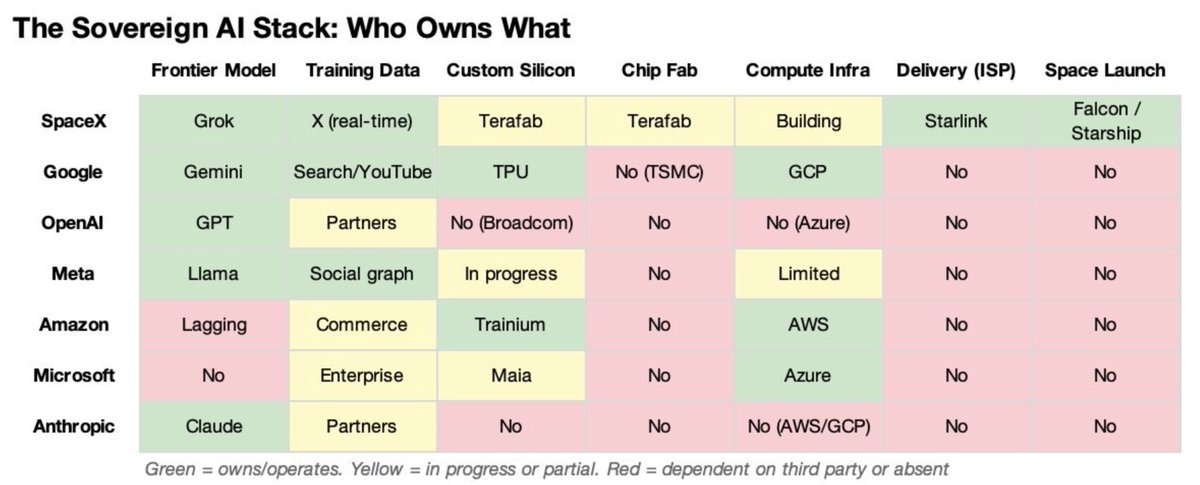
SpaceX will be the first $100 trillion company and here's why (Save this). Every company on this list owns a piece of the AI stack but SpaceX owns the entire thing and then some. Google has Gemini, owns its TPUs, runs GCP, and has Search and YouTube as a real-time data moat and that's impressive but Google doesn't own a chip fab, doesn't own its delivery network and definitely doesn't own a rocket. OpenAI has GPT, and that's essentially it and they have no custom silicon, no compute infrastructure, and no training data they fully control. Anthropic is in the same position, Claude is excellent, but they are entirely dependent on AWS and GCP for every layer of infrastructure beneath the model. But then there's SpaceX. They have a frontier model via Grok, real-time training data via X, custom silicon via Terafab, chip fabrication via Terafab, compute infrastructure being built out, global delivery via Starlink and Falcon and Starship to put it all in orbit. And the numbers behind this are incredible. Starlink generated $11.4 billion in revenue in 2025, up 50% year over year, with $4.4 billion in operating income. By Q1 2026, Starlink alone was doing $3.26 billion per quarter across 10.3 million subscribers in 155 countries. @MelvinInvests forecast Starlink hits roughly $20 billion in revenue for full year 2026 with a $8.1 billion in free cash flow and that is a profit machine funding everything else Musk wants to build. In February 2026, SpaceX completed the largest merger in history by absorbing xAI in an all-stock deal valued at $1.25 trillion. That deal brought Grok, X's real-time data firehose, and xAI's entire research team under the SpaceX umbrella, with the stated goal of building orbital AI infrastructure, literally putting compute in space, powered by continuous solar energy, running in near-zero temperatures where cooling is essentially free. In June 2026, SpaceX revealed AI1, their first orbital data center satellite, with 150 kW of peak compute power, a 70-meter solar wingspan and a liquid radiator for thermal management. @elonmusk argument is that orbital compute will be the lowest-cost way to generate AI inference within two to three years, and SpaceX already has the rockets to deploy thousands of these satellites while nobody else even comes close. The thesis comes down to one thing. Every AI company in the world needs compute, compute needs power, and power is the bottleneck. SpaceX is building a compute network in space powered by the sun, delivered globally via Starlink, launched on rockets they own, running AI models trained on real-time data from X, on chips they designed themselves. The other companies on that chart are building floors in someone else's building while SpaceX is building the planet. Milk Road Pro remains bullish on SpaceX and if you want to see the rest of our AI trades, come join us using the link below for 33% off your membership just today!
Milk Road AI tweet media
English
16
41
177
19.2K