

Felix Wick
348 posts
In our latest Cyclic Boosting release github.com/Blue-Yonder-OS…, we introduce quantile regression (via pinball loss) and subsequent (requiring 3 predicted quantiles) fit-less estimation of full individual probability distributions by means of quantile-parameterized distributions.
English
brief summary of main ML concepts: @felixwick83/understanding-machine-learning-96fd6280e2eb" target="_blank" rel="nofollow noopener">medium.com/@felixwick83/u…
English
Felix Wick retweetledi

We just open-sourced Cyclic Boosting, a pure-Python ML algorithm that's explainable, accurate, robust, easy to use, and fast! Learn more in our presentation #Cycl… @wickfelix at #PyConDE #PyDataBerlin
2023.pycon.de/program/MYARJG/
English
First open-source pre-release (still lots of polishing needed) of the Cyclic Boosting ML algorithms: github.com/Blue-Yonder-OS…
Feel free to try it out, simply do: pip install cyclic-boosting
Please come back with criticism and suggestions. Contributors highly welcome!
English
Felix Wick retweetledi

A short history of the world in 13 maps & infographics:
1. Everybody alive today compared to everybody who has ever lived

English
my recommendation for an off-the-shelf ML algorithm for regression on structured data: scikit-learn.org/stable/modules…
English
Felix Wick retweetledi

Evolution provided us with moderate math skills, AI to the rescue. deepmind.com/blog/discoveri…
English
Just stumbled upon this really nice story from @andrey_kurenkov about the history of neural networks: skynettoday.com/overviews/neur…
English
@antgoldbloom For products and locations, you need to find a way to deal with categorical features of high cardinality though. Simple one-hot encoding is not great and especially tree-based methods suffer here.
English
@antgoldbloom A single model used across all SKUs is not only better in terms of learning commonalities across SKUs, but also operationally way more convenient.
English

Been spending the last few weeks speaking to data scientists working on demand forecasting. Some interesting things I learned. 🧵
English
@antgoldbloom One of the most important, but usually overlooked, issues (especially for short-term forecasting) is temporal confounding. Autocorrelation is spurious and can mask true causal effects, e.g., from promotions or events, for the model. Take care how you include it.
English
@antgoldbloom This is better in terms of variance, but you pay for it with bias. In general, best is to learn on the granularity you want to predict.
English
More mature teams with many SKUs are typically only forecasting demand at the most zoomed out level (e.g. the national level). And then forecast "share of sales" at more granular geographic levels.
English
@PengM83 @antgoldbloom For new products (and locations) use attributes (including product groups if hierarchy available) and go for embeddings.
English

@antgoldbloom what about totally new product with no previous history? I've seen people talking about creating product cluster and then using prediction from similar products. Any real world observations on that? Thanks.
English
@marktenenholtz Probably easiest to have a look at section 5 in arxiv.org/pdf/2009.07052… or this presentation: sciforum.net/paper/view/108…
English
@marktenenholtz But beware of the detrimental effects of temporal confounding.
English

Feature engineering is the most important part of building great models for tabular data.
However, it’s easy to run out of ideas.
Much like Writer’s Block, I call this Feature Engineering Block.
So here are a bunch of ideas to make sure you never run out:
English
@marktenenholtz Two more options: Learn as a distinct category or ignore by setting to a neutral value (if your algorithm allows that).
English
Always start by filling them with a value that makes sense.
If there isn’t an obvious value, try:
• Filling with the mean
• Filling with the median
• Filling with zero
For categorical features:
• Filling with the mode
• Filling with a negative value
• Frequency encoding
English
@peterhoffmann @rasbt @BlueYonder Yes. But in fact, we recently made a twist toward upside-down reinforcement learning.
English

@rasbt @BlueYonder @WickFelix Isn't this one of your study topics how you want to build the autonomous supply chain?
English
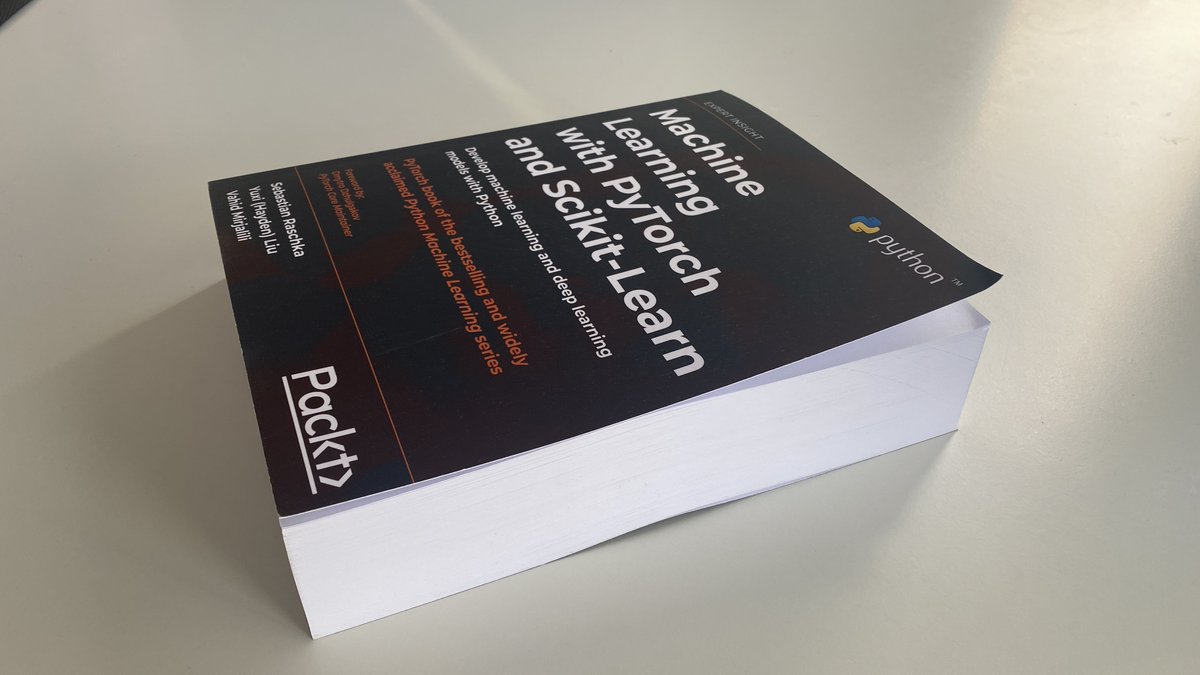
Got **the** book. Looking forward to learn quite some new stuff out of my data engineering comfort zone.
@rasbt
English
Was it really just symmetry breaking via setting random initial weights what Rosenblatt missed to get backpropagation to work? (as described in Genius Makers)
English