
Wilson Withiam

1.8K posts

Wilson Withiam banner
Wilson Withiam

Wilson Withiam

@WilsonWithiam

Head of Research @SyncracyCapital | Previously @MessariCrypto @ResearchCircle | Not financial advice. Disclaimer: https://t.co/nh0I2bkNMJ

Katılım Aralık 2017
1.1K Takip Edilen10K Takipçiler
Sabitlenmiş Tweet
Wilson Withiam
Wilson Withiam@WilsonWithiam·
I’m excited to announce that I’ve joined @SyncracyCapital as Head of Research! I’ll be working alongside fellow Messari alum @RyanWatkins_ and @HighCoinviction to execute our thesis and make concentrated investments in the secular winners of the cryptoeconomy.
English
5
8
83
21.1K
Wilson Withiam retweetledi
shaunda devens
shaunda devens@shaundadevens·
HYPE >$50. Some thoughts: Asset prices reflect the last trade in a market’s continuous auction. While this is often treated as “fair value,” only a small share of supply actually changes hands. As a result, price usually reflects the most aggressive buyers and sellers, and the premium or discount they are willing to accept relative to the recent price range. Still, over time, slower-moving supply and demand respond, and the market starts to re-equilibrate. Therefore, while there are many ways to value an asset, the best way to contextualize its current value is: 1) What do short-term flows and asymmetries look like? 2) Where are longer-term buyers and sellers likely to step in? For HYPE, short-term aggressive flows are clearly asymmetric to the upside. ETF access has started ($14.1M volume on May 19th), DATs are buying (Hyperliquid Strategies has $100M left), and the Assistance Fund continues to purchase $10M–$15M a week. On the market side, we are seeing tons of positive catalysts: Circle / Coinbase likely bringing in >$100M of stablecoin-related revenue for Hyperliquid, pre-IPO markets like SpaceX and potentially OpenAI from TradeXYZ bringing outsized TradFi attention, RWA open interest at $2.6B (up 2x from two months ago), and most recently regulatory momentum around tokenized stocks. This leads to the second question: where do longer-term holders sell into this demand? HYPE spent nearly a year auctioning between $20 and $40, rotating supply into a new holder base. My bias is that much of this supply now sits with less price-sensitive holders: Deployers, the Assistance Fund, DATs, and stakers. If motivated sellers already had repeated exits around $38–$40, how much is left to sell above $50? Instead, we may see a reflexive dynamic where investors waiting for lower (e.g HYPE’s $8 Solana moment) are forced to rotate in. My view is that flows and demand have already pushed many TradFi equities into extremely stretched valuations, while HYPE, despite being crypto’s clear winner, has remained relatively anchored to fundamentals. This break above the prior range, along with clear improvements in fundamentals (regulation, diversified revenue, 0-1 pre-IPO / 24/7 markets) and access (ETFs and DATs), could create an environment where price discovery turns reflexive and HYPE grinds much higher, detaching from traditional valuation anchors in the same way many high-growth L1s have in past cycles. Hyperliquid
shaunda devens tweet media
English
39
100
675
135.2K
Wilson Withiam retweetledi
Ryan Watkins
Ryan Watkins@RyanWatkins_·
*Why your favorite TradFi firm launching perps won’t kill Hyperliquid* Let’s establish this upfront. Perps are not just a simple payoff formula. They require a fundamental redesign of the exchange. The magic is in vertically integrating matching, margin, liquidation, and settlement into one continuous risk engine. This provides the foundation for shared collateral pools, tight liquidation loops, 24/7 funding mechanisms, and 20-50x leverage. The resulting UX and capital efficiency is why perps decisively beat out dated futures and options products within crypto. You can’t just “list perps” as if it were any other derivative. You have to reproduce the architecture. Coinbase has already demonstrated this empirically with their lackluster CFTC-regulated “perps” product despite plenty of talent and dollars thrown at it. As currently designed, they’re long-dated futures with 5-year expiries, 3-10x leverage depending on the contract, and funding that only settles twice daily. Compare that to unregulated offshore venues like Binance or blockchains like Hyperliquid and it’s obvious why the product has underwhelmed. If Coinbase can’t figure it out, why should Kalshi or Polymarket, which have worse distribution for this product? If Coinbase as the most crypto-native regulated U.S. venue can’t deliver a compelling product, why should CME or ICE? The reality is that U.S. regulated incumbents have been sidelined from truly competing. Dodd-Frank and the Commodities Exchange Act mandate centralized clearing, and separation between the different layers of the trading stack. This fragmentation structurally prevents the vertical integration necessary for real perps to work. And even if they didn’t, incumbents would still likely have regulatory limits on the amount of leverage they can offer to retail. Fixing all this requires a full regulatory overhaul and infrastructure rebuild. HOOD and IBKR pumping out whatever subpar product their underlying exchange lists wouldn’t change the problem. But regulation can change right? At a conference in March, CFTC Chairman Michael Selig suggested that the agency would allow perps for crypto soon. While CME and ICE may not have the right infrastructure in place to flip on perps anytime soon, Coinbase, Kalshi, and Polymarket could in theory offer real perps on crypto within weeks of formal guidance dropping. In fact, it is my full expectation that both Kalshi and Polymarket's upcoming perps products will be real perps with no expiry, unlike what Coinbase offers. What then would be the advantage of decentralized venues like Hyperliquid if everyone was now on a more level playing field? Well for one U.S. guidance would likely only be for crypto perps, not the equity or commodity perps which are the fastest growing segment of the market. They also might not remove limits on retail leverage. But let’s just ignore these qualifications for now and assume that there’s simultaneously 1) no regulatory advantage for offshore venues anymore and 2) decentralized venues still cannot legally offer perps to U.S. retail users (despite the CFTC also working towards creating a pathway for this). There’s a handful of long-term advantages decentralized venues like Hyperliquid have. 1) DEXs are structurally cheaper as they do not maintain fiat banking rails, large compliance teams, regional subsidiaries, customer support, or extensive custody and treasury operations 2) DEXs are permissionless, which provides significant scaling advantages over incumbents as anyone can launch and distribute new markets, creating a virtuous utility-and-distribution flywheel 3) DEXs are intrinsically global, enabling them to reach anyone on Earth so long as they have an internet connection 4) DEXs offer users substantially lower counterparty risk as they are real-time auditable and enable users to self custody their funds And none of this is to mention the bigger picture concept that Hyperliquid isn’t just a perps venue anymore. Rather it’s a full-fledged platform where traders soon be able to cross-margin perps, options, predictions, and tokenized equities in a unified experience. Incorporating all of this into a single risk engine takes years of iteration and refinement, and a baseline level of liquidity across all markets. x.com/RyanWatkins_/s… With all this in mind, who do you think is best positioned to execute on this product? Is it really the regulatorily constrained, technologically disadvantaged, incumbents that have zero experience building this product? Or is it the pioneering team with breakneck product velocity and years of experience both trading and building these products? It’s not wrong to worry about competition. I do expect TradFi firms will offer decent products over the coming quarters and help grow the market. But eventually decentralized venues will be made legal in the U.S. too and their superiority will be proven over time. So the big question in my mind is not whether TradFi will win, it’s whether another blockchain like Solana, Lighter, or Base builds a better product, or if Hyperliquid will stay the king. Time will tell.
English
44
51
388
80.8K
Wilson Withiam retweetledi
shaunda devens
shaunda devens@shaundadevens·
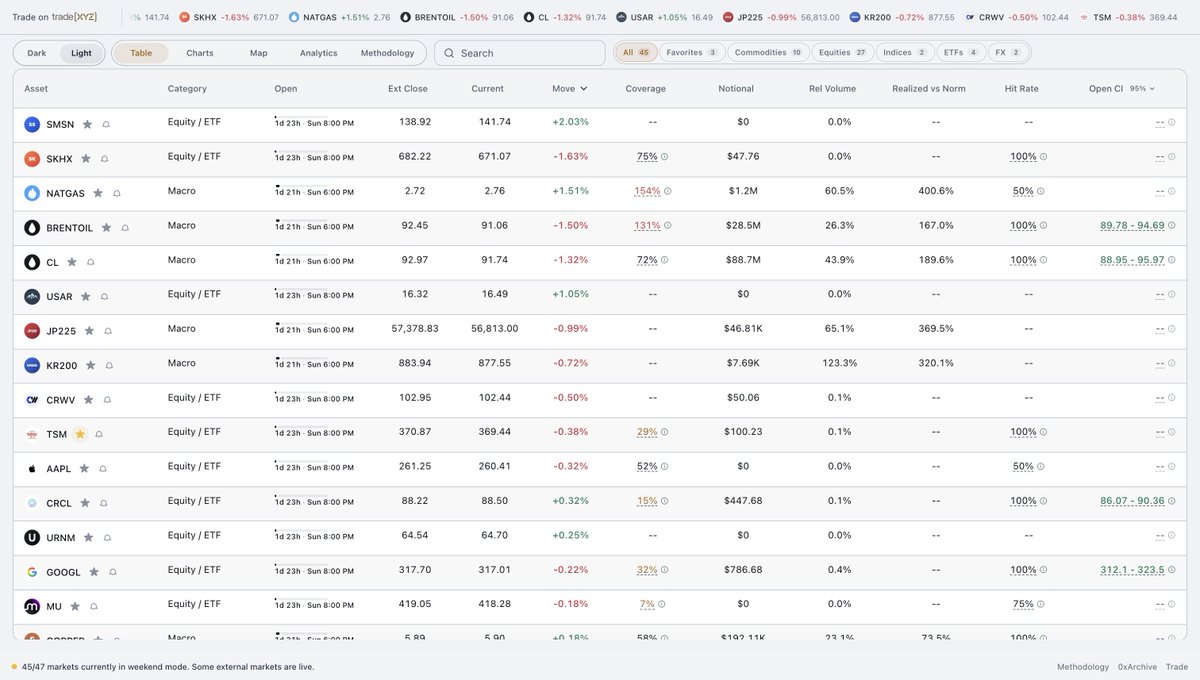
Introducing Weekend Markets: When traditional markets close, TradeXYZ becomes the only live venue for price discovery. With billions in weekend volume and a 50 bps median error predicting the Monday open, TradeXYZ prices are the most informative signal in finance relative to a stale Friday close. We built Weekend Markets to systematically track this off-hours data. Weekend Markets is the comprehensive source for analytics on traditional asset prices over the weekend. Weekendmarkets.xyz
shaunda devens tweet mediashaunda devens tweet mediashaunda devens tweet mediashaunda devens tweet media
English
52
96
858
247.9K
Wilson Withiam retweetledi
MONK
MONK@defi_monk·
Some thoughts on Solana v Hyperliquid for perps. Really loving the recent discussion around Solana perps that @LoganJastremski and others have been sparking. Some well-intentioned and genuine pushback. How do you win over retail flow for this use case? Ultimately retail flow does not care about philosophical advantages - a truth that worked in your favor when you were competing against Ethereum. They don’t care about the geographic distribution of your leaders. They, quite frankly, don’t even care about 50ms vs a couple 100ms of latency on their fills. Ask any genuine taker on HL today whether they think the product is inadequate. A lot of the arguments for why Solana will win perpetuals stems from a perceived distribution advantage, this assumption that Solana has all the retail users already and they just need to offer them perps. When I first started writing about market structure and engineering challenges on Solana (in the context of enabling perps), I thought that was true. Back then, all the relevant retail users were on Solana and only the perpetuals power users were really on Hyperliquid. At this point, that advantage is nonexistent. Hyperliquid houses the strongest and most valuable retail flow in crypto and any onchain user that is even curious about perps has migrated some funds over. All of the Solana spot trenchers are now Hyperliquid perps traders and the speculative activity that still persists on Solana is no longer as relevant to this equation. The current iteration of the trenches is a shell of its former self. With MCP it’s looking like some of the market structure issues are going to be addressed. It’s still a rather complex solution but that is obviously what’s required for a more decentralized, general purpose chain. But if that’s going to get you to (roughly) product parity with Hyperliquid I’m not sure that’s going to be enough, especially considering Hyperliquid itself is a rapidly iterating and improving product. Just not sure where Solana fits into the perps equation when it’s apparent now that this is an incredibly finicky product to perfect and longer standing, app specific solutions exist. These third party teams on Solana will have to rebuild retail flow from scratch. I’ve been trying to steel-man the Solana perps thesis but am just failing to see why any perps trader today would choose to go back to Solana for perps when Hyperliquid exists. Maybe co-location is just not the doomer issue that some people say it is and it’s just about building the best infrastructure for the best product in a world of crypto regulatory capture. Either way, it’s a worthwhile effort to work towards and would love to see some killer perps teams on Solana. Just putting on my investor hat here.
English
22
15
134
25.2K
Wilson Withiam retweetledi
Ryan Watkins
Ryan Watkins@RyanWatkins_·
Once you realize Hyperliquid is building the everything exchange, and cross-margin brings it all together, you realize that every other competitor is playing a much narrower, far less defensible game. On Hyperliquid, perps, spot, options, predictions, RWAs, and related markets are not separate products so much as expressions of a single, unified trading experience powered by a shared risk engine. At scale, the resulting liquidity and capital-efficiency flywheel should produce a winner-take-most market structure, leaving those who didn’t see the bigger picture fighting for scraps in siloed markets. Excerpt below on the approaching $HYPE endgame over the coming years.
Ryan Watkins tweet media
English
34
81
467
35.8K
Wilson Withiam retweetledi
Ryan Watkins
Ryan Watkins@RyanWatkins_·
Hyperliquid's third party ecosystem is now generating ~$100M in run-rate annual revenue. This is a significant milestone for Hyperliquid and speaks to the compounding impact of all the talent and capital pouring into its builder codes and HIP-3 ecosystem.
Ryan Watkins tweet media
English
28
48
346
60.7K
Wilson Withiam
Wilson Withiam@WilsonWithiam·
Only a few crypto native innovations (stablecoins, prediction markets, and digital SoV) have broken through crypto’s self-referential economy and demonstrated clear proof of widespread utility and adoption. Perps are shaping up to be the next transformative breakthrough. Yet the size of the opportunity, why onchain exchanges have structural advantages over incumbents, and how optimizing for perps and order book exchanges may be the correct foundation for building a full-scale financial platform remain largely underexplored. @RyanWatkins_ and @defi_monk leave no stone unturned in what is our highest conviction thesis in recent memory. It’s the culmination of countless conversations about the optimal design and sequencing for a financial superapp, trading as the foundational use case for crypto’s app layer (alongside payments), and the cryptoeconomy as fundamentally a retail phenomenon. The best is yet to come. The great perpification is just beginning.
MONK@defi_monk

x.com/i/article/2033…

English
6
1
14
1.9K
Wilson Withiam retweetledi
Ryan Watkins
Ryan Watkins@RyanWatkins_·
Perps eating global financial markets is the highest conviction thesis I’ve had in my 4 years since starting Syncracy. If we’re right, the sector could produce $350B+ in value over the next 5 years, with the winning chain becoming one of the largest platforms in global finance. As shared in our OG Hyperliquid thesis released over a year ago, we believe $HYPE is the fastest horse in this race. While many skeptics view platforms like Hyperliquid as products of regulatory arbitrage, over time we believe they will come to be understood as a fundamental transformation of the global trading stack. What was once a fragmented world of brokers, exchanges, clearinghouses, among other intermediaries, is giving way to integrated trading systems that are continuously margined, atomically settled, globally accessible, and permissionless to build on. The case isn’t just theoretical as early signs of disruption are already visible in the data. In the early months of perps’ “real world asset” expansion they’re already impacting global financial markets — most recently functioning as a price discovery engine on weekends for oil during the Iran conflict. We believe this is only the beginning and that perps will absorb an increasing share of leveraged directional trading that today lives in retail options, CFDs, and fixed-tenor futures. Even low single-digit penetration of these markets could produce dramatic outcomes for the sector. In parallel, it remains under-appreciated how quickly DEXs like Hyperliquid have emerged as leaders in equity and commodity perps. Should DEXs continue scaling these markets, it will accelerate their share gains from the likes of Binance and Coinbase while also positioning them to challenge legacy derivatives venues such as CME, who will struggle to compete due to regulatory and architectural incompatibilities. Finally, as decentralized venues lead the growth of perps, we believe they will also expand into adjacent categories. Perps are the hardest product to nail on blockchains and once a blockchain can successfully host perps it naturally starts to aggregate other crypto use cases as a byproduct. We are already seeing early evidence of this with Hyperliquid’s expansion into spot trading and stablecoins, and soon prediction markets and options. It’s in this sense that perpetual DEXs are also Trojan horses for the financial platform of the future. —— Enjoyed writing this one with @defi_monk who was the first sell-side analyst to cover Hyperliquid in summer 2024 and among the leading thinkers on the sector. Hope you all enjoy what is a very detailed and data-driven piece that was a long time in the making.
MONK@defi_monk

x.com/i/article/2033…

English
45
74
544
128.5K
Wilson Withiam
Wilson Withiam@WilsonWithiam·
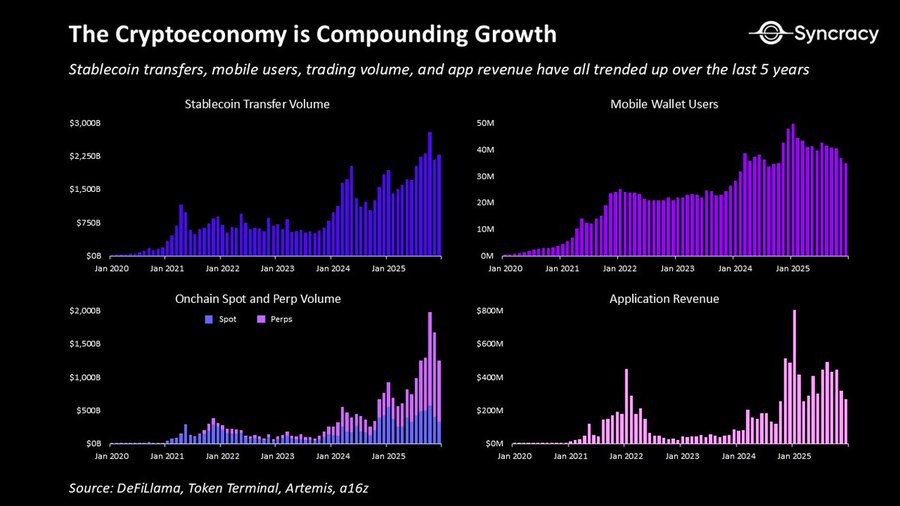
Sentiment gullies and narrative gaps aren’t new in crypto. But what’s different now is how tangible adoption has become. When you consider that crypto-led use cases like stablecoins, tokenization, perps, and prediction markets are leading financial innovation, it’s hard to see these growth trends not continuing or accelerating from here. A great and perhaps necessary dose of optimism in Ryan’s essay.
Wilson Withiam tweet media
Ryan Watkins@RyanWatkins_

x.com/i/article/2013…

English
3
0
5
462
Wilson Withiam retweetledi
Ryan Watkins
Ryan Watkins@RyanWatkins_·
The cryptoeconomy is in the biggest transition period I’ve seen in my 8 years since joining the industry. The chaos and confusion of it all is causing many people to burnout right before the golden age begins. Read if you want a first principles take on where we go from here.
Ryan Watkins@RyanWatkins_

x.com/i/article/2013…

English
28
93
381
64.2K
ria bhutoria
ria bhutoria@riabhutoria·
Life update! I’ve joined @stripe to accelerate the adoption of stablecoins 🤠 We’re just beginning to unlock the benefits of stablecoins for users, and I'm so excited for the next chapter. I went all in on crypto seven years ago because I believed it would make global payments faster, cheaper, and more accessible. Over time, the clearest path forward has become stablecoins. But to reach their full potential, stablecoins need better infrastructure, tools that are easy to integrate and the right guardrails for users across the risk spectrum. That’s exactly what Stripe is building with Bridge (@Stablecoin), @privy_io and @tempo: foundational infrastructure built from first principles, with the same craft and rigor Stripe is known for. I’ve always admired Stripe’s ability to deliver exceptional products that solve user needs, and in my short time here, I can attest the obsession is real. If you're interested in learning about our growing suite of stablecoin products, I'd love to connect. Stripe is also actively hiring, so check out our open roles and reach out!
English
123
7
545
50K
Wilson Withiam retweetledi
Alana Levin
Alana Levin@AlanaDLevin·
Excited to publish my Crypto Trends Report for 2025! It frames crypto’s growth as a story of 3 compounding s-curves: asset creation, asset accumulation, and asset utilization The report applies this lens across five key thematic areas – macro, stablecoins, centralized exchanges, onchain activity, and frontier markets – to predict where the industry may be headed
Alana Levin tweet media
English
138
125
1.1K
321.5K
Wilson Withiam
Wilson Withiam@WilsonWithiam·
It's easy to get lost in the sea of projects that have failed to live up to expectations or were outright frauds and overlook the undeniable progress the industry has made. When you zoom out, it's clear that crypto has more protocols with PMF and the chance to compound growth than ever before. And with wall street suits and the executive members of the US government finally noticing and respecting the industry, crypto is in the strongest position it's ever been on the road to adoption.
MONK@defi_monk

x.com/i/article/1980…

English
12
1
22
2.8K