Win Monroe

21.3K posts

Win Monroe banner
Win Monroe

Win Monroe

@WinMonroe

Another economist. Views and bad hot takes are my own, if even that. Likes & RTs =/= endorsements.

Copenhagen Katılım Mayıs 2014
3.5K Takip Edilen2.2K Takipçiler
Win Monroe retweetledi
DailyAFC
DailyAFC@DailyAFC·
👀 This Ecuador fan in Times Square, NYC 🍑 😂 📸 @TikiTakaConnor
DailyAFC tweet media
English
20
347
6.7K
113.4K
Win Monroe
Win Monroe@WinMonroe·
An important and interesting person, but we need not rehabilitate him. He inappropriately pressured Clinton on fiscal policy, aggressively raised rates while inflation was declining bc he feared UE <6%, & his laissez-faire regulation laid the foundation for the GFC.
Nick Timiraos@NickTimiraos

Alan Greenspan has died at 100. During his 18½ years leading the Fed, he reached rock-star heights and shaped the U.S. economy under presidents of both parties. Milton Friedman called him the greatest of all time. 2008 recast his legacy.

English
0
0
2
154
Win Monroe
Win Monroe@WinMonroe·
@mtkonczal Right exactly. The market will guess a reaction function whether the Fed describes it or not. If they're wrong then it could result in big market adjustments when the rubber hits the road.
English
0
0
1
18
Mike Konczal
Mike Konczal@mtkonczal·
@WinMonroe Thinking about this more, I'm trying to imagine the SEP raising PCE inflation 0.9% to 3.6% for 2026. And then having no communication that the median member wants to raise rates (either via dots or discussing the nature of the meeting). How confused would markets be right now?
English
1
0
1
32
Mike Konczal
Mike Konczal@mtkonczal·
Listened to the press conference this morning and I found Warsh's argument for cutting the SEP very thin. Knowing a Fed's "reaction function" has clear economic value and I don't understand the upside to ending it. I hope he explains his reasoning more fully in future speeches.
Sam Ro 📈@SamRo

"I think financial markets perform best when they react to incoming data. I think the financial markets work less efficiently when they ask a question, 'How will the Federal Reserve react to that incoming information?'" - Warsh

English
3
0
13
3.7K
Amni
Amni@AmniRusli·
Warsh’s preference for a “less is more” approach to communication is tolerable for now, given that the balance of risks has clearly tilted, to all and sundry, towards inflation. However, this latitude will disappear once the risks to the dual mandate return to a more even balance. At that point, markedly reduced communication will produce greater dispersion in market expectations and weaken the transmission of policy to financial conditions, precisely the channel the Fed seeks to influence. When risks are balanced, nuance becomes essential. Markets will not react proportionately unless they understand both the logic and the sequencing of policy decisions, as well as the shifting weight of focus du jour. This is why previous Fed statements evolved their language only gradually: retained sentences signal that a concern remains live, while the removal or softening of particular phrases indicates that conditions have shifted. “Gradualism” in communication is therefore not stylistic conservatism; it is a deliberate technique to avoid unnecessary volatility. Financial stability is placed at greater risk the less clearly the market can discern the Fed’s reaction function. In such an environment, extreme price movements become more likely precisely because uncertainty about the central bank’s response has increased. Forward guidance is not just ancillary commentary; it is the principal instrument through which the central bank anchors expectations, calibrates market reactions, and preserves the smooth transmission of policy. Without it, the Fed’s influence over financial conditions grows both weaker and more volatile.
Claudia Sahm@Claudia_Sahm

I still have no idea what Kevin Warsh thinks about monetary policy. Maybe we need a task force for that! Saying you will deliver on price stability without explaining how you might do it is empty words.

English
1
1
7
1K
Win Monroe
Win Monroe@WinMonroe·
What does seem clear is that, at least for now, the Fed is moving back to a more 90s Greenspan style, with short statements, very little communication, and power concentrated in Chair, on who’s every word we will now hang, for better or worse. Discretion it is.
English
0
0
4
475
Win Monroe
Win Monroe@WinMonroe·
We still do not know much about Warsh’s views. Is he the hawk he was pre-Trump or the dove since then or now free to be some secret third thing? We do not know.
English
1
0
2
172
Win Monroe
Win Monroe@WinMonroe·
A few thoughts on Warsh yesterday, after sleeping on it. First, one of the longest-running & classic debates in monetary policy is rules vs discretion. Traditionally, hawks & conservatives have tended to prefer more rules based monetary policy rather than discretionary.
English
1
2
8
2.6K
Win Monroe retweetledi
Nick Timiraos
Nick Timiraos@NickTimiraos·
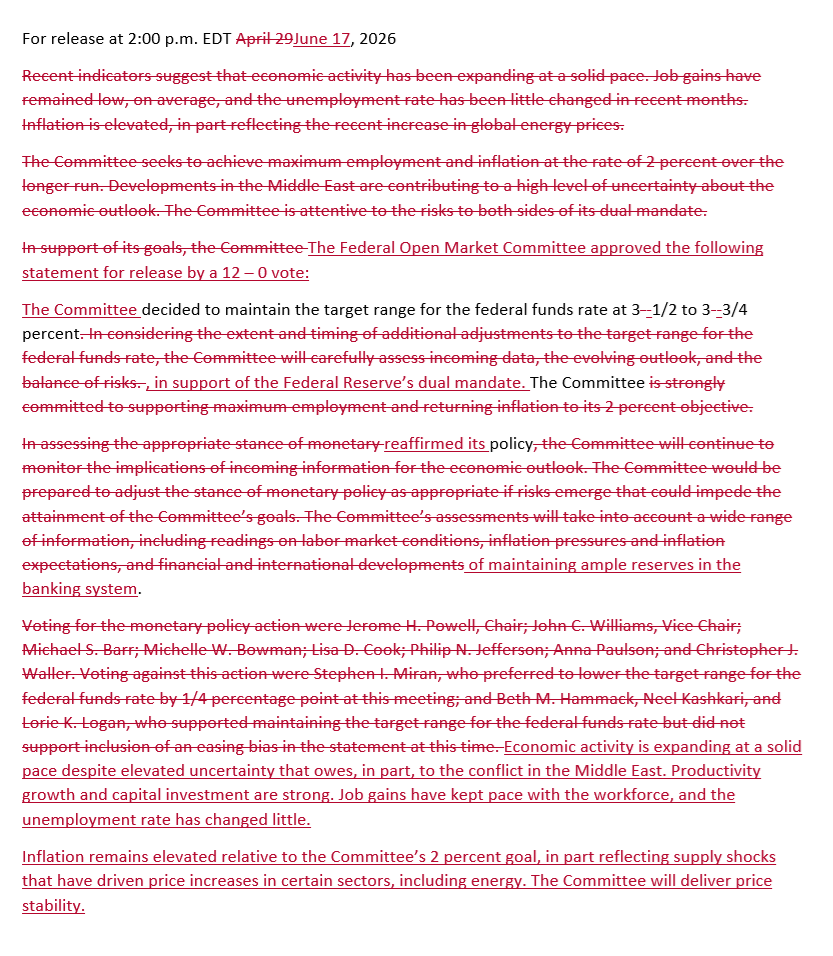
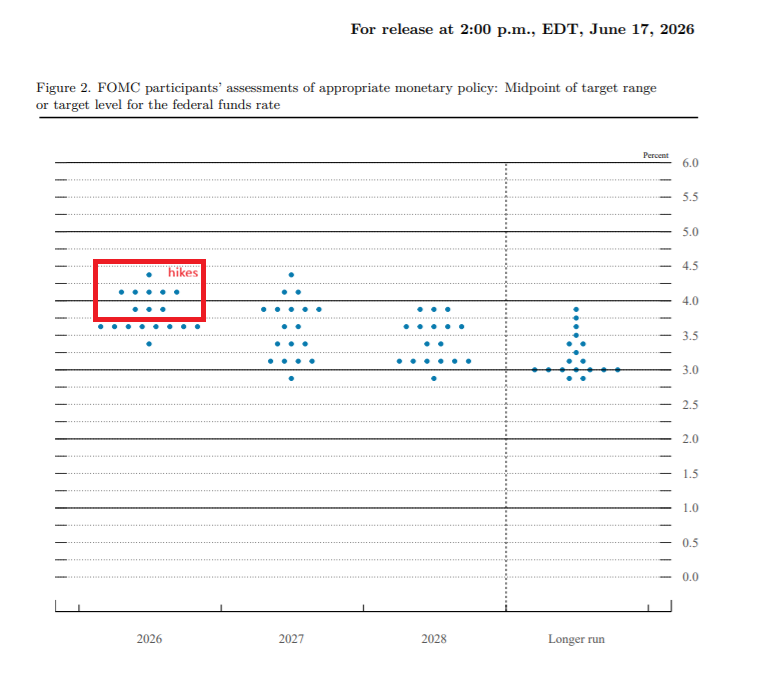
Very hawkish dot plot. Nine out of 18 officials have at least one hike this year (and six of those 9 have *multiple hikes*). Only one person has a cut this year, and one participant (presumably Warsh) didn't submit an SEP The statement gets a complete writethru from top to bottom, much shorter
Nick Timiraos tweet mediaNick Timiraos tweet media
English
98
670
2.4K
960.9K
Win Monroe retweetledi
Colby Smith
Colby Smith@colbyLsmith·
Some takeaways from today's meeting: 1) The Fed held rates steady on Wednesday, but the main focus was a new set of economic projections that showed a sea-change in officials' views about rates this year. Policymakers are split between no cuts and one or more quarter-point rate increases as they braced for higher inflation caused by the war with Iran. 2) Warsh did not give any steer about his thinking on the outlook for rates, nor did he submit a set of projections for the "dot plot." That was part of a broader shift away from the Fed providing forward guidance, which Warsh has long criticized and said limits policymakers' ability to change tack when need be. That view also seemed to motivate changes to the policy statement, which was significantly scaled back in length and substance. A previous phrase that spelled out the conditions under which the Fed will lower rates again was scrapped. 3) Warsh was explicit in one dimension, however. He made clear that the Fed will prioritize delivering price stability. That pledge was included in the policy statement and it was echoed multiple times during his news conference. Warsh will be under pressure to articulate how the Fed expects to deliver that at some point, having avoided any questions about the conditions under which the Fed would raise rates. 4) Warsh made clear that he does need see the Fed having to make a "cruel choice" between inflation and the labor market and suggested that the economy can grow without the Fed having to worry about price pressures. That argument may become more relevant if the economy continues to show signs of strength and inflation risks do not dissipate. 5) Warsh's main announcement was the creation of five task forces that he said were central to the conduct of policy. They include efforts to reform the Fed's communications framework, its $6.7 trillion balance sheet, the data sources the Fed prioritizes, how it thinks about productivity trends and jobs, and the models and measures the Fed uses to understand inflation
English
13
17
107
22.6K
Win Monroe
Win Monroe@WinMonroe·
Not willing to comment on whether policy is restrictive or have a view on current labor market. Don't love that.
English
0
0
2
158
Win Monroe retweetledi
Omair Sharif
Omair Sharif@fcastofthemonth·
It's not just portfolio management.
Omair Sharif tweet media
English
0
8
54
12.9K