Drew retweetledi
Drew
1.6K posts


@Bobbybill417 And for those getting your calculators out, that $750M - $1.5B
English

@Bobbybill417 It's a $15 Billion / yr industry... if they even pull 1% that is $150Mill revenue... The following they have, after a year or so, this could turn into a 5-10% market share...
English

#GME, #Powerpacks, #USFRAUDMARKET
GameStop just opened PowerPacks to the public — no longer limited to beta users or U.S. test markets.
This isn’t just a feature launch. It’s a major disruption.
Digital meets physical ownership. Instant access meets real asset backing. Low entry ($25) to high-end collector exposure ($2,500+).
This is scaling a of a newer channel that has already proven it's explosive potential.
If this converts even a fraction of their existing $15B trading card industry it will heavily increase collectibles momentum into digital-first participation, you’re looking at a meaningful acceleration, not a side project.
This is how you expand a $1B+ segment without adding more stores.
I'm excited to see the adoption curve of this verticle!
English

@SmallCapBob2 Check the Dollar value... It's in shares held. This has been doctored. It would be super cool, but this image is not valid
English
Drew retweetledi

I'm honestly SHOCKED at how the general public still has NO IDEA Artemis II is, right this minute, taking humans to the moon and will be the furthest humans have ever flown. Every non-space nerd I've talked to has no idea. WE MUST GET PEOPLE STOKED!!!!
THESE FOUR HUMANS ARE FLYING TO THE MOON!!!


English

@TheApester15 @JBerti_3 @CEOAdam Lack of fiduciary responsibilities in leadership at the company and that is a legally enforceable argument for investors.
English

How do experienced leaders help future generations? Human Vs Ai
I didn’t start in strategy. I started in the weeds — IT business analysis, running server backups, writing test plans. The kind of work that keeps systems running but nobody brags about.
Nobody handed me a clean data model or a governance framework. When data was wrong, I had to chase it down — through ETL pipelines, source systems, and business processes that had drifted so far from their original intent they barely resembled what they were supposed to do.
That’s where I really learned this space.
Moving from QA Tester to Business Analyst to IT Supervisor, handling hundreds of reporting requests a year, onboarding dozens of clients, dealing with legacy claims migrations nobody wanted to touch — it wasn’t just volume. It was exposure.
You start to see how things actually work, not how they’re documented.
You see why shortcuts get taken. Where technical debt hides. How temporary fixes quietly become permanent. And how decisions that made perfect sense at one point turn into real problems later.
Worst statement in human history - "That's the way it's always been done..." --- AHHH No! ABC - Always Be Changing (where required).
So when I got into building governance platforms, data dictionaries, quality rules, source-to-target mappings, stewardship models, I wasn’t guessing or working off theory. I’d already seen where things break and, more importantly, why.
Now I’m leading enterprise data management across a global, federated organization — MDM, data quality, governance, migration strategy, incident management. The scale is different, the stakes are higher, but the foundation hasn’t changed.
You don’t build trust in data from frameworks alone. You build it from understanding how and where things fail.
That’s also why I can look at an AI output and say, “This is directionally right, but it’s missing something.” Because being technically correct isn’t the same as something that actually works in a real organization.
You can have a clean model that falls apart in production, or a governance approach that looks solid but never gets adopted because it ignores how people actually operate.
That gap — between correct and usable — only really becomes visible after you’ve lived through enough of these cycles.
What concerns me now is that the next generation won’t have the same runway to learn this the slow way. Things are moving faster, expectations are higher, and a lot of the trial-and-error that built this intuition is getting compressed.
So the responsibility shifts a bit.
Not to hold onto knowledge, but to get it out of our heads. The post-mortems, the failed approaches, the decisions that didn’t age well, the trade-offs that never made it into documentation — all of that matters more now than it used to.
Because if it stays in people’s heads, it doesn’t scale. And if it doesn’t scale, it just gets relearned the hard way.
That’s the work now.
English
Drew retweetledi
Drew retweetledi

Drew retweetledi

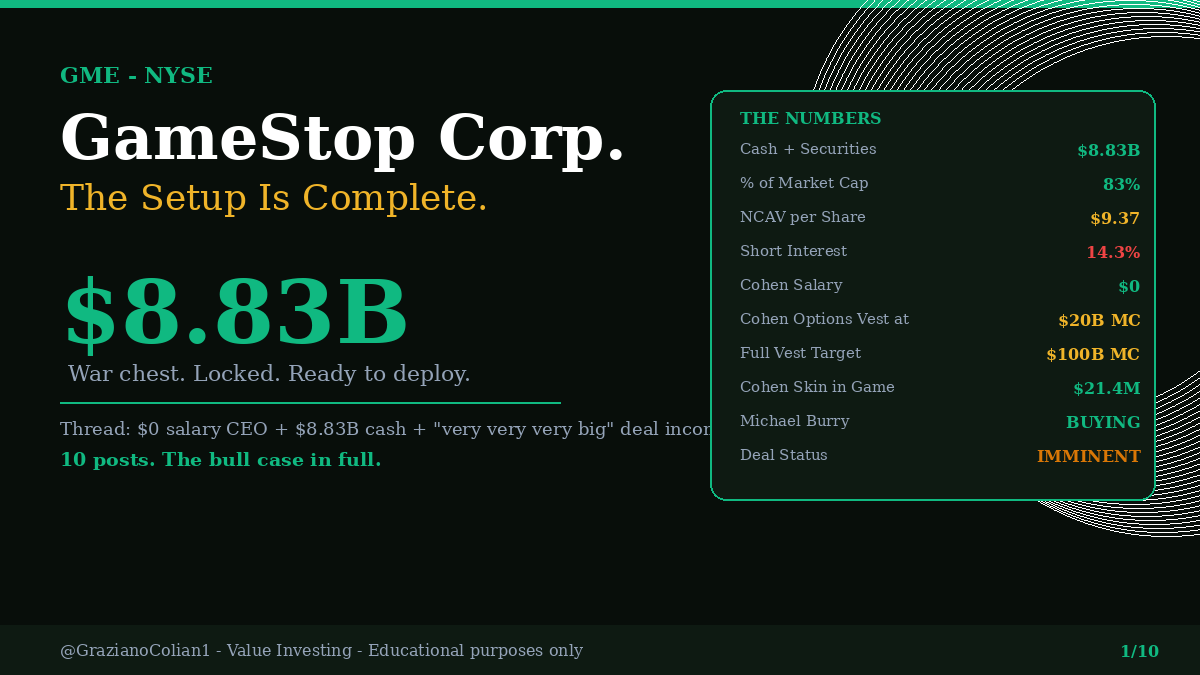
The difference between $GME and $AMC current positions is solely about leadership and their process of deploying capital from dilution.
I only use these two as a comparison because the specific and recently have done two completely different methods of dilution and for completely different uses…
$GME:
Raised capital to strengthened balance sheet
Minimal/no debt created a high cash position
Short thesis weakened
$AMC:
Raised capital and funded operations
Debt largely remained
Share count exploded and equity was diluted
Created a death spiral
Same tool. Completely different outcomes.
Dilution doesn’t decide your fate.
How you use it does.
Do I think it's over for AMC, no. Not if a full leadership shift happens. And do as I mentioned above.
Other than that.. yup.. its a goner.
English

Ok, $AMC is not doing well. I continue to see the masses believe in @CEOAdam, but honestly, I continue to have no faith that he is the right guy.
So, instead of complaining about him or the board/company I've dug in and wrote a plan to not battle shorts, but make the short math not feasible.
Below is my plan to return to profitability.
AMC is being “killed by shorts.”
That’s the narrative. Not the strategy.
If I’m in that CEO seat, I’m not fighting traders.
I’m breaking the thesis.
Because here’s the reality:
Shorts don’t win because they’re powerful.
They win when the math works.
Right now, AMC is a capital structure story.
Not an operating story.
~$4.8B revenue
~$387M EBITDA
…and still losing money
Why?
Debt + leases + interest = equity gets squeezed.
So what would I do?
Not halt trading.
Not complain about naked shorts.
Not play financial theatre.
I’d go surgical.
Fix the balance sheet
Relentlessly attack fixed costs
Refinance, repurchase, restructure
Target: materially lower interest burden, Shrink to strength
Not every theatre deserves to exist
Cut the bottom quartile
Double down on top-performing locations.
Only invest where ROI is undeniable
Premium screens
Better seating
Higher spend per guest
If it doesn’t pay back in 3–4 years → it’s out
Maximize revenue per customer
AMC already proved this works
Record per-patron spend.
Now turn that into a system: bundles, pre-orders, premium experiences
Diversify beyond Hollywood dependency
Concerts
Events
Alternative content
Fill seats without relying on studios
Stop the noise, build the case
If manipulation exists → bring evidence
SEC / FINRA / exchange escalation
Not tweets. Not speculation. Evidence.
Kill dilution unless it kills debt
Every share issued must destroy liabilities
Otherwise you’re just feeding the short thesis
Here’s the punchline:
You don’t beat shorts by stopping trading.
You beat them by removing bankruptcy from the equation.
Make the company cash generative
Make the balance sheet survivable
Make the equity undeniable
Then the market does the rest.
AMC doesn’t need a squeeze.
It needs a strategy.
And if they execute?
The same shorts pressing it today
become forced buyers tomorrow.
English

Ok so below is my detailed phased approach to doing the above.
Let’s walk it — phase by phase.
Phase 1 — Fix the balance sheet (or nothing else matters)
Right now, equity is suffocating under fixed obligations.
So the move isn’t growth first — it’s survival math:
• Target $150M–$200M reduction in annual interest / fixed costs
• Opportunistically repurchase debt at discounts
• Extend maturities wherever possible
• Renegotiate leases (this is massively underplayed)
And most importantly:
Maintain a hard liquidity floor (~$500M)
No liquidity = no negotiating power
No negotiating power = equity death spiral
Phase 2 — Shrink to strength
This is where most leadership teams hesitate.
Scale ≠ strength
Cash flow per location = strength
So,
• Rank every theatre by 4-wall profitability
• Cut / exit bottom quartile aggressively
• Reallocate capital to top-performing locations
AMC already dominates top-grossing theatres.
Lean into that.
Better to run 700 great screens than 1,000 mediocre ones
Phase 3 — Only invest where ROI is undeniable
Capex is not a strategy.
It’s a weapon — or a liability.
So the rule becomes:
If it doesn’t pay back in 3–4 years, it doesn’t get built
Focus areas:
• Premium formats (IMAX, Dolby, XL)
• Recliner / seating upgrades
• Laser projection (experience upgrade = pricing power)
Not because it sounds good —
because it drives higher spend per guest
Phase 4 — Turn every guest into a higher-margin customer
This is already working — quietly.
Per-patron revenue is at all-time highs.
Now systematize it:
• Pre-order food & bundles in-app
• Premium + concessions packages
• Dynamic pricing by customer segment
• Loyalty-driven upsells
The goal:
Don’t just fill seats
Maximize contribution margin per visit
Phase 5 — Reduce dependency on Hollywood
This is a structural risk most people ignore.
AMC’s biggest vulnerability isn’t shorts — it’s content supply.
So:
• Expand alternative content (concerts, anime, live events)
• Use off-peak capacity intentionally
• Build recurring event programming
Fill seats even when Hollywood doesn’t.
That stabilizes revenue → stabilizes valuation.
Phase 6 — Handle “predatory trading” the right way
If something is happening — prove it.
• Track FTDs, borrow rates, settlement anomalies
• Build a formal evidence package
• Escalate through SEC / FINRA / exchanges
Not noise. Not speculation.
Prosecutable evidence only
Anything else hurts credibility.
Phase 7 — Use capital markets surgically
This is where companies get destroyed.
AMC has already diluted heavily.
So the new rule:
No equity unless it DESTROYS debt
Not funds operations
Not buys time
Destroys liabilities
Every issuance must be: • Accretive to survival
• Accretive to long-term equity value
Otherwise you’re feeding the short thesis.
Phase 8 — Change the narrative (with data, not words)
You don’t argue with shorts.
You invalidate them.
So start reporting:
• Cash flow (not just revenue)
• Fixed cost reduction progress
• ROI on capex
• Revenue per patron trends
• Theatre-level performance improvements
Make it undeniable.
Final Thought
You don’t win by stopping trading.
You don’t win by blaming shorts.
You win by making this statement true:
This company is not going bankrupt.
Because once that flips…
Everything flips.
English

2008 all.over again. This time we all see it coming. Plan accordingly.
youtu.be/7C0cBXQ8gfw?si…

YouTube
English