
Windy.com

10.7K posts

Windy.com banner
Windy.com

Windy.com

@Windycom

🛰️🌎 Windy is an extraordinary tool for #weather #forecast visualization. It's fast, intuitive, detailed & most accurate #app trusted by #professionals

Prague Katılım Kasım 2014
2.9K Takip Edilen73.5K Takipçiler
Sabitlenmiş Tweet
Windy.com
Windy.com@Windycom·
🌀 Category 5 Hurricane Genevieve continues to strengthen, while Category 1 Hurricane Fausto approaches the Hawaiian Islands Hurricane Genevieve Genevieve is located over the eastern North Pacific. Monday, 27 July 2026, 00:00 CST: • Location: approximately 560 miles (900 km) west of Manzanillo on Mexico’s Pacific coast • Maximum sustained winds: 155 mph (250 km/h) • Movement: northwestwards at approximately 14 mph (22 km/h) Although Genevieve is moving away from the Mexican coast, swells generated by the hurricane are affecting parts of the southwestern coast of Mexico. They may cause life-threatening surf and strong rip currents. Genevieve is expected to strengthen slightly further, but should begin to weaken gradually from Tuesday as it continues northwestwards. Hurricane Fausto Sunday, 26 July 2026, 20:00 HST: • Location: approximately 715 miles (1,150 km) east of Hilo on the island of Hawaiʻi • Maximum sustained winds: 85 mph (140 km/h) • Movement: northwestwards and gradually weakening During Tuesday and Wednesday, Fausto is expected to pass north of the Hawaiian Islands, probably coming closest to Oʻahu and Kauaʻi. The strongest winds and heaviest rainfall should remain north of the islands. However, swells generated by the hurricane will cause high surf and strong currents along exposed Hawaiian coastlines, creating potentially dangerous conditions. ⚠️ Follow official forecasts and warnings.
English
0
13
41
3.1K
Windy.com
Windy.com@Windycom·
🌀 Bertha, Fausto, Noul and 98E: Tropical Systems over the Atlantic and Pacific Remnants of Bertha: Tropical Storm Bertha moved inland along the US Gulf Coast in Louisiana on the afternoon of Wednesday, 22 July, and then continued into Texas. Over Texas, it dissipated and degenerated into a surface trough of low pressure. Tropical System 98E: The area of low pressure is moving generally northwestward and remains well offshore of Mexico. Conditions are favourable for further development, and it is likely to become a tropical depression or tropical storm soon. Category 2 Hurricane Fausto: Fausto is moving westward over the eastern North Pacific. It currently remains about 1,550 miles (2,500 km) east-southeast of the Hawaiian Islands and is likely to approach them on Tuesday. Swells generated by Hurricane Fausto are affecting the west coast of the Baja California Peninsula and the coast of Southern California. They may cause life-threatening surf and rip currents. Tropical Storm Noul: Noul, known as Kiyapo in the Philippines, is located over the Luzon Strait and is bringing strong winds, heavy rain and rough seas to the northern Philippines and parts of Taiwan. It will continue westward to west-northwestward across the South China Sea and is likely to move inland over southern China, north of Hong Kong, on Sunday. ⚠️ Follow the latest forecasts and warnings issued by local meteorological services.
English
2
17
79
4.5K
Windy.com
Windy.com@Windycom·
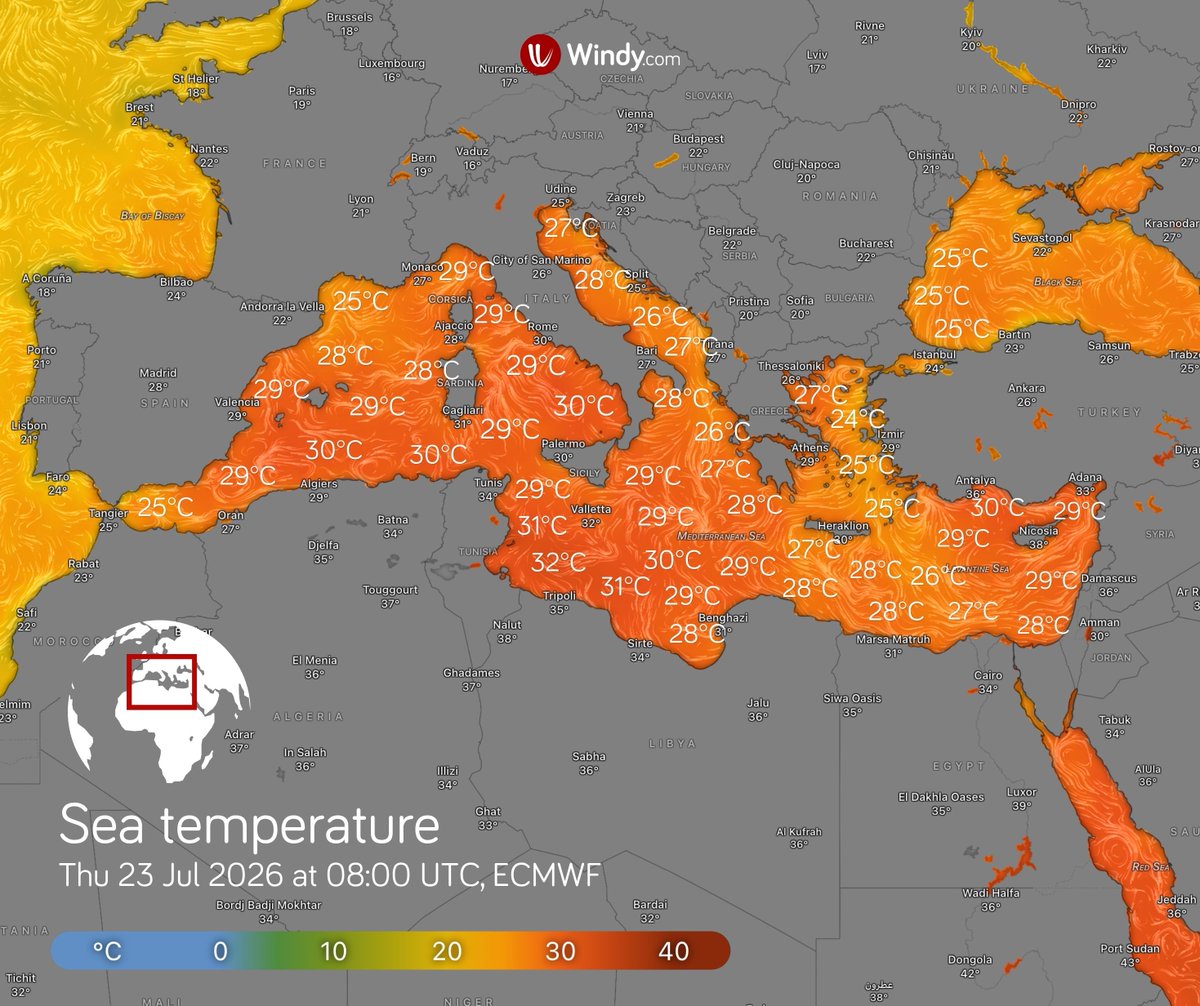
🌡️ The Mediterranean is experiencing an extreme marine heatwave Sea surface temperatures are above average across almost the entire Mediterranean. On 21 July, the basin-wide average reached 27.71 °C, which is 2.91 °C above the long-term average for that date (Copernicus Marine Service). The largest anomalies are currently occurring in the western Mediterranean: • off the coasts of Algeria and Tunisia and along the western coast of Libya, the water is locally more than 5 °C warmer than usual, with temperatures reaching almost 32 °C • around Corsica, Sardinia and Sicily, and along the western coast of Italy, anomalies are around 4 °C, with water temperatures often between 29 and 30 °C • off the coast of southern France, the water is more than 4 °C warmer than usual, with temperatures around 26 °C Water temperatures in the western Mediterranean are therefore locally reaching levels more typical of the eastern part of the basin. A marine heatwave is persisting across large parts of the western Mediterranean and is locally classified as severe to extreme. A marine heatwave occurs when sea temperatures remain above the 90th percentile of the usual values for a given location and time of year for at least five consecutive days. ⛈️ Warmer seas increase evaporation and provide more heat and moisture to the atmosphere. Under favourable conditions, this can support more intense thunderstorms and heavier rainfall. 🐠 Prolonged warming also places marine ecosystems under stress, can cause mass mortality of marine organisms, and may alter the distribution of species.
Windy.com tweet media
English
8
82
221
19.3K
Windy.com
Windy.com@Windycom·
🌀 Tropical Storm Bertha threatens the coast from western Florida to Texas Tropical Storm Bertha is moving along the northern Gulf Coast. On Wednesday morning, 22 July 2026, it was located approximately 40 miles (65 km) south of Pascagoula, Mississippi (NOAA/NHC). Maximum sustained winds near the centre were around 50 mph (85 km/h), with gusts close to 60 mph (100 km/h). The storm was moving westward at around 6 mph (9 km/h). Bertha is expected to continue moving westward close to the coast, with its centre briefly crossing land near the mouth of the Mississippi River before reaching the Texas coast on Thursday afternoon. Although unfavourable wind shear should cause gradual weakening, the storm may remain a tropical storm through Thursday evening. Strong winds, high waves, and storm surge may cause coastal flooding from western Florida to southern Texas. NOAA/NHC warns that, if peak storm surge occurs at the time of high tide, water levels may reach the following heights above ground: • from the mouth of the Mississippi River to the Mississippi–Alabama border: 2–4 ft (0.6–1.2 m) • from Port Bolivar, Texas, to the mouth of the Mississippi River: 1–3 ft (0.3–0.9 m) • from the Mississippi–Alabama border to the Okaloosa–Walton county line in Florida: 1–3 ft (0.3–0.9 m) Most of the rainfall is expected to remain over the Gulf of Mexico. Coastal areas may receive up to 4 in (100 mm), with isolated totals of up to 6 in (150 mm). Localised flash flooding therefore cannot be ruled out. ⚠️ Follow official warnings and instructions from local authorities.
English
0
7
32
2.8K
Windy.com
Windy.com@Windycom·
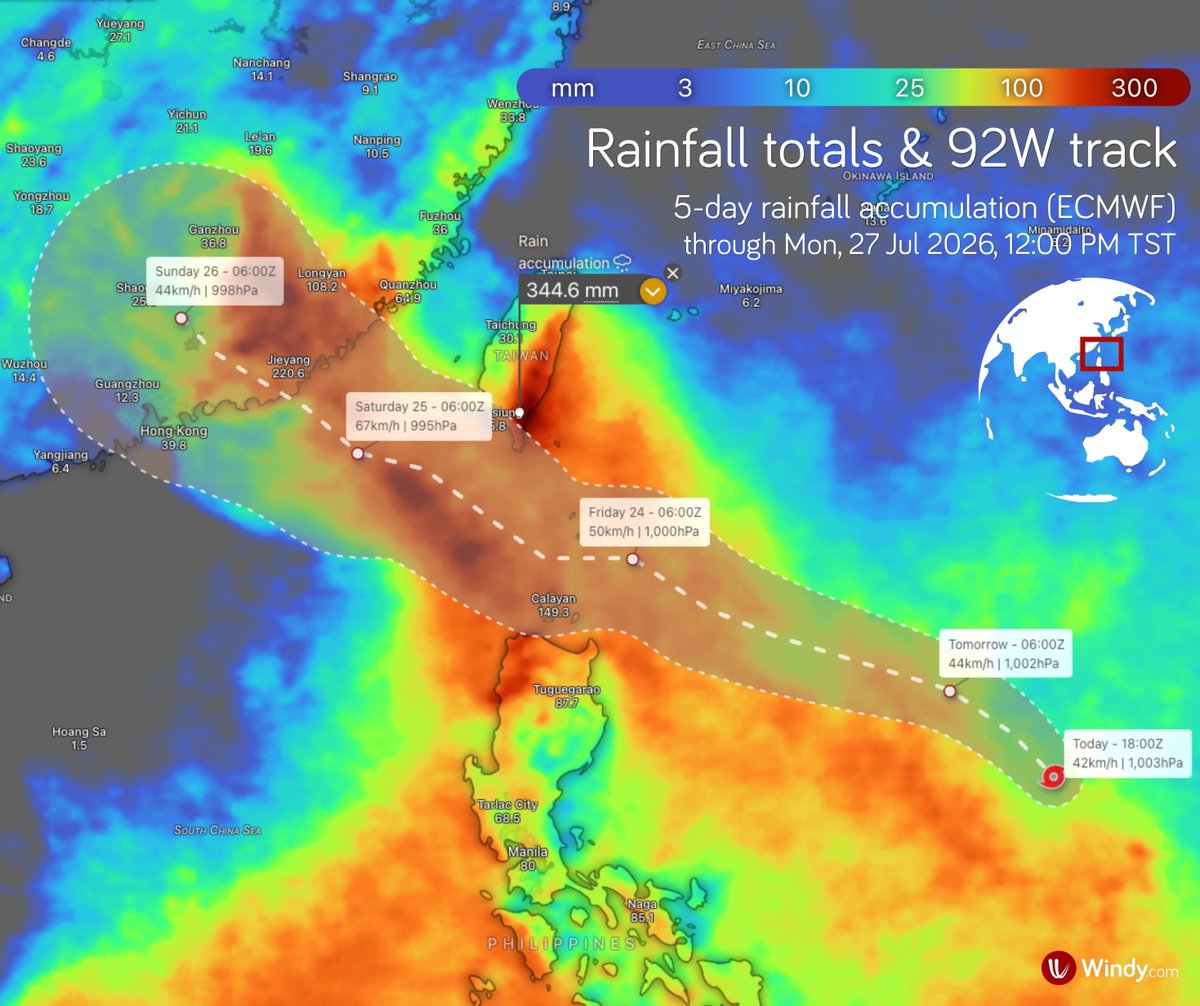
🌀 Tropical Depression 92W is strengthening over the Philippine Sea At 8:00 PM PHT/TST (12:00 UTC) on Wednesday, 22 July 2026, the depression was located approximately 900 km east of Polillo Island in the Philippines. The tropical depression is expected to continue moving generally west to west-northwest and strengthen under favourable environmental conditions, particularly sea surface temperatures of around 30 °C and low wind shear. During Friday and Saturday, it is expected to move through the Luzon Strait into the South China Sea, bringing hazardous weather to northern parts of the Philippines and to Taiwan. Heavy to extreme rainfall may produce totals of 100 to 200 mm, locally exceeding 300 mm. This may trigger flash floods, landslides, and debris flows. Wind gusts may reach 50 to 90 km/h. Waves along the eastern coast of Taiwan may reach up to 4 metres. ⚠️ Follow the latest forecasts and official warnings issued by local meteorological services.
Windy.com tweet mediaWindy.com tweet media
English
1
11
66
4K
Windy.com
Windy.com@Windycom·
🔥 Extreme heat in Italy and parts of the Balkans will gradually ease Very warm and humid air from northwestern Africa is flowing into the western and central Mediterranean, bringing exceptionally high temperatures to Corsica, Sardinia, Sicily and the Italian Peninsula. The most intense heat over the weekend affected inland parts of Sardinia and Sicily, where temperatures locally exceeded 45 °C. A temperature of 47.8 °C was reported at Santa Lucia di Capoterra in Sardinia, just 1 °C below the European record of 48.8 °C, set in Syracuse, Sicily, on 11 August 2021. On Monday and Tuesday, temperatures may again exceed 40 °C in southern Sardinia, Sicily and southern Italy, locally approaching 45 °C. Cooler air will gradually spread across the Italian Peninsula and the Balkans. By Friday, temperatures across most of the Italian Peninsula will move closer to the long-term average, although they will remain slightly above average in Sardinia and Sicily. Across the southern Balkans, temperatures on Friday may temporarily fall as much as 10 °C below average. However, this will not be a sudden, sharp cool-down, but rather a gradual return to more comfortable conditions. Numerous showers and thunderstorms may develop along the frontal boundary between the warmer and cooler air masses, some of which may become severe. ⚠️ Follow the latest weather forecasts and official warnings.
Windy.com tweet mediaWindy.com tweet media
English
0
9
52
5.1K
Windy.com
Windy.com@Windycom·
🔥 Smoke from wildfires in Canada is worsening air quality in the northeastern United States The most significant wildfire activity continues in the Northwest Territories and the province of Ontario, while major fires are also burning in other parts of Canada. Smoke is being carried towards densely populated parts of central and southern Canada, as well as the northeastern United States, where air quality is being significantly affected. The main health risk comes from fine PM2.5 particles, which can penetrate deep into the lungs. Limit time outdoors and avoid strenuous activity where air quality is poor. Children, older adults, and people with heart or respiratory conditions should remain indoors whenever possible. ⚠️ Follow official alerts and forecasts for smoke and air quality. Aerosol optical depth forecasts show the movement and extent of smoke plumes, while PM2.5 concentrations and the Air Quality Index provide a better indication of air quality near the surface. Note that newly ignited fires or sudden increases in fire intensity will only appear in subsequent model updates.
English
0
25
79
10.2K
Windy.com
Windy.com@Windycom·
🌍 Saharan dust is travelling more than 7,000 km On Friday morning, 17 July, significant concentrations of Saharan dust are being carried in two main directions: 🟠 Across the Atlantic to the Caribbean Saharan dust has been reaching the Caribbean for much of July, originating mainly in the western Sahara, across the region from Morocco to Mauritania. Similar outbreaks are common at this time of year, with Saharan dust transport typically increasing from mid-June and peaking between late June and mid-August. Over the Atlantic, the dust is transported within the Saharan Air Layer (SAL), a layer of very warm, dry and often dusty air. The dry, stable conditions and stronger winds associated with the SAL may currently limit tropical cyclone development. 🟠 Across the Mediterranean to Europe Large amounts of Saharan dust are moving from Algeria across the western and central Mediterranean towards Italy, as well as parts of central Europe and the Balkans. The dust can cause milky, hazy skies and may also contribute to vividly coloured sunrises and sunsets. 🌅
English
11
67
207
64.9K
Windy.com
Windy.com@Windycom·
🌧️ Life-threatening and catastrophic flooding is expected in Texas, USA Texas has experienced nearly a week of rainy weather, with exceptionally high rainfall totals in some areas. In the 24 hours leading up to the morning of 15 July, more than 200 mm of rain fell in parts of the Texas Hill Country, with approximately 307 mm recorded near Camp Wood (NOAA/NWS). A nearly stationary front and a continuous supply of very moist air from the Gulf of Mexico are bringing repeated bands of heavy showers and thunderstorms. The worst-affected area remains the Texas Hill Country. As of 2:00 AM CDT on 16 July, two river gauges on the Nueces River were at major flood stage, while another six were at moderate flood stage (NOAA/NWS). Flooding is expected to worsen as repeated storms may bring a further 150 to 200 mm of rain, with local totals exceeding 250 mm, mainly through Thursday evening. Further heavy rain is also possible in the following days. Widespread flash flooding and significant river flooding are expected. Water levels in smaller streams, dry channels and ravines may rise extremely quickly. Possible impacts: • threat to life • damage to buildings and property • flooded roads – never drive onto a flooded road ⚠️ Stay up to date with the latest conditions and follow the instructions of local authorities.
English
3
10
44
5.2K
Windy.com
Windy.com@Windycom·
⛈️🌪️ Severe thunderstorms across Europe, strongest in northern Italy Atmospheric conditions across parts of Europe are exceptionally conducive to severe thunderstorm development today, Wednesday, 15 July. The greatest risk is expected during the afternoon, evening and overnight into Thursday. National meteorological services have issued thunderstorm warnings for parts of the following countries: 🔴 Red warnings: Italy, Germany 🟠 Orange warnings: France, Switzerland, Slovenia, Germany, Poland 🟡 Yellow warnings: Spain, France, Italy, Austria, Czechia, Hungary, Slovakia, Croatia, Ukraine, Romania, Serbia, Bosnia and Herzegovina, Kosovo, Montenegro, North Macedonia and Greece Intense supercells may develop across the Alpine region, northern Italy, Slovenia and northern Croatia, bringing giant hail, destructive wind gusts and torrential rainfall. Tornadoes cannot be ruled out either. Why are conditions so supportive of severe thunderstorms? A broad area of high pressure with very warm air extends across the western and central Mediterranean, while an upper-level low is situated over central Europe. Strong upper-level flow and pronounced wind shear are developing between these two systems. There is also abundant moisture in the lower levels of the atmosphere, while temperatures decrease rapidly with height in the mid-levels. The combination of high instability, moisture and strong wind shear creates an ideal environment for organised thunderstorms. The highest risk of intense supercells is expected in the Italian regions of Lombardy, Piedmont and Emilia-Romagna. This severe thunderstorm pattern will persist across parts of Europe over the coming days. On Thursday, the greatest risk will shift towards France, before moving farther into central Europe on Friday. On Saturday, more significant thunderstorm activity is expected again over the northern Adriatic and gradually across the Balkans. ⚠️ Stay up to date with the latest forecasts and official warnings.
English
2
10
46
5.8K
Windy.com
Windy.com@Windycom·
🔥 Smoke from wildfires in Manitoba and Ontario in Canada and northern Minnesota in the United States is being carried southeast, causing hazy skies and worsening air quality across southeastern Canada and the northeastern United States. ⚠️ Limit strenuous outdoor activities, especially if you have heart or respiratory conditions.
Windy.com tweet mediaWindy.com tweet mediaWindy.com tweet media
English
0
2
27
3.1K
Windy.com
Windy.com@Windycom·
🌡️ The heatwave in the U.S. is peaking over the Great Lakes and shifting southeastwards A widespread heatwave is currently affecting a large part of the United States. It stretches from the Great Plains across the Great Lakes region and New England to the Mid-Atlantic states. This Tuesday afternoon, temperatures are widely ranging from 95 to 105 °F (approximately 35 to 41 °C). Daily temperature records may be broken in some places. The heat is being driven by a broad area of high pressure extending into the upper troposphere, creating a so-called heat dome. Within it, air sinks on a large scale, compressing and warming as it descends, while heat builds up in the lower levels of the atmosphere. The heatwave is peaking today across the Upper Great Lakes ahead of a frontal boundary associated with a deepening low-pressure system over eastern Canada. The front extends roughly along the Canadian border and will gradually bring slightly cooler and drier air. On Wednesday, the core of the heat will shift farther south and east, particularly towards the Mid-Atlantic states, where the heatwave is expected to peak between Wednesday and Thursday. However, hot weather will persist in parts of the northern Great Plains and the Midwest until the weekend. ⚠️ Keep up to date with the latest warnings, limit time outdoors during the hottest part of the day, and make sure you drink plenty of fluids.
English
1
21
55
5.5K
Windy.com
Windy.com@Windycom·
🌀 Former Super Typhoon Bavi’s journey is not over yet Bavi formed in early July and gradually intensified into a super typhoon. It is now transitioning into an extratropical cyclone, but it continues to affect the weather. 🌧️ Korean Peninsula Bavi is currently bringing intense rainfall to central parts of the Korean Peninsula. Wind gusts may still reach around 80 km/h overnight and on Wednesday morning. 🇯🇵 Northern Japan The system will then move over the Sea of Japan as a mid-latitude low-pressure system and continue north-eastwards, then northwards. Its associated frontal system will affect Hokkaido and Aomori Prefecture on Wednesday and Thursday. Rainfall totals will generally remain below 50 mm, but may locally exceed 100 mm. Wind gusts may reach around 80 km/h in exposed areas. 🌡️ Heat to intensify in Japan Ahead of the cold front, the flow of very warm air into Japan will strengthen. The country is already experiencing a heatwave. On Tuesday, 14 July, temperatures reached 35 °C or higher at many weather stations. The heat may become even more intense on Wednesday. ⚠️ Stay up to date with the latest forecasts and official warnings.
English
1
14
36
4K
Windy.com
Windy.com@Windycom·
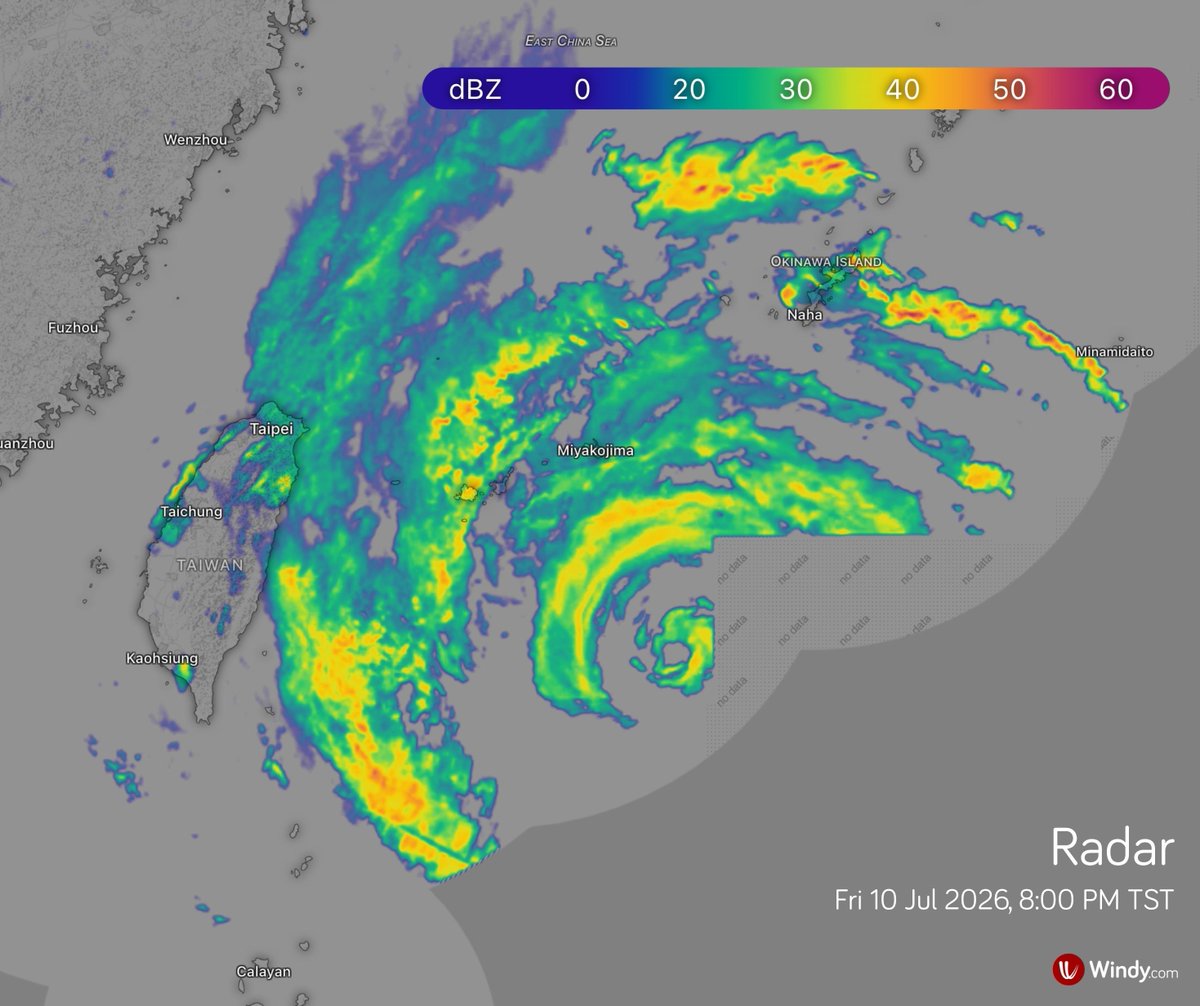
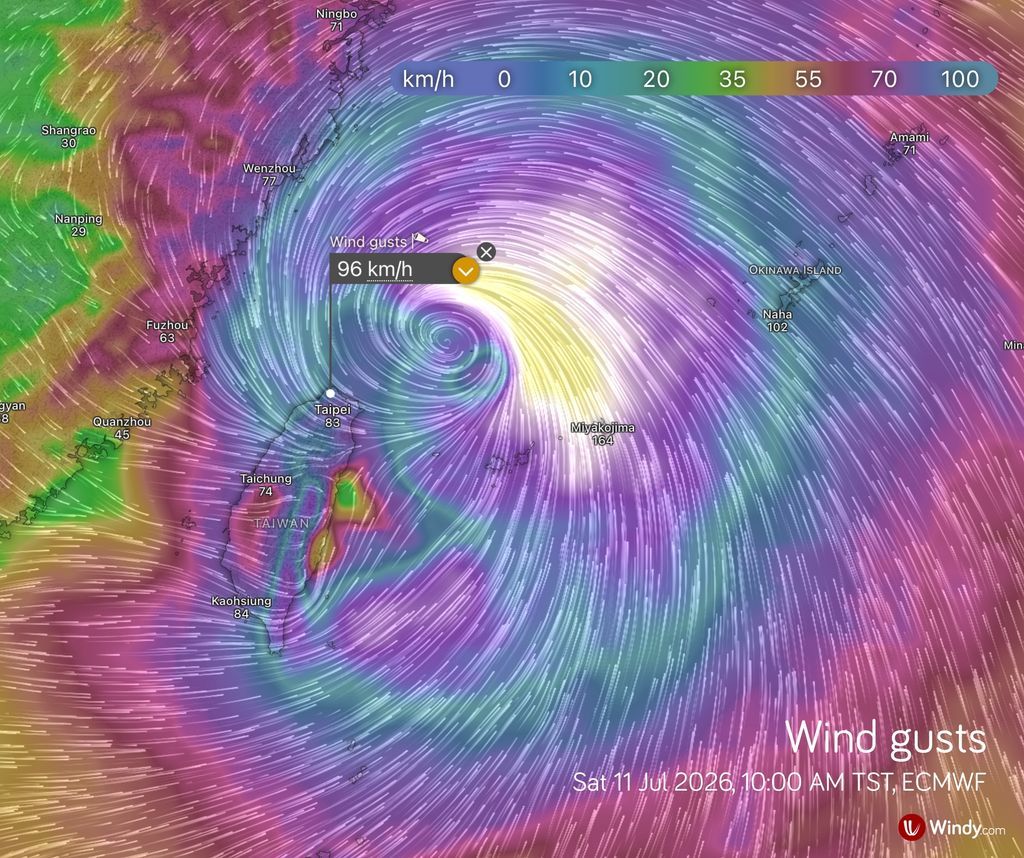
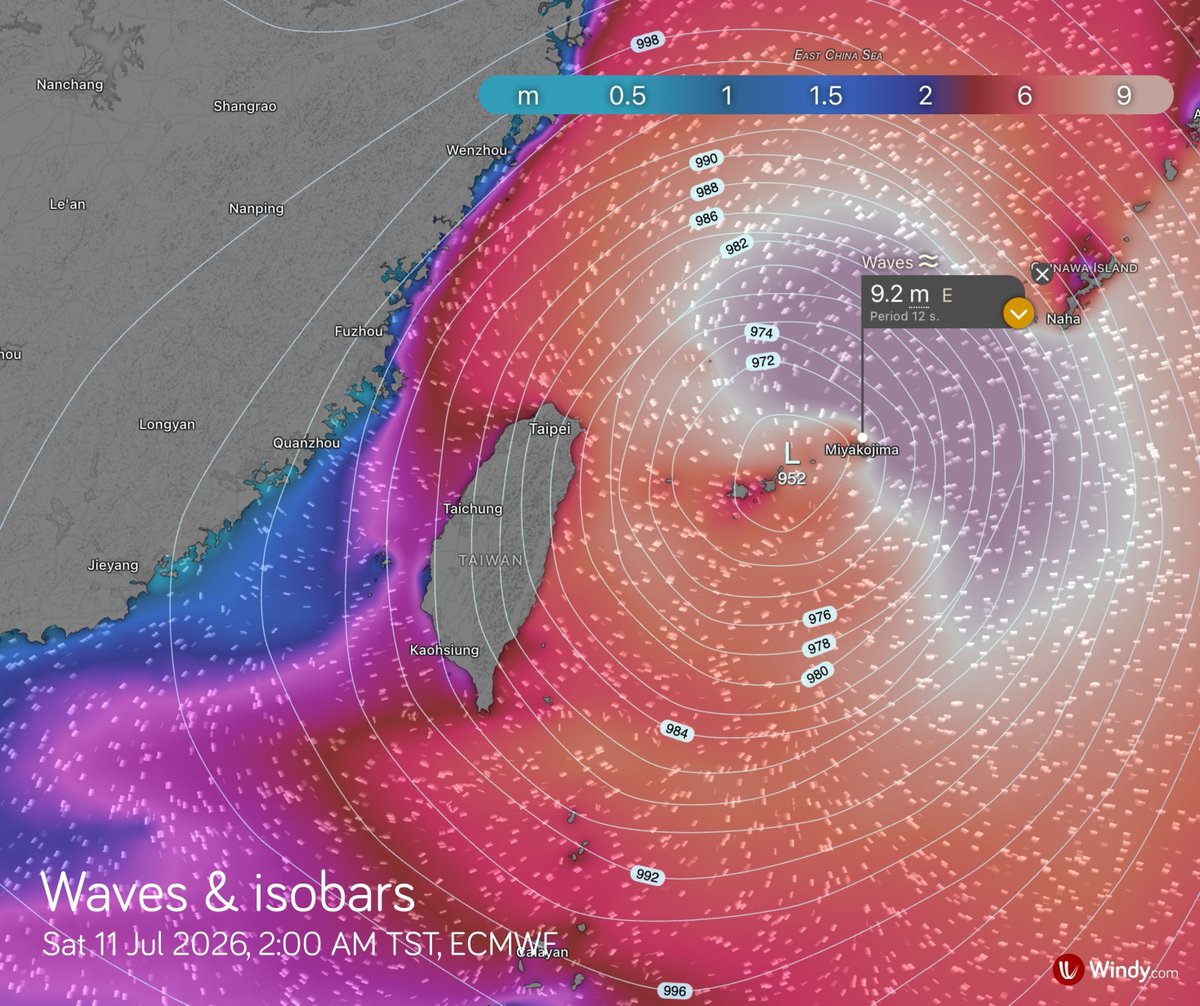
🌀 Typhoon Bavi brings dangerous weather to Taiwan and nearby islands Typhoon Bavi, known in the Philippines as Inday, is approaching Taiwan and nearby islands, where it is expected to bring very serious weather impacts. Winds are already strengthening across the region, with intense rainfall occurring in some areas. On Friday, 10 July, at around 5:00 PM TST / 09:00 UTC: Location: • 260 km southeast of Ishigaki Island, Japan • 480 km east of Taitung City, Taiwan • 520 km northeast of Itbayat Island, Philippines Intensity: sustained winds around 140 km/h, gusts up to 170 km/h Movement: northwestward at around 20 km/h Bavi is forecast to continue moving northwestward. Early on Saturday morning, its centre should pass near Tarama Island in Japan’s Sakishima Islands. After midday on Saturday, it is likely to come closest to the northern tip of Taiwan, before reaching the coast of eastern China, near Zhejiang or northern Fujian, around midnight from Saturday into Sunday. The most dangerous weather on Taiwan and nearby islands in the Philippine Sea is expected mainly from Friday night through Saturday. Dangerous winds: • Sakishima Islands: winds around 140 km/h, with gusts up to around 170 km/h • Taiwan, Orchid Island and Green Island: winds around 100 km/h, with gusts around 130 km/h • Itbayat Island: winds around 80 km/h, with gusts around 100 km/h Very heavy rain: • Taiwan: more than 500 mm of rain may fall within 24 hours, especially in the mountainous interior, with flash floods and landslides possible • Sakishima Islands: rainfall totals may reach 100 to 200 mm, locally up to 300 mm Storm surge and high waves: • Sakishima Islands: waves may reach up to 10 m • N and NE coast of Taiwan and Green Island: waves may reach up to 6 m • Orchid Island and Itbayat Island: waves may reach around 5 m ⚠️ Stay up to date with the latest forecasts and official warnings, and follow the instructions of local authorities.
Windy.com tweet mediaWindy.com tweet mediaWindy.com tweet mediaWindy.com tweet media
English
0
17
66
7.3K
Windy.com
Windy.com@Windycom·
🌀 Typhoon Bavi to bring extreme rainfall to Taiwan Typhoon Bavi is approaching Taiwan. Although it is weakening faster than initially expected, its impacts may still be very severe. Winds are already strengthening across Taiwan and the surrounding islands, with intense rainfall occurring in some areas. Early on Saturday, the centre of the typhoon is expected to pass near Tarama Island in Japan’s Sakishima Islands. On Saturday afternoon, it will move close to the northern tip of Taiwan before heading towards the coast of mainland China. The most severe impact of Typhoon Bavi in Taiwan will be extreme rainfall, along with strong winds with gusts of up to 130 km/h. More than 500 mm of rain may fall locally within 24 hours, especially in the mountainous interior. Such rainfall totals could lead to life-threatening flash floods and landslides. ⚠️ Stay up to date with the latest forecasts and official warnings, and follow the instructions of local authorities.
English
2
29
105
8.6K
Windy.com
Windy.com@Windycom·
🌧️⛈️ The 2026 southwest monsoon has now covered all of India The India Meteorological Department announced that on Thursday, 9 July 2026, the southwest monsoon advanced across the entire country. This happened just one day later than usual. The typical monsoon circulation is also visible in satellite imagery through the movement of clouds at different levels. In the animation, lower-level clouds are mainly carried from west to east, while high clouds often move in the opposite direction. Why do clouds move in different directions at different levels? During summer, the Asian landmass heats up strongly. The heated air rises, creating a broad area of lower pressure in the lower levels of the atmosphere. This circulation also includes the monsoon trough, an elongated area of lower pressure and convergence. It usually extends from Pakistan and Rajasthan across northern India towards the Bay of Bengal. Along its southern edge, moist oceanic air flows into India from the southwest and west. Higher in the troposphere, an upper-level anticyclone forms over the Tibetan Plateau and surrounding regions. On its southern side, easterly flow is present and can sometimes form the Tropical Easterly Jet. This east-to-west flow is a typical feature of a well-developed summer monsoon over South Asia.
English
3
34
160
10.6K
Windy.com
Windy.com@Windycom·
🌀 Super Typhoon Bavi threatens the Philippines and Taiwan Powerful Typhoon Bavi, known in the Philippines as Inday, is located over the Philippine Sea east of the country. Winds are strengthening across parts of the islands, while waves along the eastern coast are increasing and may reach up to 3 m in exposed areas. Wednesday, 8 July 2026, 17:00 PHT / 9:00 UTC • Location: approximately 1,080 km east of Tuguegarao, Luzon, Philippines • Intensity: sustained winds around 250 km/h, with gusts up to 305 km/h • Movement: westward at around 20 km/h Bavi will move northwestward. It is likely to come closest to the extreme northern part of Luzon on Friday. It will then head towards the Sakishima Islands in southern Japan. On Saturday morning, the centre of the typhoon may move over northern Taiwan, near the Taipei area, or pass just north of the island. Bavi is expected to weaken only slowly. As it approaches Taiwan, sustained winds may still reach around 195 km/h, with gusts around 240 km/h. Possible impacts in the northeastern Philippines, mainly on Thursday and Friday: • Wind: gusts up to around 100 km/h in exposed areas • Storm surge and high waves: up to around 5 m • Dangerous marine conditions Possible impacts in the Sakishima Islands and Taiwan, worst on Friday night and Saturday: • Wind: gusts may reach up to around 240 km/h • Heavy rainfall: 100 to 200 mm, locally up to 350 mm • Risk of flooding and landslides • Storm surge and high waves: up to around 9 m in exposed areas ⚠️ Follow the latest forecasts and instructions from local authorities.
English
0
34
110
9K
Windy.com
Windy.com@Windycom·
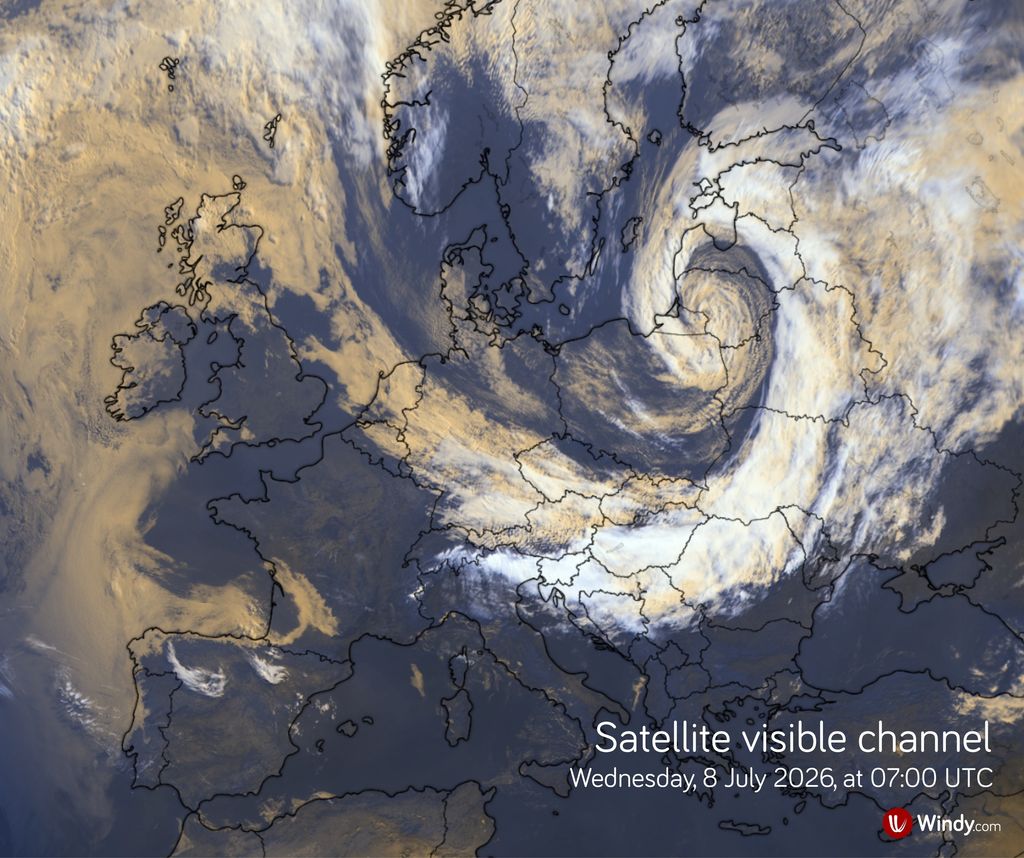
🛰️ Europe from an altitude of approximately 36,000 km An image from the geostationary Meteosat Third Generation (MTG) satellite shows Europe on the morning of Wednesday, 8 July 2026, at 7:00 UTC. 🌡️☀️ Western and southern Europe are almost cloud-free. This is where hot and sunny weather is currently prevailing, especially in France, Spain, the southern UK and the western Mediterranean. 🌫️ Morning fog and low cloud are visible along the coasts of Portugal, Spain, southwestern France, Cornwall and southern Wales. 💨 🌧️ Eastern Europe offers a completely different picture. A distinct cloud spiral over the Baltic region is associated with a relatively deep low-pressure system, bringing windy, rainy and cooler weather. ☁️ The image also shows frontal cloud bands associated with this low. An occluded front lies over the Baltic region, while a cold front extends from Belarus across Ukraine, Romania and central Europe towards the North Sea.
Windy.com tweet media
English
1
21
100
8.5K
Windy.com
Windy.com@Windycom·
🌡️ Western and southwestern Europe are facing another significant heatwave, only shortly after June’s record-breaking heat The heat is currently affecting France, Spain and Portugal the most, and is gradually spreading into southern parts of the United Kingdom. 🇫🇷 France On Monday, 6 July, temperatures locally exceeded 40 °C in the southwest and near the Mediterranean, including 40.8 °C in Moules-et-Baucels, 40.7 °C in Pissos and 40.4 °C in Narbonne. Temperatures may rise above 40 °C again in southern France on Wednesday and Thursday. The heat is not expected to ease in the coming days. 🇪🇸 Spain The hottest conditions are affecting the southwest of the Iberian Peninsula, the Ebro valley, the northeastern lowlands, and the valleys of the Pyrenees. Temperatures are reaching above 41 °C across a wider area, with 43.5 °C recorded in Serradilla on Monday. In the east and northeast, temperatures may reach 40-42 °C, with 42-44 °C near the Valencian coast and adjacent inland areas. 🇵🇹 Portugal The highest temperatures are in the southeast and east. On Monday, temperatures exceeded 40 °C in places, with 43.8 °C recorded in Pinhão, Santa Bárbara. The heat should partially ease from Thursday. 🇬🇧 England Southern and southeastern England will see temperatures above 30 °C. The heat is expected to peak on Thursday or Friday, with maximum temperatures possibly reaching around 35 °C. ⚠️ Follow the latest weather forecast and warnings.
English
1
17
44
4.8K
Windy.com
Windy.com@Windycom·
🌡️⛈️ Record-breaking heat continues across the central and eastern U.S. A dangerous heatwave will persist through the extended Independence Day weekend, affecting millions across the region. By Thursday afternoon, temperatures had reached 104 °F in several places. Friday and Saturday may be even hotter locally. According to NOAA, highs across the eastern third of the U.S. will climb 10 to 20 °F above average, reaching 95 to 105 °F. High humidity may push heat index values to 100 to 115 °F. Numerous daily temperature records are expected, and long-standing heat records may be threatened in some locations. By Sunday, the core of the most intense heat will shift southeastward into the Mid-Atlantic and Southeast. Extreme heat and humidity will also fuel afternoon showers and thunderstorms across parts of the Northeast, Southeast, and Mid-Atlantic on Friday and Saturday. By Sunday and Monday, storm chances will become more widespread as frontal systems move through, bringing some relief. ⚠️ Limit outdoor activities, stay hydrated, and make sure you have access to air conditioning or cooling centers. Follow the latest forecasts and local warnings.
English
1
20
60
5.8K