Works in Progress

2.5K posts

Works in Progress banner
Works in Progress

Works in Progress

@WorksInProgMag

Works in Progress is a magazine of new and underrated ideas to improve the world. Subscribe to our new print edition now. We are proud to be part of @Stripe.

Katılım Ocak 2020
28 Takip Edilen24.9K Takipçiler
Sabitlenmiş Tweet
Works in Progress
Works in Progress@WorksInProgMag·
Issue 23 of Works in Progress is out now! With features on: 🪞 ASML, Europe's AI juggernaut. 🧷 Engineering the disposable diaper. 🛕 Modern Hindu temples, some of the world's most inspiring architecture. 🚌 The invention and reinvention of buses. worksinprogress.co Plus: 👶 Why the best time to freeze your eggs is now 🚄 How America can have Japanese-tier railways ☢️ How Britain forgot to build cheap nuclear power And more! worksinprogress.co
Works in Progress tweet media
English
5
23
68
28.4K
Works in Progress retweetledi
Jeremy Horpedahl 🥚📉
There's a great article on Japan's railways in this month's @WorksInProgMag. It's worth considering a print subscription too, because the design is so beautiful and makes this article even more of a joy to read: worksinprogress.co/issue/why-japa…
Jeremy Horpedahl 🥚📉 tweet media
Handre@Handre

The Japanese railway privatization of 1987 stands as one of the most devastating defeats ever dealt to statist transportation mythology. The government split the bloated Japan National Railways into seven regional companies, sold them off, and watched private ownership transform a bankruptcy-bound disaster into the world's most efficient rail system. JNR hemorrhaged money for decades before privatization. By 1987, the state railway carried debt equivalent to $200 billion in today's money while delivering mediocre service plagued by strikes and inefficiency. Politicians treated it as a jobs program rather than a transportation service. The predictable result: chronic losses, deteriorating infrastructure, and customer service that reflected government monopoly arrogance. Private ownership changed everything overnight. The new JR companies slashed operating costs by 40% within five years while dramatically improving service quality. JR East alone now generates annual profits exceeding $3 billion. These companies invest billions in cutting-edge technology, maintain punctuality rates above 99%, and operate the world's most advanced high-speed rail networks. They achieved this without a single yen of operational subsidies. The transformation reveals a core dynamic of transportation infrastructure: private companies must satisfy customers to survive, while government monopolies need only satisfy politicians. JR companies diversified into real estate, retail, and hospitality around their stations, creating integrated profit centers that cross-subsidize rail operations. Government railways never innovate this way because bureaucrats face no market pressure to generate returns. Meanwhile, Amtrak burns through $2 billion in annual subsidies while delivering third-world service across most routes, and European state railways require massive taxpayer bailouts every few years to stay solvent.

English
7
75
556
65.6K
Works in Progress retweetledi
Henry Valk
Henry Valk@HLValk·
Works in Progress 23 — Title page art (ASML) is revealed when negative space on the translucent page is filled in by the previous page. Delightful! @s8mb @WorksInProgMag
English
2
5
51
8.7K
Works in Progress
Works in Progress@WorksInProgMag·
Many European governments have come to regard offshore processing as something of a silver bullet for reducing immigration, on the grounds that it worked for Australia. But, as @AmeliaERWood explains, it is not, in fact, what worked for Australia.
Sam Bowman@s8mb

Europe keeps trying offshore processing for asylum seekers. Britain attempted its Rwanda scheme; Italy is dispatching asylum seekers to Albania; Denmark has passed legislation to process claims abroad. They are trying because of Australia, where small boat crossing are widely thought to have been stopped by offshore processing. But they weren't. worksinprogress.co/issue/how-aust… Australia has used two policies to stop boat migration: offshore processing and naval turnbacks, where asylum seekers are transferred onto purpose-built lifeboats and towed back into Indonesian waters. It was turnbacks *alone* that stopped the boats: • In 2001, during the first wave of boat arrivals, the Australian government introduced both offshore processing and turnbacks. Arrivals fell from 5,516 in 2001 to just one person in 2002. • In 2008, both policies were abolished. Arrivals rose seventeen-fold the following year. • In 2012, the Gillard government reintroduced offshore processing, but without turnbacks. Arrivals did not fall. • In 2013, turnbacks were reintroduced alongside offshore processing and boat migration collapsed. • In 2014, offshore transfers were abandoned entirely, leaving turnbacks to do the work alone. Arrivals have remained at essentially zero ever since. Offshore processing is expensive and politically toxic. It is also unnecessary. Governments that want to reduce boat migration should learn from Australia and focus on turnbacks instead. New in Works in Progress by @AmeliaERWood. worksinprogress.co/issue/how-aust…

English
0
0
20
3.1K
Works in Progress
Works in Progress@WorksInProgMag·
Judging competition in markets is difficult. Simply measuring concentration, which is what we do now, isn't conclusive because markets also become more concentrated when the best firms outcompete weaker ones. Instead we should measure whether more productive firms are gaining market share. Listen to Measuring Competition by @BrianCAlbrecht on WiP Out Loud. YouTube: youtube.com/watch?v=rclPbI… Podcasts: podcasts.apple.com/gb/podcast/how… Spotify: open.spotify.com/episode/40xGvw…
YouTube video
YouTube
English
0
4
14
6.2K
Works in Progress retweetledi
Ruxandra Teslo 🧬
Ruxandra Teslo 🧬@RuxandraTeslo·
It's a myth that egg freezing doesn't work. It works extremely well for women who freeze young. It has low success rates for women in their 40s and late 30s, when fertility has already declined significantly. - Women who freeze enough of their eggs in their twenties have the same success rate using those eggs later as they would have had using them fresh in their twenties: 85-90%. -Women generally freeze too few eggs and too late (median age: 37). This is why overall success rates reported in papers are low. - Women's fertility does not drop off rapidly after age 35. That's a myth caused by faulty data. The decline is earlier and more linear. - Clinics in Spain are significantly cheaper but just as good or better than British or American ones in success rates. I got my eggs frozen in Valencia last week. - Clinic choice matters a lot. Average success rates can vary between 25% to more than 60% probability of live birth per embryo transfer for the worst and best clinics, respectively. worksinprogress.co/issue/were-fre… @_revoluzia_ and I are both in our late 20s, and both decided to get our eggs frozen, so that we could definitely have the number of children we wanted, regardless of where life takes us. Recent technological improvements make egg and embryo freezing an effective 'fertility insurance'. We share our lessons from the process in a new article for Works in Progress.
Ruxandra Teslo 🧬 tweet media
English
78
165
1.3K
1M
Works in Progress retweetledi
Sam Vuong
Sam Vuong@samjvuong·
Latest from @WorksInProgMag. The cover art is always so beautiful.
Sam Vuong tweet media
English
0
4
26
2.3K
Works in Progress retweetledi
Sparsh Agarwal
Sparsh Agarwal@SparshAgarwall·
We got a chance to showcase @AlterMagIndia in our favourite journal of ideas @WorksInProgMag. In 1924, a self-taught physicist from Calcutta, teaching at a newly established university in Dhaka, solved a problem that had stumped European physics. He mailed it to Einstein, and changed how we understand matter. His name was Satyendra Nath Bose. Bose never won a Nobel Prize. But his contribution, Bosons, advanced human progress. Bosons change the world by gathering. So do Ideas.
English
4
28
86
22.1K
Works in Progress
Works in Progress@WorksInProgMag·
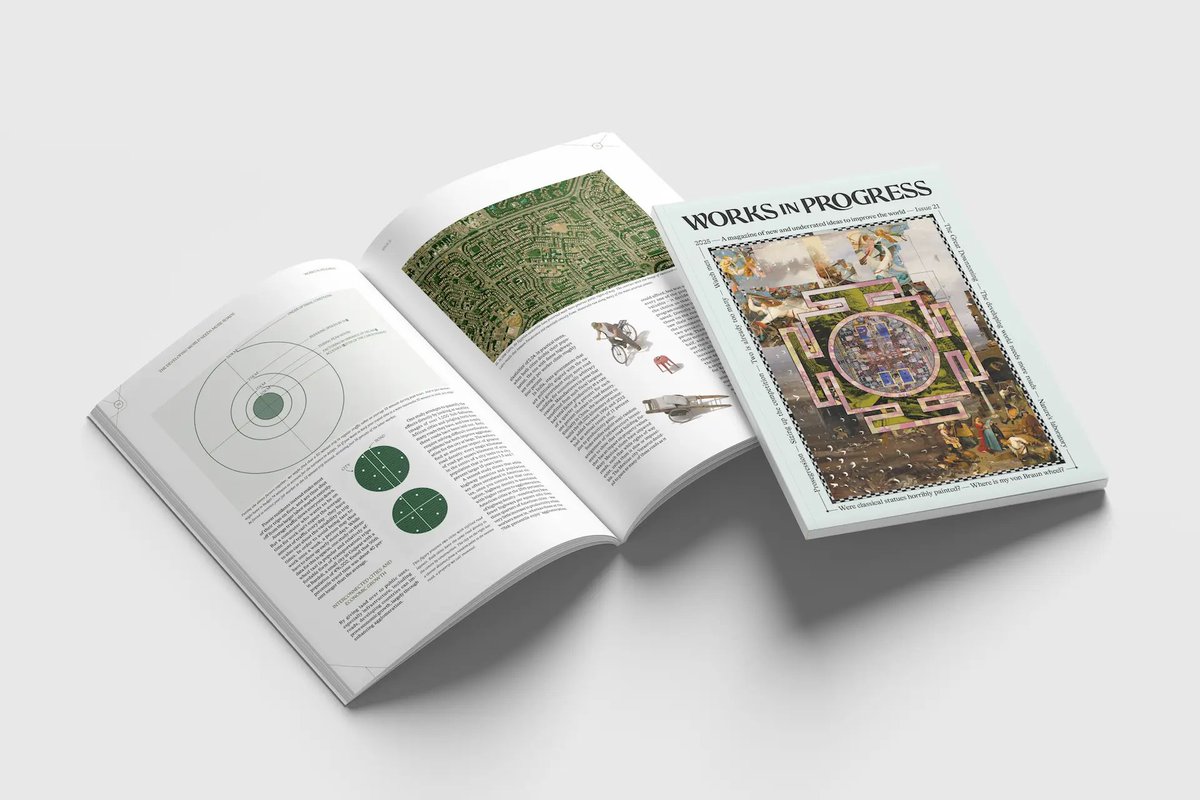
The new issue of Works in Progress is arriving with subscribers this weekend, with articles on ASML, Japan’s railways, instant coffee, curing cancer, and more. To get your copy, as well as invitations to subscriber events, visit: worksinprogress.co/print
Ruxandra Teslo 🧬@RuxandraTeslo

I can't believe how much care goes into the visual design for each article in the print edition of @WorksInProgMag. With @_revoluzia_, I wrote on Egg Freezing: the biology of female reproductive aging, how egg freezing works if done early enough & practical steps towards it.

English
6
7
54
11.9K
Works in Progress retweetledi
Ruxandra Teslo 🧬
Ruxandra Teslo 🧬@RuxandraTeslo·
I can't believe how much care goes into the visual design for each article in the print edition of @WorksInProgMag. With @_revoluzia_, I wrote on Egg Freezing: the biology of female reproductive aging, how egg freezing works if done early enough & practical steps towards it.
Ruxandra Teslo 🧬 tweet mediaRuxandra Teslo 🧬 tweet media
English
5
26
196
27.9K
Works in Progress retweetledi
Ronak Daya
Ronak Daya@RonakDaya·
VERY excited about my @WorksInProgMag physical copy being delivered today! 📖
Ronak Daya tweet media
English
5
3
32
10.7K
Works in Progress retweetledi
Neil Chilson ⤴️⬆️🆙📈 🚀
“Prices are messengers, and it is a persistent feature of human psychology to blame the messenger for bad news.” Love this letter to the editor in the latest @WorksInProgMag. Nice work, Daisy.
Neil Chilson ⤴️⬆️🆙📈 🚀 tweet media
English
1
12
55
7.8K
Works in Progress retweetledi
Ben Southwood
Ben Southwood@bswud·
We have just opened applications for Invisible College 2026, sure to surpass even the excellent standards set in 2025 and 2024. The students on past years have been absolutely outstanding, and they have told us that it made a major difference in their lives. If you have a thirst for knowledge and for improving the world, then apply! worksinprogress.co/invisiblecolle…
Ben Southwood tweet mediaBen Southwood tweet media
English
13
29
123
68.2K
Works in Progress
Works in Progress@WorksInProgMag·
We might be able to stamp out the common cold by treating indoor air like drinking water: something society systematically monitors and disinfects. Germicidal ultraviolet light can kill airborne pathogens to make colds, the flu and coronaviruses much rarer. Listen to The death rays that guard life on WiP Out Loud. Apple podcasts: podcasts.apple.com/gb/podcast/the… Spotify: open.spotify.com/episode/0jO7CX… YouTube: youtube.com/watch?v=7siHHW…
YouTube video
YouTube
English
0
2
27
5.4K
Works in Progress retweetledi
Ben Southwood
Ben Southwood@bswud·
Issue 23 of Works in Progress should arrive with subscribers later this week (or early next). In it, we tackle the big questions: - How does a woman's fertility really decline (and why are we so wrong about it)? - How did Australia actually stop the boats? - How did Britain go from being an early adopter of cheap nuclear power to a place that builds it slower and more expensively than anywhere else? - Was ASML the product of successful industrial strategy? - Why did it take so long to invent the first bus? - Are autonomous vehicles going to cause gridlock on streets? - What makes neotraditional Hindu temples so cool? @pietergaricano, @Aria_Babu and I sat down to give you a sneak preview of all this and MORE coming in the upcoming next issue of our magazine.
English
9
14
80
30.2K
Works in Progress retweetledi
Oscar Sykes
Oscar Sykes@OscarSykes7·
Today most instant coffee is made using spray drying. You spray liquid coffee down a tall tower of hot air, which evaporates the water and leaves dry coffee granules at the bottom. The technique had been used to make milk powder since the early 1900s, but applying it to coffee was more challenging: coffee's natural sugars go sticky at low temperatures, causing the powder to clump into paste when spray dried rather than flowing freely. Max Morgenthaler, a Swiss chemist at Nestlé, found a solution to this issue in the 1930s by mixing the coffee with carbohydrates like maltodextrin before drying. The larger molecules stay solid at higher temperatures, which prevents clumping and lets it dry into free-flowing powder. Nestlé later figured out how to extract those carbohydrates from the coffee itself, giving 100% pure coffee powder.
Oscar Sykes tweet media
Sam Bowman@s8mb

Instant coffee started out as a baked paste of ground coffee, butter and tallow. Unfortunately, the fats went rancid. People have wanted instant coffee for centuries. During the American Civil War, transporting the 12.5 tons of coffee that made up 100,000 soldiers' daily ration was a logistical nightmare. And they still needed to roast, grind, and brew it in the field. Most attempts have had serious drawbacks: - Boiling coffee down to concentrate destroys the flavour. - Dry hot-air dehydration, which is what's used for drying pasta, oxidizes the coffee. - Spray drying, used for dried milk, loses important compounds because molecules in coffee become sticky and clump together at different temperatures. - Freeze drying and flash freezing are expensive and cost several dollars per cup. But we cracked coffee in the end, and it's getting better. New at Works in Progress by @OscarSykes7 and Benjamin Stubbing, the story of how instant coffee became drinkable. worksinprogress.co/issue/a-brief-…

English
5
17
203
32.3K