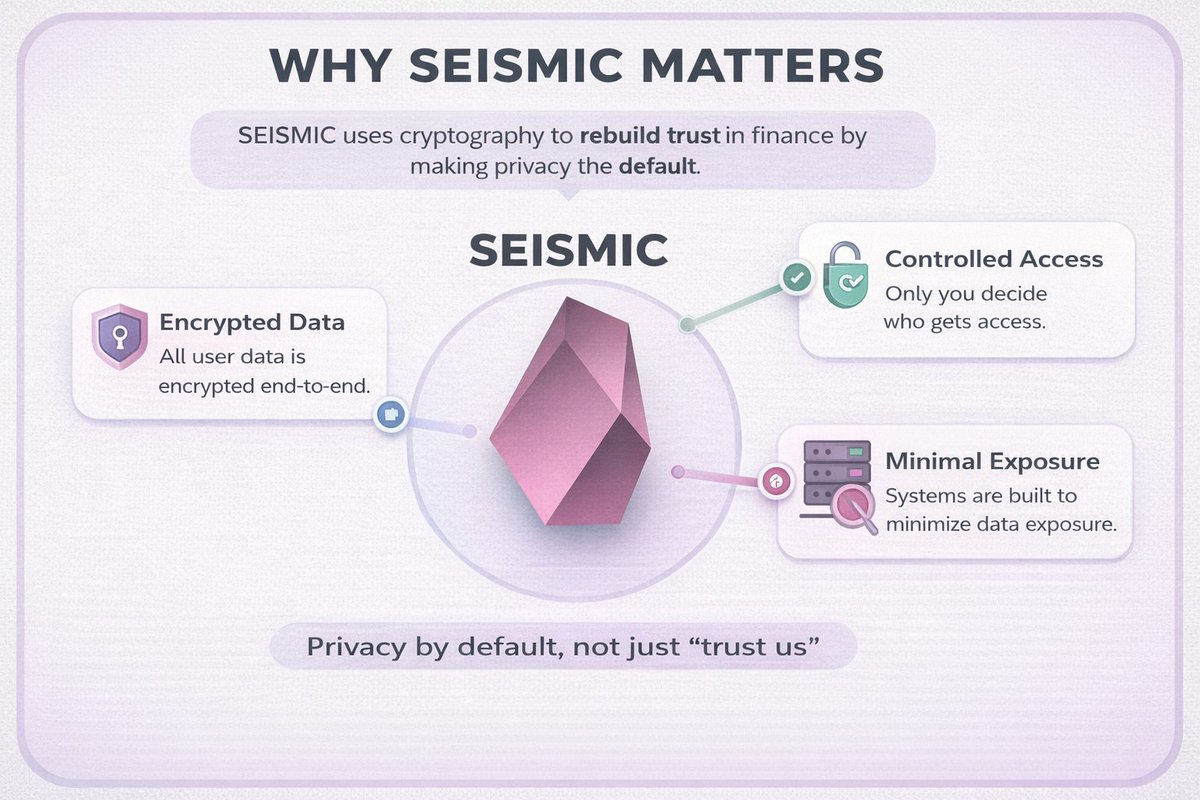
Honestly, what stands out to me about @SeismicSys is that it’s not trying to look flashy or chase hype. It’s focused on something finance has been struggling with for a long time: trust. Most financial systems today still work on the idea that you should just trust institutions with your data trust that they won’t misuse it, leak it, or give too much access to the wrong people. And over the years, we’ve seen how fragile that trust really is. One breach, one insider issue, one bad decision, and everything falls apart. Seismic approaches this problem differently. Instead of saying “trust us,” it’s built so that you don’t need to. Privacy is part of the system by default, not something added later. Data is encrypted and split in a way that limits exposure, so no single party can see more than they should not even insiders. That’s a big deal. What I also like is that Seismic doesn’t treat privacy as something only a few people care about. It understands that without privacy, finance doesn’t really work the way it’s supposed to. Your transactions, your identity, your financial activity these things should be protected automatically, not monitored or exploited behind the scenes. A lot of projects talk about decentralization and security, but Seismic actually focuses on practical, real-world use. It’s not just theory. It’s about building financial infrastructure that people and institutions can actually rely on without constantly worrying about who has access to what. To me, Seismic feels like one of those projects that’s solving the problem at the root, not just covering it up. It’s calm, intentional, and focused on doing things right from the start. In a space full of noise, that kind of approach really stands out. @NoxxW3 @xealistt @heathcliff_eth