Yankees Slut-2

10 posts

Yankees Slut-2

Yankees Slut-2

@yankeesslut

This is Slut’s backup account. Please engage the main account @YankeesSlut

Katılım Mayıs 2022
1 Takip Edilen25 Takipçiler
Yankees Slut-2 retweetledi
Yankees Slut
Yankees Slut@yankeeslite·
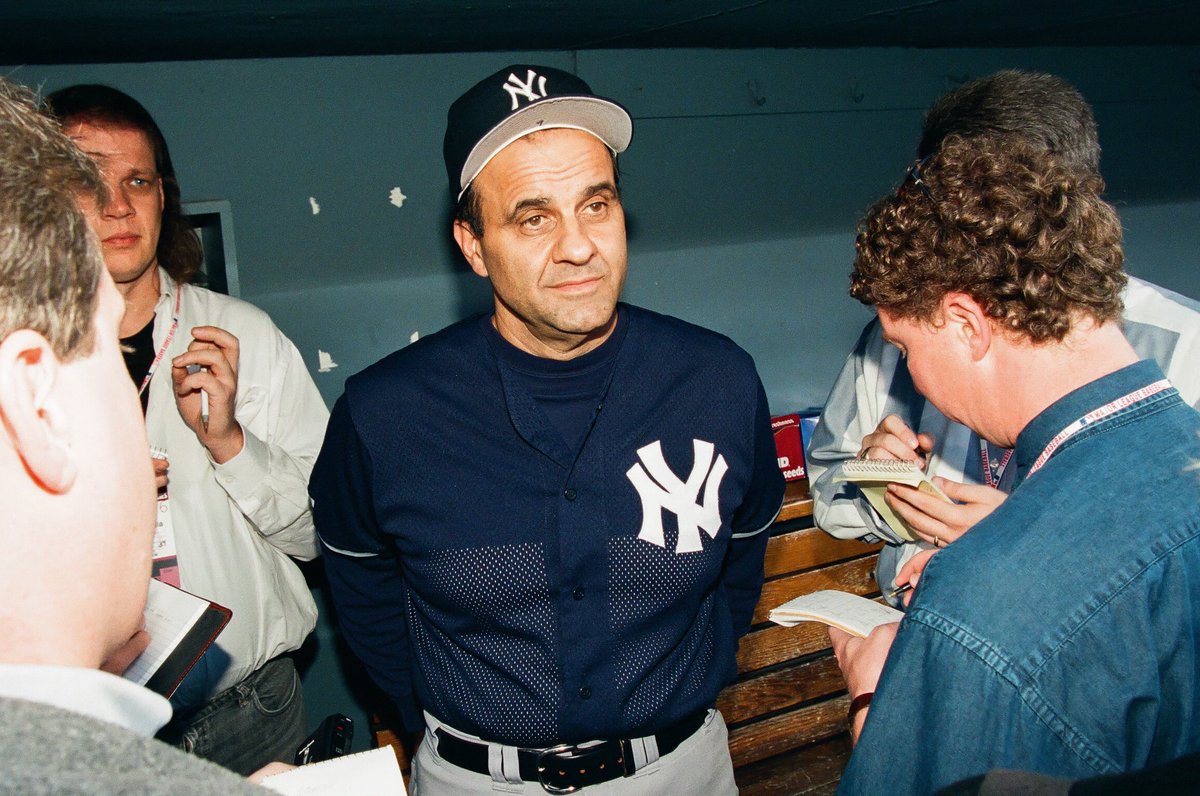
The PR game: examining post-game comments from the Joe Torre era. Does this matter? Today a video is circulating on X of a Derek Jeter postgame interview during a rough stretch of the 2007 season. I was surprised this particular video gained traction, as it frankly read like any generic Aaron Judge presser. In it he talks about “bouncing back tomorrow”, and how a key error led to a big inning. This is typically Judge’s tone: calling himself out where he could have executed better, and “onto the next”. Indeed, the Yankees of old are viewed through rose-colored glasses; the full 1996-2007 Joe Torre tenure is retrospectively characterized as a steady, well-oiled bootcamp. If only their “attitudes” could be superimposed on the current team— they would finally ascend to the promised land. An extra layer of nostalgia has been baked into what was indisputably a unique and historic period. Still, there were some key cultural differences between then and now. I pulled a few quotes from that time which I think are indicative of those differences. I want to highlight them, not with any naive agenda to return to how things were, but to point to key gaps in the current vision. I don’t deify Joe Torre or Derek Jeter, nor believe their success was born out of postgame quotes. The content of these quotes are pretty basic, and could likely be found in-like across teams and across time. What I mean to demonstrate are that the current Yankees do lack these basic elements. Their public comments are not themselves the issue, they are the signal. The issue obviously lies in their associated behavior. October 11th, 2000: ALCS Game 2. The Yankees win 7-1, snapping out of an offensive funk. Luis Sojo: “We haven’t been scoring runs, and guys were starting to worry…there was some tension. Normally we’re joking around on the bench, but there was no joking around today. It was quiet.” Joe Torre: “We’ve been through this before, but still, that human element takes over when everybody tries too hard...you see a bad umpire’s call, guys are jumping up and spinning around. We don’t normally react like that. I think a lot of it was the tension of the situation and the thought of going on the road 0-2.” Loose and relaxed is generally a good thing, particularly in the face of postseason pressure. Still, among group of humans, sometimes tension mounts and you can’t will it away. The contemporary Yankees do a great job of loosening up their baseline, but as a rule, will never concede to collective tension, even when it’s visible. It’s also notable that Torre here regards fixation with bad umpire calls as essentially a coping mechanism. Combativeness over home-plate umpiring is a key behavioral trait of the current team, from the manager through to the players— a sole outlet for their repressed feelings. April 23rd, 2004: The Yankees fall to the Red Sox, 11-2. Derek Jeter: “It’s hard to imagine being worse than we were tonight. Put me at the front of that list.” “You have to beat the best to be the best.” Jeter would probably get retrospective praise here for “holding the team accountable”. I think the notion of enforcing discipline via the media is pretty much a myth. But I am interested in the acknowledgment itself, and the acknowledment the terrible state of things as a psychologically healthy practice. Secondarily, there's a notion of earning the right to be called “the best”, rather than just believing you’re the best regardless of outcomes, in an effort of manifestation. Tangible implications are here. A team committed to an unwavering self-image may not adjust their preparation in the face of defensive miscues... instead chalking those events up to player limitations or acts of chance. June 3rd, 2005: the Yankees are swept by the then-worst team in MLB, Kansas City Royals. Joe Torre: “When you have the ability that we have on this club, I think it’s more an emphasis on our inability to win than somebody else’s ability to win. And I take nothing away from the opposition because I understand how hard it is to play this game. I hoped we could limit it to a two-game losing streak. Now we have to limit it to a five-game losing streak.” A straw-man that often comes up in defense of Boone: “what is he supposed to say? ‘[insert player] is terrible’? ‘The team sucks’? Here, Torre doesn’t target specific players, nor decry his “sh**ty” team. There’s just basic acknowledgement: the result is not acceptable for a roster of that talent. A longer poor streak is a bigger problem than a shorter one. Not every bad spell is necessarily a routine “speed-bump” (particularly an annual 10-20 stretch, for chrissake). Torre is not special, this is basic. Boone (and his larger apparatus) are the idiosyncratic ones. May 29th, 2007. Torres holds a team meeting after a 21-29 start. "I've seen some tentativeness," Torre said. "If there's a word to characterize this whole thing, it's 'frustration.” "We're going to keep rearranging the furniture until we find something that works," he said. "Right now, we don't seem to be blending this thing very well." What is important here (beyond once again, the acknowledgement), is the pledge to make adjustments to correct the acute crisis. This is actually vital on the PR side (a notion which has been lost), but is obviously also tangible. When the tact is: “we’re doing a lot of things well, it’s just about grinding through it”, what adjustments are made? Do the matchups get more aggressive? Do the defensive alignments shift? Does prep work and protocol evolve? I admit, sometimes, that things are going on behind the scenes which are concealed from the media. Sometimes though, it’s very apparent when this is not the case. When words and tangible outcomes are aligned, what else is there to glean? And for the Yankees, slipperiness on the field and in the basepaths (collectively, independent of player personnel or talent), has not been tangibly addressed. In 8 years. First and foremost, it hasn’t even been acknowledged.
Yankees Slut tweet media
English
5
10
56
6.1K
Yankees Slut-2 retweetledi
Yankees Slut
Yankees Slut@yankeeslite·
They wanted it toxic
English
23
283
3K
109K
Yankees Slut-2 retweetledi
Yankees Slut
Yankees Slut@yankeeslite·
Dave Sims calls the best game of young 2025
English
30
150
2.7K
147.4K
Yankees Slut-2 retweetledi
Yankees Slut
Yankees Slut@yankeeslite·
Only Aaron Judge can save the Yankees. In a weekend of baseball that could have revived Party City from bankruptcy, the Yankees’ bats fired on all cylinders. Seven Yankees hitters left the yard, and eight posted a wRC+ above 150. It was a showcase of that ideal team—the deep, dynamic, athletic Yankees who could burn you all over the place. Still, at the center of it all was Judge, who, in three games, drove in 11 runs and won “AL Player of the Week.” In reality, it’s been a lot longer than a week. If not for a broken toe, Judge would be vying for his fourth consecutive MVP. Bonds, Ruth, Williams, Mays. Judge is up there with all of them. He’s a colossal force whose production won’t be matched by a Yankee again for a very long time, if not forever. Judge doesn’t care for torpedoes, but he is the Commanding Officer of Bronx’s submarine—taking his captaincy duties more seriously than any before him and extending his support to everyone. Year in and year out, Judge showed that he could carry any team when he was at his best, which was most of the time. Still, the Yankees tried, in their own way, not to pin all their title hopes on him. They paired him with a twin, Giancarlo Stanton, in ’18. They peppered him with depth in ’19. They rebuilt the other side of the ball in ’20 with the big splash in Cole, and Matt Blake as the operator. Nothing was getting them to the finish line. In ’24, they pulled the only lever left to pull: a superstar psychopath and postseason dynamo in Juan Soto. Every missing piece was accounted for. Together—Stanton, Soto, Cole, and the pitching staff—dragged the Yankees through the 2024 postseason. They dragged them through the ALDS, and the ALCS, and each game of the World Series. All the while, Judge was doing everything possible to drag them in the other direction. The captain was shell-shocked as the team scrambled to extend his opportunities. The fans, for the first time in history, organized unconditional support: standing ovations every at-bat, no matter what. Judge had committed to the fans—leaving dollars on the table to be a Yankee. Everyone tried to will him through. “Sleeping giant has awoken.” Judge broke through in Game 5, and while the task that followed was improbable, it was less so, knowing what he could do. But in an instant, he gave it back. Distracted by a Dodgers runner and trying to do too much, he catalyzed a string of events that blew the project to smithereens. I called his performance “unforgivable.” And it was. The rarest of opportunities—a World Series championship—sat in the Yankees’ hands. The greatest organization in sports hadn’t been this close in 15 years. Had Aaron Judge played to a fraction of his abilities, and not shirked fundamentals at the worst moment, the opportunity would not have slipped. Judge agreed: “Falling short in the World Series will stay with me until I die.” I will always love him, root for him, support him, and be in awe of him. But I can never forgive him for that. So what happened? Why did it play out this way? Does Judge lack the “clutch” gene? How, then, do we account for his .963 career “late & close” OPS, his .946 “high leverage” OPS, and his .994 postseason OPS from 2017–2018? In fact, he is the furthest thing from a natural “choker.” If we examine Judge’s 2024 playoff performance, we can essentially divide each series into two phases: Games 1–3, and Game 4 onward. If we combine all the series (ALDS, ALCS, WS), we get the following split: Games 1–3: .511 OPS Games 4 and beyond: 1.083 OPS Due to the Yankees earning a first-round bye, and due to each series ending “early,” there were extended days off between each round. It was clear that after time off between playoff rounds, Judge had to use the early part of the next series to regain his timing. While he appeared to be “pressing” on top of this, it was obvious the timing cycles were dictating his results far more than any “pressing.” We see further evidence of Judge’s “timing cycles” throughout his career: 2024: Missed final two weeks of Spring Training and posted a .674 OPS over his first 27 games. 2023: Missed two months with a broken toe and posted a .685 OPS in his first 9 games upon returning. 2018: Missed just under two months with a wrist fracture and posted a .675 OPS over the remaining regular season. There have been some instances where Judge immediately performed well after time off, but these timing cycles have been a pattern. It may also be noteworthy that his two best postseason performances (2017, 2018) occurred in years in which NYY was both a wild-card team and subsequently played in series that went the full distance. This meant that “time off” in those runs was kept to a minimum. Aaron Judge has been a master of improving his craft. First, with the profound changes from ’16–’17, resulting from his work with Richard Schenck. Then in the years that followed: improvements to his coverage of the outside slider, improvements to his contact rates, improvements to his spray angles. In 2022, he reached a new threshold. His mechanics became quieter and easier. From there, he entered his prime. I am no mechanics expert. I have no insight as to what extent Judge might be able to make the next necessary “tweak”: reducing his “timing cycles,” and accessing his swing more quickly. Such a tweak is not a regular-season necessity, but come postseason, it would mean everything. The Yankees have done a lot to build a supporting cast around Judge. Hopefully this year, they will come through again. But they can’t finish the job. The “last piece” is no longer external: it’s him.
Yankees Slut tweet media
English
8
8
90
15.4K
Yankees Slut-2 retweetledi
Yankees Slut
Yankees Slut@yankeeslite·
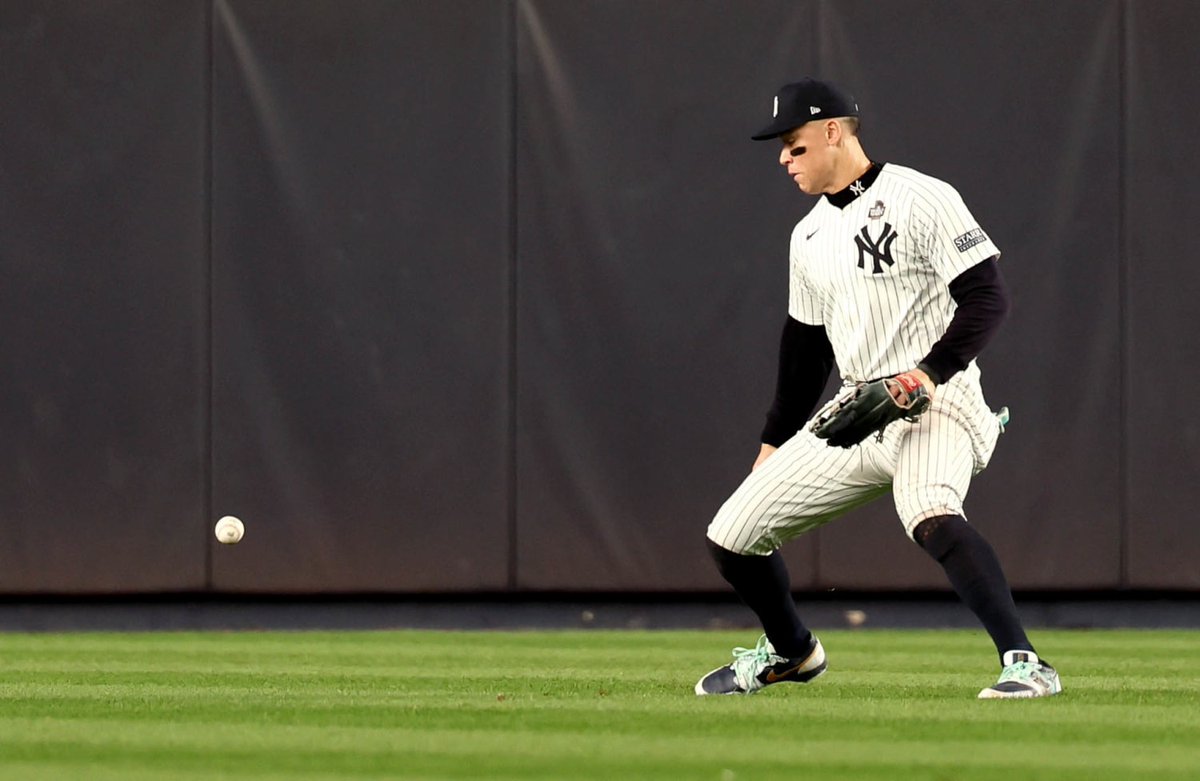
The Yankees embark on a new chapter today. One filled with youth, lightness, and the unknown. They have been a good team for a long time— continually refining a robust process which has kept them in the upper echelon of the standings and leaderboards virtually every season. But one crucial element has continued to elude them. In order to move forward, they will need to look back. World Series. Game 5. 5th inning. The 21 minute, 13 second affair has been replayed ad infinitum. A spectre which will hang over the team for a very long time. Said Brian Cashman of the defensive shortcomings: “I think some of it’s inherent to certain players we have… [but] the big fifth inning that people point to, those players are pretty consistently buttoned up." For Cashman, there were two categories: 1. The “bad” defenders: we attribute their mistakes to their skill level 2. The “good” defenders: we attribute their mistakes to random aberration Regardless of persuasion, I doubt many would disagree with Cashman’s characterizations here. How to fix it? Swap out the bad defenders with better ones, right? What else is there to do? In my mind, there’s a big fallacy that’s being missed. Let’s rewind to October 1st. The postseason is about to begin. With the Yankees the poised AL favorites, the question circulated across social media: “which team presents the biggest threat to the Yankees this October?”. The most popular answer? “The Yankees”. Sure enough, the Yankees’ season ended in an act of self-sabotage. But how did the preponderance of the public predict it? After all, it came down to a succession of “good” defenders making errors— an abject fluke. Not quite. On that fatal October night, as Aaron Judge went to corral that routine line drive, his eyes caught something else: Kike Hernandez dancing toward second base. Judge, sensing an opportunity, moved his gaze off of the ball, and lost it. It wasn’t happenstance— it was a fundamental misstep. Then, Volpe skipped a ball to third— perhaps in an act of chance. Then Cole, as a result of not just the errors but his sudden need for strikeouts, had to muster 38 pitches in the inning. Mookie hits a ground ball to first, and Cole doesn’t cover. His explanation: “By the time the ball got by me, I was not in a position to cover first.” Video replay showed that this wasn’t the case. When the ball got past Cole, he was in motion, in perfect position to cover. When it got to Rizzo, Cole suddenly stopped— pointing to first and asking Rizzo to make the play. Cole, likely awash with exhaustion and relief, had lost his focus. It was an inexcusable lapse, but also a result of a butterfly effect that began with Judge’s microscopic glance. Here’s where Cashman’s account was fallacious: he was engaged in what is called “begging the question”. He starts with a conclusion, (“defense can never be a collective problem”), backwards-rationalizing with his premises (there are only individual “good” and “bad” defenders), making it impossible to falsify his position. After the World Series, Joel Sherman reported that the Dodgers’ scouting team relayed internally that if “they run the bases with purpose and aggression, the Yankees will self-inflict harm”. The three plays of that notorious inning were all catalyzed by the pressure of aggressive baserunning: Hernandez on the first two, and Betts on the third. It was unfortunate that select idiotic, unprofessional, and irrelevant members of the Dodgers’ roster went on to publicly chastise the Yankees, as it served to undermine the important insights from the scouting group. Recall World Series Game 1, when Oswaldo Cabrera, subbed in for defense, missed a crucial play in the 10th. Recall ALCS Game 4, as the Yankees were suddenly feeling the pressure of the Guardians— the ball through Rizzo’s legs, the juggling act by Berti to close it. Recall the myriad of games that the defense blew for Clay Holmes; in particular, July 14th in an important division game— the routine boot by Volpe, Verdugo moving the wrong way and falling to the floor. “Good” defenders disproportionately malfunctioning under pressure. The public saw all this, and said “The Yankees” were the Yankees’ biggest threat. But the public wasn’t fixated on defense, they were fixated on self-sabotage proper. The self-sabotage of a team that would attempt to close a World Series game with a starting pitcher on a 5-week hiatus. Who committed a myriad of baserunning lapses. Who were exposed for their poor communication infrastructure in 2023. Who orchestrated the bizarre JA Happ “surprise attack” in 2020. Who in 2019, broke a 43-year team record for errors in a postseason game. Who’s 2018 ace was unaware of the start time of his own playoff outing, and issued the biggest postseason blowout in franchise history. Errors happen. Huge mess-ups are part of the game. We’ll never forget that moment in 1998 when Chuck Knoblauch griped with the umpire while the ball was live. We can point to key mistakes by all kinds of teams, in all kinds of places. My contention is that the “1998 Chuck Knoblauch” caliber self-sabotage is a disproportionate feature of the Cashman/Boone Yankees operation, which is otherwise very well run from a field management (and increasingly, development) perspective. Until they reconcile with this, it will continue to show up in high-stakes moments. We can’t predict when, or where (plate, bases, field, management), but it will show up somehow, and continue to derail opportunities in otherwise well-performed seasons. It’s not about Hal or Cashman firing people. It’s not about Boone throwing chairs, screaming at players, or benching anyone. It’s not about coaches “teaching” the players fundamentals. Professionals at the highest level of the game don’t need 101 lessons or angry “reminders” of the basics. The issue is that of unconscious pressure-response. The change needs to take place at all levels: beginning with the tone of Steinbrenner. There needs to be maximum communication between departments, and greater cohesion as far as what the departments are prioritizing. The Yankees are adept at constructing and developing individuals, while largely abdicating the collective. To the extent that the “collective” is tended to at the field management level, a strong “relaxed” and “relational” culture has been cultivated, which aids the group most of the time. But this culture has been particularly challenged in moments of adversity or high-stakes. What Boone chooses to say to the public is irrelevant, but his constant obfuscations of adversity are reflective of the underlying culture (which he is a part of, not the instigator of). A culture that pretends pressure and adversity don’t exist will struggle to meet it when it really mounts. When Nestor Cortes talks about who “should” have won the World Series, or Luis Severino talks about which home runs “should” have been hit (2022 ALCS), the statements are innocuous in a vacuum but are reflective of the underlying culture (conflating process with individual outcomes, conflating data with subjective notions like “should have”). The players are as culpable for designing the culture as everyone else— in particular, the captain. The Joel Sherman article touched on Mookie Betts’ routine of incessantly fielding practice balls against the Yankee Stadium wall, to get a perfect feel for the ricochet. This anecdote on its own is not that meaningful (though he did field the ricochets really well). It’s just a small window; a reflection into the larger culture he is a part of and contributing to. The Yankees don’t need silly, performative discipline. For the most part, they should be doing exactly what they’re already doing. They just need an additional point of emphasis —coming from everyone at all levels of the org— on fundamentals, self-accountability, and a viscous hunger to get every edge over an opponent that they can (as opposed to: “keep it as chill as possible, and the talent will shine through”). This needs to inform their department allocations, roster construction, managerial design, team practices, and the day-to-day conversations that take place in the dugout and clubhouse. The Yankees have set themselves up so well. They need to push it over the edge and finish the job. “It’s right in front of them”.
Yankees Slut tweet media
English
14
11
74
10.3K
Yankees Slut-2 retweetledi
Yankees Slut
Yankees Slut@yankeeslite·
Yankees Slut tweet media
ZXX
0
1
8
1.4K
Yankees Slut-2 retweetledi
Yankees Slut
Yankees Slut@yankeeslite·
Allow me to reintroduce myself. My name is Yankees Slut. It’s the 100-year anniversary of our first championship. The next century starts tomorrow.
English
16
14
178
13.3K
Yankees Slut-2
Yankees Slut-2@yankeesslut·
@Mobos6 @YankeesSlut I asked that in response to your original reply. It wasn’t “sarcastic”, it was pointing out the logical contradiction in your original reply There can be an answer why he is on the roster, or why he shouldn’t be But he can’t both be not expected to perform, and on the roster
English
0
0
0
0
Mobo
Mobo@Mobos6·
@YankeesSlut You sarcastically asked why he was on the roster. If it wasn’t sarcastic, then you aren’t as knowledgeable you think you are. He is a better option than Locastro or Gonzalez if he is motivated. I would have kicked his ass to the curb long ago, but the guy can play if motivated
English
1
0
0
0
Yankees Slut
Yankees Slut@yankeeslite·
I don’t say this lightly, Hicks did not make an effort on the fly ball. Looked completely checked out.
English
33
7
257
0
Yankees Slut
Yankees Slut@yankeeslite·
A lot of people seem to think there isn’t a meaningful difference between the Texas version of Joey Gallo, and the Yankees version. Anthony Rizzo is hitting .216 with an .812 OPS. That’s almost to a T, the Texas version of Joey Gallo.
English
21
4
144
0
Yankees Slut-2
Yankees Slut-2@yankeesslut·
@Jack25433732 @YankeesSlut @RobertBrezinski I said his career is a series of good stretches followed by bad stretches. You asked what the good stretches were. I answered your question. You proceeded to block me. When did I say he was “good”? All I did was answer your question.
English
0
0
0
0