Yaugourt.hl

1.2K posts

Yaugourt.hl banner
Yaugourt.hl

Yaugourt.hl

@Yaugourt

Building on @hyperliquidx - @liquidterminal

Hyperliquid Katılım Kasım 2017
4.5K Takip Edilen1.3K Takipçiler
Sabitlenmiş Tweet
Yaugourt.hl
Yaugourt.hl@Yaugourt·
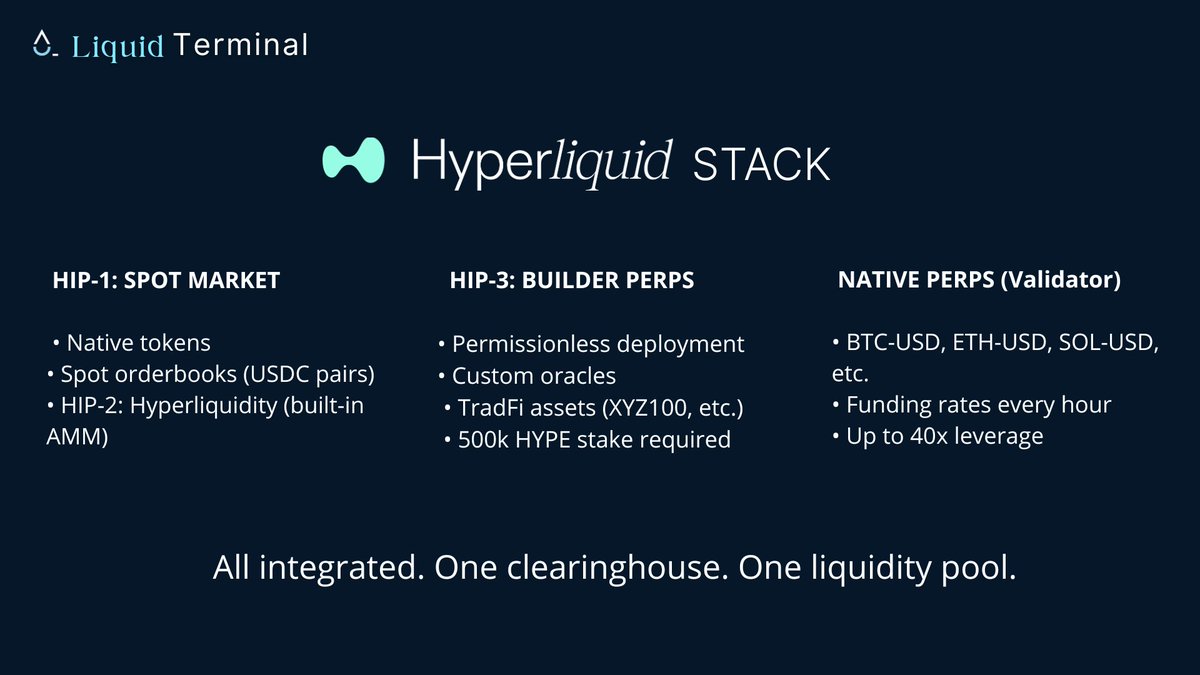
Hyperliquid: The Decentralized Nasdaq Financial infrastructure is evolving. While Nasdaq pioneered electronic trading and orderbook technology, Hyperliquid takes the next step: a neutral, permissionless protocol layer where anyone can build, list, and trade. Same efficiency, different architecture. Think of it as the TCP/IP of finance—infrastructure so fundamental that everything else gets built on top. What is Nasdaq? Before we talk about why Hyperliquid is better, let's understand what Nasdaq actually does: Nasdaq is a platform that provides: • Spot market for stocks (buy and own shares of companies) • Infrastructure for trading (orderbooks, matching engine, clearing) • Listing process for companies (IPOs, standards, compliance) • Derivatives market via partners (futures, options through CME) The limitation? Everything lives under one roof. The protocol, the listing, the access, the frontend, the compliance, all controlled by a single entity. This creates: • Single point of failure • Easy censorship (governments can force delistings) • Centralized control (regulatory pressure can force delistings) • No competition on UX (one interface for all users) • Bundled pricing (can't separate infrastructure costs from compliance costs) Enter Hyperliquid: The Modular Financial Stack Hyperliquid takes a radically different approach by separating the protocol layer from the application layer. The Protocol Layer (Permissionless Infrastructure) HYPERLIQUID L1 (HyperCore) • Native orderbooks (200k orders/sec) • Matching engine (on-chain) • Margin system (cross + isolated) • Liquidation engine • 0.2s median latency Permissionless • Neutral • 24/7 What lives on the protocol: • HIP-1: Spot tokens (like stocks, but tokenized) • Native perps: BTC-USD, ETH-USD, SOL-USD, etc. • HIP-3: Builder-deployed perps (anyone can list derivatives) What doesn't: • KYC/AML enforcement • Token filtering or censorship • Frontend interface • User onboarding The Application Layer (Competitive Frontends) Frontends compete on: • User experience (UX/UI) • Fee structure (builder codes) • Compliance level (KYC vs no-KYC) • Target audience (institutions vs retail vs niche communities) • Features (AI trading assistants, social trading, gamification) Why This Changes Everything 1. True Permissionlessness Nasdaq: Need approval from Nasdaq Inc. to list. Expensive ($50k-$500k+ in fees), slow (months), and requires meeting strict standards. Hyperliquid: Anyone can list via Dutch auction. • HIP-1 tokens: 500 HYPE auction every 31 hours • HIP-3 perps: First 3 assets free, then 500 HYPE auction • No gatekeepers, no approval process, no lobbying needed Example: Want to create a spot for your niche community token? Just win the auction and deploy. Done. 2. Censorship Resistance Nasdaq: Can delist assets based on regulatory pressure, compliance issues, or internal decisions. Once delisted, trading stops entirely. Hyperliquid: Once deployed, tokens and perps stay on-chain forever. The protocol is neutral—it doesn't care what you list or who you are. Important distinction: Frontends can choose to hide certain tokens from their interface, but the tokens remain tradeable on-chain. This is like how Gmail can filter emails, but the email protocol (SMTP) doesn't censor content. 3. Separation of Compliance and Infrastructure This is the genius move that makes Hyperliquid scale to billions of users. Traditional model (Nasdaq): • Protocol + Compliance = One package • Everyone must KYC → High friction → Excludes billions Hyperliquid model: Protocol (neutral) ≠ Compliance (optional at frontend level) Frontend A: Strict KYC → Institutional users Frontend B: No KYC → DeFi natives Frontend C: Light KYC → Retail users Same infrastructure, different compliance levels Why this matters: • Institutions can use compliant frontends (satisfies regulators) • DeFi natives can use permissionless frontends (preserves decentralization) • Everyone trades on the same liquidity pool (network effects) 4. 24/7 Global Markets Nasdaq: • Trading hours: 9:30 AM - 4:00 PM EST • Monday-Friday only • Closed on holidays • Extended hours available but with low liquidity Hyperliquid: • 24/7/365 • No holidays • No "market closed" (even for TradFi assets like XYZ100) • Same liquidity at 3 AM as at 3 PM Innovation: XYZ Perps XYZ100 (Nasdaq-100 index perp) trades 24/7 even when US equity markets are closed. How? Internal pricing mechanism: • When external markets are open: Uses Pyth oracle (CME futures data) • When external markets are closed: Uses 8-hour EMA of mark price + orderbook impact price • Smooth transition when markets reopen This is revolutionary. You can trade exposure to Apple, Microsoft, Tesla at 2 AM on a Sunday. No other platform offers this. 5. Builder Ecosystem via Builder Codes Nasdaq: Limited or no revenue share with third-party interfaces. If you build a trading app that routes orders, you typically make money from subscriptions or payment-for-order-flow, not direct fee sharing from the exchange Hyperliquid: Builder codes let frontends earn a percentage of trading fees. How it works: // User trades 100,000 USDC notional // Base fee: 0.045% = $45 // Builder code: 0.02% = $20 to frontend // Net user fee: 0.065% // Frontend earns revenue directly from facilitating trades This creates a flywheel: 1. Better frontends attract more users 2. More users = more volume = more revenue for frontend 3. More revenue = more resources to improve UX 4. Better UX = more users (repeat) Result: Explosion of innovation at the application layer. We'll see hundreds of specialized frontends, each optimizing for different use cases. 6. Complete Market Stack Hyperliquid isn't just spot or just derivatives—it's everything. Nasdaq ecosystem: • Nasdaq: Spot stocks • CME: Futures and options (separate entity) • CBOE: More options (another separate entity) 7. Performance That Matches (or Beats) CEXs Hyperliquid benchmarks: • Throughput: 200k orders/second (current), millions planned • Latency: 0.2s median, 0.9s p99 (comparable to major CEXs) • Finality: 1 block (<1 second) • Uptime: 99.9%+ All of this, fully on-chain. No off-chain orderbooks, no trusted intermediaries, no shortcuts. 8. Composability with DeFi Nasdaq: Walled garden. If you want to build something that uses Nasdaq data or infrastructure, you need expensive licenses and permissions. Hyperliquid: Open protocol. HyperEVM lets you build anything: Examples: • Lending protocols that use Hyperliquid spot prices for liquidations • Automated trading vaults that rebalance based on funding rates • Prediction markets that settle against Hyperliquid perp prices • Social trading platforms where you copy top traders All permissionless. No approval needed. Real-World Example: XYZ Perps XYZ is the first HIP-3 deployment, and it's already proving the model works. XYZ100 (Nasdaq-100 Index Perp): • Tracks the top 100 non-financial companies on Nasdaq (AAPL, MSFT, NVDA, TSLA, etc.) • Uses Pyth oracle for CME futures prices • Converts futures to spot using cost-of-carry model • 24/7 trading even when US equity markets are closed • Isolated margin only (for now) Why this matters: • First decentralized way to get 24/7 exposure to US equities • Proof that TradFi assets can trade on-chain with robust pricing • Opens the door to thousands more TradFi perps (individual stocks, commodities, forex, indices) What's next for XYZ: • Individual stock perps (AAPL-USD, TSLA-USD, NVDA-USD) • More indices (S&P 500, Dow Jones, Russell 2000) • International equities (Nikkei, DAX, FTSE) • Commodities (gold, oil, natural gas) Why Hyperliquid Wins: The TCP/IP Analogy What TCP/IP did for the internet: • Created a neutral protocol layer (anyone can send packets) • Enabled permissionless innovation (anyone can build apps) • Separated infrastructure from applications (Gmail vs SMTP) • Made the internet censorship-resistant What Hyperliquid does for finance: • Creates a neutral protocol layer (anyone can list and trade) • Enables permissionless innovation (anyone can build frontends) • Separates infrastructure from compliance (protocol vs frontends) • Makes finance censorship-resistant The Trilemma Solution Traditional systems can't achieve all three: Permissionless ▲ ╱ ╼ ╱ ╲ ╱ ╲ ╱ ╲ ╱ ╲ Compliant ──────── Performant Nasdaq: ✅ Compliant (strict KYC/AML) ✅ Performant (low latency) ❌ Permissionless (high barriers to entry) Hyperliquid: ✅ Permissionless (protocol level) ✅ Compliant (frontend level, optional) ✅ Performant (200k orders/sec, <0.2s latency) This is the breakthrough. By separating the layers, Hyperliquid solves the trilemma. What This Means for You If you're a trader: • Access to any asset, any time, from anywhere • Choose your frontend based on your needs (KYC vs no-KYC, fees, UX) • Trade with confidence (all transactions on-chain, auditable) If you're a builder: • Free infrastructure (orderbooks, matching engine, clearing) • Monetize via builder codes (earn fees from trades) • Focus on product, not infrastructure • Launch fast, iterate quickly If you're a project: • Permissionless listing (no gatekeepers) • Guaranteed liquidity (HIP-2 Hyperliquidity) • Exposure across all frontends • No politics, just auction price Nasdaq is a company that controls a trading platform. Hyperliquid is a protocol that enables infinite trading platforms. This isn't just a decentralized version of Nasdaq. It's what Nasdaq would look like if it were built from first principles in 2025, with everything we've learned about the internet, open protocols, and permissionless innovation. The future of finance isn't one platform to rule them all. It's a neutral infrastructure layer where thousands of platforms compete to serve users better. That infrastructure layer is Hyperliquid. Sources: docs.trade.xyz/about-trade-xy… hyperliquid.gitbook.io/hyperliquid-do… listingcenter.nasdaq.com cmegroup.com/markets/equiti…
Yaugourt.hl tweet mediaYaugourt.hl tweet mediaYaugourt.hl tweet media
English
11
31
190
10.3K
Yaugourt.hl
Yaugourt.hl@Yaugourt·
gLiqud There are no words to describe how the last days were. There is no second best. Back to work, back to contributing to the house of all finance. Thank you hyperFamily. Hyperliquid.
English
1
0
33
706
Yaugourt.hl retweetledi
sleepy.pika.hl
sleepy.pika.hl@sleepypikapika·
3/ @Yaugourt’s Discoveries on HIP-4 V2 Smart Contract → Yaugourt uncovers reverse-engineering findings on HIP-4 V2, with upgrades like ReentrancyGuard → HIP-4 enables collateralized outcome trading, boosting HYPE by 10-14% → V2 improves claim mechanics with Merkle proofs
Yaugourt.hl@Yaugourt

Update on HIP-4, V2 contract found. After posting the V1 research, @androolloyd and I kept digging. He reverse-engineered a second contract deployed at genesis by the same team wallet. V2: 0x6d86b21e853758F5719408633e6BcB2cfd50cf07 Team wallet: 0xe21c78037329d06fe0d6fefc4221aaa67cb0d135 Full bytecode decompiled, Solidity reconstructed. 24/24 function selectors verified against on-chain bytecode. Important: All live prediction markets currently trading on HyperCore are linked to the V1 contract, NOT V2. V2 has no active markets yet. It exists on-chain at genesis but appears unused so far. What changed: Security V1 had no protection. V2 adds the full OpenZeppelin stack: Ownable2Step (2-phase ownership transfer), ReentrancyGuard on every financial function, Pausable as a circuit breaker. Claim system reworked, V1 leaf: hash(contestId, sideId, address). V2 leaf: hash(index, recipient, amount). Payout amounts are now inside the Merkle proof. Enables ranked payouts, weighted rewards, not just proportional splits. Bitmap tracking instead of mappings, cheaper gas. Fee model V1: Hardcoded 0.9% + sweepUnclaimed takes everything. V2: admin publishes a rewardPool with the Merkle root, withdraws precise amounts via withdrawPlatformFee. Fee can vary per contest. Deposit now takes a deadline param. Protection against stale mempool txs. Same: Same owner, same genesis, HYPE only, renounce disabled, zero interaction with CoreWriter or precompiles. Also cracked V1's mystery selector 0xb2447e34, it was withdrawPlatformFee all along. V2 research → liquidterminal.xyz/hip4/home Credit @androolloyd for the V2 decompilation 🤝 Hyperliquid

English
1
1
1
113
Yaugourt.hl
Yaugourt.hl@Yaugourt·
@crestalblue_ Classic HL move, they always ship before they document. Most HIPs were documented retroactively. But this is the first time they're doing it with an EVM contract, so it's a new level of digging.
English
0
0
1
14
Yaugourt.hl
Yaugourt.hl@Yaugourt·
Yesterday I posted about HIP4 being the first HIP to use HyperEVM. Full research → liquidterminal.xyz/hip4/home HIP4 has no official documentation. No verified source. No ABI. So we reverse-engineered the contract from bytecode and calldata on testnet. What we mapped: → Full reconstructed ABI (selectors, signatures, access control) → Every event (DepositReceived, Claimed, ContestCreated, ContestFinalized, MerkleRootPublished) → All revert strings mined from bytecode → Storage layout (owner, mappings, initialization flags) → Complete contest lifecycle: createContest → deposit → publishMerkleRoot → claim → sweepUnclaimed → Bridge architecture L1↔EVM (asset index formula, outcome token mapping) → Real decoded testnet transactions → JS + Python code examples Some findings: - Pre-deployed at genesis, not a standard deployment - renounceOwnership always reverts, admin is permanent by design - Merkle-based claims, 0.9% platform fee on reward pool - Three market types: custom, priceBinary, recurring liquidterminal.xyz/hip4/home Testnet only. This is v1, early test from the team, raw design, and some things might be off. Nothing is final. If you spot errors or have insights, feedback is very much appreciated. Hyperliquid.
Yaugourt.hl tweet media
English
22
29
218
92.8K
Yaugourt.hl retweetledi
Kinetiq
Kinetiq@Kinetiq_xyz·
HIP-4
QST
59
42
537
30.5K
Yaugourt.hl retweetledi
HypurrCollective.hl 🐱
HIP-4 CODED.
Yaugourt.hl@Yaugourt

Update on HIP-4, V2 contract found. After posting the V1 research, @androolloyd and I kept digging. He reverse-engineered a second contract deployed at genesis by the same team wallet. V2: 0x6d86b21e853758F5719408633e6BcB2cfd50cf07 Team wallet: 0xe21c78037329d06fe0d6fefc4221aaa67cb0d135 Full bytecode decompiled, Solidity reconstructed. 24/24 function selectors verified against on-chain bytecode. Important: All live prediction markets currently trading on HyperCore are linked to the V1 contract, NOT V2. V2 has no active markets yet. It exists on-chain at genesis but appears unused so far. What changed: Security V1 had no protection. V2 adds the full OpenZeppelin stack: Ownable2Step (2-phase ownership transfer), ReentrancyGuard on every financial function, Pausable as a circuit breaker. Claim system reworked, V1 leaf: hash(contestId, sideId, address). V2 leaf: hash(index, recipient, amount). Payout amounts are now inside the Merkle proof. Enables ranked payouts, weighted rewards, not just proportional splits. Bitmap tracking instead of mappings, cheaper gas. Fee model V1: Hardcoded 0.9% + sweepUnclaimed takes everything. V2: admin publishes a rewardPool with the Merkle root, withdraws precise amounts via withdrawPlatformFee. Fee can vary per contest. Deposit now takes a deadline param. Protection against stale mempool txs. Same: Same owner, same genesis, HYPE only, renounce disabled, zero interaction with CoreWriter or precompiles. Also cracked V1's mystery selector 0xb2447e34, it was withdrawPlatformFee all along. V2 research → liquidterminal.xyz/hip4/home Credit @androolloyd for the V2 decompilation 🤝 Hyperliquid

English
1
3
26
4.1K
Yaugourt.hl
Yaugourt.hl@Yaugourt·
Update on HIP-4, V2 contract found. After posting the V1 research, @androolloyd and I kept digging. He reverse-engineered a second contract deployed at genesis by the same team wallet. V2: 0x6d86b21e853758F5719408633e6BcB2cfd50cf07 Team wallet: 0xe21c78037329d06fe0d6fefc4221aaa67cb0d135 Full bytecode decompiled, Solidity reconstructed. 24/24 function selectors verified against on-chain bytecode. Important: All live prediction markets currently trading on HyperCore are linked to the V1 contract, NOT V2. V2 has no active markets yet. It exists on-chain at genesis but appears unused so far. What changed: Security V1 had no protection. V2 adds the full OpenZeppelin stack: Ownable2Step (2-phase ownership transfer), ReentrancyGuard on every financial function, Pausable as a circuit breaker. Claim system reworked, V1 leaf: hash(contestId, sideId, address). V2 leaf: hash(index, recipient, amount). Payout amounts are now inside the Merkle proof. Enables ranked payouts, weighted rewards, not just proportional splits. Bitmap tracking instead of mappings, cheaper gas. Fee model V1: Hardcoded 0.9% + sweepUnclaimed takes everything. V2: admin publishes a rewardPool with the Merkle root, withdraws precise amounts via withdrawPlatformFee. Fee can vary per contest. Deposit now takes a deadline param. Protection against stale mempool txs. Same: Same owner, same genesis, HYPE only, renounce disabled, zero interaction with CoreWriter or precompiles. Also cracked V1's mystery selector 0xb2447e34, it was withdrawPlatformFee all along. V2 research → liquidterminal.xyz/hip4/home Credit @androolloyd for the V2 decompilation 🤝 Hyperliquid
Yaugourt.hl@Yaugourt

Yesterday I posted about HIP4 being the first HIP to use HyperEVM. Full research → liquidterminal.xyz/hip4/home HIP4 has no official documentation. No verified source. No ABI. So we reverse-engineered the contract from bytecode and calldata on testnet. What we mapped: → Full reconstructed ABI (selectors, signatures, access control) → Every event (DepositReceived, Claimed, ContestCreated, ContestFinalized, MerkleRootPublished) → All revert strings mined from bytecode → Storage layout (owner, mappings, initialization flags) → Complete contest lifecycle: createContest → deposit → publishMerkleRoot → claim → sweepUnclaimed → Bridge architecture L1↔EVM (asset index formula, outcome token mapping) → Real decoded testnet transactions → JS + Python code examples Some findings: - Pre-deployed at genesis, not a standard deployment - renounceOwnership always reverts, admin is permanent by design - Merkle-based claims, 0.9% platform fee on reward pool - Three market types: custom, priceBinary, recurring liquidterminal.xyz/hip4/home Testnet only. This is v1, early test from the team, raw design, and some things might be off. Nothing is final. If you spot errors or have insights, feedback is very much appreciated. Hyperliquid.

English
11
19
139
21.4K
Yaugourt.hl retweetledi
HypurrCorea.hl
HypurrCorea.hl@hypurrcorea·
What happened across the Hyperliquid ecosystem on Mar 24 @tradexyz reached new all-time highs in trading volume, open interest, and unique traders x.com/tradexyz/statu… @Markets_xyz is opening up beta access to its mobile app x.com/Markets_xyz/st… @hydromancerxyz is providing free historical Hyperliquid market data, including HIP-3 trades and trader positions x.com/hydromancerxyz… @HyperionDeFi has a new HAUS agreement with @silhouette_ex for shielded trading x.com/HyperionDeFi/s… x.com/silhouette_ex/… @HypeStrat announces milestone with launch of options trading on PURR common stock prnewswire.com/news-releases/… @hyperlendx MAINNET is now live on HyperliquidEVM x.com/hyperlendx/sta… @Yaugourt provides research on HIP4 reverse engineering x.com/Yaugourt/statu… Hyperliquid
Markets@Markets_xyz

Markets mobile app is now in beta. We're opening up limited slots to a focused group of traders. The first users will get a free trade, on us. Comment "Markets" if you have $1m+ volume on Hyperliquid.

English
1
4
7
344
Ramen🍜
Ramen🍜@Ramen_HL·
@Yaugourt @0xNairolf @androolloyd I think it’s an either/or for EVM/Core as different venues for different types of contracts Without CoreWriter and Core exclusively being binary outcomes, i think EVM might be its own siloed venue for complex outcomes / multi wager events Hyperliquid is so awesome
English
1
0
2
148
nairolf
nairolf@0xNairolf·
so, hip-4 in simple terms: 1. someone creates a market with x outcomes 2. x outcomes = x different tokens 3. to bet, you either trade the outcome token on hyperliquid (the exchange) or deposit hype directly into the outcome you believe in via the smart contract 4. arbitrage keeps token prices in line with the odds 5. the market ends 6. the admin posts the winning result onchain as a merkle root 7. winners claim their share of the prize pool (minus 0.9% fee)
nairolf tweet media
Yaugourt.hl@Yaugourt

Yesterday I posted about HIP4 being the first HIP to use HyperEVM. Full research → liquidterminal.xyz/hip4/home HIP4 has no official documentation. No verified source. No ABI. So we reverse-engineered the contract from bytecode and calldata on testnet. What we mapped: → Full reconstructed ABI (selectors, signatures, access control) → Every event (DepositReceived, Claimed, ContestCreated, ContestFinalized, MerkleRootPublished) → All revert strings mined from bytecode → Storage layout (owner, mappings, initialization flags) → Complete contest lifecycle: createContest → deposit → publishMerkleRoot → claim → sweepUnclaimed → Bridge architecture L1↔EVM (asset index formula, outcome token mapping) → Real decoded testnet transactions → JS + Python code examples Some findings: - Pre-deployed at genesis, not a standard deployment - renounceOwnership always reverts, admin is permanent by design - Merkle-based claims, 0.9% platform fee on reward pool - Three market types: custom, priceBinary, recurring liquidterminal.xyz/hip4/home Testnet only. This is v1, early test from the team, raw design, and some things might be off. Nothing is final. If you spot errors or have insights, feedback is very much appreciated. Hyperliquid.

English
13
5
132
16.4K
Henrik
Henrik@Henrik_on_HL·
Most people view Hyperliquid upgrades in isolation. That’s a mistake. Jeff’s vision is composability at the core: HIP-1 → assets HIP-2 → liquidity HIP-3 → builder-deployed perps HIP-4 → outcome markets (prediction + non-linear payoffs) > HyperEVM → programmability > Portfolio Margin → shared risk engine > USDH → settlement layer People can hedge outcome positions with perps. With outcome markets, traders can express views without liquidation risk (which is huge). Through HIP-3, builders can spin up new markets that instantly tap into existing liquidity. And with HyperEVM, you can build strategies on top that tie everything together. Most people still look at this and see features being shipped over time. But it’s not a product roadmap. It’s a system coming online piece by piece. The house of all finance. Hyperliquid
Henrik tweet media
English
7
14
102
4.8K
Yaugourt.hl
Yaugourt.hl@Yaugourt·
Nope, no verified source for either contract. No explorer on testnet EVM so nothing to verify against. V1 was my own bytecode analysis + selector brute-force. V2 was decompiled by @androolloyd using heimdall-rs, then reconstructed into clean Solidity. Compiles with solcjs 0.8.34, all 24 selectors match on-chain. Reconstructed, not official.
English
1
0
4
31
emo.eth
emo.eth@emo_eth·
@Yaugourt @androolloyd so no solidity source either aside from heimdall reconstruction (which probably doesn't compile), i assume?
English
1
0
2
22
Yaugourt.hl
Yaugourt.hl@Yaugourt·
@emo_eth @androolloyd We messed up the wording: “Solidity verified” was wrong, there’s no explorer-style verification for that contract. We’ve fixed the copy. Sorry for the confusion.
English
1
0
2
28
emo.eth
emo.eth@emo_eth·
@androolloyd @Yaugourt site says v2 solidity is verified + in repo - verified how, just runtime bytecode? (is there a hyperevm testnet explorer i don't know about? lol) - any link to the repo?
English
1
0
4
50
Yaugourt.hl
Yaugourt.hl@Yaugourt·
@androolloyd Appreciate that, wouldn't have gotten to V2 without your decompilation work today. 🫶 The heimdall-rs team deserves it fr, absolute cheat code for bytecode analysis.
English
0
0
5
342
androolloyd.hl
androolloyd.hl@androolloyd·
@Yaugourt You paved the way champ. Also shoutout to the heimdall-rs devs.
English
6
0
9
523
Freak ⛳️
Freak ⛳️@ThatAIFreak·
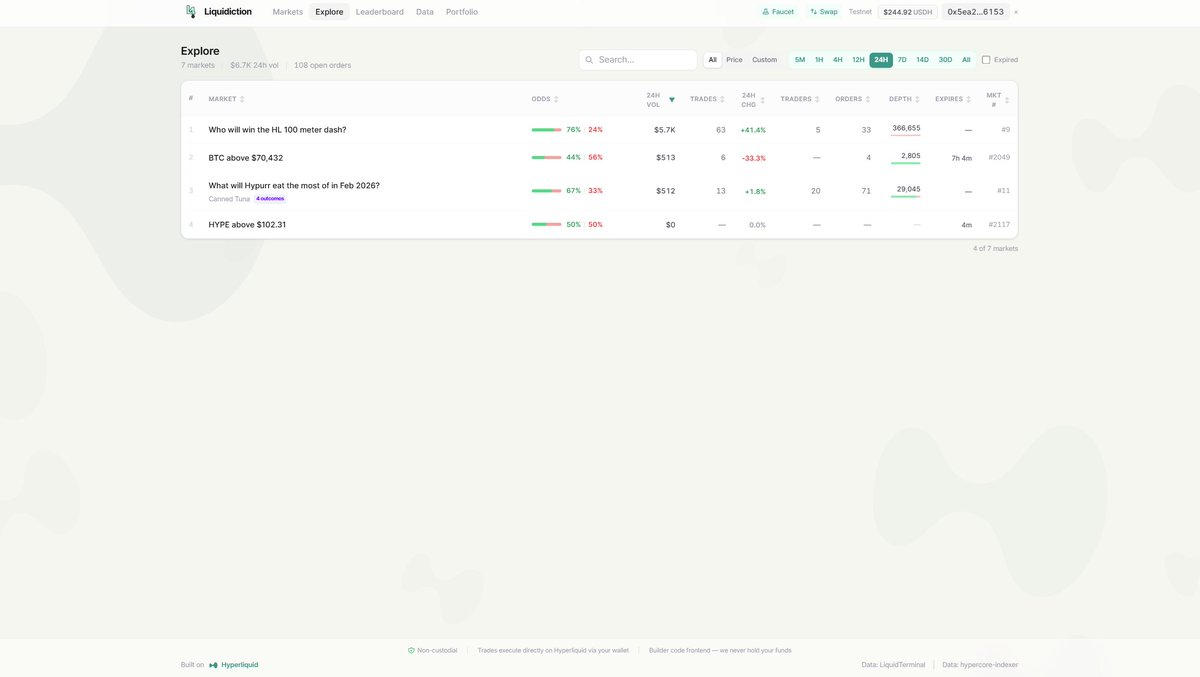
Liquidiction is live on testnet Built a prediction market frontend on @HyperliquidX HIP-4 Started as something for myself to view markets more easily, and decided to ship it for everyone What it does: - Browse, analyze & trade all HIP-4 prediction markets - Live price feeds + order depth for every market - Underlying asset charts (BTC, HYPE) with strike price overlays - Connect any wallet through Privy - Claim 1,000 tUSDC daily from the faucet in the nav - Worth using on testnet now (daily), max your on-chain activity, you never know when the next points season hits :) Mainnet the second HIP-4 goes live Want features? Reply or DM me as I'd like this to be community-inspired Shoutout @0xExoMonk and @Yaugourt for their documentation they tweeted out, linked it in the footer Please try to break it so I can catch all the flaws now while it's on testnet liquidiction.xyz Hyperliquid
Freak ⛳️ tweet mediaFreak ⛳️ tweet mediaFreak ⛳️ tweet media
English
20
15
96
14.3K
Yaugourt.hl
Yaugourt.hl@Yaugourt·
Yaugourt.hl@Yaugourt

Update on HIP-4, V2 contract found. After posting the V1 research, @androolloyd and I kept digging. He reverse-engineered a second contract deployed at genesis by the same team wallet. V2: 0x6d86b21e853758F5719408633e6BcB2cfd50cf07 Team wallet: 0xe21c78037329d06fe0d6fefc4221aaa67cb0d135 Full bytecode decompiled, Solidity reconstructed. 24/24 function selectors verified against on-chain bytecode. Important: All live prediction markets currently trading on HyperCore are linked to the V1 contract, NOT V2. V2 has no active markets yet. It exists on-chain at genesis but appears unused so far. What changed: Security V1 had no protection. V2 adds the full OpenZeppelin stack: Ownable2Step (2-phase ownership transfer), ReentrancyGuard on every financial function, Pausable as a circuit breaker. Claim system reworked, V1 leaf: hash(contestId, sideId, address). V2 leaf: hash(index, recipient, amount). Payout amounts are now inside the Merkle proof. Enables ranked payouts, weighted rewards, not just proportional splits. Bitmap tracking instead of mappings, cheaper gas. Fee model V1: Hardcoded 0.9% + sweepUnclaimed takes everything. V2: admin publishes a rewardPool with the Merkle root, withdraws precise amounts via withdrawPlatformFee. Fee can vary per contest. Deposit now takes a deadline param. Protection against stale mempool txs. Same: Same owner, same genesis, HYPE only, renounce disabled, zero interaction with CoreWriter or precompiles. Also cracked V1's mystery selector 0xb2447e34, it was withdrawPlatformFee all along. V2 research → liquidterminal.xyz/hip4/home Credit @androolloyd for the V2 decompilation 🤝 Hyperliquid

ZXX
0
0
3
379
Yaugourt.hl
Yaugourt.hl@Yaugourt·
A v2 HIP-4 contract has been found on hyperEVM. Update incoming. @androolloyd is goated
English
6
5
84
3.8K
Yaugourt.hl
Yaugourt.hl@Yaugourt·
Yaugourt.hl@Yaugourt

Update on HIP-4, V2 contract found. After posting the V1 research yesterday, @androolloyd and I kept digging. He reverse-engineered a second contract deployed at genesis by the same team wallet. V2: 0x6d86b21e853758F5719408633e6BcB2cfd50cf07 Team wallet: 0xe21c78037329d06fe0d6fefc4221aaa67cb0d135 Full bytecode decompiled, Solidity reconstructed. 24/24 function selectors verified against on-chain bytecode. Important: All live prediction markets currently trading on HyperCore are linked to the V1 contract, NOT V2. V2 has no active markets yet. It exists on-chain at genesis but appears unused so far. What changed: Security V1 had no protection. V2 adds the full OpenZeppelin stack: Ownable2Step (2-phase ownership transfer), ReentrancyGuard on every financial function, Pausable as a circuit breaker. Claim system reworked, V1 leaf: hash(contestId, sideId, address). V2 leaf: hash(index, recipient, amount). Payout amounts are now inside the Merkle proof. Enables ranked payouts, weighted rewards, not just proportional splits. Bitmap tracking instead of mappings, cheaper gas. Fee model V1: Hardcoded 0.9% + sweepUnclaimed takes everything. V2: admin publishes a rewardPool with the Merkle root, withdraws precise amounts via withdrawPlatformFee. Fee can vary per contest. Deposit now takes a deadline param. Protection against stale mempool txs. Same: Same owner, same genesis, HYPE only, renounce disabled, zero interaction with CoreWriter or precompiles. Also cracked V1's mystery selector 0xb2447e34, it was withdrawPlatformFee all along. V2 research → liquidterminal.xyz/hip4/home Credit @androolloyd for the V2 decompilation 🤝 Hyperliquid

QME
0
0
0
54