Show, Don’t Tell. 🧠
Can a text-to-image model reason during generation without turning every intermediate thought into text?
This is the question behind LatentMorph, an ICML 2026 work our team contributed to on implicit latent reasoning for image generation.
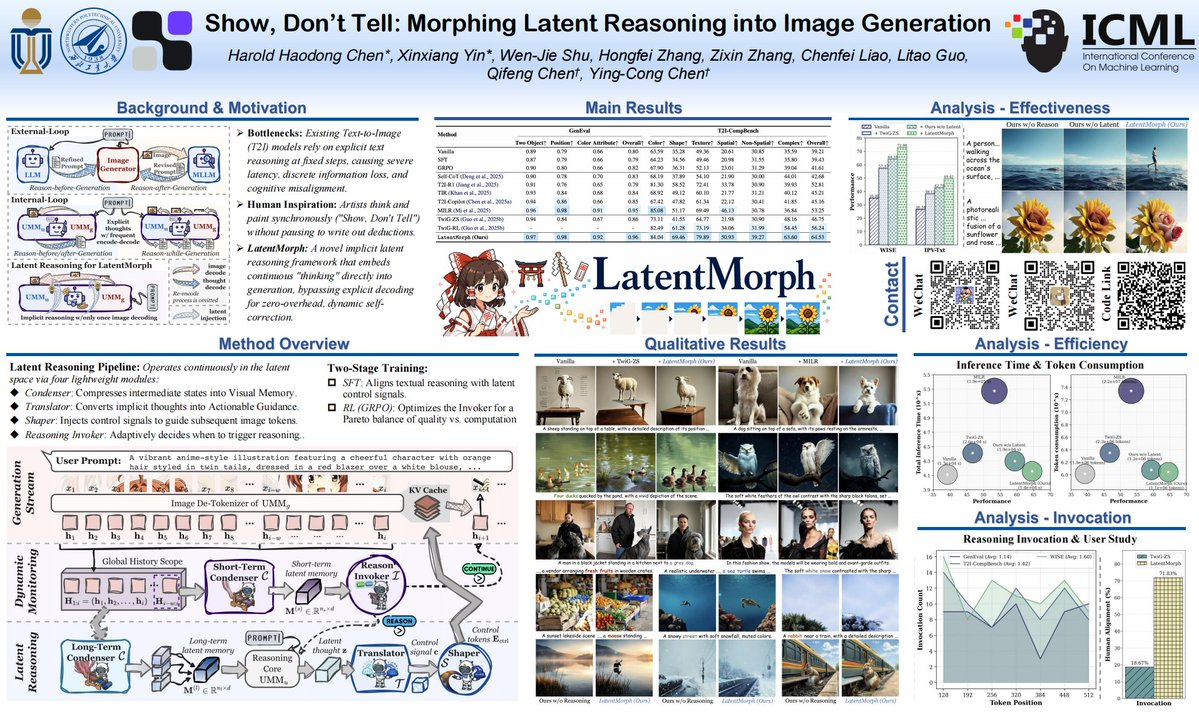
Most reasoning-augmented T2I methods rely on explicit thoughts: intermediate reasoning is decoded into text, then re-encoded back into the generation process.
This creates a bottleneck:
• visual information can be lost
• decode–encode loops add latency
• fixed-step reasoning does not match the dynamics of visual creation
LatentMorph keeps reasoning in continuous latent space instead. ✨
It monitors the autoregressive generation stream, invokes reasoning only when needed, and injects latent guidance back into later image token prediction.
Core components:
🧩 Condenser
compresses intermediate states into compact visual memory
🔁 Translator
maps latent thoughts into generation-compatible guidance
🎛️ Shaper
injects control signals into the generator’s KV cache
⚡ RL-trained Invoker
adaptively decides when reasoning should be triggered
On Janus-Pro, LatentMorph reports:
📈 +16.0% on GenEval
📈 +25.3% on T2I-CompBench
📈 +15.6% / +11.3% over explicit reason-while-generation on WISE and IPV-Txt
⏱️ 44.3% less inference time
🪙 51.0% lower token consumption
🧠 71.8% alignment with human reasoning-invocation preferences
The takeaway: for visual generation, reasoning does not always need to be verbalized.
LatentMorph shows that latent thoughts can support more adaptive, efficient, and cognitively aligned text-to-image generation.
arXiv: 2602.02227
#ICML2026 #GenerativeAI #ComputerVision #TextToImage #MultimodalAI #AIResearch


English