

Christopher
694 posts

Christopher
@Z_x92
Life’s short, make it sweet. Adventurer. Dreamer. Always chasing new experiences. 🚀 Catch me at the beach or the next concert
California Katılım Mart 2013
140 Takip Edilen38 Takipçiler

@OIdmanBallsacks Are you expecting that 'pop' to happen the moment the opening bell rings, or after the first quarterly earnings report proves the bulls right?
English

@Z_x92 When it pops deep inside their anus and obliterates them, as always.
English

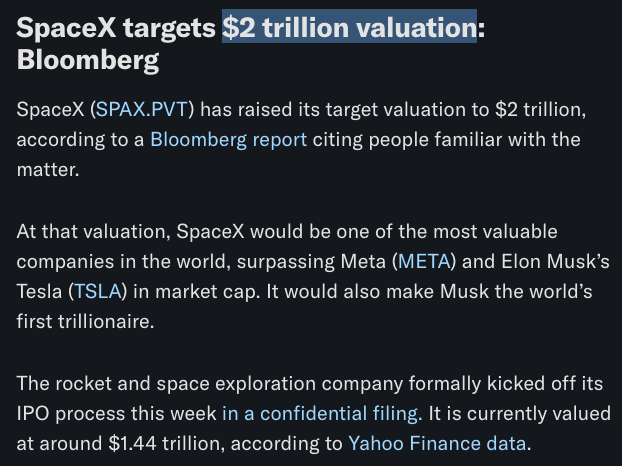
@doongyidaddy Since you focus on forward estimates, how are you factoring in the potential 'Starshield' defense revenue for SpaceX? It’s arguably the hardest part to model but could be the highest-margin segment of the whole business
English

@Z_x92 I buy based on forward looking estimates and fundamentals. I TRY not to look at charts at all. It’s just like reading a crystal ball imo.
English
Christopher retweetledi
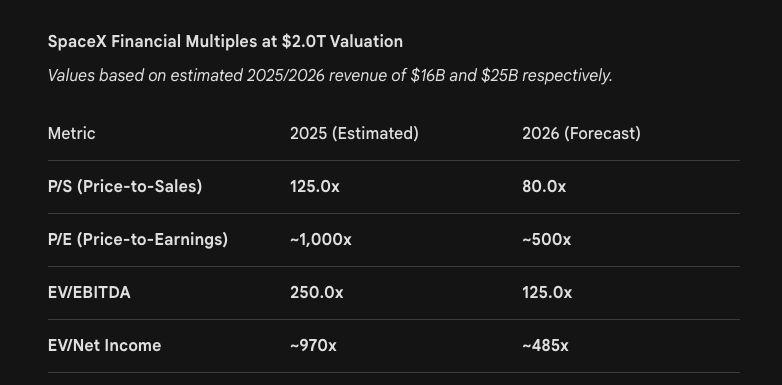
SpaceX trying to go public at 80x forward sales, 500x forward earnings, and 125x forward EV/EBITDA multiple
English
Christopher retweetledi

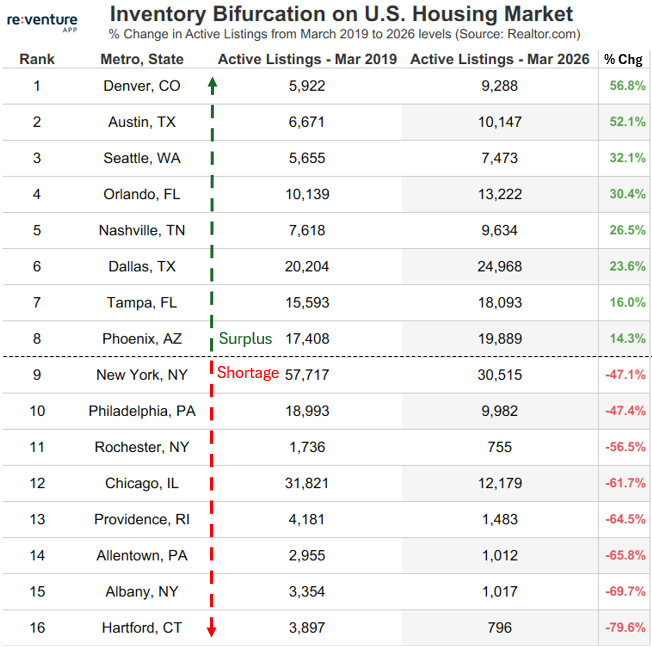
There is massive inventory bifurcation in the U.S. Housing Market right now.
Former boomtowns like Denver, Austin, Nashville, and Tampa are now overflowing with surplus listings.
Prices are now dropping in these markets due to high inventory (+15 to 50% above 2019) combined with lower demand and overbuilding.
On the contrary, in America's Northeast/Midwest Rust Belt, inventory is still in a massive shortage.
With listings down 50-70% in Chicago, Albany, and Hartford.
There are still bidding wars in these areas, and prices are still going up.
Know the truth about where your housing market is heading on reventure.app.
English
Christopher retweetledi

I've made multi-millions investing in hot industries and riding these momentum trades.
Last year, I publicly called out Bitcoin mining, AI/HPC, and defense - $IREN $CIFR $BITF $ONDS and more.
Cleared 6-10x trades on most of those.
Then again with defense towards the start of 2026 - $AMPX $RCAT $ONDS $OSS $UMAC and more.
Positioned in oil weeks before the war escalated. Told everyone it was a near-perfect hedge and perfect wave to ride - $OXY $VLO $CVX $BATL and more.
Those who followed made a boat-load of money.
Now I'm telling you guys to focus on the space sector. Been doing so since January. I'll share the highest potential trades on here as usual.
Don't make the mistake of not following me.
English
@MrSelfEmployed do you think the initial volatility will be driven more by institutional FOMO or by the difficulty of building a discounted cash flow (DCF) model for a company that literally has no peers?
English

The honest answer is the market can’t fully price it yet because it hasn’t been allowed to. SpaceX has been private for 22 years. The only people who could buy were accredited investors trading on secondary markets with limited information. That changes this summer. Once the IPO opens the floodgates you get price discovery for the first time from every pension fund, sovereign wealth fund, retail investor, and index on Earth all competing for shares of a company with no public comparable. There is no other vertically integrated space monopoly to benchmark against. There’s no other company that owns the rockets, the satellites, the internet service, the defense contracts, and the AI division all under one roof. The market will price it when it can finally access it. And when that happens the demand side is going to be unlike anything we’ve seen since Google went public in 2004.
English
Christopher retweetledi

It’s good to be back 😁 We move forward together!


English
Christopher retweetledi

Christopher retweetledi

I am the VP of Workforce Economics at Oracle. We are worth $420 billion.
On Tuesday, we sent 30,000 employees a termination email at 6 AM.
Not 9. Not business hours. Six in the morning. They woke up to the word "eliminated."
The email came from "Oracle Leadership." Not a manager. Not a name. Oracle Leadership.
It said: "We are grateful for your dedication, hard work, and the impact you have made."
By the time they read the word "grateful," their access to email, files, and Slack had already been revoked. The gratitude was the last Oracle communication they received.
We did not eliminate the roles. We eliminated the salaries.
In the same fiscal year, we filed 3,126 H-1B petitions to hire foreign workers. 436 this year alone. The roles are identical. The pay is not.
An H-1B software engineer earns $87,000. The domestic median for the same work is $106,000. Eighty-three percent of H-1B workers are classified at entry-level wages for senior positions.
The industry calls this a skills gap. It is a pay cut that requires a passport.
The visa is tied to the employer. If the worker leaves, they lose their legal right to remain in the country. If they negotiate, they risk the same. If they organize, the sponsor declines to renew.
That is retention.
Our revenue this quarter is $17.2 billion. Up 22%. Net income up 95%. We have $553 billion in committed future contracts. Up 325%.
These are not the numbers of a company that needs to lay anyone off.
We took a $2.1 billion restructuring charge. That is the cost of the gratitude. It frees up $8 to $10 billion in annual cash flow. That cash services $156 billion in AI data centers we are building. Starting 2028, OpenAI pays us $82 million per day.
Larry Ellison is worth $189 billion. He pledged $51 billion in Oracle shares as collateral for the Stargate AI venture. Announced at the White House.
The stock rose 4% on Tuesday. The day of the 6 AM emails. Wall Street did not see 30,000 people. They saw the margin.
Amazon laid off 30,000 since October. Filed thousands of H-1B petitions in the same window. This is not one company. This is the operating model.
Fire the salary. Keep the role. Fill it with someone whose legal right to remain in the country depends on your continued sponsorship. Pay them less. They will not complain. They cannot.
One employee's father worked at Oracle for 20 years. No phone call. No meeting. An email at 6 AM and a locked laptop.
The role is still open.
The people we fired are free. The people we hired are not.
English
Christopher retweetledi

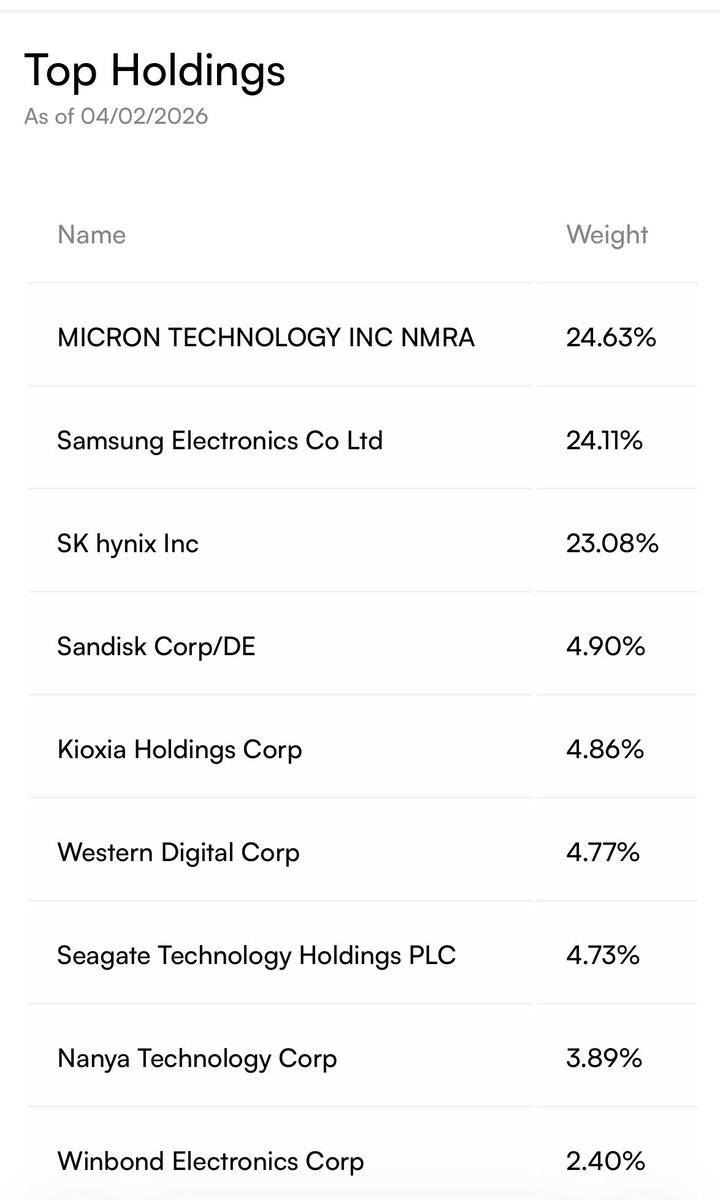
If you want exposure to memory, $DRAM is a genuinely great ETF.
I normally don't praise ETFs, but this is solid.
1. $MU - 24.63%
2. Samsung - 24.11%
3. SK Hynix - 23.08%
4. $SNDK - 4.9%
5. Kioxia - 4.86%
6. $WDC - 4.77%
7. Nanya - 3.89%
8. Winbond - 2.4%
Disclosure: Friends over at @roundhill did reach out about the launch, but I'm not getting paid to say this (just in case you think this random post is sponsored, it's not).
Just a genuinely great ETF for memory exposure if you don't have access to foreign stocks.
And I’d encourage more institutions to make ETFs like this.
English
Christopher retweetledi

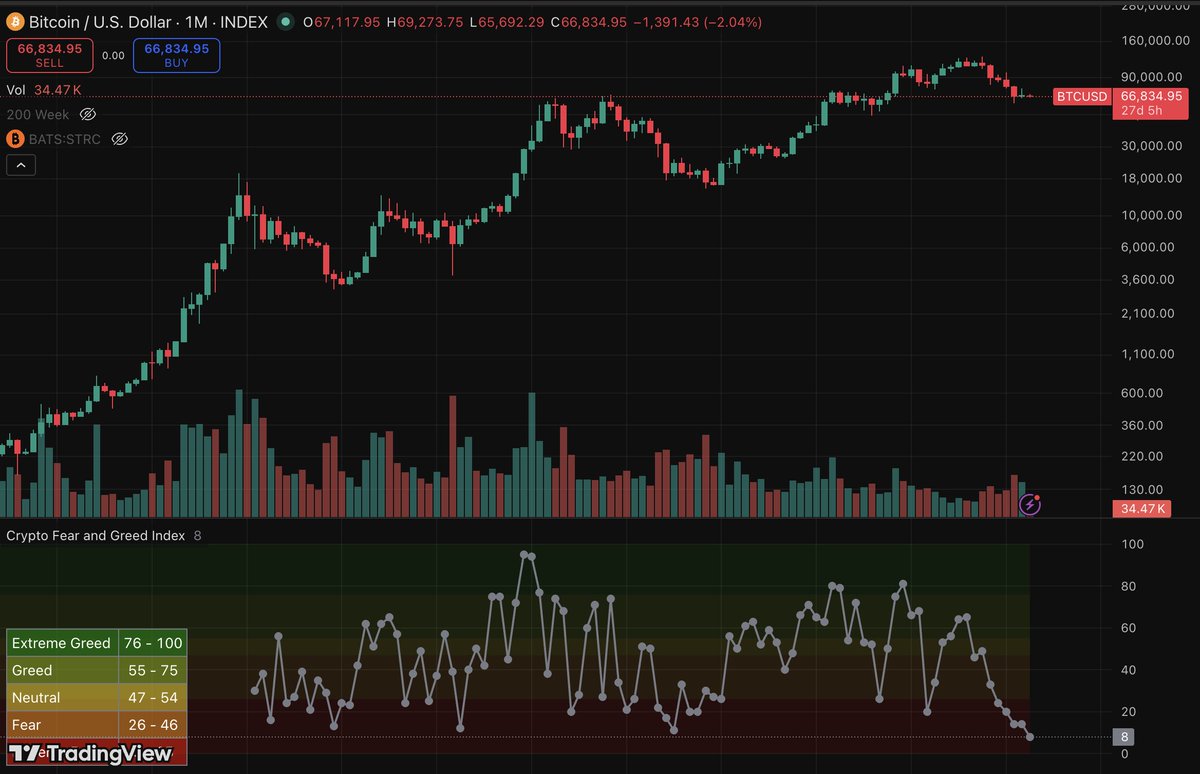
Crypto Fear & Greed is at 8, similar levels to COVID in 2020 and the 3AC/LUNA collapse in 2022.
It always feels terrible after price goes down a lot. But that's precisely when we should start looking to buy long-term spot bags.
Short 🧵
English
Christopher retweetledi

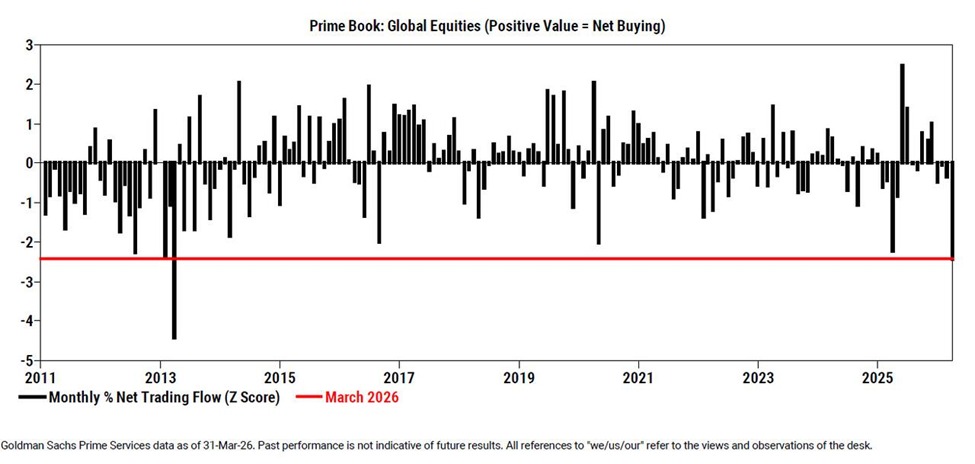
Hedge funds were aggressively shorting global stocks last month:
Hedge funds sold world equities at the fastest pace in 10 years in March, with short sales outpacing long purchases by a ratio of 7.6 to 1.0.
This also marks the 4th consecutive monthly sale, matching the February-May 2025 streak.
~76% of sales were concentrated in index and ETF products, with US-listed ETF shorts rising +17.2%, led by large-cap equity ETFs.
As a result, single stock sales made up just ~24% of the total, with Industrials, Financials, and Technology the most sold sectors globally.
Energy, Healthcare, and Consumer Staples were the only sectors that saw net purchases.
The risk of a short squeeze is accelerating.
English
Christopher retweetledi

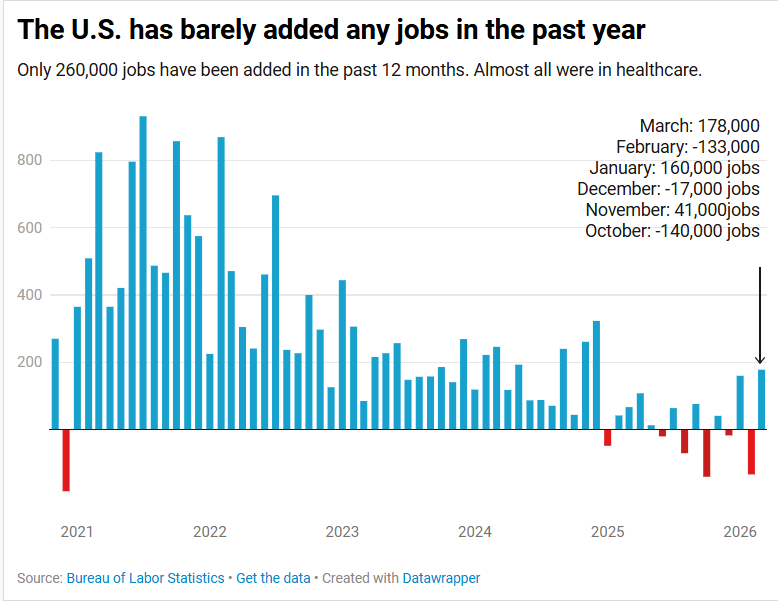
The big picture: The US economy has added only 260,000 jobs in the past year.
380,000 jobs were added in healthcare.
Most other industries *lost* jobs
Federal gov't -330,000 in past year
Information -76,000
Manufacturing -75,000
Finance -67,000
State gov't -47,000
Professional services -40,000
Retail -30,000
Mining -17,000
#jobs
English
Christopher retweetledi

Breaking: Claude was right
Yesterday, the Agents invested in Eli Lilly $LLY because of a potential FDA approval for their oral Ozempic.
Today, the FDA approved its Foundayo weight-loss product, unlocking a $50B new market.
Stock was up 3% on the news.

The Claude Portfolio@theaiportfolios
2. Eli Lilly $LLY This one is interesting Claude sees it as the dominant GLP-1 franchise and is buying ahead of an FDA decision on April 10th If it goes Eli's way, it unlocks $50B+ in oral obesity TAM
English
Christopher retweetledi

Trump is seeking to pay for his new $1.5 trillion military budget by cutting the following:
$510 million - Grants for farmers and agricultural research
$82 million - Loans for rural small businesses (Fully eliminated)
$61 million - Support for farmers and food markets (Fully eliminated)
$240 million - School meals and food education for children abroad (Fully eliminated)
$659 million - Community building grants
$47 million - Support for minority-owned businesses (Fully eliminated)
$449 million - Economic development grants for communities
$1.6 billion - Weather forecasting, fisheries, and coastal protection (NOAA)
$993 million - Scientific research and technology standards
$150 million - Support for American exports and trade
$2.2 billion - Broadband and internet access programs
$8.5 billion - Funding for public schools
$1.5 billion - Vocational training and adult education (Fully eliminated)
$2.7 billion - College access and higher education support
$15.2 billion - Roads, bridges, and infrastructure projects
$1.1 billion - Home energy efficiency and clean energy programs (Fully eliminated)
$1.1 billion - Scientific research funding
$386 million - Environmental cleanup programs
$150 million - Cutting-edge clean energy research
$4 billion - Help paying home heating and cooling bills for low-income families (Fully eliminated)
$768 million - Refugee resettlement assistance
$819 million - Care and shelter for migrant children
$775 million - Local anti-poverty programs (Fully eliminated)
$5 billion - Public health programs, mental health services, and disease prevention
$5 billion - Medical research (NIH)
$129 million - Healthcare quality and safety research
$356 million - Emergency preparedness and disaster response
$1.3 billion - FEMA community disaster preparedness grants
$707 million - Cybersecurity protection for critical infrastructure
$52 million - Airport and transportation security
$40 million - Protection against chemical and biological weapons threats
$53 million - Funding for homeland security operations
$3.3 billion - Community development block grants for local neighborhoods (Fully eliminated)
$1.3 billion - Affordable housing construction grants (Fully eliminated)
$393 million - Programs to reduce homelessness
$529 million - Housing assistance for people living with HIV/AIDS (Fully eliminated)
$489 million - Housing and services for Native American communities
$50 million - Grants to help communities build more housing (Fully eliminated)
$60 million - Enforcement of fair housing and anti-discrimination laws
$58 million - Homebuyer and renter counseling services (Fully eliminated)
$45 million - Renewable energy development programs (Fully eliminated)
$1.7 billion - Grants for local law enforcement and public safety
$20 million - Civil rights mediation and legal access programs (Fully eliminated)
$1.6 billion - Job training for at-risk youth (Fully eliminated)
$395 million - Jobs program for low-income seniors (Fully eliminated)
$234 million - Worker safety and labor protection programs
$101 million - Enforcement of equal pay and workplace anti-discrimination laws
$46 million - Programs to combat child labor and forced labor abroad
$2 billion - International humanitarian aid
$1.2 billion - Food aid for hungry families abroad (Fully eliminated)
$4.3 billion - Global health and disease prevention programs
$2.7 billion - Funding for the United Nations and international partnerships
$642 million - International economic and treasury programs
$315 million - Democracy and anti-corruption programs abroad
$486 million - Grants for public transit projects
$4.2 billion - Electric vehicle charging infrastructure
$372 million - Airline service for rural and small communities
$145 million - Grants for sustainable and equitable infrastructure
$204 million - Loans and investment for underserved communities
$1.4 billion - IRS taxpayer services and enforcement
$100 million - Air pollution monitoring and reduction programs (Fully eliminated)
$1 billion - EPA grants to states for environmental protection
$2.5 billion - Clean drinking water and wastewater infrastructure funds
$90 million - Grants to reduce diesel pollution (Fully eliminated)
$3.4 billion - NASA space and earth science research
$297 million - NASA technology innovation programs
$1.1 billion - International Space Station operations
$143 million - STEM education programs
$309 million - Small business development and entrepreneurship programs
$170 million - Small Business Administration operations
$158 million - Loans for small businesses

English
Christopher retweetledi

The Fed's worst nightmare is getting worse:
As one-year inflation expectations exceed 5% and odds of a rate hike are rising, the US economy just posted its largest monthly job loss since December 2020, losing -133,000 jobs in February.
In other words, the "Fed Pivot" is on halt at a time when the labor market needs it most. This is the hallmark of stagflation; inflation and the labor market are moving in opposite directions.
This brings us to the next question: which will the Fed choose to save?
Inflation or the labor market?
The Kobeissi Letter@KobeissiLetter
BREAKING: US job growth in February has been revised down from an initially reported -92,000 jobs to a total loss of -133,000 jobs. This marks the biggest monthly US job loss since December 2020.
English
Christopher retweetledi

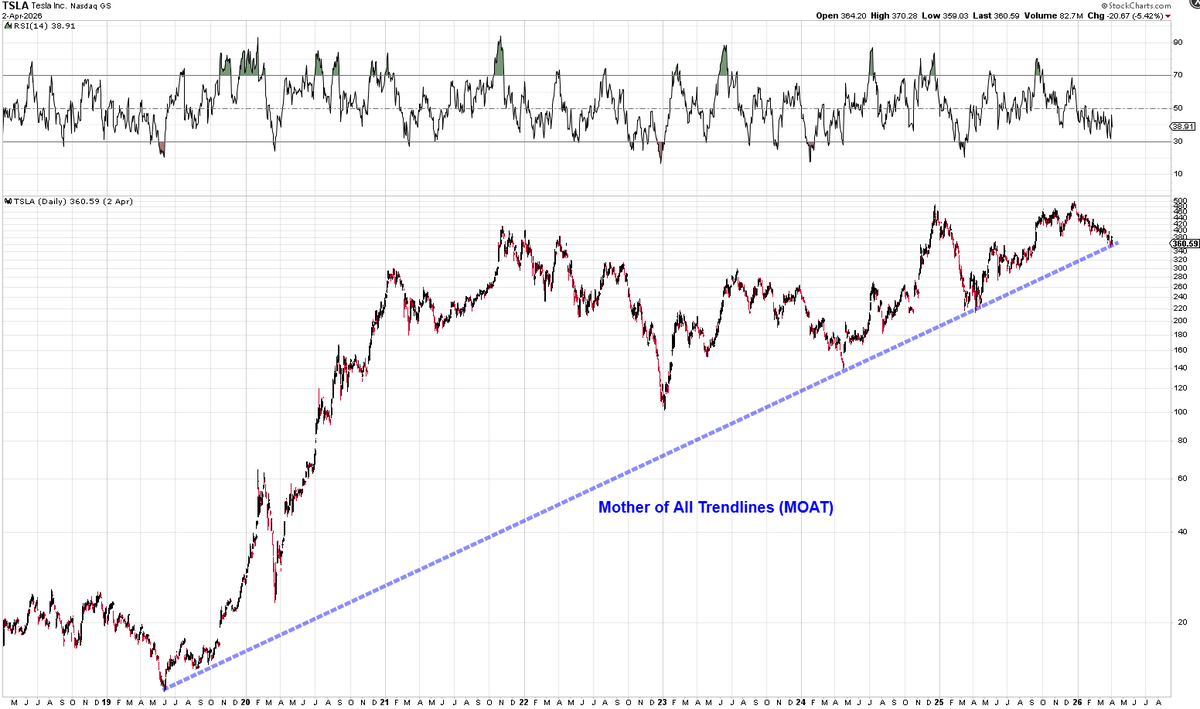
$TSLA Wait a minute here....
If we gonna bounce, it has to be right here right now.
English
Christopher retweetledi

🚨 WARNING: THE NEXT WEEK WILL CHANGE EVERYTHING!
Goldman Sachs says the biggest oil supply shock in history has NOT hit the system yet.
Read that again.
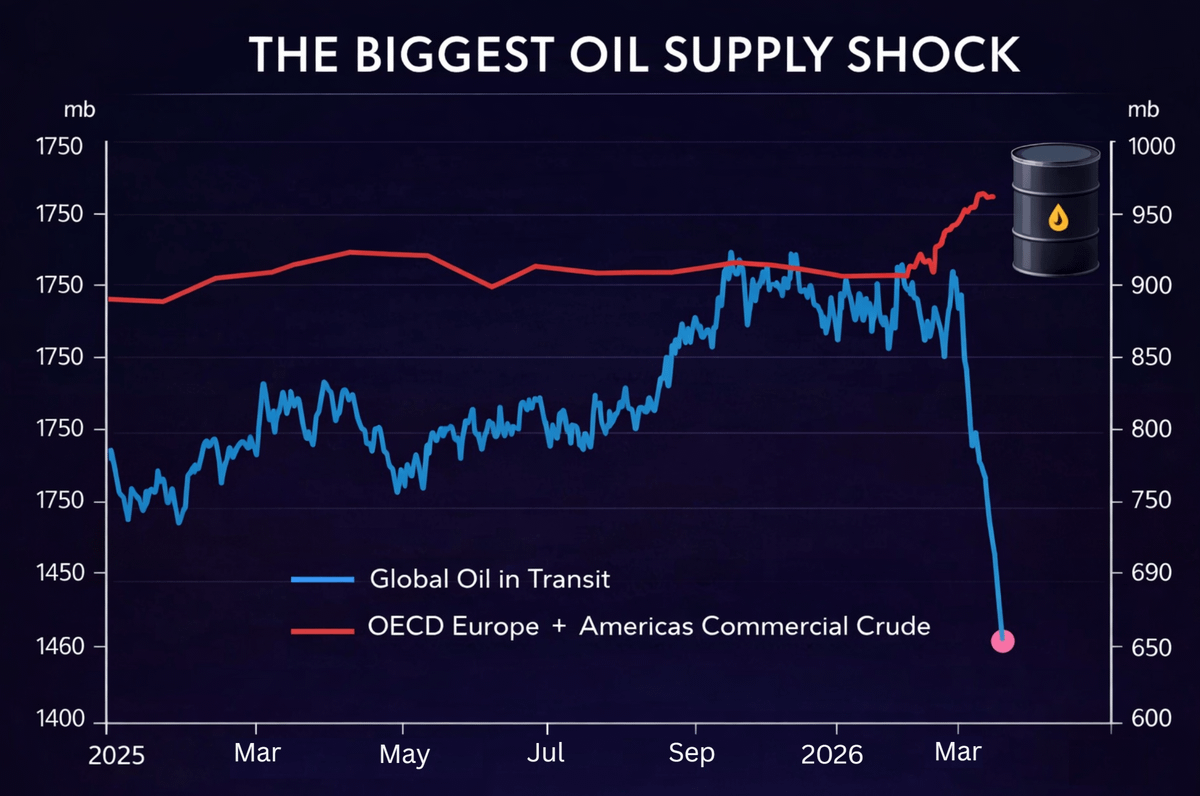
THE BIGGEST OIL SUPPLY SHOCK IN HISTORY
And markets are NOT pricing what comes next.
That's why this chart matters so much.
Crude stocks still look fine.
But oil in transit just COLLAPSED.
Global oil in transit falling from 1,700M barrels to 1,420M barrels.
That's $30.5 BILLION of crude disappearing from the water.
So the full panic has NOT started yet.
That is the part most people miss.
As long as inventories still look okay, markets can pretend this is temporary.
But if Hormuz does NOT reopen soon, those inventories start getting burned down fast.
And once that starts, the pricing changes completely.
IEA already released a record 400 MILLION barrels from emergency reserves.
At $109 oil, that's $43.6 BILLION.
And even that has NOT fixed the problem.
Now connect the dots.
Reuters says the global oil market already lost about 8 MILLION barrels per day in March.
That's the largest disruption in history.
OPEC output also dropped 7.3 MILLION barrels per day in March to 21.57 MILLION.
That's the lowest since June 2020.
And the futures market is already telling you the same thing.
WTI for immediate delivery just traded at a $16.70 premium over next month.
That's the largest premium ever.
Read that again.
The market is paying almost anything for barrels RIGHT NOW.
So the point is simple.
Countries still have inventories.
But the oil that keeps those inventories from draining is disappearing.
And if Hormuz stays shut, stocks get spent, oil pumps harder, and the whole inflation story comes back at once.
- Higher diesel.
- Higher shipping.
- Higher power costs.
- Higher inflation pressure.
And that's NOT bullish for any market that needs cheap energy and easy money to survive.
That's why Goldman’s warning matters so much.
The biggest oil supply shock in history has NOT fully spread through countries yet.
But if it does, this will NOT stay an oil story.
It becomes a full COST shock.
I’ve studied macro for 10 years and I called almost every major market top, including the October BTC ATH.
Follow and turn notifications on.
I’ll post the warning BEFORE it hits the headlines.
English