Zack T

522 posts

Zack T banner
Zack T

Zack T

@ZackStacksKap

Stock commentary | Top holdings: $NET $SHOP $MELI $CRWD | Just my thoughts - not financial advice.

Katılım Nisan 2018
252 Takip Edilen181 Takipçiler
Zack T
Zack T@ZackStacksKap·
Kaushik@WisemanCap

Why we are still a buy - Needham on $TTD We spent the day in NYC yesterday at our favorite AdTech conference, hosted by Tom Triscari. We asked every AdTech executive we met- "What's going on at TTD?" They all had an answer. Call me if you want quotes (unattributed). My synthesis is below, and we retain our buy rating, after many conversations and debates with industry insiders about TTD. What AdTech industry executives agree on: The Publicis vs TTD skirmish that has spilled into the public is: a) a power struggle over economic splits; b) bad for both companies, and their client-brands; and c) will be short-lived. Negotiating skills are a key media industry valuation driver, and the only thing that is unusual here is the "airing of dirty laundry" in the press, which is very rare for Publicis (indicating to us that they are really irritated with TTD's negotiating posture). Why we Maintain our BUY Rating Wh'at's news about this? Everyone that follows TTD knows that the big ad agency holding companies (Hold Cos) feel betrayed because TTD has been signing up their big brand clients directly, thereby disintermediating them. TTD disclosed in 2025 that JSA's (joint service agreements) account for >60% of their reported revenue, and we think it's higher at the Hold Cos. A key implication is that Publicis can NOT stop brands spending money on TTD in cases where TTD has a JSA contract with the brand directly. Those clients have contracts for "volume discounts" tied to minimum spending levels on the TTD platform, we believe. So long as TTD is transparent with those brands, they will keep renewing their JSAs, we believe. Publicis can only control spending by clients that do NOT have a direct JSA with TTD, and we heard from several of those brands that they will not follow Publicis' advice about TTD. Math: We estimate that Publicis was 10% of TTD's reported revenue of $2.9B in FY25, or about $290mm. We estimate that 70% of Publicis' brand clients have JSAs with TTD directly, and therefore are unaffected by Publicis' recommendations. That leaves a maximum of 30% ($87mm) at risk from Publicis, compared with $2.9B of actual TTD reported revs in FY25. Economically, this is a tempest in a tea pot, in our view. We retain our buy because we believe that TTD's significant decline so far in 2026 and over the past 12 months already takes into account TTD's tense relationships with the Hold Cos, the high level of senior FTE turnover at TTD, and clients grumbling about Kokai and TTD's high take rates. On the upside, we are optimistic that OpenAI will rely on TTD to bring them demand for their new ad units, and this new revenue stream is not yet in our estimates. We are also positive on TTD's CTV and RMN revenue growth. Defensively, TTD unique strategic position is hard to replace. TTD represents the largest global brands. If they try to leave TTD, they are forced to use either Walled Gardens like GOOGL or AMZN (heavily conflicted by their owned media ad units) or relatively tiny DSPs like Viant, MNTN, TBLA, and others that aren't realistic alternatives for the largest global brands, in our view. Part of TTD's stickiness is the lack of scaled independent competitors, which buys TTD time, but not infinite immunity.


QME
0
0
3
622
Rose Celine Investments 🌹
Rose Celine Investments 🌹@realroseceline·
Thoughts on $TTD It’s currently easy to throw rocks at $TTD. The stock is down significantly, sentiment has changed, Publicis dispute, and the CEO buying $150m of stock. Each of these is unusual on its own, and together they’ve completely changed the narrative. I’ve owned $TTD since it was around a $4b company, and it has been a large position for me. It’s obviously smaller now, that’s part of the game, in hindsight everyone is a genius. Today, almost no one wants to touch it. Markets love extremes, either everything is working perfectly, or everything is broken. But most of the time, reality is in the middle, and that’s where the opportunity usually is. Right now the easy narrative is that growth slowed, so something must be wrong. But a big part of that slowdown has nothing to do with the core business. Political spend ended, and autos and CPG cut budgets due to macro. If it wasn’t for this dynamic, $TTD would have gown 5% faster. Those two verticals are roughly a quarter of revenue, and they pulled back everywhere, not just with $TTD. The rest of the business is still growing nicely. So the real question is not whether growth slowed, it clearly did. The question is what actually broke? When I look at it, I don’t see something broken. I see a business going through “friction”. Most investors focus on the growth rate, but very few ask why this business exists? $TTD is not just an ad tech company, its basically capital allocation platform for marketing dollars. If $TTD didn’t exist, the open internet wouldn’t be neutral, it would be owned. And if you’re a global advertiser, relying entirely on $GOOG or $AMZN is not a great position to be in. You want control and transparency over where your dollars go. That’s the role $TTD plays, and it becomes more valuable as the ecosystem becomes more concentrated. $TTD has an enviable position because it has permission from the largest advertisers in the world to allocate their spend. $TTD doesn’t need to win everything. It just needs the marginal dollar that advertisers don’t want to send to $GOOG or $AMZN, and that becomes more valuable over time. What’s been forgotten is the quality of the business. A 40%+ EBITDA margin business that is still growing is not normal, that’s elite economics. That’s what great businesses look like when they’ve already scaled, not while they are scaling. This model has incredible operating leverage, like $DLO. The cost base is largely built, so as incremental revenue flows through each new dollar is more valuable than the last. Which means when growth stabilizes, cash flow doesn’t just grow, it accelerates! The company is also going through a transition as it grows into its scale. That creates friction, but you’ve seen this before with $AMZN, $META, and $NFLX, where things looked bleak right before the next phase. Ironically all three declined by 75% like $TTD. This is also a hard business to replicate. DSPs are not interchangeable, and what $TTD has built is years of integrations, data, and trust with large advertisers. If it were easy, there would already be real competitors at scale. But there aren’t any independent ones. There are risks. SBC is high, growth has slowed, and agency tension is a thorne (pun intended). But those are not structural breaks. Jeff Green has been running $TTD for years and has made good decisions. The $150m open market purchase is a big deal. CEOs don’t put that kind of money in unless they see something the market doesn’t. Right now the market is focused on what’s going wrong. But what happens if nothing is actually broken? Then you’re left with a business that has elite economics, a model that scales incredibly well, world class cash conversion and a pristine balance sheet with zero debt. Most people are asking what happens next quarter. I’m asking what this looks like in five years if nothing is broken? The biggest risk here isn’t the business. It’s the investor’s ability to sit through the narrative. 🌹
English
22
14
218
19.9K
Zack T
Zack T@ZackStacksKap·
@realroseceline "but what about Amazon DSP eating their lunch?!" I kid 😆
English
1
0
2
127
Zack T
Zack T@ZackStacksKap·
@realroseceline Yes, Publicis is "advising" clients to not use TTD, not banning them outright. Also I feel like there is political positioning behind it due to OpenPath competing with what agencies do. Even then, would brands be willing to settle on lower performance with a lesser DSP?
English
1
0
2
160
CapexAndChill
CapexAndChill@CapexAndChill·
So if $SE did US$127B in GMV in FY 2025 and estimates put their Brazil GMV at R$70B which is ~US$14B, that means Brazil is ~11% of Shopee's global GMV. Since their global average was 27%, and estimates were that their GMV in 2024 was R$50-60B this implies Brazil grew roughly ~30% YoY. $MELI's FXN GMV in Brazil grew exactly 35% YoY in Q4 2025. Industry estimates put $MELI's market share in Brazil at ~35-39%, with Shopee at ~15%. In order for Shopee's GMV growth to hit ~30% YoY in Brazil in 2026, they will need Shopee Mall to grow A LOT. It roughly doubled in 2025.
English
2
0
26
7.8K
Zack T
Zack T@ZackStacksKap·
@CapexAndChill My question is, what does the market want to see to price in less risk in the stock? More years of steady NPLs? Even lower NPLs?
English
1
0
1
33
CapexAndChill
CapexAndChill@CapexAndChill·
Accelerating growth while stabilizing default rates. This scares people now but when they lock-in one of the stickiest ecosystems across an entire continent people may pay attention. $MELI's NIMAL is still very strong despite the massive credit card growth too. They are appropriately pricing risk on relatively short-term loans. Most people stop paying attention after the words “credit risk” 🤣
Daniel Pronk@PronkDaniel

I took $MELI's annual reports back to 2021 and plotted their NPLs over time. You can see that $MELI's NPLs are continuing to improve, even as the loan portfolio explodes in size. To me this suggests that their underwriting is working well even as they aggressively grow.

English
2
0
12
2.3K
SE_super_bull
SE_super_bull@e_commerce_king·
Kind of scary to see $MELI NPL numbers. Seems that the model don’t actually know how to separate risk. Although their model seems to be already much better than the traditional ones.
Daniel Pronk@PronkDaniel

I took $MELI's annual reports back to 2021 and plotted their NPLs over time. You can see that $MELI's NPLs are continuing to improve, even as the loan portfolio explodes in size. To me this suggests that their underwriting is working well even as they aggressively grow.

English
3
0
13
2.7K
The Psycho Analyst
The Psycho Analyst@TheRealBirnbaum·
It’s a little more nuanced than that. My post highlighted a mistake. I wrote calls on my long positions that I either shouldn’t have or should have been much less aggressive with. (I got greedy.) I run a strategy where I write put contracts with my taxable account’s cash or margin position to increase my returns. But I only write these contracts on stocks I want to own—more often than not stocks I already own so inherently wouldn’t mind owning more of. This is a win win because it’s no different than buying the stock, in fact even better because I’m either paid or buy the stock cheaper. On the other hand, I’ll also sometimes use puts to average into a position at a lower cost basis. I think it’s not smart to sell puts on stocks you don’t want to own just to generate income. This is when you’re picking up pennies despite the possibility of larger losses. Because if you’re assigned you’re liable to sell for a loss because of a lack of conviction.
English
1
0
1
25
The Psycho Analyst
The Psycho Analyst@TheRealBirnbaum·
This latest post from @CMDarnton0 is the single most important investing lesson, bar none. In fact just this week I learned it yet again. I got cute on Friday, selling covered calls to generate returns in this kangaroo market that's been fading down since October. The very next trading day, $NBIS moons on a deal with $META. Then today, $LMND moons on an upgrade. In the first case I rolled up. Today, I bought more $LMND and will wait and see. But in both cases I should've either been way less aggressive or just held. Us humans are our own worst enemies. The best way to get rich is to hold world-class businesses until they no longer compound. World-class businesses typically compound for decades. "I Lost $20M Because Of This One Investing Mistake" open.substack.com/pub/christiani…
English
2
3
14
1.8K
Zack T
Zack T@ZackStacksKap·
@WealthyReadings @Eugeneios Yup, selling because of fuel makes no sense. I'm afraid someone knows something else... but I added here anyway😀
English
0
0
1
55
The Few Bets That Matter
The Few Bets That Matter@WealthyReadings·
@Eugeneios Could be although that's ridiculous and many transport names aren't hit at all. Even if, that isn't a reason to sell it at today's valuation, not that harsh selling
English
1
0
1
650
The Few Bets That Matter
The Few Bets That Matter@WealthyReadings·
Something up with $TMDX. You don't flush 10% on volume and lose key support without any new. Where's Scorpion's latest short report?
English
5
0
22
15.2K
Zack T
Zack T@ZackStacksKap·
From your initial post, it implied that you were playing options for small short-term returns that were not worth it. That's why I shared the other article. If the intention is to potentially own the stock for long term anyway selling puts makes more sense, I do that as well. For selling calls, I'm not quite sure it's as worth the risk, at least for me.
English
1
0
1
39
The Psycho Analyst
The Psycho Analyst@TheRealBirnbaum·
I disagree with the idea that writing options contracts aren’t value accretive. I’ve done it for years and it’s been a significant net positive for me. Like anything it’s about how you use it. If you write puts on companies you aim to own regardless, it’s not much different from owning the stock outright. If the stock falls, I’m happy to accept assignment, whether that was my goal in the first place or to run the wheel and sell calls. Where people go wrong is usually: 1. Selling puts on stocks they wouldn’t want to own 2. Selling calls on long positions too aggressively and interrupting the compounding process Otherwise it’s a sound strategy.
English
1
0
1
33
Drew Cohen
Drew Cohen@DrewCohenMoney·
@ZackStacksKap Haha I did It’s literally me talking to myself in a room for ~2 hours at a time 😂
English
1
0
1
35
Zack T
Zack T@ZackStacksKap·
I never thought I’d watch a 90-minute YouTube video of a guy just talking to a camera, but @DrewCohenMoney proved me wrong. In the age of short attention spans, there is still an audience for long form video. If you’re holding or eyeing $MELI, this is a must-watch. Here are a few takeaways that stood out to me: - It was interesting to learn how 1st-party (1P) products are used to regulate 3rd-party (3P) sellers. If 3P sellers overcharge because their costs are low, MELI introduces 1P at lower margins to force prices down. If 1P becomes too expensive, they lean back on 3P. Surprisingly, the unit economics for both generally net out to the same margins. - Amazon can be a bigger competitor to Meli, but they intentionally choose not to. Internally Amazon initiatives compete for the same investment dollars and generally higher ROI projects are prioritized (e.g. AWS). - To scale Mercado Pago, they securitize their loans to mitigate risk. However, they keep the "junior portion" to take the first loss if defaults spike but these portions also offer much higher margins to make up for it. - As profitable as the lending arm looks, the credit risk remains an untested overhang on the stock. This new segment hasn't faced a major regional credit event yet. It serves as a good reminder every time I feel like MELI looks “cheap”. Looking forward to more in the future! youtube.com/watch?v=LIW5zh…
YouTube video
YouTube
English
1
6
32
4.6K
Zack T
Zack T@ZackStacksKap·
@mathlonning Don’t see any news. Happy to add here for long term.
English
0
0
1
421
Matheus Lonning
Matheus Lonning@mathlonning·
Another rough day for $TMDX. Now down overall YTD. Stock cannot catch a break lately.
English
11
0
27
5.6K
Umer
Umer@iumerraja·
@ZackStacksKap Finally a really great insight into all this. Jeff is making many players angry inside the industry as the current complexity = more money for middle men. I don’t know how this ends for TTD, but if Jeff ultimately wins, TTD is going to win big.
English
1
0
2
200
Zack T
Zack T@ZackStacksKap·
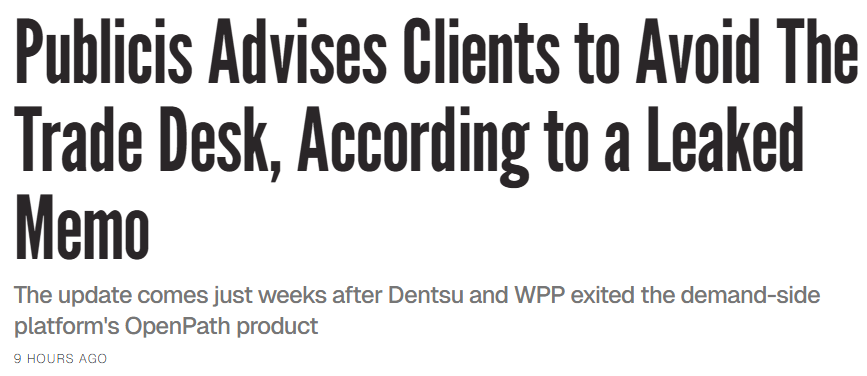
$TTD is down 10% after Publicis ceased recommending the platform to its clients. This move follows a "failed" third-party audit alleging improperly applied fees and a refusal to disclose media/data costs. It sounds scary but there's much more at play here. Let me explain.... To start, I believe this is a power play negotiation tactic by the big agencies. This isn't the first time. Last month, WPP and Dentsu quietly pulled away from TTD’s OpenPath tool (interestingly, that didn’t go nearly as viral as this latest news). To understand why, you have to understand OpenPath, which allows brands to buy ad inventory (Disney, Reuters, etc.) directly, skipping the "middleman" SSPs (Magnite, PubMatic). The main goal of this tool is to remove complexity from the supply-chain through simple, direct buying. There’s less cost, cleaner data, and true price discovery. An illustration below highlights the flow: Agency/Brand >>> TTD OpenPath >>> Publisher So it should be a win-win for both the agency, brands, and TTD right? This is where the dynamics becomes more complicated. Before OpenPath, agencies worked with supply-side partners (SSPs) to gatekeep access to publishers: Agency/Brand >>> TTD >>> SSP >>> Publisher More intermediaries = more costs to the brand before the ad is even shown, with fees ranging from 10% to 20%. Plus, agencies often have "hidden" agreements (rebates) where they get paid by SSPs for sending them business. They are incentivized to keep the middleman. To make incentives even muddier, these agencies sometimes have their own similar SSP-like solutions which allow them to take the place of the middleman, essentially double dipping on both the agency fee and middleman tech markup. With OpenPath, brands skip all that. Fees are much lower (~5%) so publishers keep more revenue. Also important, TTD even runs this at cost. They don't profit from the tool itself. They just want a transparent, efficient market. The results speak for themselves: The Guardian: Reported a 91% increase in programmatic revenue coming from TTD after integrating OpenPath. The New York Post: Saw programmatic revenue grow by 97% through the direct pipe and an 8.6 lift in fill-rate (they sold 9x more of available ad slots than before). The Arena Group: Reported a 79% boost in revenue and a 4x higher fill rate. As you can imagine, this success incentivizes publishers to go the OpenPath route instead of the traditional SSP route, and agencies are potentially hurting from it. This leads them to play hard ball: pulling away from OpenPath or making misconduct allegations, hoping as a result TTD make some kind of concession such as lower fees or grant better access to its technology. Are the Publicis allegations true? TTD denies them and it sounds like they tried their best to reconcile these audit issues without giving away their "confidential" information which would violate NDAs. Additionally Jeff Green noted it was a disagreement over “opinions” rather than facts. Where this pans out I don’t know but something to keep in mind is that Publicis only advises against clients using TTD, not banning it. If a brand sees better performance with OpenPath, they can still choose to use it. Another side note to know: Adweek is a media outlet. They thrive on clicks and big news. So it is in their benefit to highlight drama and cynicism, perhaps this scuffle isn’t nearly as bad as it seems and while it looks bad for the stock today, the long-standing partnership has mutual benefits that usually lead to a resolution. Thanks for reading! As a disclaimer I am long $TTD.
Zack T tweet media
English
2
6
26
2.7K
Zack T
Zack T@ZackStacksKap·
@DrewCohenMoney lol if I recall you even said it in the video “but maybe there’s no one here so it’s just me talking to myself” 😂
English
1
0
1
72
Drew Cohen
Drew Cohen@DrewCohenMoney·
@ZackStacksKap Love to hear that so much... ngl was wondering if the content would find an audience and so happy to hear it has
English
1
0
2
196