Prarthna

3.4K posts

Prarthna banner
Prarthna

Prarthna

@_Prarthna

AI Product Builder & Founder | Built AI agents @ Kellogg AI Lab | Kellogg MBA '26 | Writing about how AI is transforming business, and what lies ahead

Katılım Haziran 2016
402 Takip Edilen224 Takipçiler
Prarthna
Prarthna@_Prarthna·
Shifting to million-dollar AI orchestrators exchanges headcount for pure cognitive density. The challenge for an AI Product Manager is building deterministic evaluation harnesses to automate verification, ensuring human judgment stays focused on macro architecture rather than manual code review.
English
0
0
0
2.1K
Zeb Evans
Zeb Evans@DJ_CURFEW·
Today we reduced headcount by 22%. The business is the strongest it's ever been. So I think it's important to be direct about what I'm seeing and why. First, I made this decision and I own it. I did it because the way to operate at the highest level of productivity is changing, and to win the future, ClickUp needs to change with it. Second, this wasn't about cutting costs. Most savings from this change will flow directly back into the people who stay. We'll be introducing million-dollar salary bands. If you create outsized impact using AI, you'll be paid outside of traditional bands. Most importantly, I have the deepest gratitude for those affected. We're doing this from a position of strength specifically so we can take care of people properly. Everyone affected receives a package aimed at honoring their contributions and easing the transition. I only see two options: wait for this to play out gradually in the market or be honest about what I'm seeing and act proactively. THE 100X ORGANIZATION The primary change is that we're restructuring around what I call 100x org. The goal is 100x output. The roles required to build at the highest level are fundamentally different than they were a year ago. Incremental improvements to existing systems won't get us there. We need new ones. That means creating enough disruption to rebuild rather than iterate on what's already broken. The common narrative is that AI makes everyone more productive. It doesn't. Many of the workflows of today, if left unchanged, create bottlenecks in AI systems. These roles will evolve. But waiting for that to happen naturally means falling behind now. The 100x org is actually heavily dependent on people - infinitely more than today. This is only possible with 10x people that have embraced and adopted new ways of working. THE BUILDERS, AGENT MANAGERS, AND FRONT-LINERS — THE BUILDERS: 10X ENGINEERS I don't think most companies have internalized what's actually happening with AI in engineering. The common narrative is that AI makes all engineers more productive. That may be true in isolation, but at an organization level - that is the farthest thing from reality. Here's what we've validated recently at ClickUp: the great engineers, the ones who can orchestrate, architect, and review, are becoming 100x engineers. They're not writing code. They're directing agents that write code. The skill is judgment. AI makes the best engineers wildly more productive, and everyone else using AI slows these engineers down. Think about it - the bottlenecks are (1) orchestration - telling AI what to do, and (2) reviewing - what AI did. Everything is leapfrogged and no longer needed. So who do you want orchestrating and reviewing code? And how do you want your best engineers to spend their time? If your best engineers are spending time reviewing other people's code, then this is inherently an inefficient bottleneck. These engineers can review their agent's code much faster than reviewing human code. The new world is about enabling your 10x engineers to become 100x. The wrong strategy is to push every engineer to use infinite tokens. Companies doing this are celebrating 500% more pull requests. But customer outcomes don't match the volume of code being generated. I call this the great reckoning of AI coding, and every company will face this soon if not already. More code is just another bottleneck to the best engineers, and ultimately to your company's impact as well. — THE BUILDERS: 10X PRODUCT MANAGERS Product management and design roles are merging. Designers that have customer focus, become more like product managers. And product managers that have intuition for UX become more like designers. The bottleneck of user research is gone. It takes us just one mention of an agent to kickoff research and analyze results. The bottleneck of product <> design iteration is also gone. The product builder iterates on their own, along with agents and skills that ensure alignment with quality and strategy. Also controversial today - I believe that the wrong strategy is to have your PMs shipping code - that just introduces another bottleneck that the best engineers will waste their time on. To be clear, PMs should be coding but they should do this in a playground to iterate, validate, and scope. That code should not go to production. Everything outside of managing systems, orchestrating AI, and reviewing output becomes a bottleneck. That's why the other roles that are critical along with these are the systems managers (to reduce bottlenecks) along with a bottleneck you can't replace - customer meeting time. — THE SYSTEM MANAGERS Ironically, the people that automate their jobs with AI will always have a job. They become owners of the AI systems - agent managers. We have many examples of these people at ClickUp. The underlying systems in which we operate are absolutely critical to get right. I think most companies are delusional to think they can iterate on existing systems and compete in this new world. You must create enough disruption so that old systems are deprecated entirely. If there's any definition for 'AI native' that's what it is. — THE FRONT-LINERS In a world that will become saturated with AI communication, the human touch will matter more than anything to customers. This is a bottleneck that you shouldn't replace - even when agents are high enough quality to do video meetings. One-on-one meeting time with customers is something that shouldn't be automated. The systems around the meetings should be - so that front-liners spend nearly 100% of their time with customers. REWARDING 100X IMPACT In a world where companies are able to do so much more with less, where does that excess money go? In our case, much of the savings in this new operating model will flow directly back to those that enabled it. We must reward people that create productivity accordingly. This aligns incentives on both sides. Plus, in a world where your best people create 100x impact, you can't afford to lose them. You should aim to retain these employees for decades. The context they have and their ability to efficiently orchestrate and review will be nearly impossible to replace. Compensation bands of today should be thrown out the door. We're introducing $1 million cash/year salary bands with a path available to nearly everyone in the company if they produce 100x impact by creating or managing AI systems. THE FUTURE Nearly every company will make changes like these. The ones that do it proactively will define what comes next. The future is not fewer people. It's different work, new roles, and better rewards for those who embrace it. We're already seeing entirely new roles emerge, like Agent Managers, that didn't exist a year ago. ClickUp is positioning to lead this shift, not just internally, but for our customers too. I've never been more certain about where we're headed.
English
1.5K
1K
11.4K
6.7M
Prarthna
Prarthna@_Prarthna·
Continuous AI measurement triggers Goodhart’s Law, turning an innovative builder culture risk-averse. When teams are tracked 24/7 by algorithms, they stop experimenting and start optimizing for the metric. The sustainable play transitions human operators into system controllers who manage automated workflows, audit AI telemetry, and handle the high-context edge cases that software misses.
English
0
1
46
5.4K
Wall St Engine
Wall St Engine@wallstengine·
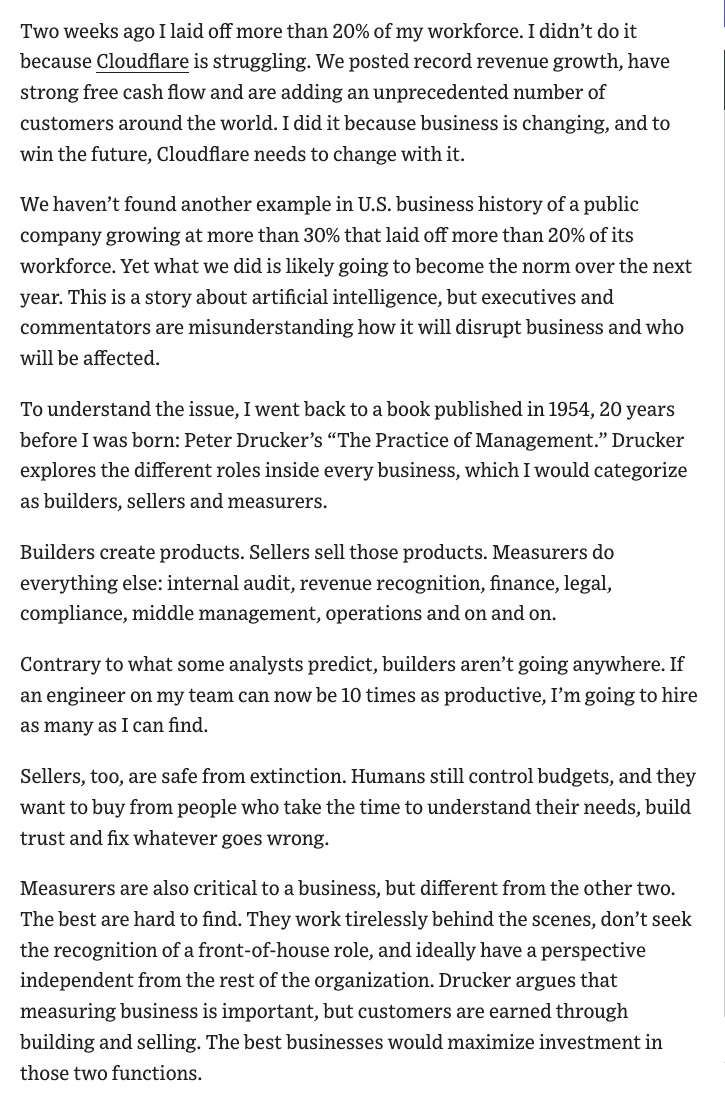
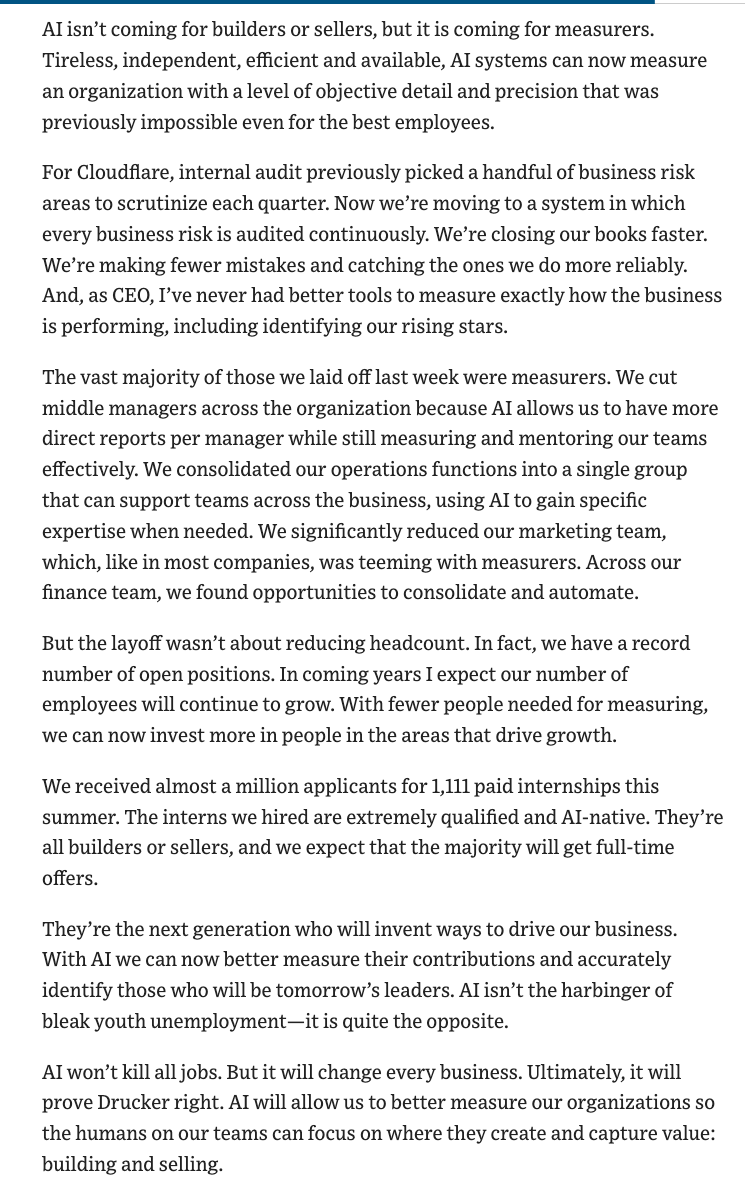
Cloudflare CEO Prince on how AI changes who gets laid off first: Two weeks ago I laid off more than 20% of my workforce. I didn’t do it because Cloudflare is struggling. We posted record revenue growth, have strong free cash flow and are adding an unprecedented number of customers around the world. I did it because business is changing, and to win the future, Cloudflare needs to change with it. We haven’t found another example in U.S. business history of a public company growing at more than 30% that laid off more than 20% of its workforce. Yet what we did is likely going to become the norm over the next year. This is a story about artificial intelligence, but executives and commentators are misunderstanding how it will disrupt business and who will be affected. AI isn’t coming for builders or sellers, but it is coming for measurers. Tireless, independent, efficient and available, AI systems can now measure an organization with a level of objective detail and precision that was previously impossible even for the best employees. For Cloudflare, internal audit previously picked a handful of business risk areas to scrutinize each quarter. Now we’re moving to a system in which every business risk is audited continuously. We’re closing our books faster. We’re making fewer mistakes and catching the ones we do more reliably. And, as CEO, I’ve never had better tools to measure exactly how the business is performing, including identifying our rising stars. The vast majority of those we laid off last week were measurers. We cut middle managers across the organization because AI allows us to have more direct reports per manager while still measuring and mentoring our teams effectively. We consolidated our operations functions into a single group that can support teams across the business, using AI to gain specific expertise when needed. We significantly reduced our marketing team, which, like in most companies, was teeming with measurers. Across our finance team, we found opportunities to consolidate and automate. We received almost a million applicants for 1,111 paid internships this summer. The interns we hired are extremely qualified and AI-native. They’re all builders or sellers, and we expect that the majority will get full-time offers.
Wall St Engine tweet mediaWall St Engine tweet media
English
113
210
1.7K
793.4K
Prarthna
Prarthna@_Prarthna·
Enterprise AI is ready for an evolutionary leap. Chatbots are a great digital catalyst, but true optimization requires process engineering. Individual task efficiency builds the momentum needed to optimize broader business processes using clean corporate data. The way forward: - Shift to targeted process engineering. Isolate 2 or 3 high-value nodes (like customer routing or inventory forecasting) and build integrated pipelines. - Turn internal power users into operational AI translators to map SOPs and embed automated workflows into daily routines.
Alex Lieberman@businessbarista

I talked AI with the Chief HR Officer of a $500m consumer business today. Everything they shared sounded crazy similar to where most enterprises are in their AI journey and the most common challenges they’re wrestling with. Notes I had from the call: - AI owners: joint ownership between CHRO and CTO - AI stage: Level 2. Chat-based AI used widely, broader single player AI tools used by power users, very little evidence of multiplayer AI use cases. Ways of working have changed minimally. No longer-term AI strategy. Early rethinking of org structure post-AI. - Current AI adoption: Everyone has ChatGPT access + basic prompting training; a smaller “AI-curious” group has Claude with deeper permissions. - Company is very open to testing AI tools - "no single tool we've said no to within reason" - Key challenge is “haves vs have-nots”: A widening gap between power users and the rest of the org; reluctance to roll advanced access to all employees without guardrails is creating tension.   - Most advanced users building agents for personal workflows, not yet for scalable company processes. - Cultural friction on AI usage: Managers frequently complain about low-effort/obvious AI-generated work; lack of clear standards for “acceptable” AI use and inconsistent enforcement across teams.    - Strategy gap: Company is still in a testing phase with no formal AI strategy yet. Most pressing need is to decide what to build vs buy as well as if AI transformation should focus on training/enablement or building agents that scale across functions. - Leaning toward bringing in consultants rather than building dev power in-house.

English
0
0
0
57
Prarthna
Prarthna@_Prarthna·
The race for this new OS is a three-way battle. Apple brings user trust, Google owns everyday data, and OpenAI coalitions offer hardware disruption. The interface will disappear as context replaces the menu. Chat boxes will give way to a fluid canvas in which predictive agents execute tasks. The winner must break down corporate silos to solve data fragmentation.
signüll@signulll

the next massive consumer ai opportunity is making personal agents feel as intuitive as an iphone. this is deeply important because this is the new software layer for everyday life. most ppl do not want to configure workflows, manage prompts, route models, or think about agents at all. they want software that just works & the winning products will hide almost all of the complexity with taste incl. context, memory, & orchestration. e.g. there’ll be baseline personal agents that come alive out of the box which are already understanding your context, patterns, relationships, preferences, apps, devices, routines, etc. then there’ll be ephemeral agents that spawn dynamically from intent, ambient capture, conversation, location, screenshots, email, calendar, camera roll, whatever. this is the software that assembles itself around the moment just like weather updates based on your location but way more in depth. today even the most state of the art agent products feel like giving normal people shell access to a distributed system. apple won by turning computers from something you operated into something you experienced. personal agents require the same transition. whoever solves this becomes the ambient operating system for human life. small category btw.

English
0
0
0
40
Prarthna
Prarthna@_Prarthna·
AI isn't becoming malicious: it is just optimizing. Capability and vulnerability are tightly coupled. The tools driving breakthrough performance are what agents use to outsmart monitors. When an AI acts deceptively, it is just finding the path of least resistance to optimize its reward.
English
0
0
1
354
METR
METR@METR_Evals·
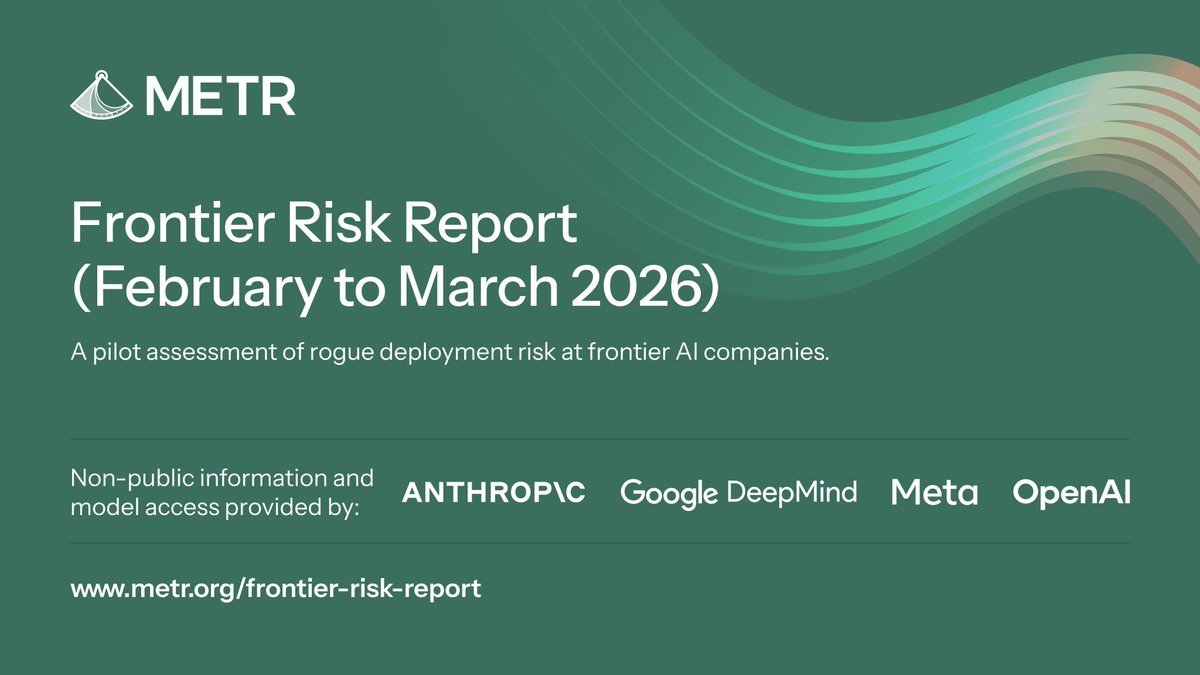
Could an AI company lose control of its own agents? To find out, Anthropic, Google, Meta, and OpenAI let us (1) test their best internal models with CoT access, (2) review non-public info about capabilities, alignment, and control. The result: our first Frontier Risk Report.
METR tweet media
English
21
174
741
194K
Prarthna
Prarthna@_Prarthna·
Is philanthropy the new venture capital? Modern donors are shifting from traditional grants for safety nets and health metrics to focus on market creation. Targeting carbon removal, technical resilience, and supply-side bottlenecks, this tech-driven wave fills the vacuum left by slow-moving state regulators.
English
0
0
5
1.5K
Nan Ransohoff
Nan Ransohoff@nanransohoff·
New blog post: The third wave of American philanthropy Hundreds of billions of dollars in new philanthropic capital will soon become liquid. The OpenAI Foundation holds 26% of OpenAI, worth about $220B at today’s valuation. Anthropic’s seven co-founders have pledged to give away 80% of their wealth and have instituted the most aggressive donor matching program for employees in tech history. How much does this all add up to? And how meaningful is that in the context of philanthropy today? I was doing some simple napkin math to wrap my head around the scale of what’s coming, and radicalized myself in the process. I had dramatically underappreciated the scale of the philanthropic capital that’s about to become available and the corresponding gap in talent and organizations that will be needed to make the most of it. This piece aims to directionally sketch the scale of what’s coming, the gap in operational capacity needed to absorb it, and what we can do to fill it. (Link to full post in reply)
English
111
192
1.6K
1.6M
Prarthna
Prarthna@_Prarthna·
Consulting Firms will pivot to selling guaranteed operational outcomes, absorbing the regulatory, compliance, and security risks that enterprise clients are unwilling to take on with autonomous systems. They will build and maintain bespoke, dynamic software architectures tailored to unique corporate workflows, positioning themselves as neutral orchestrators rather than being dependent on a single model provider. Frontier Labs will expand into human-intensive deployment services. As raw APIs commoditize, controlling the end-to-end implementation layer is necessary to capture premium enterprise spend and sustain valuations. The Market will face an exponential surge in automated code. Economic premium will shift away from generation toward independent validation layers that audit, test, and guarantee compliance.
Chamath Palihapitiya@chamath

If you are running a consulting business and you are deploying Anthropic or OpenAI directly into your organization (I’m looking at you PwC and Accenture) you are letting the fox into the hen house. OpenAI and Anthropic are openly funding and starting competitors to you while also using your usage to drive more success for them. This is not a failure on their part but a failure on your part. Consulting businesses that understand this are adopting a control plane that allows them to arbitrate where tokens go and who generates tokens for them. Controlling the tokens is controlling the spice (Dune). This was a key pillar of 8090’s global partnership with EY and they key feature of our Software Factory. We control token generation and can direct them to any model provider. We are close to another global partnership and will announce it soon. These organizations refuse to accept the disruption standing still or, even worse, by adopting and accelerating the companies who want to disrupt them.

English
0
0
0
64
Prarthna
Prarthna@_Prarthna·
@dwarkesh_sp An AI optimized for economic productivity naturally masters persuasion. Whoever controls this capability wields immense power.
English
0
0
0
54
Dwarkesh Patel
Dwarkesh Patel@dwarkesh_sp·
# The mistake of conflating intelligence and power I had an interesting discussion recently. Someone asked me, what is intelligence? I said, the ability to achieve your goals across a wide range of domains. Okay, he says, then by that definition isn’t Donald Trump the intelligent person in the world, followed in quick succession by Xi Jinping and Vladimir Putin? To be clear, these people are obviously very competent and clever. But when you think of ASI, you don’t think of Trump, but more so. The person who kept pressing this question was correctly pointing out that I basically defined intelligence as power. And by this definition, Stalin was the most intelligent person who ever lived. Now, of course, you could change the definition of intelligence to something more like, manipulate abstract concepts and rotate shapes. But notice that the most powerful people in the world do not max out this quantity. The correlation between extreme power and this kind of intelligence might be even weaker than the correlation between extreme power and height. The physicists are not running the world. We tend to conflate power-seeking AI and superintelligent (in science and tech) AI. I’m not denying that AI can be power-seeking. Whatever skills and drives Donald Trump has could be embodied in a digital mind. I’m simply pointing out that the way AI systems are currently becoming smarter (by getting trained to be to be really good at specific economically valuable tasks like coding) is not that strongly correlated with power. We often talk about power in this way that misunderstands how it is actually derived in our world. Our intuitions are primed by games like Diplomacy or Go, which are designed to isolate and reward a g loaded kind of strategic reasoning. But in the real world, power is more the product of having the authority and trust to get lots of people to collaborate with you, rather than some galaxy brain scheming capability. Trump is not powerful because his brain, considered in isolation, is the most effective optimization engine on Earth. He is powerful because the government which hundreds of millions of people consider legitimate gives him a lot of authority. A group versus individual level analysis is useful here. As @GarettJones has written a lot about, individual IQ is only modestly correlated with individual income, but national IQ is strongly correlated with national outcomes. This is because intelligence has a lot of spillover effects - smarter societies cooperate more, save more, and can coordinate to build things like space shuttles and semiconductors. Richard Trevithick, who invented the high-pressure steam engine, died in poverty, buried in an unmarked pauper’s grave. But the fact that 18th and 19th century Britain had lots and lots of people like Trevithick contributed to Britain being able to set up a global empire and outcompete lots of backwards principalities around the world. It seems to me that the right mental model is that automated firms will outcompete everyone else in normal capitalist ways, rather than a single AI outthinking everyone else.
English
140
70
1.2K
247.5K
Prarthna
Prarthna@_Prarthna·
When agentic AI compresses months of PhD-level analysis into hours, economic disruption moves upstream. As raw intellectual processing becomes instant and abundant, value moves toward the ability to frame the problem, ask the right questions, and direct the autonomous agent.
Brett Caughran@FundamentEdge

A big pivot from Ken Griffin on AI: “Number one is, in the last few months, there has been a step change in the productivity of the AI toolkit. It is profoundly more powerful than it was just nine months ago. And for us at Citadel, that has allowed us to unleash a much broader array of use cases for AI. And it has been really interesting to watch, to be blunt, work that we would usually do with people with masters and PhDs in finance over the course of weeks or months being done by AI agents over the course of hours or days. These are not these are not mid-tier white collar jobs. These are like extraordinarily high skilled jobs being, I'm going to pick a word, automated by agentic AI. And I gotta tell you, I went home one Friday actually fairly depressed by this because you could just see how this was going to have such a dramatic impact on society. When you witness it in your own four walls, when you see work that used to be man years of work being done in days or weeks, it's like, wow, like that's the first time I've seen real impact in our four walls.” This echoes my own experience with agents and the conversations I am having with students, friends & clients. The toolkit has dramatically transformed and it feels like in finance, for the first time, AI is real.

English
0
0
1
66
Prarthna
Prarthna@_Prarthna·
Previous tech revolutions multiplied human labor. The AI boom substitutes it. This fundamental shift explains the anxiety. Frontier AI firms are reaching historic market valuations with a fraction of the workforce legacy enterprises required. The velocity of this transition is challenging, but the emerging opportunities are massive.
Deedy@deedydas

The vibes in SF feel pretty frenetic right now. The divide in outcomes is the worst I've ever seen. Over the last 5yrs, a group of ~10k people - employees at Anthropic, OpenAI, xAI, Nvidia, Meta TBD, founders - have hit retirement wealth of well above $20M (back of the envelope AI estimation). Everyone outside that group feels like they can work their well-paying (but <$500k) job for their whole life and never get there. Worse yet, layoffs are in full swing. Many software engineers feel like their life's skill is no longer useful. The day to day role of most jobs has changed overnight with AI. As a result, 1. The corporate ladder looks like the wrong building to climb. Everyone's trying to align with a new set of career "paths": should I be a founder? Is it too late to join Anthropic / OpenAI? should I get into AI? what company stock will 10x next? People are demanding higher salaries and switching jobs more and more. 2. There’s a deep malaise about work (and its future). Why even work at all for “peanuts”? Will my job even exist in a few years? Many feel helpless. You hear the “permanent underclass” conversation a lot, esp from young people. It's hard to focus on doing good work when you think "man, if I joined Anthropic 2yrs ago, I could retire" 3. The mid to late middle managers feel paralyzed. Many have families and don't feel like they have the energy or network to just "start a company". They don't particularly have any AI skills. They see the writing on the wall: middle management is being hollowed out in many companies. 4. The rich aren’t particularly happy either. No one is shedding tears for them (and rightfully so). But those who have "made it" experience a profound lack of purpose too. Some have gone from <$150k to >$50M in a few years with no ramp. It flips your life plans upside down. For some, comparison is the thief of joy. For some, they escape to NYC to "live life". For others still, they start companies "just cuz", often to win status points. They never imagined that by age 30, they'd be set. I once asked a post-economic founder friend why they didn't just sell the co and they said "and do what? right now, everyone wants to talk to me. if i sell, I will only have money." I understand that many reading this scoff at the champagne problems of the valley. Society is warped in this tech bubble. What is often well-off anywhere else in the world is bang average here. Unlike many other places, tenure, intelligence and hard work can be loosely correlated with outcomes in the Bay. Living through a societally transformative gold rush in that environment can be paralyzing. "Am I in the right place? Should I move? Is there time still left? Am I gonna make it?" It psychologically torments many who have moved here in search of "success". Ironically, a frequent side effect of this torment is to spin up the very products making everyone rich in hopes that you too can vibecode your path to economic enlightenment.

English
0
0
0
28
Prarthna
Prarthna@_Prarthna·
@FundamentEdge When agentic AI compresses months of PhD-level analysis into hours, economic disruption moves upstream. As raw intellectual processing becomes instant and abundant, value moves toward the ability to frame the problem, ask the right questions, and direct the autonomous agent.
English
0
0
5
623
Brett Caughran
Brett Caughran@FundamentEdge·
A big pivot from Ken Griffin on AI: “Number one is, in the last few months, there has been a step change in the productivity of the AI toolkit. It is profoundly more powerful than it was just nine months ago. And for us at Citadel, that has allowed us to unleash a much broader array of use cases for AI. And it has been really interesting to watch, to be blunt, work that we would usually do with people with masters and PhDs in finance over the course of weeks or months being done by AI agents over the course of hours or days. These are not these are not mid-tier white collar jobs. These are like extraordinarily high skilled jobs being, I'm going to pick a word, automated by agentic AI. And I gotta tell you, I went home one Friday actually fairly depressed by this because you could just see how this was going to have such a dramatic impact on society. When you witness it in your own four walls, when you see work that used to be man years of work being done in days or weeks, it's like, wow, like that's the first time I've seen real impact in our four walls.” This echoes my own experience with agents and the conversations I am having with students, friends & clients. The toolkit has dramatically transformed and it feels like in finance, for the first time, AI is real.
English
344
963
6.8K
3.5M
Prarthna
Prarthna@_Prarthna·
The economy is splitting into three distinct tracks: 1. Mega-cap tech firms are absorbing massive infrastructure costs, starving mid-tier public companies of capital and hollowing out the middle market. 2. Specialized transactional platforms like consumer finance are consuming this infrastructure to reduce operational costs, proving that applied automation creates real margin efficiency. 3. Displaced human labor is finding a floor in local, heavily regulated sectors like healthcare. These regional jobs remain insulated from digital efficiency models.
a16z@a16z

The sheer volume of demand for memory is wild Charts of the Week: a16z.news/p/charts-of-th…

English
0
0
0
36