Sabitlenmiş Tweet

Greens: “Let’s not murder.”
Dems: “But not murdering can’t win!”
English
Richard Weiss 🌻🍉
108.6K posts

@_RL_W
Lawyer, MBA, Part-time Pre-Med Student. Support your local Green Party for progressive change: https://t.co/8KNB034142. Alt: @RichardLWeiss
BREAKING: Ferrari $RACE is down -7.57% today after unveiling its first fully electric car. The company officially debuted the "Ferrari Luce," a 1,050-horsepower vehicle starting at a price of €550,000. While the car boasts extreme acceleration numbers, investors are highly skeptical that traditional buyers want a silent, heavy electric vehicle. Its 2030 revenue projection also came in at €9 billion, nearly €800 million below what analysts were expecting. The stock is now down 41% from its February 2025 peak, One of the worst stretches in Ferrari's history as a public company. Ferrari's entire brand is built on scarcity, combustion engines, and exclusivity. Investors are not convinced its customers want a silent electric car, no matter how expensive it is.




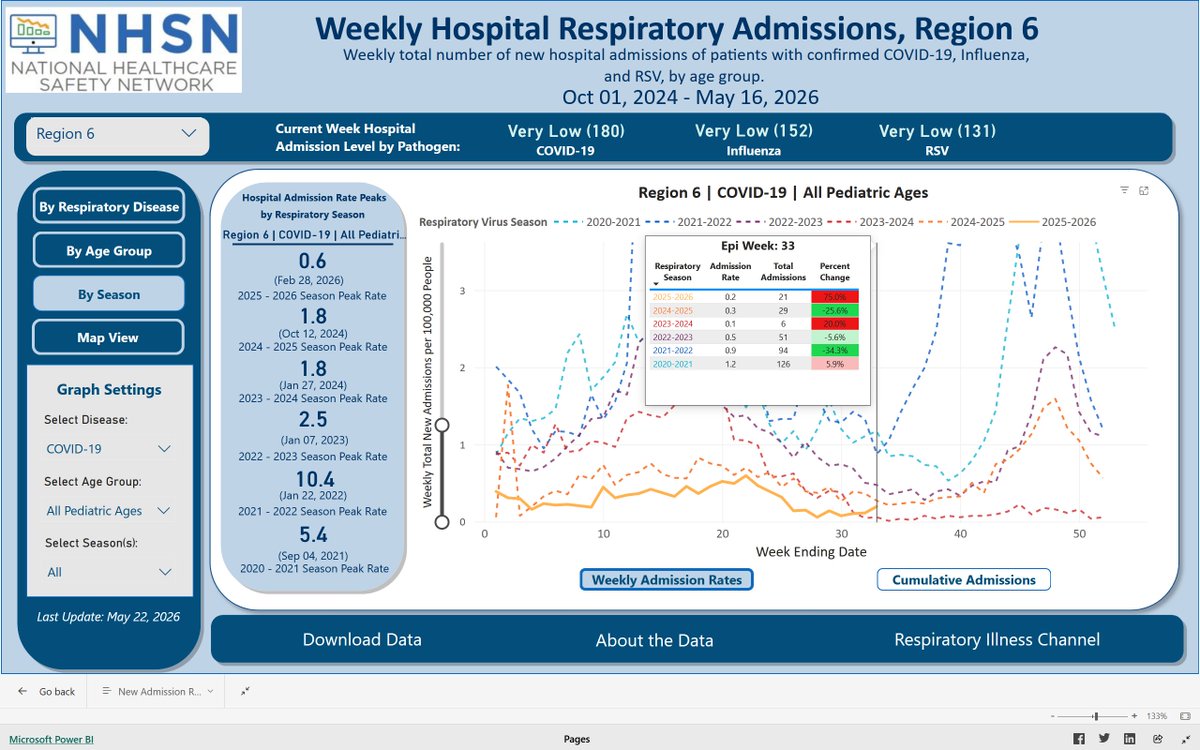


🚨🚨US reports higher COVID hospital admissions for ages 0-4 in 2026 than 2024! COVID now reigns, with more hospital admissions compared to either RSV or Influenza! Admissions are down from last week. State map shows that darker states are worse.
🚨 THE FIRST COMPANIES TO ACTUALLY USE AI AT SCALE ARE NOT ABLE TO AFFORD IT. Big Tech created a manufactured demand bubble by giving billions to AI startups under strict contracts that force them to hand that exact cash right back to buy cloud servers. Because this money simply travels in a circle, these startups never had to face the real, staggering expense of running giant AI models. This round trip loop created a protected environment where companies could burn through infinite data because they were essentially playing with house money. But the exact moment this technology leaves the safe loop and hits a normal company with a hard budget constraint, the unit economics break completely. Real enterprise customers do not get their cash recycled back to their own balance sheets. Every token bill is a final cash outflow. This is why Uber gave AI coding tools to 5,000 engineers and exhausted its entire annual AI budget by April, with power users burning up to $2,000 a month each. The invoices are so high that even Microsoft just ordered 100,000 of its own engineers to stop using Claude Code by June because the uncapped token billing became completely untenable. Microsoft has a multi-billion dollar partnership with Anthropic, yet had to cancel internal usage because the tool costs too much to run. Nvidia's VP of applied deep learning admitted that the cost of compute for his team is now far higher than the actual salaries of his human workers. Wall Street thinks that falling chip prices will automatically fix this, but the math behind agentic AI makes that assumption impossible. Gartner confirms that even if per-token prices drop 90% by 2030, total corporate bills will keep rising because active AI agents run continuously and resend massive conversation histories, multiplying token consumption up to 30 times per task. The circular loop successfully fabricated a massive growth story to pump up a $2 trillion cloud backlog, but it hid a product that is structurally too expensive for the real economy to actually deploy. The massive gap between optimistic earnings call statements and the actual invoices landing on corporate desks is the most mispriced risk in global finance today.




Flock cameras don’t just grab your license plate. They log: • Dents/stickers/damage/decals on car • Likeness of driver (clothing & facial details) • Direction, speed, duration of time on roads • Accompanying passenger count These cameras are Orwellian & unconstitutional.




🇺🇸Artificial Intelligence for Intelligence Agencies On the U.S. Intelligence Community’s Secret $9 Billion Request According to *The New York Times*, the U.S. intelligence community has secured approval for a classified $9 billion funding request to procure AI chips and deploy its own dedicated AI infrastructure for the CIA, NSA, and other intelligence agencies. Why do they need this? ▪️ Intelligence agencies complain that, due to a shortage of high-performance semiconductors, they are losing the competitive race against commercial "Big Tech" firms and are unable to fully deploy AI models on their own secure, closed networks. ▪️ The $9 billion request is intended to bridge this gap - specifically, to purchase specialized GPUs and accelerators, and to construct new data centers to house them that are completely isolated from civilian cloud services. ▪️ A separate, distinct issue involves the NSA and Anthropic. The Agency is already utilizing one of the company’s most powerful AI models; moreover, according to press reports, the White House Chief of Staff has authorized the continuation of this collaboration, despite Pentagon concerns regarding security risks and supply chain vulnerabilities. In essence, the intelligence community is openly acknowledging that, at present, it cannot effectively carry out its mission without the assistance of commercial AI developers. The U.S. is effectively constructing yet another "government AI cloud" - this time, however, it is specifically for intelligence agencies operating outside the purview of the Pentagon. This represents a logical step: the analysis of intercepted communications, satellite imagery, massive OSINT datasets, and cyber operations demands colossal computing resources - resources that, for reasons of national security and classification, cannot be hosted on commercial platforms such as Amazon or Google. At the same time, a critical vulnerability is being exposed: even the U.S. intelligence community remains dependent on the very same supply chain bottleneck - namely, a handful of chip manufacturers - that affects the entire global market. Consequently, a parallel struggle is underway to secure control over supply chains (manifested through export restrictions on China and subsidies for domestic manufacturing facilities), alongside ongoing discussions regarding whether government agencies themselves should directly participate in joint ventures to develop specialized AI hardware. For other nations, what matters in this story is not so much the size of the investment as its direction. If Washington is systematically pouring billions - not into AI models, but specifically into "hardware for intelligence" - it signifies that AI has become just as fundamental an element of security infrastructure as satellites and early warning systems once were. And the race for advanced chips is, in effect, a new form of technological rearmament - one where falling behind in hardware production automatically translates into falling behind in intelligence capabilities. nytimes.com/2026/05/22/us/… rybar


🚨 THE FIRST COMPANIES TO ACTUALLY USE AI AT SCALE ARE NOT ABLE TO AFFORD IT. Big Tech created a manufactured demand bubble by giving billions to AI startups under strict contracts that force them to hand that exact cash right back to buy cloud servers. Because this money simply travels in a circle, these startups never had to face the real, staggering expense of running giant AI models. This round trip loop created a protected environment where companies could burn through infinite data because they were essentially playing with house money. But the exact moment this technology leaves the safe loop and hits a normal company with a hard budget constraint, the unit economics break completely. Real enterprise customers do not get their cash recycled back to their own balance sheets. Every token bill is a final cash outflow. This is why Uber gave AI coding tools to 5,000 engineers and exhausted its entire annual AI budget by April, with power users burning up to $2,000 a month each. The invoices are so high that even Microsoft just ordered 100,000 of its own engineers to stop using Claude Code by June because the uncapped token billing became completely untenable. Microsoft has a multi-billion dollar partnership with Anthropic, yet had to cancel internal usage because the tool costs too much to run. Nvidia's VP of applied deep learning admitted that the cost of compute for his team is now far higher than the actual salaries of his human workers. Wall Street thinks that falling chip prices will automatically fix this, but the math behind agentic AI makes that assumption impossible. Gartner confirms that even if per-token prices drop 90% by 2030, total corporate bills will keep rising because active AI agents run continuously and resend massive conversation histories, multiplying token consumption up to 30 times per task. The circular loop successfully fabricated a massive growth story to pump up a $2 trillion cloud backlog, but it hid a product that is structurally too expensive for the real economy to actually deploy. The massive gap between optimistic earnings call statements and the actual invoices landing on corporate desks is the most mispriced risk in global finance today.

🚨 THE FIRST COMPANIES TO ACTUALLY USE AI AT SCALE ARE NOT ABLE TO AFFORD IT. Big Tech created a manufactured demand bubble by giving billions to AI startups under strict contracts that force them to hand that exact cash right back to buy cloud servers. Because this money simply travels in a circle, these startups never had to face the real, staggering expense of running giant AI models. This round trip loop created a protected environment where companies could burn through infinite data because they were essentially playing with house money. But the exact moment this technology leaves the safe loop and hits a normal company with a hard budget constraint, the unit economics break completely. Real enterprise customers do not get their cash recycled back to their own balance sheets. Every token bill is a final cash outflow. This is why Uber gave AI coding tools to 5,000 engineers and exhausted its entire annual AI budget by April, with power users burning up to $2,000 a month each. The invoices are so high that even Microsoft just ordered 100,000 of its own engineers to stop using Claude Code by June because the uncapped token billing became completely untenable. Microsoft has a multi-billion dollar partnership with Anthropic, yet had to cancel internal usage because the tool costs too much to run. Nvidia's VP of applied deep learning admitted that the cost of compute for his team is now far higher than the actual salaries of his human workers. Wall Street thinks that falling chip prices will automatically fix this, but the math behind agentic AI makes that assumption impossible. Gartner confirms that even if per-token prices drop 90% by 2030, total corporate bills will keep rising because active AI agents run continuously and resend massive conversation histories, multiplying token consumption up to 30 times per task. The circular loop successfully fabricated a massive growth story to pump up a $2 trillion cloud backlog, but it hid a product that is structurally too expensive for the real economy to actually deploy. The massive gap between optimistic earnings call statements and the actual invoices landing on corporate desks is the most mispriced risk in global finance today.

Tucker Carlson exposes a terrifying revelation. BlackRock CEO Larry Fink openly admits he fears domestic uprisings against AI data centers. He confirms elites are terrified that ordinary citizens will use cheap drones to completely destroy their billion dollar tech investments.
🚨 THE FIRST COMPANIES TO ACTUALLY USE AI AT SCALE ARE NOT ABLE TO AFFORD IT. Big Tech created a manufactured demand bubble by giving billions to AI startups under strict contracts that force them to hand that exact cash right back to buy cloud servers. Because this money simply travels in a circle, these startups never had to face the real, staggering expense of running giant AI models. This round trip loop created a protected environment where companies could burn through infinite data because they were essentially playing with house money. But the exact moment this technology leaves the safe loop and hits a normal company with a hard budget constraint, the unit economics break completely. Real enterprise customers do not get their cash recycled back to their own balance sheets. Every token bill is a final cash outflow. This is why Uber gave AI coding tools to 5,000 engineers and exhausted its entire annual AI budget by April, with power users burning up to $2,000 a month each. The invoices are so high that even Microsoft just ordered 100,000 of its own engineers to stop using Claude Code by June because the uncapped token billing became completely untenable. Microsoft has a multi-billion dollar partnership with Anthropic, yet had to cancel internal usage because the tool costs too much to run. Nvidia's VP of applied deep learning admitted that the cost of compute for his team is now far higher than the actual salaries of his human workers. Wall Street thinks that falling chip prices will automatically fix this, but the math behind agentic AI makes that assumption impossible. Gartner confirms that even if per-token prices drop 90% by 2030, total corporate bills will keep rising because active AI agents run continuously and resend massive conversation histories, multiplying token consumption up to 30 times per task. The circular loop successfully fabricated a massive growth story to pump up a $2 trillion cloud backlog, but it hid a product that is structurally too expensive for the real economy to actually deploy. The massive gap between optimistic earnings call statements and the actual invoices landing on corporate desks is the most mispriced risk in global finance today.

Artificial intelligence is causing a net U.S. loss of 16,000 jobs per month, per Goldman Sachs.







BREAKING: Verily reports US national SARS-2 levels are UP 20% from 1 week earlier after revisions as of May 14. The West is up 76% from May 7! The South is up 23% from May 7! WWscan hasn't yet updated the heavily weighted West yet past May 13, and will update later today. The Northeast was downgraded to LOW category. Biofire reports 0.8% SARS-CoV-2 positivity for the 3rd time recently, an ALL TIME LOW. Prior reports were all revised upward later.