Edwin Hu

105 posts

Edwin Hu

Edwin Hu

@_edwinhu_

Associate Professor @UVALaw. Former @SECGov Economist, @SECJackson Counsel, Division of Elon Musk.

Katılım Temmuz 2016
277 Takip Edilen96 Takipçiler
Sabitlenmiş Tweet
Edwin Hu retweetledi
NBER
NBER@nberpubs·
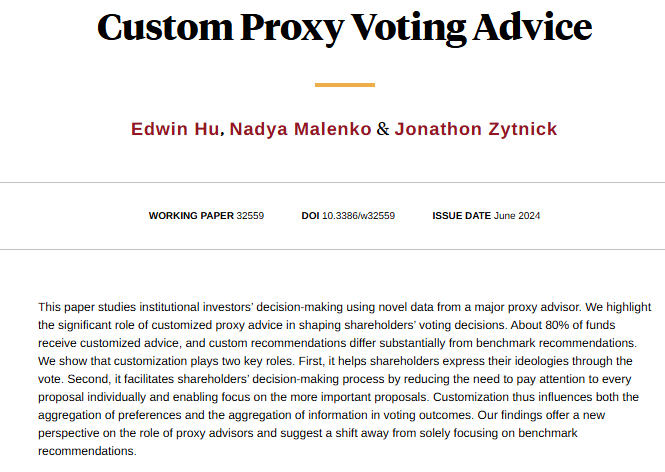
Institutional investors rely heavily on customized recommendations from proxy advisors. Customization helps funds express their ideologies and allocate attention effectively, from @_edwinhu_, @nmalenko, and Jonathon Zytnick nber.org/papers/w32559
NBER tweet media
English
0
4
8
4.7K
Edwin Hu
Edwin Hu@_edwinhu_·
@AnthonyLeeZhang And of course secondary trades on an exchange are normally not public offerings because they don’t involve the “issuer” or their “underwriter.” By contrast a direct listing is a programmatic sale that involves an issuer.
English
1
0
1
61
Edwin Hu
Edwin Hu@_edwinhu_·
@AnthonyLeeZhang Yes, once you have answered the threshold question of is it (ever) a security, you look at whether the offering was illegal. It should have come out the opposite. Institutional sales likely exempt (not a “public offering”), but programmatic sales definitely a “public offering.”
English
1
0
1
64
alz
alz@alz_zyd_·
Not a lawyer and definitely not legal advice, but isn't the following logic in the XRP case kinda self-referential - If I sell XRP on exchanges only, there is no reasonable expectation of profit hence XRP not a security - Hence exchanges can list XRP? Since XRP not a security?
English
2
0
6
2.4K
Edwin Hu
Edwin Hu@_edwinhu_·
@kadhim yeah it makes no sense. a direct listing is a programmatic sale via an auction.
English
0
0
1
77
kadhim (^ー^)ノ
kadhim (^ー^)ノ@kadhim·
So when Ripple sold to sophisticated investors, those investors were protected by securities laws, but when it sold its token to retail, those unsophisticated investors weren't? It's pretty much the inverse of our normal understanding of how securities laws function
English
8
13
44
9.2K
Edwin Hu
Edwin Hu@_edwinhu_·
@AnthonyLeeZhang @theshah39 A DAO that can—through tokenomics, pricing, or vote weights—allocate value would potentially be a viable for-profit member-investor hybrid entity. I suspect most DAOs will degenerate into investor-owned entities unless they are basically run as nonprofits.
English
0
0
2
0
Edwin Hu
Edwin Hu@_edwinhu_·
@AnthonyLeeZhang @theshah39 Voting weights maybe a second or third-best option, but not clear that "loyalty shares" model of Curve approximates that either.
English
1
0
1
0
Edwin Hu retweetledi
Silla Brush
Silla Brush@sabrush·
US regulators are expanding their crackdown on misleading labels of investment products with a probe focused on whether managers of funds marketed as sustainable are trading away their right to vote on ESG issues bloomberg.com/news/articles/… via @business
English
1
8
4
0
Edwin Hu
Edwin Hu@_edwinhu_·
But the argument that proxy votes "impose" on firms makes little since since proposals are precatory under Delaware law.
English
0
0
0
0
Edwin Hu
Edwin Hu@_edwinhu_·
To be sure, there may be reasons to prefer engagement over proxy voting as there is at least correlative evidence that the former is effective (in Europe). doi.org/10.1016/j.jfin…
English
1
0
0
0
Edwin Hu
Edwin Hu@_edwinhu_·
@SMTuffy Yup. Levered/inverse was the main thing our office was concerned about. I was under the impression that this would be addressed by other rules. The surprise (to me) is that the industry got these through before the SEC/FINRA added those safeguards. sec.gov/news/public-st…
English
0
0
1
0
Edwin Hu
Edwin Hu@_edwinhu_·
@SMTuffy In trying to streamline the ETF registration process (and derivatives rules) the SEC (inadvertently) opened the door to these products. Funds no longer have to seek individual exemptive relief or "approval" as long as they meet certain reqs.
English
1
0
1
0
Matt Levine
Matt Levine@matt_levine·
@IvanTheK but like ... to the extent that exchanges are listing obviously equity-like governance tokens and VCs are blowing them out to retail, that is just much more important than one little insider trader and it is weird to start here.
English
3
1
30
0
alz
alz@alz_zyd_·
Also true that some forms of tradfi HFT competition are not wasteful, like colocation auctions twitter.com/_edwinhu_/stat…
Edwin Hu@_edwinhu_

@AnthonyLeeZhang Digging cables is only one form of the HFT arms race though. Exchanges selling co-location in their server facilities is "competitive bidding" for speed as well. Since it doesn't seem to produce positive liquidity externalities, could just be monopoly rent extraction.

English
2
0
2
0
alz
alz@alz_zyd_·
Random thought (which I might substack in the future): Gas fee races/MEV competition has many similarities to "speed races" in tradfi HFT. However, one surprising thing is that gas fee races are less socially wasteful than HFT speed races!
English
2
0
15
0