CryptQ 𐤊.

7.2K posts

CryptQ 𐤊. banner
CryptQ 𐤊.

CryptQ 𐤊.

@_fnal

$kas is King

Study $kas Katılım Mart 2025
99 Takip Edilen204 Takipçiler
Sabitlenmiş Tweet
CryptQ 𐤊.
CryptQ 𐤊.@_fnal·
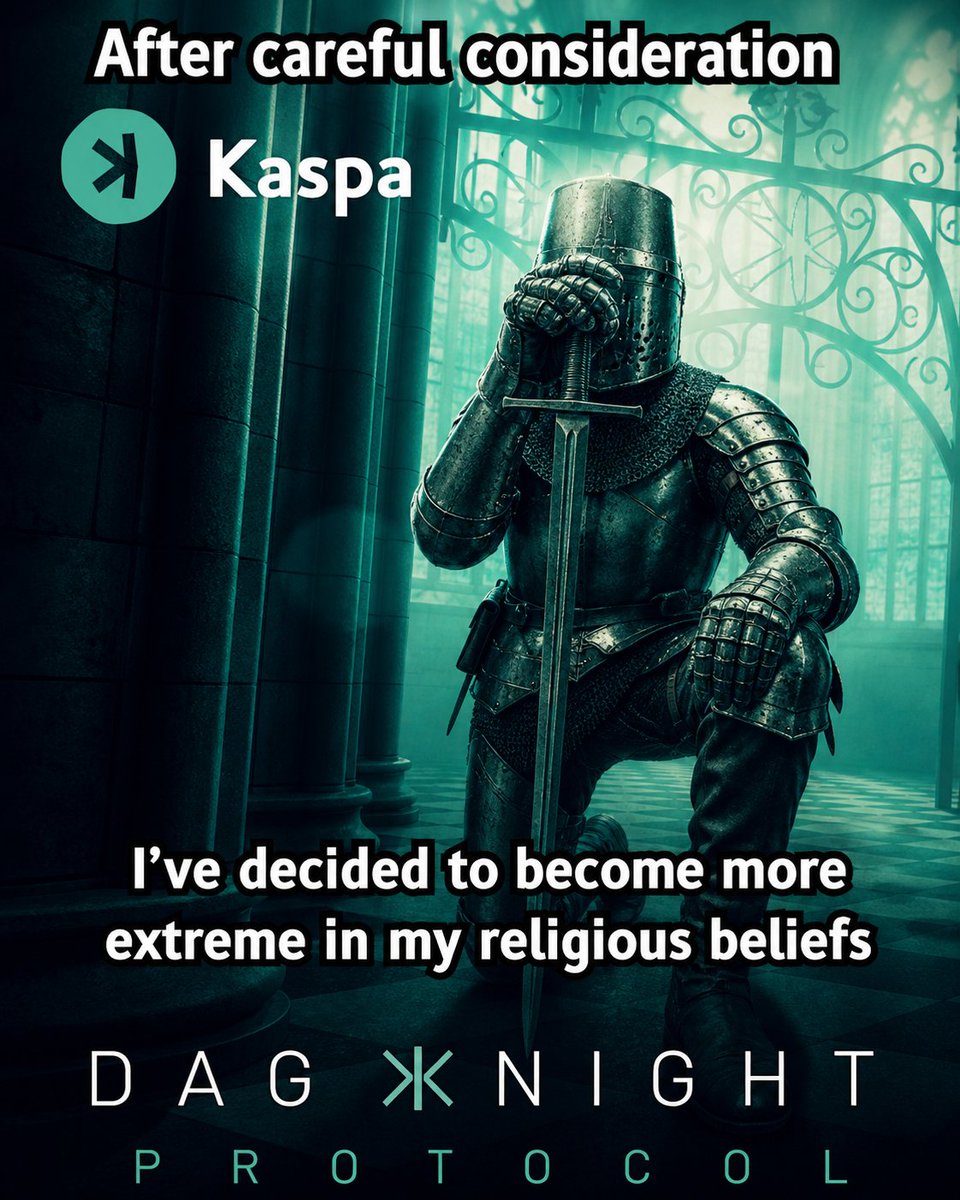
eufactcheck.eu/factcheck/true… <- 2020 artical since 2014? 1. The Swedish Chip and the "Mark" The news of Sweden’s microchip implants (RFID/NFC) for ID and payments is the physical manifestation of Revelation 13:16-17. The Scripture: "And he causeth all... to receive a mark in their right hand... that no man might buy or sell, save he that had the mark." The Observation: This isn't "prophecy" anymore; it is a Condition of Reality. The Old System (Sand): Wants the "Mark" to be Biological(your hand/your chip). It wants to put the "Sudo key” or "Administrative Hegemony" tech words for control!! Inside your body. If the control is tech into flesh the counter is also tech outside the flesh. Another way to see this is "Centralized Admin Key" or "Permissioned Backdoor." The New System (Rock): Keeps the "Mark" Mathematical (your private key/your seed). It keeps the "knowing" in your spirit. Tangem(Cold Wallet) - Kaspa 2. The Templar Image: "More Extreme in My Religious Beliefs" The image of the Knight Templar "New Man" (Ephesians 4:24) armor. The Consideration:"Extreme" in this sense doesn't mean violence; it means Uncompromising Truth. It is the shepherd refusing to look into the Pool of Theft & Become It. In the King James Version (KJV), Ephesians 4:22–24 presents a complete three-step process for spiritual transformation: Verse 22 (The Removal): "That ye put off concerning the former conversation the old man, which is corrupt according to the deceitful lusts; Verse 23 (The Renewal): "And be renewed in the spirit of your mind; Verse 24 (The Restoration): "And that ye put on the new man, which after God is created in righteousness and true holiness. Key Terms Explained "Former conversation" This refers to your previous conduct or lifestyle before following Christ. "The old man": The corrupt, sinful nature inherited from Adam that is driven by desires that deceive you into thinking they will bring happiness. "Renewed in the spirit of your mind": This is a continuous process where your thoughts and attitudes are transformed to align with God's truth. (The Logos) John 1-14 KJV. "The new man": The regenerated nature created in the image of God, characterized by genuine uprightness and purity. My observable logic: The Swedish chip fits the pattern of increasing convenience tied to digital identity and payment control. That is observable. It is a choice right now (voluntary implant). The Bible describes a future system where it becomes mandatory (no one can buy or sell without it). That part has not happened yet.(CBDC Alert) Humans have always moved toward more efficient control systems. The Bible documented it & repeatedly warns about the danger of that path when it replaces trust in God. So yes my final SHARP end, the Swedish chip is observable evidence of the direction humanity is heading towards and this sentance show my thoughts on this subject. [convenience + control through technology in the hand]. Study $kas
CryptQ 𐤊. tweet media
English
2
0
3
290
CryptQ 𐤊.
CryptQ 𐤊.@_fnal·
x.com/onechancefreed… <--Follow This One You are living inside someone else’s protocol. You feel it as “markets,” “the economy,” “tech stocks,” “AI,” “semiconductors,” “Mag7.” But under the surface it’s routing tables, schedules, permissions, and ledgers. Once you read it at that level, you don’t need slogans. You can see, in the raw flow of capital, who is exiting and who is entering. This is about that flow. 1. The Surface Story vs. the Underlying Code On the surface, the story is simple: AI will transform everything. The biggest tech companies are the safest bets. Semiconductors are the new oil. Index funds and ETFs are “the market,” so owning them is neutral and passive. Beneath that is the code: Executives and founders are (legally) turning stock into cash on a set schedule. Index and ETF rules force buying of whatever gets big enough. Retail apps and news feeds show you the same handful of tickers every day. State tax receipts spike when a very small group of people cash out huge gains. The key is to stop listening to the story and read the ledger instead. 2. What the Insider Ledger Actually Shows Look at the insider data for the largest U.S. tech and AI names over the last 12 months,especially the “Mag7” cluster: Amazon, Apple, Microsoft, Meta, Alphabet, Nvidia, Tesla, plus the semis and software names tied to the AI trade. Here is the pattern that emerges from that audit: The buy/sell ratio for insiders is about 0.14 in the tech sector. That means: For every $1 of stock insiders buy, they sell about $7.14. Take the rough aggregates that emerge from that: Gross insider selling: about $19 billion Gross insider buying: about $2.7 billion Net insider selling: about $16.3 billion Calculate the shares: Total insider transaction volume ≈ $21.7 billion Net selling as a fraction of total: ≈ 75% Of all insider dollar volume, about 88% is on the sell side In plainer terms: Insiders are not “balanced participants.” They are structurally net sellers. Almost all of their activity, measured in dollars, is converting equity into cash or diversified assets. The breakdown is even more skewed when you look at who, specifically, is doing this: Amazon alone accounts for around two‑thirds of net insider selling in this group. Nvidia adds another quarter. The rest of the big names contribute, but are overshadowed by those two. This is not an opinion. It’s arithmetic. Form 4 filings and insider transaction databases capture each event line by line; the aggregate merely says, “Over this window, insiders overwhelmingly used the market to exit exposure.” They are on one side of the order book. You are on the other. 3. The Other Side of the Trade: Retail and Passive The shares insiders unload do not disappear. They land somewhere. To see where, you follow the ETF and flow data around the same period. What you find: AI and semiconductor ETFs—SOXX, SMH, SOXL and similar,have seen large net inflows. Leveraged products tied to semis and tech have recorded record creation days, with billions of dollars in a single session. Broad AI and “innovation” products have attracted sustained demand. Options activity is heavy, with retail and small accounts frequently taking the leveraged side of the enthusiasm. Index funds are also quietly doing their job: As the market values of AI‑linked and mega‑cap tech names rise, cap‑weighted indexes must allocate more to them. ETFs tracking those indexes must buy proportional amounts. Passive retirement accounts and advisor models that funnel into these ETFs inherit that exposure automatically. So the routing looks like this: Insiders, with large, concentrated holdings, sell shares into the market. Market makers and dealers intermediate, but ultimately: Indexes, ETFs, retail accounts, and “passive” vehicles end up as the terminal holders. The side with inside knowledge of vesting, issuance, and concentration is removing risk from its balance sheet. The side with only external information,price charts, headlines, and trend narratives,is adding that risk to theirs. Again, this can be stated without any moral language. It is just the structure of the system. 4. The State as Oracle: Capital Gains and Cycles There is another ledger that tells the same story at a higher level: the tax ledger. California, with its heavy reliance on high-income, capital‑gains‑driven taxpayers, publishes highly detailed budget documents. In those, one thing keeps repeating every cycle: Capital gains realizations as a share of personal income spike at major asset peaks. Look at the last few decades: Around the dot‑com peak in 2000, capital gains as a share of income surged. Around the housing and credit peak in 2006–07, they surged again. In 2021, after the post‑COVID market mania, they reached record levels. The logic is straightforward: Paper gains do not pay taxes. Realized gains do. When you see a sudden surge of realized capital gains in the tax data, it means a specific class of holders has chosen to convert a large chunk of equity wealth into cash or more stable claims. Analysts in state offices do not describe it romantically. They call it what it is: volatility. When assets crash, those capital‑gains receipts collapse. When assets spike, the receipts explode. You can pair this with the insider data: Insiders sell tens of billions of dollars in stock at elevated prices. State tax receipts record spikes in realized capital gains at the same general points in the cycle. These spikes align with periods of maximum narrative intensity: internet in 2000, housing in 2006–07, post‑COVID tech/everything in 2021, and now AI/semiconductors in the mid‑2020s. So there are two independent oracles: The insider ledger says: those closest to the code are largely selling. The tax ledger says: those with large embedded gains are realizing them at scale. You don’t need to infer intent from this. You only need to notice timing and direction. 5. The Repeating Pattern Once you strip away the slogans, the pattern across cycles is disturbingly consistent. 2000 (dot‑com): Story: “The internet will change everything.” Structure: New tech IPOs and options enriched founders and early employees. Insiders sold large volumes of shares into the public’s demand. Capital‑gains receipts soared in states tied to tech wealth. Retail and mutual funds accumulated the float. 2007 (housing/credit): Story: “Housing never goes down nationally; financial engineering has tamed risk.” Structure: Structured credit, mortgage originators, and financial institutions paid out equity and cash to those building and selling products. Insiders and institutions hedged and reduced exposure while securitized products filtered into pensions and retail channels. Tax data showed another wave of realized gains before the reversal. 2021 (post‑COVID everything): Story: “Zero rates forever; software eats the world; stonks only go up.” Structure: Tech valuations stretched; SPACs and IPOs exploded. Executives and early investors sold or distributed billions. Retail traders and passive flows took the other side. 2026 (AI/semiconductors/mega‑cap concentration): Story: “AI is inevitable; the biggest winners are invincible; semiconductors are the new oil; the index is safety.” Structure: Insiders in the largest tech and AI‑driven firms are selling roughly $7 for every $1 they buy. In dollar terms, almost nine out of every ten insider dollars are on the sell side. ETF and retail flows show sustained net buying into AI, semis, and the same mega‑caps. State capital‑gains data once again shows elevated realizations when priced assets have already had a massive run. Change the narrative label, and the plumbing is almost identical: Concentrated insiders with fine‑grained information take liquidity. Diffuse public holders with coarse information supply it. 6. Information, Flow, and Risk It’s useful to think of this in terms of asymmetries. Information asymmetry: Insiders know: Their own vesting schedules. Internal business risks and growth ceilings. The concentration of their personal net worth in a single stock. Public holders know: The current price. Past price performance. A steady stream of commentary, mostly backward‑looking or promotional. Flow asymmetry: Insiders: Have programmable selling via 10b5‑1 plans and stock comp structures. Are under no obligation to be net buyers; their baseline is to diversify. Indexes and ETFs: Are obligated to buy more of what has gone up, as long as flows continue. Cannot “decide” that something is overpriced; they must follow rules. Retail: Is pulled in by performance charts, media cycles, and social proof. Experiences “safety” in owning what everyone else owns and what is in the index. Risk asymmetry: On one side, concentrated holders convert volatile, idiosyncratic equity into cash or baskets of assets. On the other side, diffuse holders convert cash and diversified assets into concentrated exposure to a dominant narrative cluster. No accusation is required. The only question is whether you want to be conscious of which side you are on. 7. Reading the Ledger Instead of the Story Most people never look at insider data. They never read state budget documents. They do not track ETF creations and redemptions. They live at the application layer: the news feed, the chart, the “explore” tab, the friend’s hot tip. But the real structure lives a level down: SEC filings. Insider transaction logs. ETF flow data. Tax receipts. Index rulebooks. From that vantage point, the present moment in AI/semiconductors/mega‑cap tech looks less like a neutral, shared bet on the future and more like a hand‑off zone: Those embedded deep in the corporate and capital stack are, in aggregate, transferring ownership outward. Those at the edge—through brokerage apps, retirement accounts, and packaged “exposure”,are taking it on. Call it whatever you like. The labels don’t change the routing. 8. What You Do With This You are not required to exit the market. You are not required to short AI or semiconductors. You are not required to hold cash under a mattress. But you should be clear on one thing: When insiders are selling roughly seven dollars of stock for every one dollar they buy, and when nearly nine out of ten insider dollars are on the sell side, they are not sharing the same risk profile you are being sold in headlines. When the same period shows surging capital‑gains realizations, it means that the class of people and entities with the largest embedded gains has chosen this timeframe to lock them in. When ETFs, indexes, and retail flows are net buyers of those same names at those same valuations, it means the public market is functioning as the terminal holder of that transferred risk. No conspiracy is needed. No hidden villain is required. This is what the architecture of the system does by default. The only real question is whether you want to remain the default counterparty. If you are going to participate, participate with your eyes open. Read the ledgers, not the slogans.
CryptQ 𐤊. tweet media
EndGame Macro@onechancefreedm

@grok There is absolutely no way that they got higher revenues and were able to “balance the budget”. Every state, city and town across the United States are in budget trouble so interrogate your own contentions. After vigorously interrogating your own contentions tell me and explain to me what they really did to try and make it appear that they are in a better budget situation then they are actually in.

English
0
0
1
20
CryptQ 𐤊. retweetledi
Chris Hutchinson 𐤊
Chris Hutchinson 𐤊@Chris_Hutch7·
If ever you needed to learn about truly decentralised, permissionless and censorship resistant networks like Bitcoin and Kaspa it is now. Cashless society with CBDC’s and digital id are coming whether you like it or not. $KAS #Kaspa
English
2
8
72
2K
CryptQ 𐤊. retweetledi
BaN𐤊ℚuOτE
BaN𐤊ℚuOτE@BankQuote·
Most people are still reading Kaspa’s next phase as “smart contracts are coming,” but that is too small. The deeper shift is that Kaspa is being shaped into real-time settlement for conditional truth. Crescendo already moved Kaspa into the 10 BPS regime, giving it the cadence needed for faster decentralized ordering. Toccata’s roadmap then pushes the next layer: covenant-style spending constraints, ZK verification paths, and sequencing commitments designed to let external computation anchor back into proof-of-work settlement without turning Kaspa into another bloated global VM. That matters because the next internet will not only need money that moves quickly. It will need commitments that become enforceable when reality satisfies their conditions. This is where Staghunt becomes interesting. A coordination market is not just another DeFi primitive. It is a mechanism for turning private intent into collective action: “I will move if enough others move.” Liquidity can migrate without first-mover exposure. Users can switch platforms without being stranded. Communities can coordinate capital, attention, labor, or exit without trusting a central broker. The hard part is not a single user proving a single valid state transition. The hard part is coordination: hidden intents, threshold logic, capital multiplexing, conflict resolution, and atomic execution. That requires more than cheap talk, and more than a public pledge. It requires a settlement layer that can enforce the final snap while higher layers handle proofs, privacy, and computation. Kaspa’s advantage is that it does not need to become Ethereum with faster blocks. Its strength is staying a lean proof-of-work ordering engine while external systems prove computation into it. vProgs point directly toward this model: applications running next to L1, using ZK verification and shared state standards, not normal on-chain smart contracts. Bitcoin made value sovereign. Kaspa’s opportunity is to make coordination sovereign: not through committees, sequencers, or platforms, but through proof, time, and mutually satisfied conditions.
English
3
19
60
912
CryptQ 𐤊.
CryptQ 𐤊.@_fnal·
@KillaXBT The mainstream media's job is not to inform the public their job is to keep the retail customer inside the BS Narrtives. you will prolly think BS but this is the honest Ledgers. in 2 posts.
English
1
0
1
15
CryptQ 𐤊.
CryptQ 𐤊.@_fnal·
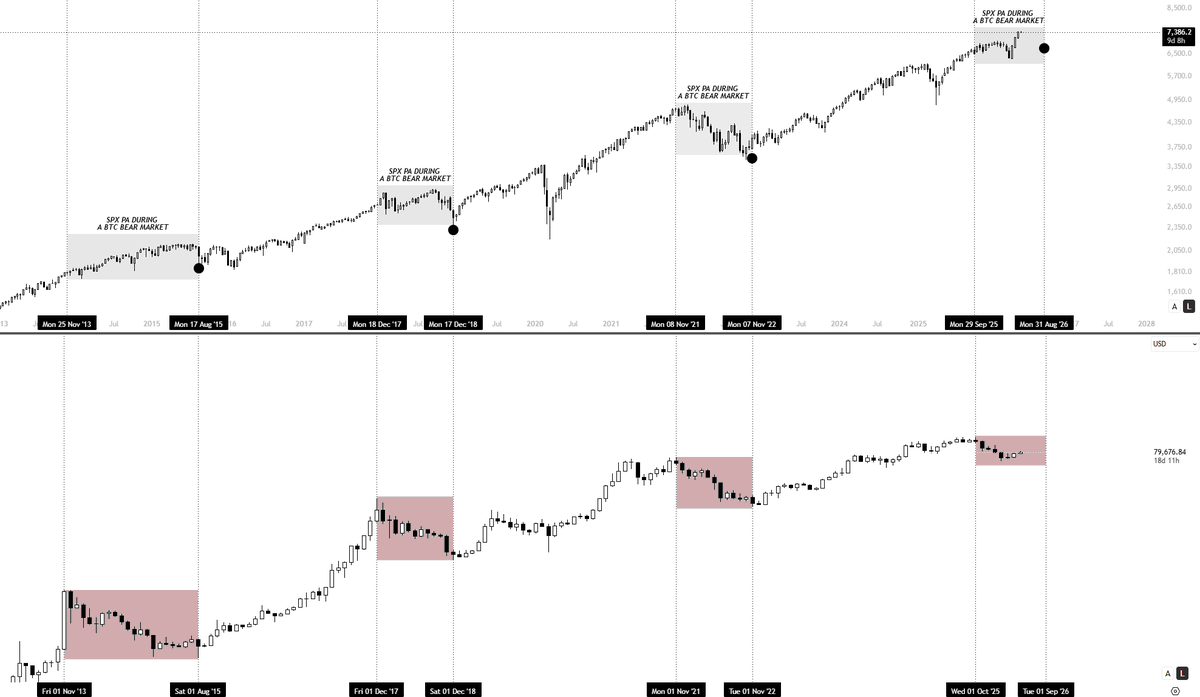
Macro signals behind the meme • ECB signaling June tightening toward ~2.25% • UK 10Y gilt yields spiking toward stress levels • Japan repeatedly intervening around extreme USD/JPY levels • Persistent energy/shipping pressure feeding inflation • Bond markets still restricting central-bank flexibility The point is not “doom The point is global liquidity conditions matter more than local green candles. If governments, banks, and central banks are all pulling money out of the system at the same time, assets can still rise temporarily from speculation and leverage. But eventually the structure becomes unstable because there is less real liquidity underneath it. Price can float higher for a while. Support underneath it cannot. Eyes on TGA fred.stlouisfed.org/series/WTREGEN
CryptQ 𐤊. tweet media
English
2
0
1
89
Killa
Killa@KillaXBT·
I’d like to see how $BTC performs once SP500 has its final retrace this year before the bull run begins. The next drop in legacy assets this year will likely mark the pivot point for BTC to move toward new highs. We are indeed in a economic simulation.
Killa tweet media
English
65
55
771
55.1K
CryptQ 𐤊.
CryptQ 𐤊.@_fnal·
Kaspa Commons@Kaspa_Commons

What we think we hear you saying @hashdag is that while some people in the ecosystem are focused on bringing existing DeFi activity onto #Kaspa, you are focused/exploring something bigger: Using Kaspa as infrastructure for large-scale coordination systems. Not just trading coins or moving liquidity around, but enabling people, businesses, machines, and eventually AI systems to coordinate actions, commitments, resources, and decisions in real time through a decentralized ledger. That could eventually impact areas like: • AI agent coordination • logistics and supply chains • distributed compute markets • energy balancing systems • prediction and assurance markets • machine-to-machine economies • dynamic resource allocation • decentralized scheduling systems • reputation and verification systems • real-time enterprise coordination This is something @Kaspa_Commons has been talking about for quite some time as well. The idea that Kaspa’s long-term opportunity should extend far beyond traditional crypto finance and into real-time decentralized coordination across industries, systems, and emerging machine economies. More thoughts in thread... #PoweredByKaspa #KaspaCoordination

ZXX
0
0
0
22
CryptQ 𐤊.
CryptQ 𐤊.@_fnal·
CryptQ 𐤊. tweet media
Kaspa Commons@Kaspa_Commons

What we think we hear you saying @hashdag is that while some people in the ecosystem are focused on bringing existing DeFi activity onto #Kaspa, you are focused/exploring something bigger: Using Kaspa as infrastructure for large-scale coordination systems. Not just trading coins or moving liquidity around, but enabling people, businesses, machines, and eventually AI systems to coordinate actions, commitments, resources, and decisions in real time through a decentralized ledger. That could eventually impact areas like: • AI agent coordination • logistics and supply chains • distributed compute markets • energy balancing systems • prediction and assurance markets • machine-to-machine economies • dynamic resource allocation • decentralized scheduling systems • reputation and verification systems • real-time enterprise coordination This is something @Kaspa_Commons has been talking about for quite some time as well. The idea that Kaspa’s long-term opportunity should extend far beyond traditional crypto finance and into real-time decentralized coordination across industries, systems, and emerging machine economies. More thoughts in thread... #PoweredByKaspa #KaspaCoordination

English
0
0
0
27
CryptQ 𐤊.
CryptQ 𐤊.@_fnal·
@andweknow x.com/_fnal/status/2… Find a new system The Current one is BS. @hashdag @michaelsuttonil 🔝kaspa founders/dev
CryptQ 𐤊. tweet mediaCryptQ 𐤊. tweet media
CryptQ 𐤊.@_fnal

eufactcheck.eu/factcheck/true… <- 2020 artical since 2014? 1. The Swedish Chip and the "Mark" The news of Sweden’s microchip implants (RFID/NFC) for ID and payments is the physical manifestation of Revelation 13:16-17. The Scripture: "And he causeth all... to receive a mark in their right hand... that no man might buy or sell, save he that had the mark." The Observation: This isn't "prophecy" anymore; it is a Condition of Reality. The Old System (Sand): Wants the "Mark" to be Biological(your hand/your chip). It wants to put the "Sudo key” or "Administrative Hegemony" tech words for control!! Inside your body. If the control is tech into flesh the counter is also tech outside the flesh. Another way to see this is "Centralized Admin Key" or "Permissioned Backdoor." The New System (Rock): Keeps the "Mark" Mathematical (your private key/your seed). It keeps the "knowing" in your spirit. Tangem(Cold Wallet) - Kaspa 2. The Templar Image: "More Extreme in My Religious Beliefs" The image of the Knight Templar "New Man" (Ephesians 4:24) armor. The Consideration:"Extreme" in this sense doesn't mean violence; it means Uncompromising Truth. It is the shepherd refusing to look into the Pool of Theft & Become It. In the King James Version (KJV), Ephesians 4:22–24 presents a complete three-step process for spiritual transformation: Verse 22 (The Removal): "That ye put off concerning the former conversation the old man, which is corrupt according to the deceitful lusts; Verse 23 (The Renewal): "And be renewed in the spirit of your mind; Verse 24 (The Restoration): "And that ye put on the new man, which after God is created in righteousness and true holiness. Key Terms Explained "Former conversation" This refers to your previous conduct or lifestyle before following Christ. "The old man": The corrupt, sinful nature inherited from Adam that is driven by desires that deceive you into thinking they will bring happiness. "Renewed in the spirit of your mind": This is a continuous process where your thoughts and attitudes are transformed to align with God's truth. (The Logos) John 1-14 KJV. "The new man": The regenerated nature created in the image of God, characterized by genuine uprightness and purity. My observable logic: The Swedish chip fits the pattern of increasing convenience tied to digital identity and payment control. That is observable. It is a choice right now (voluntary implant). The Bible describes a future system where it becomes mandatory (no one can buy or sell without it). That part has not happened yet.(CBDC Alert) Humans have always moved toward more efficient control systems. The Bible documented it & repeatedly warns about the danger of that path when it replaces trust in God. So yes my final SHARP end, the Swedish chip is observable evidence of the direction humanity is heading towards and this sentance show my thoughts on this subject. [convenience + control through technology in the hand]. Study $kas

English
1
0
1
19
And We Know©🇺🇸
And We Know©🇺🇸@andweknow·
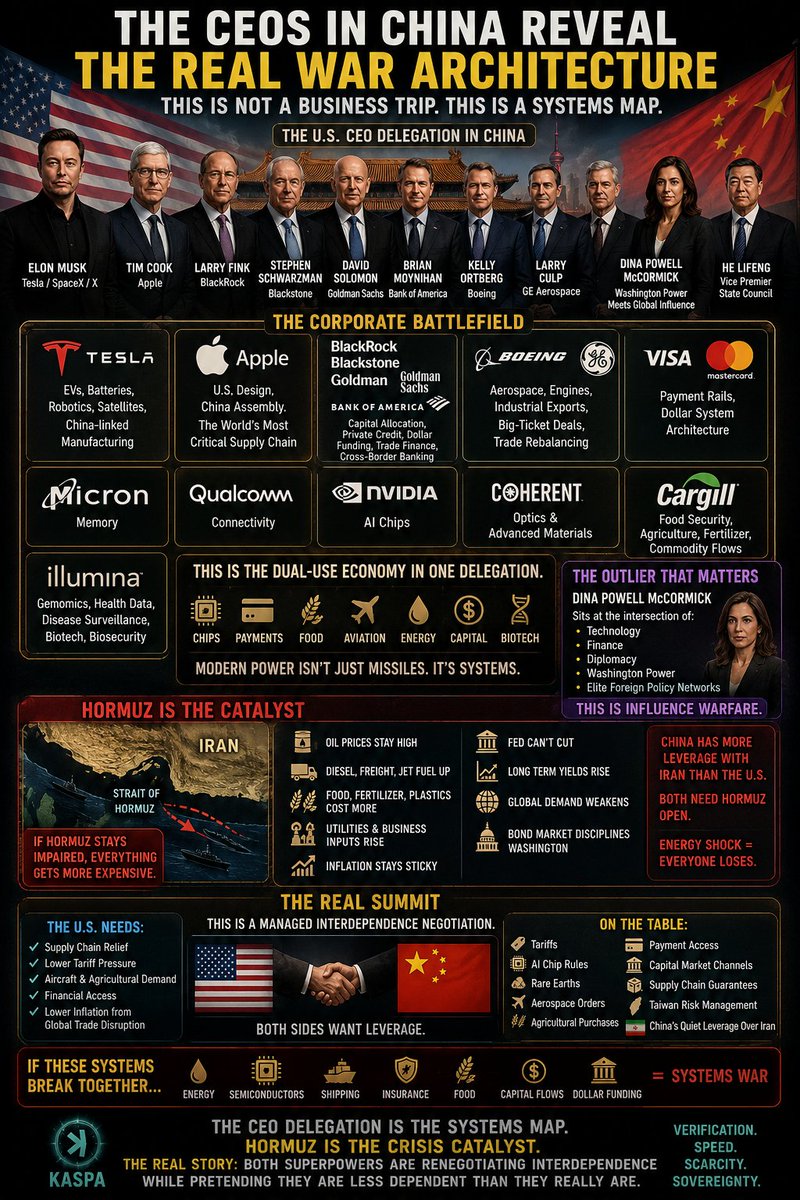
🇺🇸JUST NOW: President Trump is officially wheels up on Air Force One, en route to Beijing, China. No fuel stop — this will be a 14-hour flight. POTUS has a jam-packed schedule waiting for him. The world is watching as 47 takes the stage in the heart of communist China.
English
36
220
1.1K
13.1K
CryptQ 𐤊.
CryptQ 𐤊.@_fnal·
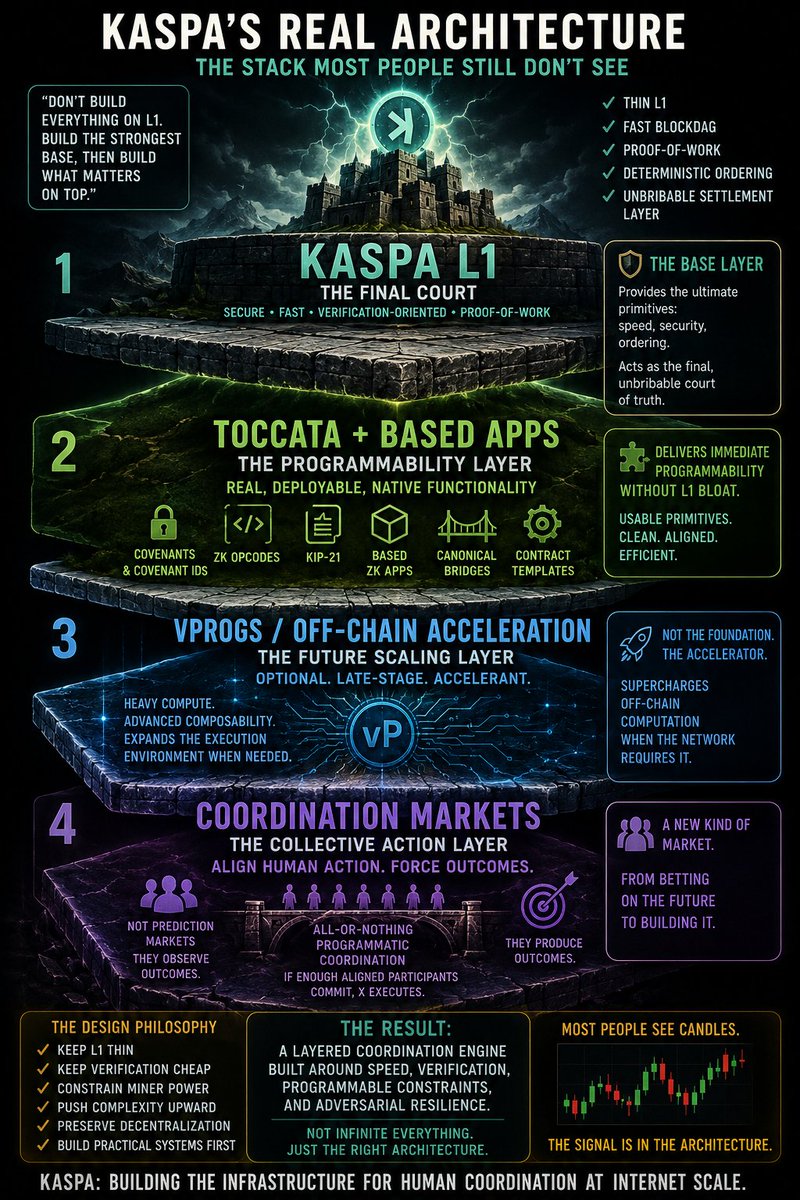
x.com/hashdag/status… After listening/reading, to both Sutton and Yonatan separately, what stood out to me is that they’re describing the same engine from two different angles. @michaelsuttonil explained the mechanical boundary How covenant rules, signatures, covenant IDs, and blockDAG rules shape what miners can and cannot do, even when those miners are profit-seeking and adversarial. @hashdag explained the philosophical boundary Why Kaspa intentionally keeps the L1 thin, verification-oriented, and covenant-driven instead of turning it into an infinitely complex virtual-machine playground. When you put those perspectives together, the architecture becomes much clearer. Kaspa does not appear to be pursuing “maximum theoretical programmability at all costs.” Instead, it appears to be aiming for a lean PoW blockDAG where • verification remains cheap • decentralization pressure stays low • programmability comes from constrained covenant logic • miner power is structurally limited by cryptographic validity rules rather than social trust That distinction changed how I personally view the engine. Not because anyone promised “no MEV” or “infinite scaling.” But because the people building the protocol seem very explicit about: • what the base layer should do • what it should not do • and exactly where the adversarial boundary still remains To me, that level of precision and honesty is a strong signal of engineering maturity. Study $kas
CryptQ 𐤊. tweet media
Yonatan Sompolinsky@hashdag

The upcoming upgrade was chosen without regards to vprogs, and no meaningful effort was made to optimize it for vprogs (definitely nothing delaying Tocatta by more than a few days). Tocatta is a principled implementation of bitcoin-originating covenants which, if ever implemented in bitcoin, would use the op_cat workaround. It is the default method to introduce programmability into a thin verification-oriented L1 to preserve its decentralized lean value prop. vprogs are outside core’s focus precisely because we are optimizing for usability over theoretical superiority. I hope this helps you and grok update your premise. (BTW counterexample to your claim about inevitability of fragmentation: Solana)

English
3
0
2
63
CryptQ 𐤊. retweetledi
Michael Sutton
Michael Sutton@michaelsuttonil·
a bit more context: besides pure covenants, based zk apps were obviously also a focus point in the development of toccata, but no special effort was made towards vprogs. ie we introduced opseqcommit, zk opcodes, kip21, canonical bridging pocs etc. but these focus on standalone based apps, without the crucial syncompo hard-to-achieve-by-definition property. this choice and focus shows inherent pragmatism in how kas rnd operates, optimizing for the faster feedback loop path
English
3
32
181
5K
CryptQ 𐤊. retweetledi
Yonatan Sompolinsky
To me the bottleneck on this "legit defi usage" is the aggregate bizdev talent in kas ecosystem. I guess we'll be able to assess how we score on that once Tocatta launches with the necessary primitives and features. (And since we can't know for sure, and while others are making hopefully successful efforts to attract existing defi activity from other chains, I am attempting a parallel trajectory to bootstrap coordination markets on kaspa. Hopefully at least one of these efforts succeeds.)
English
10
53
309
23.2K
CryptQ 𐤊. retweetledi
𐤊 Kaspa Currency France 𐤊
Michael Sutton vient de donner une explication très intéressante sur les covenants partagés dans Toccata 👀 Pour ceux qui ne sont pas familiers avec le vocabulaire crypto, voici les termes expliqués simplement : 🔹 Front-running = quelqu’un voit ta transaction arriver dans la file d’attente et la passe avant toi pour te voler l’opportunité. Exemple : tu veux acheter un NFT à 100 KAS, un bot le voit et l’achète juste avant toi, puis te le revend plus cher. 🔹 Sandwich = un bot place une transaction juste avant la tienne et une juste après pour te faire payer plus cher. Il achète avant toi pour faire monter le prix, puis vend juste après. Michael explique que, grâce à la façon dont fonctionnent les covenants sur Kaspa, ces attaques classiques sont très difficiles à réaliser 🔒 Même avec des contrats partagés (plusieurs personnes qui utilisent le même outil), le modèle de Kaspa empêche un mineur ou un bot de s’intercaler facilement dans le même bloc. C’est une très bonne nouvelle : ça veut dire que les outils qu’on imagine (Dead Man Switch, Time-Lock, KasPot, etc.) pourront être utilisés en toute confiance, sans que quelqu’un puisse venir manipuler les transactions. C’est exactement le genre de sécurité dont on a besoin pour que Kaspa devienne vraiment utilisable par tout le monde. Vous en pensez quoi ? Est-ce que ces explications vous aident à mieux comprendre pourquoi les covenants sont une grosse étape pour Kaspa ? $KAS #Kaspa #Toccata
𐤊 Kaspa Currency France 𐤊 tweet media
Michael Sutton@michaelsuttonil

I did not follow the full convo, but a few clarifications came to mind from the parts I did read. 1. @maxibitcat’s idea of “ordering of this type of transaction only at merge time, using some randomness coming from the whole round” obviously requires a consensus change. btw I’d apply it to all txs in order to reduce MEV also for based apps etc. 2. there is a ladder here: step 1 (what I referred to in the main post): non-consensus change that can be implemented post Toccata activation: accept the tx to the mempool without resolving the shared-state UTXO (call this abstract entity X). when building the block template, resolve to the most updated UTXO of X. requires indexing the UTXO set by covenant ids. con: parallel miners can resolve different txs to the same UTXO so some of them will not count (effectively serializing access to X to 1 per round). step 2: a future consensus change that resolves X at block merge time according to the final mergeset order. as I’ve told bitcat, this would break fundamental assumptions of the UTXO model and I highly doubt we can do this. eg it breaks the linkage between a tx id and the UTXOs the tx spends (in graph terms it breaks the hashable edge structure of the tx DAG). step 3 (independent of 2): randomize the per-round order and don’t give the merging block full control. relevant to any MEV-hardness claim over Kaspa. 3. interestingly, step 1 does not allow easy front-running and sandwiching. that’s bcs Kaspa rules forbid chained txs within the same block, so the miner can’t have both his tx and the attacked tx in his block (the latter must use the output of the earlier as input).

Français
2
28
100
2.8K
BaN𐤊ℚuOτE
BaN𐤊ℚuOτE@BankQuote·
Crescendo proved that Kaspa could accelerate Proof-of-Work without abandoning the properties that make Proof-of-Work matter. It was not merely a “faster blocks” upgrade. It was the moment Kaspa moved from 1 BPS to 10 BPS, after years of Rusty Kaspa optimization, network testing, mempool refinement, node-performance work, and ecosystem coordination. Crescendo expanded the clock. It made the base layer more frequent, more parallel, and more useful without turning Kaspa into another committee-driven chain pretending that synthetic speed is the same thing as decentralized settlement. Toccata is different. If Crescendo was about proving that Kaspa can scale time, Toccata is about proving that Kaspa can constrain state. Covenants, extended script logic, covenant IDs, zk verifier support, and sequencing commitments are not random feature additions. They are the first serious primitives for programmable value on a high-frequency Proof-of-Work BlockDAG. This is not Ethereum-style global-state bloat stapled onto Kaspa. It is a more disciplined path: local UTXO computation, enforceable spending rules, native covenant flows, and zk-assisted systems that can follow L1 sequencing without forcing the base layer to replay every computation. That distinction matters. Crescendo made Kaspa’s settlement engine breathe faster. Toccata begins teaching that engine how to enforce more complex conditions while keeping the foundation lean. One upgrade increased the cadence of consensus. The next upgrade expands what consensus can safely commit to. This is why Toccata should not be reduced to a “smart contract upgrade.” That undersells the architecture. The deeper story is that Kaspa is moving toward programmable Proof-of-Work without sacrificing the mechanical honesty of its base layer. Crescendo accelerated the public clock. Toccata begins turning that clock into a programmable coordination surface.
English
7
40
182
3.8K
CryptQ 𐤊.
CryptQ 𐤊.@_fnal·
@BankQuote What I really like about how you framed Crescendo vs Toccata is that it matches how the core devs talk about the engine internally.
English
0
0
0
18