M

6.8K posts

M banner
M

M

@_hindenbug

0.5x Developer • Father • Husband • Tinkerer • Humour • #DistributedSystems • #Databases • #zig • #go • #elixir Gamer 🎮 • Star Gazer 🪐• 🌍 ⌨️

Katılım Ağustos 2009
269 Takip Edilen176 Takipçiler
M retweetledi
Abhishek Baxi
Abhishek Baxi@baxiabhishek·
"Aadhaar verification is a mandatory requirement under the RBI’s KYC guidelines." That's incorrect. Doesn't augur for a fintech company to put out false assertion in response to a customer query.
Niyo Solutions Inc.@theniyo

@grumpeoldman Hi Murali, we completely understand your perspective. We would like to inform you that while PAN is used for taxation, Aadhaar verification is a mandatory requirement under the RBI’s KYC guidelines. This ensures secure identity mapping and

English
6
25
117
10.5K
M retweetledi
ThePrimeagen
ThePrimeagen@ThePrimeagen·
"Non technical teams shipping production code" - coinbase
Brian Armstrong@brian_armstrong

This is an email I sent earlier today to all employees at Coinbase: Team, Today I’ve made the difficult decision to reduce the size of Coinbase by ~14%. I want to walk you through why we're doing this now, what it means for those affected, and how this positions us for the future. Why now Two forces are converging at the same time. We need to be front footed to respond to both. First, the market. Coinbase is well-capitalized, has diversified revenue streams, and is well-positioned to weather any storm. Crypto is also on the verge of the next wave of adoption, with stablecoins, prediction markets, tokenization, and more taking off. However, our business is still volatile from quarter to quarter. While we've managed through that cyclicality many times before and come out stronger on the other side, we’re currently in a down market and need to adjust our cost structure now so that we emerge from this period leaner, faster, and more efficient for our next phase of growth. Second, AI is changing how we work. Over the past year, I’ve watched engineers use AI to ship in days what used to take a team weeks. Non-technical teams are now shipping production code and many of our workflows are being automated. The pace of what's possible with a small, focused team has changed dramatically, and it's accelerating every day. All of this has led us to an inflection point, not just for Coinbase, but for every company. The biggest risk now is not taking action. We are adjusting early and deliberately to rebuild Coinbase to be lean, fast, and AI-native. We need to return to the speed and focus of our startup founding, with AI at our core. What this means To get there, we are not just reducing headcount and cutting costs, we’re fundamentally changing how we operate: rebuilding Coinbase as an intelligence, with humans around the edge aligning it. What does this mean in practice? - Fewer layers, faster decisions: We are flattening our org structure to 5 layers max below CEO/COO. Layers slow things down and create coordination tax. The future is small, high context teams that can move quickly. Leaders will own much more, with as many as 15+ direct reports. Fewer layers also means a leaner cost structure that is built to perform through all market cycles. - No pure managers: Every leader at Coinbase must also be a strong and active individual contributor. Managers should be like player-coaches, getting their hands dirty alongside their teams. - AI-native pods: We’ll be concentrating around AI-native talent who can manage fleets of agents to drive outsized impact. We’ll also be experimenting with reduced pod sizes, including “one person teams” with engineers, designers, and product managers all in one role. In short: AI is bringing a profound shift in how companies operate, and we’re reshaping Coinbase to lead in this new era. This is a new way of working, and we need to leverage AI across every facet of our jobs. To those who are affected I know there are real people behind these decisions — talented colleagues who have poured themselves into this company and our mission. To those of you who will be leaving: thank you. You’ve helped build Coinbase into what it is today, and I am sincerely grateful for everything you've done. All impacted team members will receive an email to their personal account in the next hour with more information, and an invitation to meet with an HRBP and a senior leader in your organization. Coinbase system access has been removed today. I know this feels sudden and harsh, but it is the only responsible choice given our duty to protect customer information. To those affected, we will be providing a comprehensive package to support you through this transition. US employees will receive a minimum of 16 weeks base pay (plus 2 weeks per year worked), their next equity vest, and 6 months of COBRA. Employees on a work visa will get extra transition support. Those outside of the US will receive similar support, based on local factors and subject to any consultation requirements. Coinbase prides itself on talent density. Our employees are among the most talented people in the world, and I have no doubt that your skills and experience will be highly sought after as you pursue your next chapters. How we move forward To the team that is staying, I know this is a difficult day. We’re saying goodbye to colleagues and friends you've been in the trenches with. But here’s what I want you to know as we move forward together: Over the past 13 years, we have weathered four crypto winters, gone public, and built the most trusted platform in our industry. We’ve made it this far by making hard decisions and by always staying focused on our mission. This time will be no different – nothing has changed about the long term outlook of our company or industry. And most importantly, our mission has never been more important for the world. Increasing economic freedom requires a new financial system, and we’re building it. The Coinbase that emerges from this will be more capable than ever to achieve our mission. Brian

English
433
481
10.8K
895.5K
M retweetledi
Roshan Rai
Roshan Rai@RoshanKrRaii·
Lmao
Roshan Rai tweet media
HT
6
502
2.7K
87.1K
M retweetledi
Gaurav Sabnis
Gaurav Sabnis@gauravsabnis·
Thinking that only "iron fist" policies will clean India up that keep India dirty. You think other countries are clean mainly cos they punish littering with an iron fist whereas in reality it's cos they are taught at home not to litter. In India, parents teach kids to litter.
Nikhil saini@iNikhilsaini

Himachal govt installs a charging point in Manali for tourists to charge phones and gadgets, and within hours people turn it into a dustbin. No Swachh Bharat or any scheme can fix this nation, only an iron fist policy can bring change.

English
22
57
352
8.8K
M retweetledi
kalim
kalim@akhmxt·
Indians are in a monkey’s paw kind of a situation. Elected Modi and the economy showed some signs of promise (which was mostly just inherited from UPA era but let’s just entertain that idea) then the paw moved and twisted like a snake and came demonetisation and GST. Asked for a more globalised India. The paw moved and twisted like a snake - momentarily cheap internet, everyone is an influencer. Followed by covid. Now the loyal middle class can’t afford internet, or rent, or air, or water, or air conditioner, or education.
English
29
95
910
34.5K
M retweetledi
Vikas Vij
Vikas Vij@TheClubJunto·
IT Industry Wants to Be the World’s “AI Coolies” 1. IIT Prof slams IT leaders for saying India need not build own AI. 2. Vishal Sikka: The idea that India should let other nations build AI – is a stupid idea. 3. Time for Govt to force IT sector’s “skin in the game.” INSIGHTS: IIT Delhi Prof Hits Out a. Yesterday, Nandan Nilekani, Chairman of Infosys, wrote an opinion piece arguing that India does not need to lead in advanced AI models and should instead focus on using AI to improve human productivity. b. Padma Bhushan Nandan Nilekani and Padma Vibhushan Narayana Murthy, both influential voices in government tech policy, have consistently spoken against aggressive AI infrastructure investments in India. c. Dr. Manabendra Saharia, IIT Delhi AI professor and former NASA researcher, hit out against Nilekani’s views on X. He said that a country capable of developing nuclear weapons and achieving a moon landing can also build its own proprietary AI models. “But for that, we must first dream of becoming more than AI coolies,” he remarked. d. The professor also shared a slide on X from his presentation on their Geospatial AI foundation model. He highlighted that only the Indian government and NVIDIA supported the project (after seeing initial results) – “the kind of support which should have come from Indian IT behemoths.” e. As a stark reminder, an evidence exhibit presented yesterday in a U.S. court (Elon Musk vs. OpenAI) showed that in 2015, 7 pioneers had come together to invest in OpenAI: Sam Altman (OpenAI) Greg Brockman (Stripe) Reid Hoffman (LinkedIn) Peter Thiel (PayPal) Jeff Bezos (Amazon) Jessica L (Y Combinator) Infosys At that point, Infosys threw out Vishal Sikka for his daring vision. Exactly 11 years later, with AI now a reality, Infosys and other IT slave farms are still resisting technological change just like the old days. IT Blindspot: 70-Hr Coolies a. The headline of Dr. Saharia’s PPT slide says (see pic): “Indian industry leaders have a defeatist mindset. IITs must take the lead in developing foundational AI technology.” b. While Indian IT is still busy with share buybacks and promoting 70-hour workweeks, the government’s IndiaAI Mission (₹10,000+ cr) is already moving forward without industry support. c. Over 38,000 GPUs are empanelled with NVIDIA partnership to provide cheap compute power to Indian AI researchers, startups, and academia. Public-private clusters are live or deploying. d. IndiaAI Mission received 500+ proposals for AI foundation models. 12 selected teams are getting government support. These include: Sarvam AI, BharatGen (IIT Bombay-led multilingual model), ZenteiQ, Genloop, etc. e. India has the government readiness, high-end academic pool, the engineering talent pipeline, and the data moat (Indic languages, satellite imagery, sectoral datasets). What is missing is industry support. AI Sovereignty: Skin in the Game a. Earlier this year at the AI Impact Summit, Vishal Sikka said: “God has not pre-ordained that only certain people can build foundation models, and Indians are not one of them.” He continued: “India has 18% of the world’s population. We have to build our own large-scale AI systems instead of living with permanent foreign dependence.” b. To move from a “labour arbitrage” to “IP ownership” economy, India must draw inspiration from how the U.S. and China are forcing their private companies to have “skin in the game.” c. The U.S. Playbook: The U.S. has imposed restrictions on its companies to profit from selling advanced AI chips (like H200 GPUs), hardware, and design tools. The Trump administration sees advanced AI compute as a national security asset that must be denied to rivals. d. The China Playbook: China is aggressively controlling IP flows and preventing AI tech and talent to leave the borders. Earlier this week, Chinese government blocked Meta’s $2 billion acquisition of Manus, a Chinese agentic AI startup. The startup’s founders were detained in mainland China. Endquote: Dr. Sikka @ AI Summit संप्राप्ते सन्निहिते काले नहि न रक्षति दुकृजनकरणे “When it’s a life-and-death situation, decisive action, and not intellectual posturing, will save you.” – Bhaj Govindam by Adi Shankaracharya, 8th century @arabicatrader
Vikas Vij tweet media
English
30
75
267
20.8K
M retweetledi
Frontier Indica
Frontier Indica@frontierindica·
When a billionaire dhandho seth close to the nationalist pro max ecosystem imports billions in Chinese machinery, electronics and chemicals, it is it is called global supply-chain integration. But if some middle-class guy in Kota, Kanpur or Gwalior wants to order phone covers, soldering kits or RGB lights from AliExpress, it is anti-national activity and a threat to Make in India.
Asim Ali@AsimAli6

Indian oligarchs, as Raghuram Rajan said back in 2010, make their wealth via state discretion from real estate, natural resources & exclusive licenses. Real 'strategic threat' is this oligarch class which refuses to invest in industrial tech, which is imported wholesale frm China

English
24
341
1.6K
61K
M retweetledi
Vineeth K
Vineeth K@DealsDhamaka·
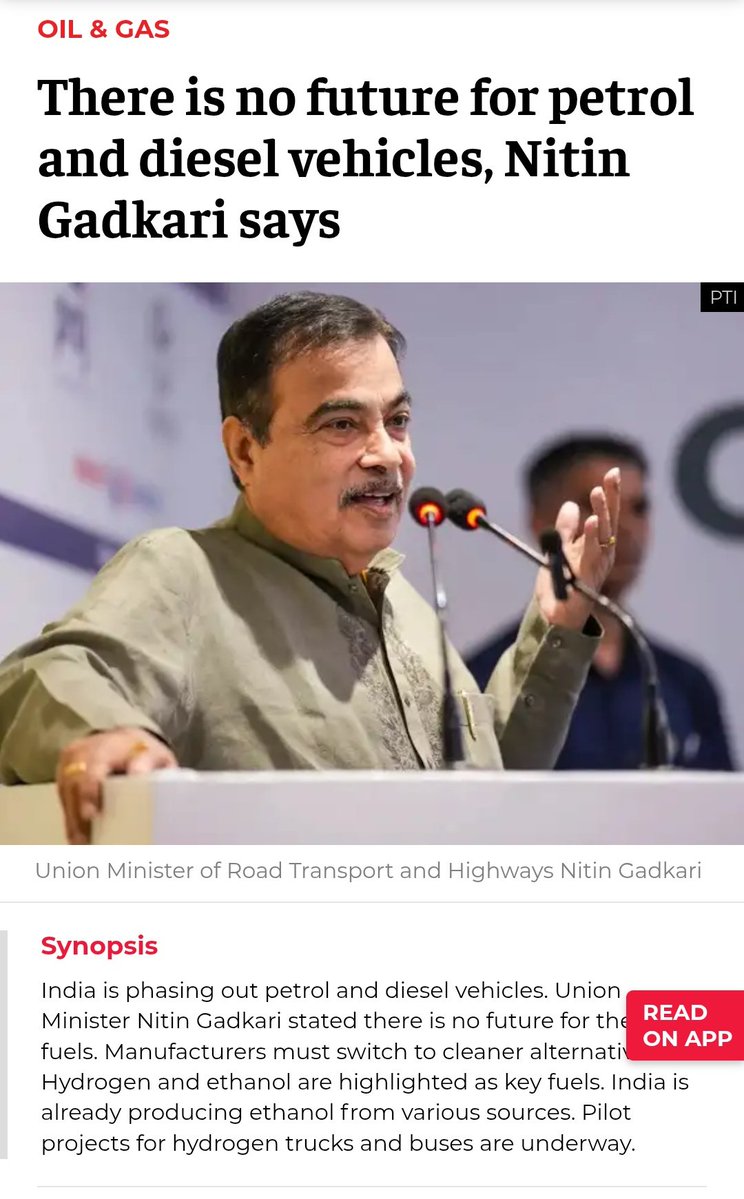
When a country where the 98% of the vehicles still run on petrol and diesel vehicles hears statements like this from the higher officials in govt, it creates more anxiety than clarity. India is not a niche market ready for an overnight shift. We’re talking about a base of 30+ crore registered vehicles, where alternatives like EVs still make up barely ~2–3% of total sales. For most families, buying a vehicle is a once-in-years decision, often backed by savings or loans. When they hear “no future,” it naturally triggers panic for new buyers and anxiety for existing owners. The transition to cleaner mobility is absolutely needed—but messaging matters just as much as policy. Policy direction should inspire confidence, not fear and communication should focus on a phased, practical roadmap: – strengthen EV infrastructure – ensure affordability of alternatives – support existing vehicle owners – give clear timelines, not sweeping statements People don’t resist change, they resist uncertainty. India needs evolution, not shockwaves.
Vineeth K tweet media
Chicago, IL 🇺🇸 English
144
182
737
60.6K
M retweetledi
Sam Gatlin
Sam Gatlin@sam_gatlin·
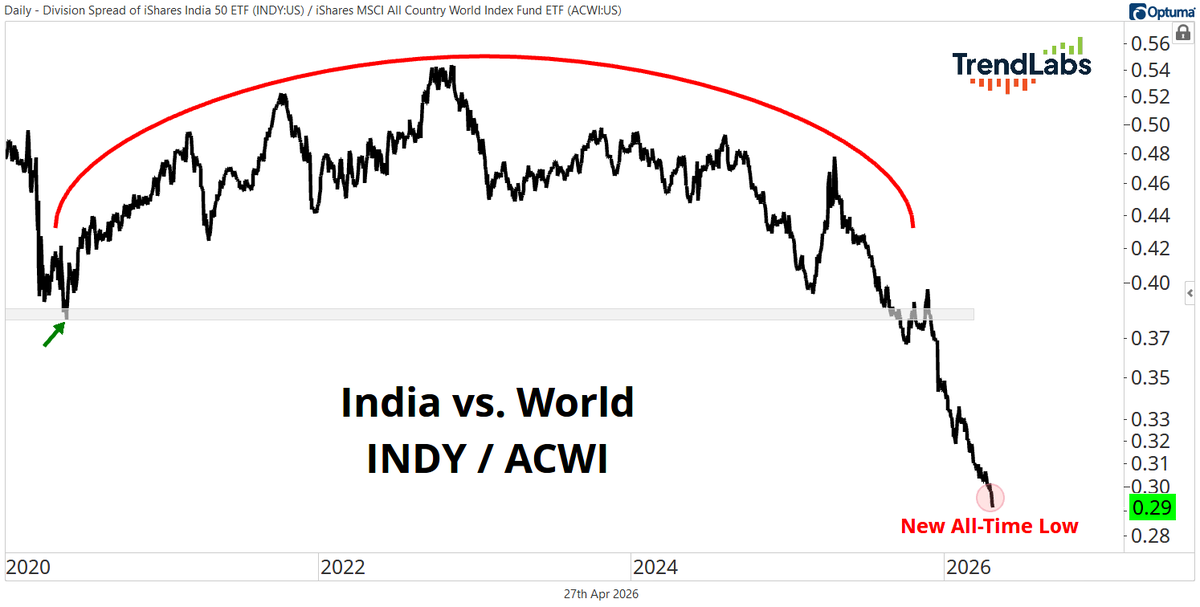
If you want to light your money on fire, buying Indian stocks seems like a great way to do it.
Sam Gatlin tweet media
English
11
65
576
52.2K